半导体设备ETF(159516)

Search documents
牛势春回,景气高昂——半导体设备ETF(159516)大涨点评
Sou Hu Cai Jing· 2026-02-25 08:59
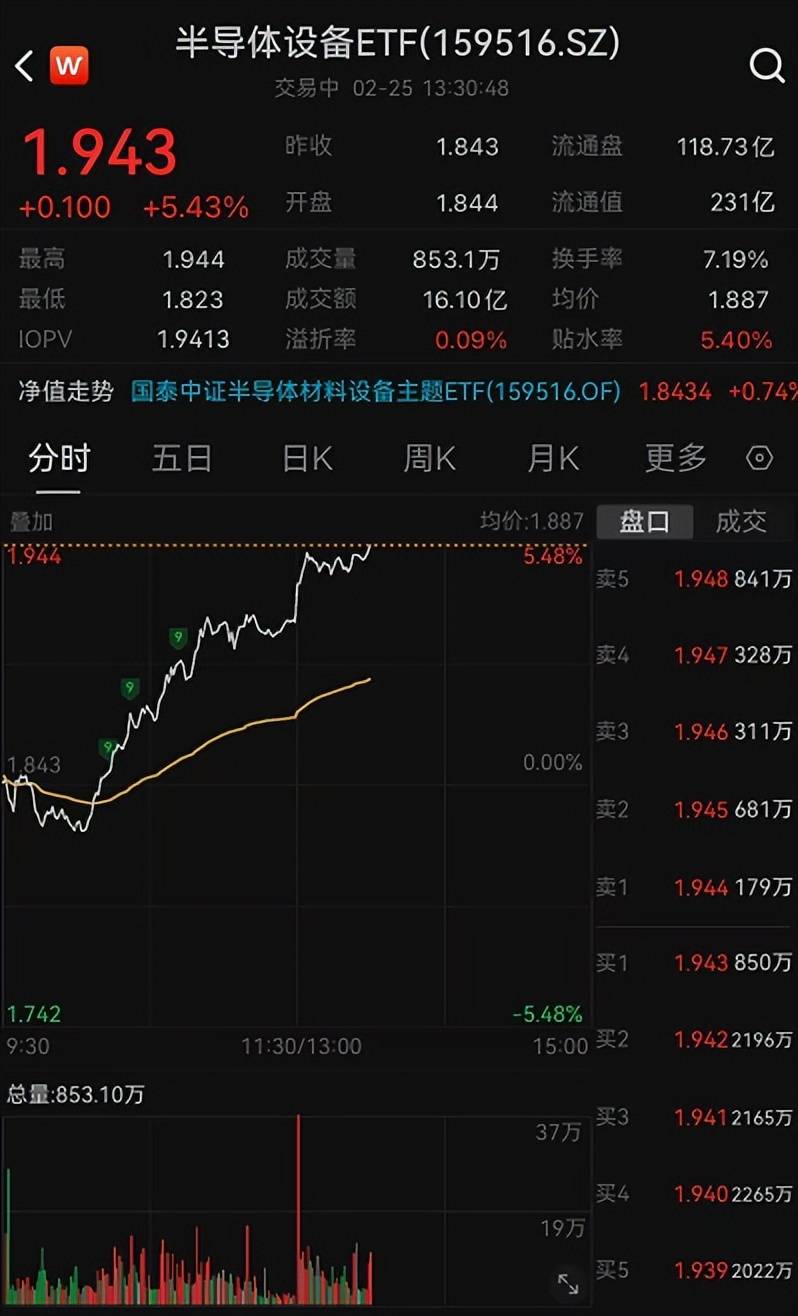
Market Performance - The semiconductor equipment ETF (159516) experienced a recovery today, initially dropping but then rising over 5% during the afternoon session [1]. Upward Factors Analysis - According to Reuters citing Nikkei news, China's top chip manufacturers plan to increase advanced chip production from less than 20,000 units currently to 100,000 units within 1-2 years, with a long-term goal of adding 500,000 units by 2030 [4]. - There are expectations of significant orders from major storage clients, with a large storage manufacturer recently submitting an IPO application, indicating potential progress in the listing timeline [4]. Future Market Outlook - The semiconductor equipment sector is clearly positioned to benefit from both advanced process and storage capacity expansions, indicating strong medium to long-term growth narratives [5]. - The anticipation of two storage companies going public enhances event-driven catalysts, with storage being a key focus area for domestic development since 2018, leading to accelerated growth [6]. - The semiconductor equipment sector is expected to benefit from a combination of storage expansion and advanced process growth, with significant events such as the upcoming listings and market share gains from domestic firms [6]. - The unprecedented capital expenditure forecast of $650 billion by major cloud providers by 2026 highlights the transformative impact of AI on productivity, suggesting that the semiconductor industry will experience strong demand driven by AI [7]. - In the storage segment, major companies like Samsung and SK Hynix are shifting to monthly pricing for DRAM contracts, with projected price increases of 90-95% for Q1 2026, indicating a robust market environment for storage products [7].

逆势大涨超2%!半导体设备ETF(159516)领涨硬科技
Sou Hu Cai Jing· 2026-02-13 02:46
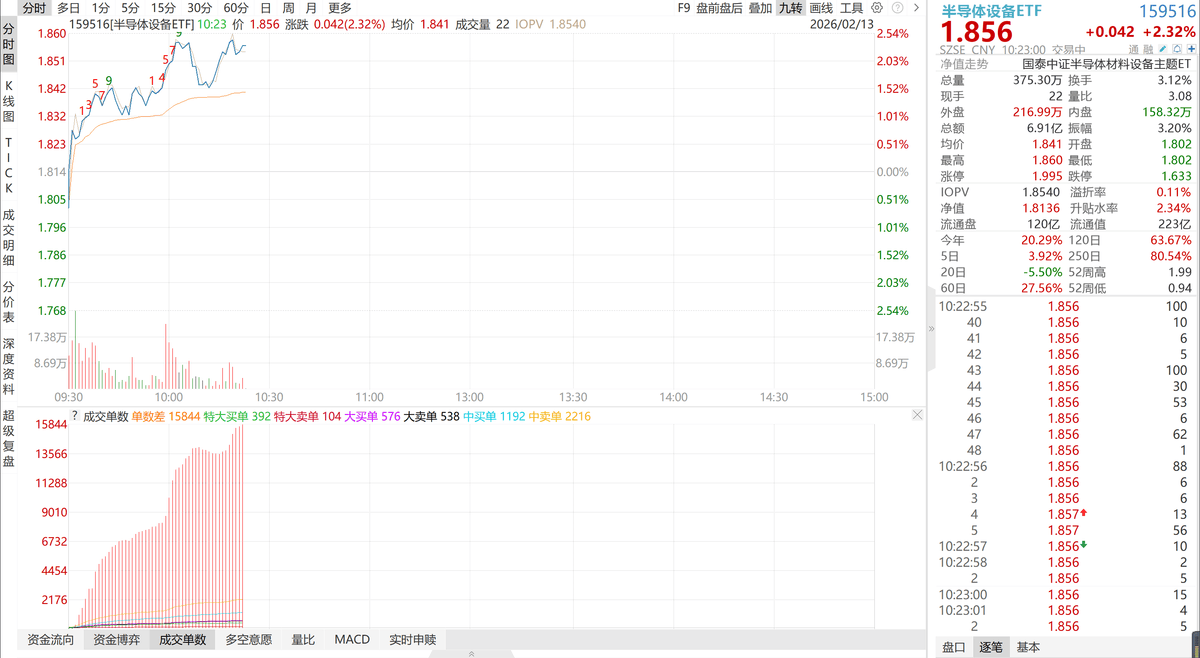
Core Viewpoint - The semiconductor equipment ETF (159516) has risen over 2% amidst market fluctuations, positioning itself as a key direction for capital seeking safety and investment in hard technology. The sector is benefiting from a "triple dividend" of AI computing power explosion, storage cycle recovery, and accelerated self-sufficiency, making it one of the most certain investment tracks in technology [1]. Industry Overview - The semiconductor industry is divided into four main segments: design, manufacturing, testing, and equipment materials, with equipment being the cornerstone of the entire industry, often referred to as the "crown" of chip manufacturing. Without self-sufficient equipment, there can be no self-controlled chip supply chain [3]. - Currently, China's semiconductor industry faces significant shortcomings in the upstream segment. While breakthroughs have been made in certain areas of chip design, the manufacturing process remains highly dependent on foreign equipment, with an overall domestic equipment localization rate of only 20%-35%, and less than 10% in high-end segments. Core equipment such as lithography machines, etching, thin film deposition, inspection, and coating are long dominated by foreign giants. In the context of trade friction and technological restrictions, achieving equipment self-sufficiency has become a national strategy, with significant funding and policy support directed towards the equipment sector, making it the most certain and high-growth segment of the industry [3]. Investment Opportunities - Within the semiconductor equipment sector, there are multiple areas showing rapid breakthroughs and replacement potential. Etching equipment is currently the fastest in terms of domestic replacement progress and has significant performance elasticity, with domestic leaders entering mainstream wafer supply chains and making continuous breakthroughs in the mid-to-high-end market. Thin film deposition equipment is a necessity for advanced process expansion, with a broad market space and domestic companies making progress in key categories such as PECVD and ALD, accelerating customer integration. Measurement and inspection equipment directly impact chip yield and manufacturing costs, with a very low localization rate in high-end fields, making it a key area for addressing shortcomings, benefiting from the explosive demand for AI chips and advanced packaging. Additionally, cleaning equipment, coating, CMP, and core components are emerging with a number of technically strong specialized enterprises, forming an essential part of the upstream equipment investment matrix [4]. Investment Tools - For ordinary investors, directly investing in individual stocks poses challenges such as high technical barriers, significant volatility, and concentrated individual stock risks. The semiconductor equipment ETF (159516) serves as an efficient tool for entering this golden sector. This product closely tracks indices related to semiconductor equipment and materials, focusing on core upstream assets in the chip sector, with high holding purity and strong industry representation, allowing for precise capture of the overall upward trend in the equipment sector. Furthermore, ETF products offer advantages such as convenient trading, ample liquidity, and risk diversification, enabling investors to avoid individual stock risks while fully sharing the benefits of domestic replacement and industry expansion. The recent strength of the semiconductor equipment ETF (159516) is not merely a short-term market fluctuation but a reflection of long-term industry logic, with the investment value in upstream equipment continuing to stand out against the backdrop of deepening self-sufficiency and expanding downstream capacity. Investing through the ETF is a prudent choice to seize opportunities in the "bottleneck" areas of the chip industry [5].
2026核心赛道前瞻:科技+周期双轮驱动,这些行业值得重点关注
Mei Ri Jing Ji Xin Wen· 2026-02-09 01:37
Group 1 - The market liquidity is relatively abundant at the beginning of 2026, with A-shares daily trading volume maintaining above 2 trillion yuan, and technology and cyclical stocks showing a rotating upward trend [1] - The technology sector and related cyclical fields, such as upstream non-ferrous metals, are expected to present investment opportunities in 2026, particularly in the semiconductor chip industry where leading companies' capital expenditures have exceeded expectations [1] - The communication sector remains a core area deeply tied to overseas computing power demand, with capital expenditures from overseas cloud companies expected to continue rising in 2026 [1] Group 2 - The AI industry is anticipated to drive growth in related supply chains, with potential shortages and price increases in certain sectors, such as space photovoltaics in the electricity supply side [2] - According to the "14th Five-Year Plan," domestic grid investment is set to accelerate, with fixed asset investment by the State Grid expected to grow by 40% compared to the previous five-year period [2] - The cyclical sector, particularly non-ferrous metals, is gaining market attention, with financial attributes expected to receive strong support during a rate-cutting cycle [2]
2026投资风口解析:“0到1”的刺激与“1到N”的确定性
Mei Ri Jing Ji Xin Wen· 2026-01-16 06:52
Core Viewpoint - The article discusses the investment opportunities and risks associated with emerging sectors in 2026, emphasizing the importance of identifying "wind" sectors for investment strategies [1][2]. Group 1: Investment Phases - Industries typically progress through three stages: "0 to 1," "1 to n," and "n+," with the first two stages being critical for identifying investment opportunities [1]. - The "0 to 1" stage is characterized by rapid growth but high uncertainty, while the "1 to n" stage represents a more stable growth phase [2]. Group 2: Current "0 to 1" Opportunities - Current sectors in the "0 to 1" phase include commercial aerospace, brain-computer interfaces, and solid-state batteries, which are still in early development stages [1][2]. - The brain-computer interface market is limited, with a potential global market size of only a few billion dollars, yet companies in this space have valuations exceeding this potential [2]. Group 3: Transition to "1 to n" - Successful transition from "0 to 1" to "1 to n" can lead to super wind sectors, but failure to transition can result in investment losses [2]. - Artificial intelligence is highlighted as a sector currently in the "1 to n" phase, with significant growth potential and lower uncertainty compared to "0 to 1" sectors [3][4]. Group 4: AI and Computing Power - In the AI sector, focus should be on upstream computing power, which is essential for AI applications [5]. - The demand for computing power is expected to grow exponentially, driven by major tech companies deploying large-scale computing clusters [6]. Group 5: Semiconductor Equipment - The semiconductor equipment ETF (159516) has seen significant price increases due to advanced process expansions and rising storage prices [8]. - The growth in the semiconductor sector is linked to the need for advanced manufacturing equipment, particularly for high-performance storage chips [8][9]. Group 6: Future Trends - The "光入柜内" (optical integration into cabinets) trend is anticipated to expand the market size for optical modules significantly by 2027 [7]. - The semiconductor industry is advised to focus on upstream equipment and materials, as these areas are likely to benefit first from industry expansion [7].

展望2026:宏观环境、产业趋势与投资配置新思路
Mei Ri Jing Ji Xin Wen· 2025-12-31 02:33
Group 1 - The macro environment for next year may continue with fiscal policies such as trade-in programs and consumer subsidies, while overseas liquidity is expected to be supported by the Federal Reserve's interest rate cuts [1] - Concerns about whether AI has entered a bubble phase are prevalent, with significant adjustments in the US stock market and worries about cash flow and debt issues among cloud companies [1] - However, compared to the internet bubble in 2000, the cash flow, profitability, and profit margins of leading overseas cloud companies are healthier, with capital expenditure growth expected to reach 30% to 40% next year [1] Group 2 - Some growth sectors' earnings expectations for next year are already priced in, while high dividend and high cash flow assets have lagged behind, making them attractive for investment [2] - The recommendation is to diversify investments, especially for sectors with high floating profits, to achieve a better investment experience during potential market fluctuations [2] Group 3 - The direction of the Federal Reserve's interest rate cuts is relatively clear, which may lead to a more accommodative overseas liquidity environment, benefiting technology growth sectors [3] - Domestic monetary policy is expected to remain moderately loose, with potential for further rate cuts, which would favor high dividend and high cash flow assets [3] - Historical data shows a negative correlation between high dividend assets and domestic bond yields, suggesting that a decline in bond yields could enhance the attractiveness of high dividend assets in the A-share market [3] Group 4 - High dividend and high cash flow assets are becoming the core of investment allocation, with specific ETFs like cash flow ETF (159399) and dividend state-owned enterprise ETF (510720) offering distinct advantages [4] - The current market is undergoing valuation adjustments, and long-term funds are encouraged to accumulate positions at lower prices, with a balanced allocation being more suitable for the market outlook in 2026 [4]
2025年A股复盘:两大分水岭与核心驱动逻辑拆解
Mei Ri Jing Ji Xin Wen· 2025-12-31 01:54
Group 1 - The market is facing two significant turning points in 2025, with the first being the tariff event that occurred in early April 2024, which led to a rapid market decline [1] - The tariff conflict's progression has been faster than in 2018, with both sides quickly raising tariffs and entering negotiations, indicating a strong bilateral dependency [2] - The second turning point in September is marked by major domestic events, leading to profit-taking after significant market gains in July and August [2] Group 2 - Following the tariff event, sectors such as optical modules, servers, and optical fiber cables performed exceptionally well in the second and third quarters, particularly benefiting from the accelerated shipment of NVIDIA's GB200 cabinets [2] - The market is currently experiencing volatility due to profit-taking and concerns over potential AI bubbles, alongside anticipation of policy directions from upcoming meetings [3] - High dividend and high cash flow assets are recommended for future allocations, with specific ETFs like cash flow ETF (159399) and dividend state-owned enterprise ETF (510720) being highlighted for their stability and potential [3]
展望2026年,如何把握AI算力投资机会?
Mei Ri Jing Ji Xin Wen· 2025-12-09 01:47
Group 1: AI and Chip Industry Outlook - The introduction of the 1.6T optical module is anticipated next year, corresponding to NVIDIA's next-generation Rubin architecture, which is expected to drive upgrades in the related supply chain and achieve volume and price increases [1] - The AI application sector is projected to experience significant growth next year, with ASIC fields likely accelerating, as companies like Google, OpenAI, and AWS are advancing ASIC-related solutions, which the domestic supply chain can meet [1] - The North American computing segment shows high certainty in demand due to the transition from NVIDIA's Blackwell architecture to Rubin architecture and the ramp-up of Google's TPU, positively impacting domestic optical modules, PCBs, and server demand [1] Group 2: Domestic Chip Market Dynamics - The core logic for domestic chips revolves around domestic substitution and self-control, with AI chips expected to continue gaining market share from traditional chips [2] - The semiconductor equipment sector has high certainty, as the production and capacity expansion of GPU chips rely on upstream equipment and materials, with demand growth in the storage sector likely reflected in etching and thin-film deposition equipment [2] - The chip sector, including chip ETFs and semiconductor equipment ETFs, is expected to perform well next year due to the ongoing demand expansion cycle across various segments of the domestic chip industry [2] Group 3: AI Applications and Market Sentiment - Current AI applications include lightweight solutions like AI writing and video generation, with larger fields such as robotics and smart driving, although the robotics sector has shown volatility due to Tesla's production guidance adjustments [3] - The AI application sector has not yet seen large-scale deployment, suggesting a cautious investment approach until clear demand signals emerge, although low valuations may present early investment opportunities [3] - The U.S. faces potential electricity supply issues, which could impact computing power support for future AI applications, highlighting a need for ongoing monitoring [3]
存储市场迎价格上涨周期,半导体设备ETF(159516)大涨超3%
Sou Hu Cai Jing· 2025-11-18 03:05
Group 1 - The semiconductor equipment ETF (159516) has seen a significant increase of over 3% on November 18, with a year-to-date share growth of over 160%, reaching a scale of over 6.2 billion yuan, ranking first among similar products [1][7] - The storage market is currently experiencing a notable price increase cycle driven by explosive growth in enterprise-level storage demand due to AI applications and a structural supply tightness in traditional storage products [3] - Major storage manufacturers, including Samsung, SK Hynix, Kioxia, and Micron, have reduced NAND Flash supply in the second half of this year, which may prolong the tight supply situation and further drive up NAND prices [3] Group 2 - The "domestic substitution" trend has become a necessity in the semiconductor industry, creating a stable domestic market for equipment and materials companies, which can withstand global cyclical fluctuations [4] - The storage chip industry is entering a new upcycle, supporting the high-quality development of the digital economy, and companies achieving technological breakthroughs in key areas are likely to outperform expectations [4] - The semiconductor equipment ETF (159516) is positioned to benefit from the increasing importance of semiconductor equipment amid escalating geopolitical tensions and the expansion of advanced process and storage production [5] Group 3 - The semiconductor equipment ETF (159516) tracks the CSI Semiconductor Materials and Equipment Theme Index, representing the fundamental progress in the equipment and materials sector [5] - Key companies within the semiconductor equipment ETF include Zhongwei Company (17.29% weight), Northern Huachuang (13.46% weight), and Tuojing Technology (6.05% weight), among others [6]

11月或逢低布局科技板块
Mei Ri Jing Ji Xin Wen· 2025-11-07 01:41
Market Overview - The market showed strong fluctuations on November 6, with the Shanghai Composite Index rising above 4000 points. The total trading volume in the Shanghai and Shenzhen markets reached 2.06 trillion yuan, an increase of 182.9 billion yuan compared to the previous trading day. The Shanghai Index rose by 0.97%, the Shenzhen Component Index by 1.73%, and the ChiNext Index by 1.84% [1] Sector Performance - The computing power sector saw a significant increase, led by domestic computing power stocks. Additionally, sectors such as non-ferrous metals and mining rebounded, while the power grid continued its strong performance [1] - The technology sector is expected to remain active in the wake of the earnings vacuum period starting in November, with computing power being a core performance line. Investors are encouraged to consider buying on dips in this sector [1] Investment Opportunities - Several new domestic GPU manufacturers are expected to go public in mid-November, which may serve as a catalyst for the market. The price increase in storage is anticipated to continue into Q4, with capacity shortages expected to persist until 2026. There are also expectations for major domestic storage companies to go public in 2026 [1] - The Sci-Tech Chip ETF (589100) is highlighted as a potential beneficiary of the storage price increase, while the Semiconductor Equipment ETF (159516) is noted for its cost-effectiveness amid the expansion of advanced processes and storage demand [1] Electric Grid Sector - The new narrative surrounding the electric grid may reshape performance and valuation fundamentals. Despite prior consensus on the high electricity consumption of AI data centers, the ongoing power shortages in North America have led to a new opportunity for domestic electric grid companies through power exports. This could enhance profits and potentially raise valuation levels [2] - Investors are advised to pay attention to the Electric Grid ETF (561380) as a potential investment opportunity in this context [2]
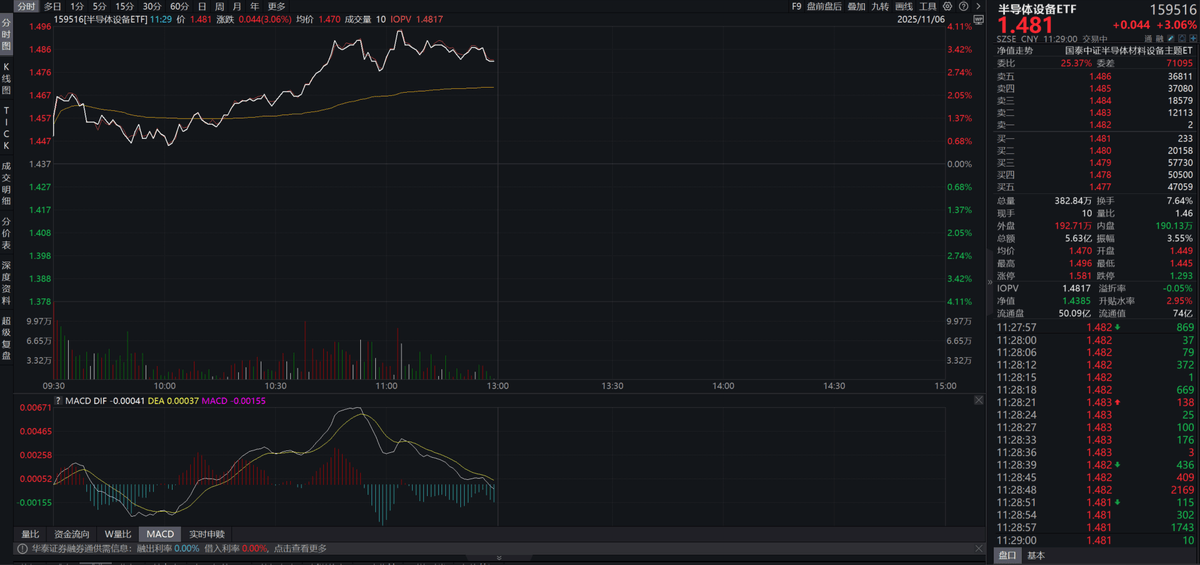
存储芯片景气有望推动扩产,半导体设备ETF(159516)大涨3%
Sou Hu Cai Jing· 2025-11-06 05:47
Group 1 - The semiconductor equipment ETF (159516) has seen a significant increase of over 3% on November 6, with a nearly 200% growth in shares since the beginning of the year, reaching a scale of over 7 billion yuan, ranking first among similar products [1][8] - AI servers are driving a new wave of innovation, significantly increasing storage requirements, which is leading to a surge in demand for NAND and DRAM applications in servers, becoming the core engine for global storage market growth [3] - Samsung has paused its October DDR5 DRAM contract pricing, prompting other manufacturers like SK Hynix and Micron to follow suit, resulting in a 25% increase in DDR5 spot prices within a week due to supply chain concerns [3] Group 2 - The "14th Five-Year Plan" emphasizes technological self-reliance, positioning the domestic computing power sector as a market focus, while also supporting the storage cycle and innovation in consumer electronics driven by the AI wave [4][5] - The importance of semiconductor equipment has increased amid intensifying geopolitical tensions, benefiting from both advanced process expansion and storage expansion, presenting investment opportunities in the semiconductor equipment ETF (159516) [6] - The semiconductor equipment ETF (159516) tracks the CSI Semiconductor Materials and Equipment Theme Index, effectively representing the fundamental progress in the equipment and materials sector [6]