
墨甲人形机器人

Search documents
奇瑞2025年:出口稳冠、新能源翻盘与资本新篇
Sou Hu Cai Jing· 2026-01-09 03:01
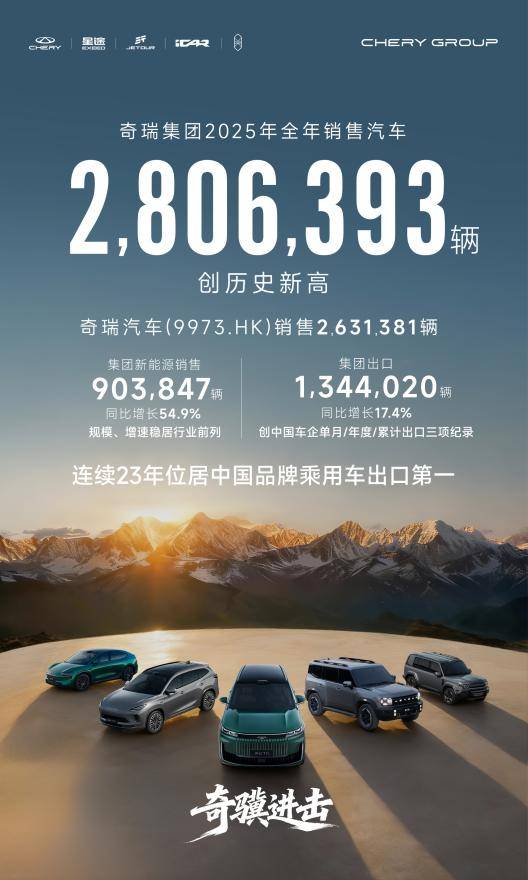
Core Insights - Chery's listing on the Hong Kong Stock Exchange in 2025 marks a significant milestone, showcasing its transition from a traditional manufacturer to a company focused on profitability and innovation [1][4] - In 2025, Chery sold over 2.806 million vehicles, achieving a year-on-year growth of 7.8%, with exports reaching 1.344 million units, maintaining its position as the top Chinese brand in passenger car exports for 23 consecutive years [1][3] Group 1: Financial Performance - Chery's 2025 performance report highlights four historical breakthroughs, including a substantial increase in electric vehicle sales, which reached 903,800 units, a remarkable growth of 54.9% [3][7] - The company’s listing raised HKD 9.14 billion, with 35% of the funds allocated for vehicle development and 25% for next-generation technology, indicating a strong commitment to innovation [4][6] Group 2: Market Position and Strategy - Chery's growth strategy has evolved from a singular focus on sales to a multi-dimensional approach that includes export leadership, accelerated development of new energy vehicles, multi-brand collaboration, and quality assurance [3][9] - The company has established itself as a leader in the new energy vehicle sector, with its wholesale sales ranking among the top three in the industry by November 2025 [7][9] Group 3: Global Expansion - Chery's export strategy has transformed from merely selling cars to embedding itself within local markets, exemplified by partnerships in Europe and the Middle East [10][12] - The company is also diversifying its global offerings beyond automobiles, including humanoid robots that have received EU certification, indicating a broader technological and ecological export strategy [12][14] Group 4: Future Outlook - Chery's chairman has defined 2026 as a year for breaking through existing growth models and establishing long-term competitiveness in advanced technologies like AI and solid-state batteries [14] - The company's 2025 achievements reflect a systematic evolution from a traditional manufacturer to a participant in the global mobile technology ecosystem, with future performance set to test its ability to sustain commercial success and brand influence [14]

2025,车企跨界造“人”
Tai Mei Ti A P P· 2025-12-31 06:22
Core Insights - The rise of humanoid robots has become a significant trend in the tech industry, with automotive companies increasingly investing in humanoid robot development as a new growth avenue amidst slowing market growth in traditional automotive sectors [2][20][26] - Tesla's humanoid robot, Optimus, is positioned as a key product for the company's future, with expectations that it will contribute significantly to Tesla's overall value [3][4][20] - Chinese automakers, including Xpeng and BYD, are also making strides in humanoid robotics, with Xpeng's IRON robot showcasing advanced capabilities and aiming for mass production by the end of 2026 [8][10][26] Industry Trends - The automotive sector is witnessing a collective push towards humanoid robotics, with nearly all major car manufacturers increasing their involvement in this field [2][7] - Companies are adopting various strategies, including full-stack self-research and partnerships with established robotics firms, to accelerate their entry into the humanoid robot market [10][11] - The market is expected to see a significant increase in humanoid robot deployment, with projections suggesting a market size of $5 trillion by 2050 [27] Technological Challenges - The development of humanoid robots faces significant technical hurdles, particularly in achieving stability and functionality in real-world environments [12][13][15] - Key challenges include the complexity of creating dexterous hands, stable locomotion, and advanced AI capabilities for real-time decision-making [14][16][17] - Current production methods are still largely manual, limiting the scalability of humanoid robot manufacturing [18] Market Dynamics - The entry of automotive companies into humanoid robotics is seen as a strategic move to diversify and mitigate risks associated with traditional automotive business cycles [20][21] - The overlap in technology and components between electric vehicles and humanoid robots provides automotive companies with a competitive advantage in this new market [21][22] - The industry is at a critical juncture, with the potential for significant breakthroughs or the risk of stagnation due to unresolved challenges [27]


出口领跑、机器人出海,奇瑞以“全球化创新体系”勾勒增长蓝图
Cai Jing Wang· 2025-12-15 03:33
Core Insights - Chery Group has achieved significant export success, with over 100,000 vehicles exported monthly for seven consecutive months, totaling 137,000 units in November 2025, marking a 30.3% year-on-year increase [2][3] - The company has established a strong presence in the global market, with over 5.7 million overseas users and a growing reputation among investors, as evidenced by several leading brokerages initiating coverage with "buy" or "outperform" ratings [1][4] - Chery's strategy focuses on technological innovation and quality, aiming to transition into a global high-tech ecological group [1][14] Export Performance - In the first eleven months of 2025, Chery's total vehicle sales reached 2.562 million, with exports accounting for approximately 1.2 million units, reflecting a 14.7% increase year-on-year [2][3] - Chery's export volume represents nearly 20% of China's total automotive exports, with one in five Chinese passenger cars exported being a Chery vehicle [2][4] Brand Development - Chery has successfully penetrated the European market, launching multiple models and achieving a 2.4-fold increase in sales in the EU and UK markets from January to October 2025 [3] - The company has diversified its product offerings in emerging markets, such as Southeast Asia and the Middle East, to cater to varying consumer needs [3][6] Global User Base - As of November 2025, Chery's global user base exceeded 18.28 million, with over 5.7 million users located overseas, providing a solid foundation for its global strategy [4][6] Capital Market Response - The positive feedback from capital markets indicates strong investor confidence in Chery's growth potential, with analysts highlighting the company's first-mover advantage in exports and expected growth in new energy vehicle sales [4][8] Globalization Strategy - Chery's globalization narrative extends beyond mere product sales to include building a local ecosystem, with a focus on adapting products to meet local market demands [5][6] - The company has established 16 production bases worldwide, integrating into local economies and creating jobs, such as the joint venture in Spain that revitalized a local brand and created over 1,000 jobs [7] Technological Foundation - Chery has developed a comprehensive technology framework encompassing fuel, hybrid, electric, and hydrogen power, with notable advancements in hybrid engine efficiency [8][10] - The company is also advancing in smart technology, integrating AI and intelligent driving systems across its vehicle lineup [9][10] Future Outlook - Chery is positioning itself in the emerging field of embodied intelligence, with plans to develop humanoid robots and expand its market presence in various sectors by leveraging its existing global service network [11][12] - The company aims to achieve significant sales milestones in the robotics sector by 2030, targeting over 40,000 humanoid robots and 90,000 robotic dogs [13]

车企竞逐人形机器人赛道
Zheng Quan Ri Bao· 2025-11-25 16:41
Core Insights - The 23rd Guangzhou International Auto Show highlights the automotive industry's increasing focus on humanoid robots as a strategic direction for growth [1][3] - Companies like Changan Automobile and XPeng Motors are showcasing their humanoid robot products, indicating a trend towards integrating robotics into their business models [1][2] Company Developments - Changan Automobile presented its humanoid robot "Xiao An," which features 40 degrees of freedom and a battery life exceeding 2 hours, emphasizing its capabilities in communication and assistance [1] - The company views its robotics business as a new growth engine and is actively developing various functionalities for its humanoid robots [1] - XPeng Motors introduced its next-generation humanoid robot IRON at the auto show, while Guangzhou Automobile Group showcased its fourth-generation intelligent robot GoMate Mini [1] Industry Trends - The automotive sector is leveraging its existing technological advantages in smart driving and manufacturing to enter the humanoid robotics market [3] - Companies are collaborating with tech firms, as seen with Seres Group's partnership with ByteDance's Volcano Engine to develop embodied intelligence solutions [2] - IDC forecasts that the global robotics market will exceed $400 billion by 2029, with humanoid robots expected to capture over 30% of the market share, driving advancements towards generalization and autonomy [3] Challenges - The automotive industry's entry into the robotics field faces significant challenges, including high R&D costs and limited profit margins, which may strain cash flow [4] - Many robotic products are still in the technology validation phase, and there is currently no strong demand in consumer and healthcare applications, complicating commercialization efforts [4]

智元人形机器人拥有中美欧认证,机器人ETF基金(159213)跌逾2%溢价走阔,再度逆市吸金!从"表演型"迈向"实用型",人形机器人还要多久?
Sou Hu Cai Jing· 2025-05-30 09:11
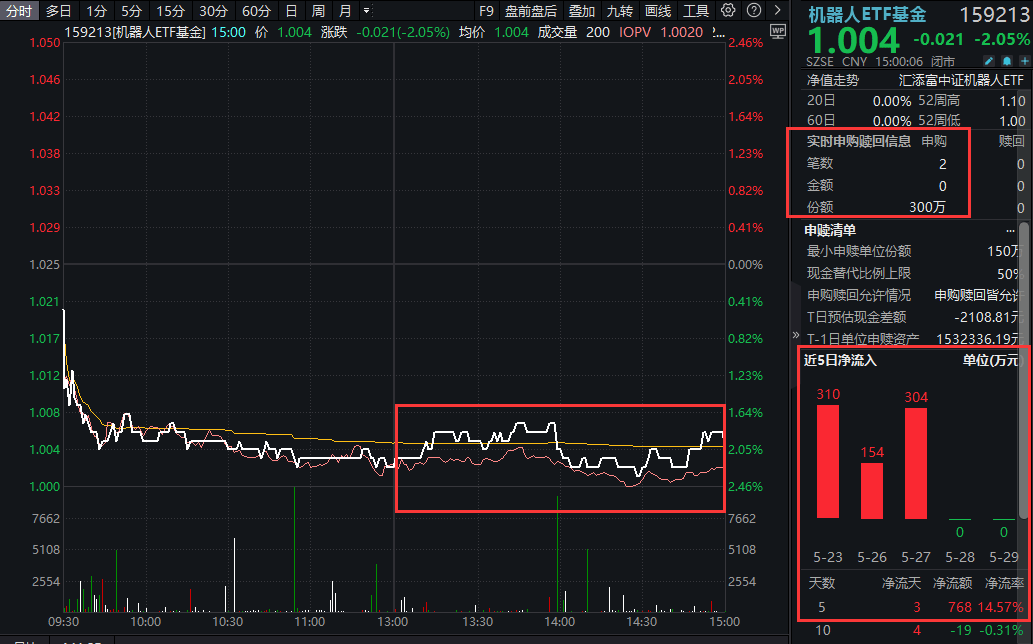
Core Viewpoint - The robot industry is experiencing a mix of challenges and opportunities, with significant developments in technology and policy support driving the commercialization of humanoid robots, while also facing hurdles in cost reduction and capability enhancement [4][5][8]. Group 1: Market Performance - The A-share market saw a pullback after a previous rebound, with the Robot ETF Fund (159213) closing down over 2%, despite a net inflow of 3 million shares throughout the day [1]. - The majority of the index component stocks for the Robot ETF Fund experienced declines, with only a few stocks like Nanwang Technology and Ruishun Technology showing gains [3]. Group 2: Industry Developments - The 2025 Zhangjiang Embodied Intelligence Developer Conference and International Humanoid Robot Skills Competition highlighted the transition of humanoid robots from experimental to practical applications in various settings [4]. - Shanghai Zhiyuan Robotics announced that its humanoid robot, the Expedition A2, received multiple certifications, making it the first humanoid robot to achieve certifications in China, the EU, and the US [4]. - The first global standard for "Humanoid Robot Intelligence Classification" was released, indicating a shift towards policy support for the humanoid robot industry [4]. Group 3: Commercialization Challenges - The commercialization of humanoid robots is estimated to take at least 10 years, with challenges including the need for improved generalization capabilities and cost reduction [5]. - The current progress in humanoid robot hardware is outpacing software development, particularly in the area of generalization capabilities, which is a critical barrier to commercialization [5]. Group 4: Opportunities in the Industry - Continuous policy support at the national level is expected to drive the development of humanoid robots, with significant funding being allocated to the sector [8]. - Major tech companies and industry leaders are entering the humanoid robot space, expanding applications in both industrial and domestic settings [9]. - The domestic robot industry has seen an increase in localization rates, with the localization rate rising from 17.5% in 2015 to 35.7% in 2022, indicating a growing capacity for cost reduction [7]. Group 5: Investment Insights - The Robot ETF Fund (159213) provides investors with a tool to gain exposure to the entire robot industry chain, including upstream hardware, midstream software, and downstream applications [10].
海外云厂商capex持续加大,机器人行业加速突破,持续看好相关产业投资机会
Great Wall Securities· 2025-05-15 12:57
Group 1 - The report highlights that overseas cloud vendors are significantly increasing their capital expenditures (capex) to accelerate AI infrastructure development, with Microsoft planning to invest a total of $80 billion in AI infrastructure for the fiscal year 2025, aiming to increase AI training computing power by five times by 2026 [1][16][35] - Meta has raised its annual capital expenditure forecast from $60-65 billion to $64-72 billion, primarily for generative AI and core business investments [2][16] - Google reported a capital expenditure of $17.2 billion in Q1 2025, up from $12 billion in the same period last year, focusing on technology infrastructure investments [2][16] Group 2 - The report notes that the robotics industry is experiencing accelerated growth, with companies like Hyundai planning to deploy Boston Dynamics' Atlas robots in their new U.S. factory as part of a $21 billion investment plan [3][36] - Lenovo introduced its first humanoid robot, "Lenovo Enjoy No. 1," showcasing its capabilities in a live demonstration [6][40] - Midea's self-developed humanoid robot is set to enter its washing machine factory in Hubei for operational tasks, while Chery has delivered the first batch of 220 units of its humanoid robot, which can assist in sales and customer service [6][44] Group 3 - The communication sector index rose by 4.96% during the week of May 6-9, 2025, outperforming the CSI 300 index, which increased by 2.00% [11] - The report recommends several stocks for investment, including China Mobile, China Telecom, and various technology and cloud service providers [8][21] - The overall valuation of the communication sector is reported at a price-to-earnings ratio of 20.82, ranking fourth among TMT sectors [13][15]




外骨骼机器人消费场景应用可期,美的人形机器人进厂“打工”
AVIC Securities· 2025-05-12 15:00
Investment Rating - The industry investment rating is "Overweight" [3][30]. Core Viewpoints - The humanoid robot industry is expected to see significant growth, with a projected cumulative demand of approximately 2 million units by 2030, indicating a critical breakthrough phase from 0 to 1 [6][24]. - The report highlights key companies to watch in the humanoid robot supply chain, including Tier 1 suppliers and core component manufacturers [6][24]. - The report emphasizes the importance of technological advancements in various sectors, including photovoltaic equipment, energy storage, semiconductor equipment, automation, and hydrogen energy, suggesting a favorable outlook for leading companies in these areas [6][25][26]. Summary by Sections Humanoid Robots - Recent developments include the launch of the first domestic AI-powered exoskeleton robot by Zhiyuan, which features advanced technology for various applications [7]. - The first batch of 220 humanoid robots was delivered by Chery, showcasing their capabilities in customer service and sales guidance [17]. - The World Humanoid Robot Sports Competition is set to take place in August, highlighting the growing interest and innovation in the humanoid robotics field [23]. Photovoltaic Equipment - The penetration rate of N-type photovoltaic technology is accelerating, strengthening the competitive edge of leading companies [25]. - The report suggests focusing on companies that are innovating in cost-reduction technologies and expanding production capacity [25]. Energy Storage - Favorable policies are expected to drive growth in both generation-side and user-side energy storage [25]. - Companies like Xingyun Co. are positioned to benefit from strategic partnerships in the energy storage sector [25]. Semiconductor Equipment - The semiconductor equipment market is projected to reach $140 billion by 2030, with a focus on domestic alternatives due to low current localization rates [26]. - The report recommends monitoring companies that are well-positioned to capitalize on this trend [26]. Automation - The market for industrial tools is expected to grow from approximately 40 billion to 55.7 billion by 2026, with opportunities for leading companies to gain market share through increased concentration and import substitution [26]. Hydrogen Energy - The report highlights the potential of green hydrogen in achieving carbon neutrality, with a focus on companies that integrate the hydrogen supply chain [25].



汽车行业周报:吉利推进极氪私有化,奇瑞首批人形机器人实现交付-20250511
CMS· 2025-05-11 08:33
Investment Rating - The report maintains a "Recommended" rating for the automotive industry, indicating a positive outlook for the sector's fundamentals and expectations for the industry index to outperform the benchmark index [4][27]. Core Insights - The automotive industry experienced an overall increase of 1.8% from May 4 to May 10, with significant movements in various segments, including a notable rise in motorcycle and auto parts sectors [2][10]. - Key developments include Geely's plan to acquire all issued shares of Zeekr, aiming for a complete merger, and Chery's delivery of the first batch of 220 humanoid robots [1][20][21]. - The report highlights the performance of individual stocks, with notable increases for companies like Chengfei Integration (+34.1%) and Wanxiang Qianchao (+29.8%) [12]. Market Performance Overview - The automotive sector's performance was positive, with the CS automotive index rising by 1.8%, while the broader market indices also showed gains, with the Shanghai A index up by 1.9% and the Shenzhen A index up by 2.9% [2][8]. - Among the automotive sub-sectors, motorcycles and auto parts saw the highest weekly increases of 2.7% and 2.4%, respectively [10]. Individual Stock Performance - The report notes that most covered automotive stocks saw increases, with Zongshen Power (+13.3%) and Qin'an Co. (+6.5%) among the top performers [3][14]. - Conversely, stocks like Longsheng Technology (-5.4%) and Sulian Co. (-3.6%) experienced declines [14]. Industry Dynamics - The report discusses the impact of the May Day holiday on new energy vehicle sales, with a significant drop in sales for many brands, while Li Auto managed to increase its sales by 33% [18]. - The report also mentions the successful launch of 119 new charging stations by Li Auto, bringing the total to over 2,200 stations nationwide [22]. Key Developments - Geely's acquisition of Zeekr is expected to enhance resource integration and operational efficiency [21]. - Chery's humanoid robot delivery and the establishment of a joint venture for sensor technology indicate a strategic push into robotics [20][24]. - The report highlights the introduction of new models, such as BYD's Hai Si 07DM and Geely's Galaxy Star, which are set to launch soon [17].



未知机构:机器人近日发生了什么20250505特斯拉表示目标在2030-20250506
未知机构· 2025-05-06 01:45
Summary of Key Points from Conference Call Records Industry Overview - The robotics industry is experiencing significant advancements, particularly in humanoid robots, with various companies making strides in production and application across different sectors [1][2][3]. Core Insights and Arguments - **Tesla's Ambition**: Tesla aims to achieve an annual production capacity of 1 million humanoid robots by 2030, with plans to initiate manufacturing on a pilot production line in Fremont by 2025 [1]. - **Chery's Collaboration**: Chery, in partnership with the AiMOGA team, has successfully delivered the first batch of 220 "墨甲" humanoid robots globally, focusing initially on 4S store applications before expanding into supermarkets, government services, and eventually home service markets [1]. - **Core Component Supply**: Zhongding Co., as a strategic supplier of core components for the "墨甲" robot, participated in the global delivery and overseas distributor authorization ceremony [1]. - **Diverse Applications**: The acceleration of innovative applications for intelligent robots is noted, including tea-picking robots, inspection robots, and elderly care robots [2]. - **New Product Launch**: Digital Huaxia has launched a new member of its IP series robots, the "星行侠P01," which is the first dual-form humanoid robot combining a body and wheeled movement in the industry [3]. - **China FAW's Development**: China FAW showcased its humanoid robot "旗小智" at the Shanghai Auto Show, which stands at 1.65 meters tall, with development starting in early 2024 [3]. Other Important Insights - The focus on humanoid robots is not only limited to manufacturing but also extends to various service sectors, indicating a trend towards integrating robotics into everyday life and business operations [1][2]. - The collaboration between automotive companies and robotics firms highlights the cross-industry potential and the growing importance of robotics in enhancing operational efficiency and service delivery [1][3].
未知机构:奇瑞汽车奇瑞墨甲机器人全球批量交付东吴机械事件4月26-20250506
未知机构· 2025-05-06 01:45
Summary of Key Points Company and Industry - **Company**: Chery Automobile - **Industry**: Humanoid Robotics Core Insights and Arguments - Chery has successfully delivered the first batch of 220 units of the墨甲 humanoid robot, marking it as the first automotive company to achieve mass delivery of humanoid robots globally [1][2] - The humanoid robotics industry is primarily in the conceptual demonstration or small-batch customization phase, with mass production being limited [3] - The mass delivery of墨甲 robots breaks this limitation, positioning Chery as a leader in the humanoid robotics market [3] - The year 2025 is anticipated to be a pivotal year for mass production in the humanoid robotics sector, with various companies accelerating the iteration and production of humanoid robots, which will facilitate the commercialization of this technology [3] Additional Important Content - Chery's墨甲 robot follows a three-step strategic plan: 1. Initially focusing on enhancing the automotive sales industry through intelligent transformation in 4S store scenarios 2. Expanding into supermarkets and public service sectors to improve service efficiency and quality 3. Ultimately aiming to enter the home service market, positioning the robot as a smart companion for families [3]