太阳能人工智能卫星

Search documents
行业催化不断,太空光伏前景广阔,3年100GW目标引爆市场,光伏ETF易方达(562970)备受关注
Xin Lang Cai Jing· 2026-01-23 06:32
Core Insights - The commercial space industry is poised for growth, with space photovoltaics potentially becoming a significant new market [1] - The market activity is expected to revolve around SpaceX's IPO and the launch and recovery of the Starship [1] Group 1: SpaceX Developments - SpaceX plans to launch solar-powered artificial intelligence satellites in the coming years [2] - The company aims to achieve a solar energy production capacity of 100 GW within approximately three years [2] - The Starship is expected to demonstrate full reusability this year [2] Group 2: Industry Trends - The demand for communication satellites is increasing, with a clear timeline for space computing advancements [2] - The projected 100 GW capacity represents a significant increase compared to the annual demand of 10 GW, indicating a potential 3-4 times flexibility in supply [2] - Looking further ahead, the energy needs for lunar bases and Mars colonization could push the limits of space photovoltaics beyond 100 GW [2]

马斯克:几年后,太空探索技术公司(SpaceX)将发射太阳能人工智能卫星。
Xin Lang Cai Jing· 2026-01-22 15:52
Core Insights - Elon Musk announced that SpaceX will launch solar-powered artificial intelligence satellites in the coming years [1] Group 1 - The initiative aims to integrate solar energy with AI technology for satellite operations [1] - This development reflects SpaceX's ongoing commitment to innovation in space technology [1] - The project is expected to enhance satellite capabilities and efficiency [1]

马斯克提出太空AI愿景!黄仁勋回应:这就是个梦想,面临温度波动等现实挑战
Sou Hu Cai Jing· 2025-11-24 03:31
Core Idea - Elon Musk proposes a revolutionary concept of placing artificial intelligence computing facilities in space, believing that it could become a more cost-effective location for AI operations within the next four to five years [1][3]. Group 1: Business Synergy - Musk's businesses, including xAI, SpaceX, and Tesla, create a potential support loop for this initiative, with xAI focusing on AI model development, SpaceX providing commercial space capabilities, and Tesla involved in energy storage and robotics [3]. - The synergy among these companies is expected to offer comprehensive support from technology development to hardware deployment for a space-based AI computing center [3]. Group 2: Rationale for Space Deployment - Musk argues that Earth receives only one-twentieth of a billionth of solar energy, while space can harness significantly more solar energy [3]. - He highlights the limitations of terrestrial AI computing due to power constraints, stating that achieving 200 or 300 gigawatts of AI computing on Earth is challenging, and reaching a scale of 1 terawatt is impossible [3]. - The space environment can provide continuous solar energy and utilize radiation cooling technology to address equipment heat dissipation issues [3]. Group 3: Specific Plans - Musk mentions that the Starship could launch approximately 300 to 500 gigawatts of solar-powered AI satellites into orbit annually [3]. - He envisions a lunar base to manufacture solar-powered AI satellites on-site and accelerate them to escape velocity using mass drivers, aiming for an annual power production of 100 terawatts [3]. Group 4: Challenges and Criticism - NVIDIA CEO Jensen Huang describes Musk's vision as a "dream," pointing out the complexities of the actual orbital environment, including temperature fluctuations and radiation exposure that could affect high-performance AI chips [4]. - The practical challenges of launching hundreds of gigawatts of satellites annually would require thousands of Starship flights, which is difficult to achieve in the short term [4]. - External factors such as orbital debris, international space policies, and regulatory approvals add uncertainty to the project [4]. - Musk has stated that solar-powered AI satellites are the only way to achieve a "Type II Kardashev civilization," which theoretically could harness the energy of an entire star, but significant obstacles remain from concept to implementation [4].


智能早报丨我国启动聚变领域国际科学计划;“国产GPU第一股”摩尔线程今日发行
Guan Cha Zhe Wang· 2025-11-24 02:35
Group 1: Nuclear Fusion Research - China's "Burning Plasma" international scientific program has been officially launched, focusing on the BEST (Broadly Enhanced Stellarator Technology) research plan aimed at achieving controlled nuclear fusion [1] - The BEST device, set to be completed by the end of 2027, will conduct deuterium-tritium burning plasma experiments, targeting fusion power output between 20 megawatts and 200 megawatts [1] - The goal is to demonstrate energy output exceeding energy consumption, paving the way for fusion energy generation [1] Group 2: Stock Market Developments - "Moore Threads," known as the first domestic GPU stock, has launched its IPO on the Sci-Tech Innovation Board at a record price of 114.28 yuan per share, marking the highest IPO price in the A-share market this year [2] - Investors need to pay 57,140 yuan for one lot (500 shares), indicating strong market interest [2] Group 3: Autonomous Driving Industry - "HaoMo Intelligent Driving," backed by Great Wall Holdings and other investors, has reportedly ceased operations and notified employees not to report to work starting November 24 [3] - Founded in November 2019, HaoMo was the first company in China to achieve mass production of autonomous driving technology, with its HPilot system deployed in over 20 vehicle models [3] - The company had projected to surpass 250 million kilometers of autonomous driving mileage by 2024 and was listed in the Hurun Global Unicorn List [3] Group 4: Social Media and Mental Health - Meta is facing a lawsuit from multiple school districts in the U.S. for allegedly concealing evidence of the negative impact of its platforms, Facebook and Instagram, on users' mental health [4] - The lawsuit claims that Meta halted internal research after discovering causal evidence linking its products to adverse psychological effects [4] Group 5: Space Energy Production - Elon Musk announced plans for the Starship to potentially deliver around 300 gigawatts of solar energy satellites annually, with a possibility of reaching 500 gigawatts [5] - Musk indicated that with lunar manufacturing combined with mass drivers, an energy output exceeding 100 terawatts per year could be achieved [5]


月球制造+质量投射器,马斯克瞄准每年100太瓦太空能源产能
Xin Lang Cai Jing· 2025-11-23 01:07
Core Insights - Elon Musk stated that the Starship should be able to deliver approximately 300 gigawatts (GW) of solar-powered artificial intelligence satellites to orbit annually, with the potential to reach 500 GW [1] - A commentator noted that at a growth rate of 300 GW per year, it would take only 12 years to surpass the current total global power generation capacity of about 3.5 terawatts (TW) [1] - On the 23rd, Musk responded that lunar manufacturing combined with mass drivers could achieve an annual output exceeding 100 terawatts [1] Group 1 - The Starship's potential annual delivery capacity is projected at 300 GW, with a possibility of reaching 500 GW [1] - Current global power generation capacity is approximately 3.5 TW, which could be surpassed in 12 years at the stated growth rate [1] - Musk's assertion of lunar manufacturing capabilities suggests a future output of over 100 TW annually [1]
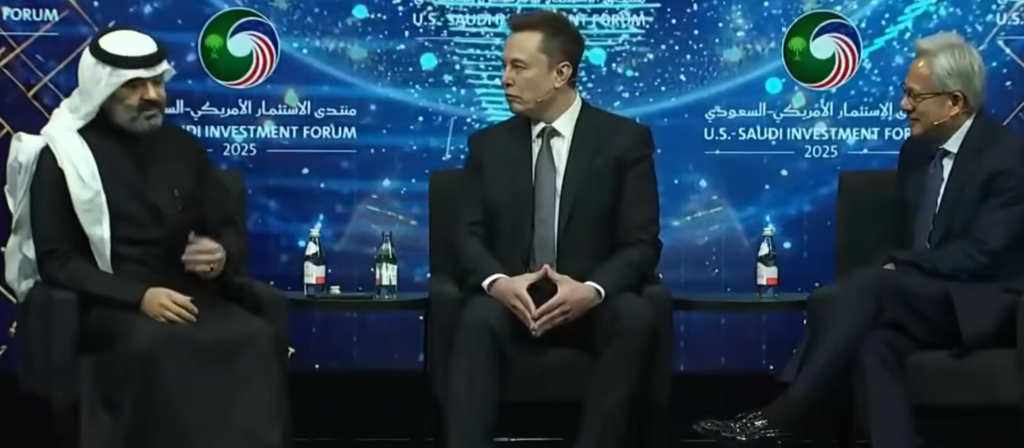
马斯克黄仁勋对谈:AI会让你更忙,人形机器人将成为有史以来最大的产业
美股IPO· 2025-11-20 13:09
Core Insights - AI will not lead to unemployment but will increase workload, resulting in more tasks piling up for companies [4][21] - Humanoid robots are expected to become the largest industry or product in history, surpassing smartphones and other technologies [3][11] - A significant investment in AI infrastructure was announced, including a 500 MW AI data center in collaboration with xAI and Nvidia [30][31] Group 1: Innovation and AI Development - The focus of innovation is on creation rather than disruption, exemplified by SpaceX's reusable rockets [3][8] - The shift from "retrieval-based" to "generative" computing necessitates the establishment of AI factories globally to produce real-time content [13][14] - AI and humanoid robots are seen as solutions to poverty, with the potential to make everyone wealthy [4][11] Group 2: Future of Work - Future work will become optional, akin to a hobby, where individuals can choose to work if they desire [5][16] - Increased productivity from AI will lead to more ideas and projects, making individuals busier rather than less so [21][22] - The role of radiologists has evolved positively with AI, leading to increased hiring rather than job losses [22] Group 3: AI in Space and Infrastructure - Space-based AI is deemed inevitable, with solar-powered satellites expected to become the most cost-effective method for AI computation within five years [40][41] - The collaboration between xAI and Saudi Arabia aims to build a substantial AI data center, marking a significant step in AI infrastructure development [30][31] Group 4: Transition in Computing - A fundamental shift from general computing to accelerated computing is underway, with a notable decrease in CPU usage in favor of GPU-based systems [46][47] - The end of Moore's Law has led to increased demand for accelerated computing resources, particularly in data-intensive tasks [46][47] - The rise of generative AI represents a third major opportunity in the evolution of AI technologies [47]

马斯克黄仁勋对谈:AI会让你更忙,人形机器人将成为有史以来最大的产业
Hua Er Jie Jian Wen· 2025-11-20 07:36
Core Insights - The discussion between Elon Musk and Jensen Huang at the US-Saudi Investment Forum highlighted a significant collaboration in AI infrastructure, specifically the construction of a 500 MW AI data center in the desert, involving Musk's xAI, Nvidia, and the Saudi AI company Humane [1][29]. Group 1: Innovation and AI Development - Musk emphasized that his focus is on creation rather than disruption, citing SpaceX's reusable rockets as an example of innovation that did not previously exist [3][7]. - The conversation pointed out that humanoid robots are expected to become the largest industry ever, surpassing smartphones, as demand for personal robots will be high [3][11]. - Huang noted that AI is becoming a foundational infrastructure, transforming industries and requiring global AI factories to generate unique content in real-time [12][13]. Group 2: Economic and Employment Implications - Musk argued that AI and humanoid robots could eliminate poverty, suggesting that the only way to achieve widespread wealth is through these technologies [3][11]. - The future of work is predicted to become optional, akin to a hobby, where individuals can choose to work if they desire [15][17]. - Huang highlighted that AI will increase productivity, leading to more tasks and potentially making people busier rather than causing job losses [21][22]. Group 3: Space and AI - Musk stated that AI in space is inevitable, with solar-powered AI satellites expected to become the most cost-effective method for AI computation within five years [5][32]. - The discussion included the potential for space to provide vast energy resources, which would be essential for scaling AI computations beyond what is feasible on Earth [34][35]. Group 4: Market Trends and AI Evolution - Huang described a fundamental shift from general computing to accelerated computing, with a significant decrease in the use of CPUs in favor of GPUs for high-performance tasks [37][38]. - The transition to generative AI is seen as a major opportunity, with the current landscape moving towards intelligent agents that leverage accelerated computing resources [38].

晚报 | 11月10日主题前瞻
Xuan Gu Bao· 2025-11-09 14:19
Carbon Neutrality - The State Council's white paper emphasizes the importance of energy storage in building a new power system, promoting the integration of "new energy + storage" and multi-energy complementarity [1] - By the end of 2024, new energy storage installations are expected to reach 73.76 million kilowatts (168 million kilowatt-hours), which is 20 times that of 2020, accounting for over 40% of global installations [1] Space Computing - Several U.S. space companies are advancing orbital data center plans, utilizing solar energy to address AI energy consumption [2] - SpaceX is expected to increase its share of global orbital launches from 90% to 99% with the frequent launches of Starship [2] - The competition in space computing is intensifying, with China leading in the development of space computing capabilities [3] Ultra High Definition Video - The World Ultra High Definition Video Industry Alliance held a conference in Shenzhen, releasing key technologies and marking a new stage in the industrialization of ultra HD standards in China [4] - The market for ultra HD video is projected to reach 5-6 trillion yuan by 2025, driven by the rapid development of new displays and consumer electronics [4] Proton Therapy - An international standard for medical proton accelerators has been published, highlighting the global collaboration in developing advanced cancer treatment technologies [5] Smart Agriculture - The Ministry of Agriculture and Rural Affairs released guidelines for building a smart agriculture standard system by 2030, aiming to enhance agricultural efficiency and technology [6] E-sports - The KPL annual finals set a Guinness World Record for the highest attendance at an e-sports event, with 62,196 attendees [6] - The e-sports industry is evolving into a significant cultural phenomenon, with increasing integration into the entertainment sector [6] Commercial Space - The successful launch of the Kuaizhou-1A rocket marks a milestone for China's commercial space sector, with significant advancements in reusable rocket technology [7] Macro and Industry News - The State Council issued opinions to accelerate the application of new scenarios in artificial intelligence and promote clean energy in coal and new energy integration [8]