政策性银行债

Search documents
2025年债券市场发展报告
Lian He Zi Xin· 2026-02-13 11:47
1. Report's Industry Investment Rating No information provided in the content. 2. Core Viewpoints of the Report - In 2025, the central bank implemented a moderately loose monetary policy, keeping liquidity abundant. The yields of interest - rate bonds showed an overall fluctuating upward trend, while the issuance rates of credit bonds decreased. The total issuance of interest - rate and credit bonds increased steadily year - on - year. Credit risks were converging. Looking forward to 2026, bond market yields are expected to remain volatile at low levels, credit spreads may show structural differentiation, the bond market issuance scale is expected to grow steadily, and bond market credit risks will continue to converge with the default rate possibly at a historical low [2]. 3. Summary by Relevant Catalogs 3.1 Bond Market Overall Situation - In 2025, China's bond market issued a total of 88.52 trillion yuan of various bonds, a year - on - year increase of 12.35%. Excluding inter - bank certificates of deposit, the total issuance of various bonds was 54.70 trillion yuan, a year - on - year increase of 15.40%. By the end of 2025, the stock of various bonds in China reached 196.17 trillion yuan, a growth of 11.45% compared with the end of 2024 [4]. 3.1.1 Interest - rate Bonds - **Yield Trend**: The yield of China's treasury bonds showed an overall fluctuating upward trend in 2025. The 10 - year treasury bond yield fluctuated in five different stages throughout the year, affected by factors such as economic data, policy expectations, and market sentiment [5]. - **Issuance Scale**: The bond market issued 32.39 trillion yuan of interest - rate bonds in 2025, a year - on - year increase of 20.63%. The issuance scale of each type of bond increased. By the end of 2025, the stock of interest - rate bond varieties in China's bond market was 123.51 trillion yuan, a growth of 14.75% compared with the previous year - end [8][9]. 3.1.2 Credit Bonds - **Issuance Interest Rate**: In 2025, the issuance rates of major credit bonds showed a downward trend. Taking the credit bonds issued by AAA - rated entities as an example, the average issuance rates of major bond types with various maturities decreased [10]. - **Issuance Volume**: The issuance scale of credit bonds reached 22.06 trillion yuan in 2025, a year - on - year increase of 8.14%. By the end of 2025, the stock of credit bonds was 51.35 trillion yuan, a year - on - year increase of 8.61%. Different sub - categories of credit bonds had different issuance trends [13]. - **Non - financial Enterprise Bonds**: In 2025, non - financial enterprises issued 15,790 issues of bonds with a total issuance scale of 13.94 trillion yuan. The issuance period and scale increased by 2.87% and 1.70% year - on - year respectively. By the end of 2025, the stock of non - financial enterprise bonds was 31.29 trillion yuan, a growth of 10.00% compared with the previous year - end [14]. - **Non - policy Financial Bonds**: Financial institutions issued 1,488 issues of non - policy financial bonds in 2025, with a total issuance scale of 5.66 trillion yuan. The issuance period and scale increased by 34.54% and 24.74% year - on - year respectively. By the end of 2025, the stock of non - policy financial bonds was 15.66 trillion yuan, a growth of 11.35% compared with the previous year - end [18]. - **Asset - backed Securities**: In 2025, the issuance period, number, and scale of asset - backed securities all increased by about 15%. By the end of 2025, the stock of asset - backed securities was 3.61 trillion yuan, an increase of 9.16% compared with the previous year - end [22]. - **Other Credit Bonds**: In 2025, the issuance period and scale of other credit bonds increased year - on - year. By the end of 2025, the stock of other credit bonds was 1.07 trillion yuan, a decrease of 14.81% compared with the previous year - end [24]. 3.2 Bond Market Operation Characteristics - **Issuance of Urban Investment Bonds and Industrial Bonds**: In 2025, the issuance of urban investment bonds decreased, while the issuance of industrial bonds increased. The net financing of urban investment bonds decreased, and that of industrial bonds increased [27]. - **Rating and Credit - grade Distribution**: The proportion of bonds without debt ratings continued to increase, and the proportion of bonds issued by AAA - rated entities continued to rise. The credit grades of non - financial enterprise credit bond issuers were mainly distributed between AAA and AA [29][34]. - **Enterprise Nature of Issuers**: In 2025, state - owned enterprises were still the main issuers of non - financial enterprise bonds. The proportion of bonds issued by central state - owned enterprises and private enterprises increased, while that of local state - owned enterprises decreased [36]. - **Regional and Industry Differentiation**: The regions and industries involved in non - financial enterprise bond issuers remained differentiated. In terms of regions, the issuance scale of non - financial enterprise bonds in some regions increased, while in some others it decreased. In terms of industries, the issuance scale of some industries increased, while in some others it decreased [41]. - **Innovative Bond Issuance**: In 2025, the issuance of innovative bonds maintained a good momentum. The issuance period and scale of science and technology innovation bonds increased by about 80%, and the issuance of other innovative bonds also increased significantly [43]. - **Credit Risk Convergence**: In 2025, the number of new default issuers, the number of defaulted bonds, and the default amount in China's bond market all decreased year - on - year. The number of new extended - maturity issuers decreased, but the number of extended - maturity bonds and the extended - maturity scale increased. Overall, the bond market credit risk showed a converging trend [47]. 3.3 Bond Market Outlook - **Yield and Credit Spread**: Interest - rate bond yields are expected to remain volatile at low levels, with limited upside and downside space. Credit bond yields are expected to follow interest - rate bonds and maintain a low - level volatile trend. Credit spreads are expected to remain low, but market disturbances may increase [48][49]. - **Issuance Scale**: In 2026, the issuance scale of interest - rate bonds is expected to increase due to a more active fiscal policy. The issuance scale of financial institution bonds in the credit bond market is expected to grow steadily, while the issuance of urban investment bonds may shrink slightly, and the issuance of industrial bonds is expected to grow continuously [50]. - **Credit Risk**: In 2026, the bond market credit risk is expected to continue to converge, and the default rate may be at a historical low. Different types of bonds, such as urban investment bonds, real estate enterprise bonds, financial bonds, and convertible bonds, have different credit risk characteristics and need to be monitored [51][52].
【债市观察】收益率连续三周下行 10债较高点回落近9BP
Xin Hua Cai Jing· 2026-02-02 03:15
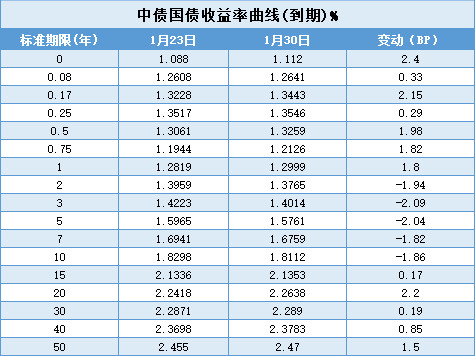
Core Viewpoint - The liquidity tightening in the market has eased under the central bank's support, leading to a stronger bond market despite weakness in commodity and equity markets, with yields generally declining by about 2 basis points [1]. Market Overview - From January 26 to January 30, 2026, the bond market saw a mixed performance with the yield curve showing a downward trend for most maturities, while the ultra-long end experienced upward pressure due to supply concerns [1][4]. - The 10-year government bond yield decreased by 2 basis points over the week, closing at 1.81% [4]. Bond Yield Changes - The changes in the China government bond yields from January 23 to January 30, 2026, were as follows: - 1-year: +1.8 BP - 2-year: -1.94 BP - 3-year: -2.09 BP - 5-year: -2.04 BP - 7-year: -1.82 BP - 10-year: -1.86 BP - 30-year: +0.19 BP - 50-year: +1.5 BP [2][3]. Primary Market Activity - A total of 95 bonds were issued last week, amounting to 624.275 billion yuan, with no government bonds issued [8]. - Local government bonds saw a significant increase in issuance, totaling 863.35 billion yuan in January, representing a year-on-year growth of 54.84% and 124.57% compared to the same period in 2024 [9]. International Market Insights - The U.S. bond market showed a mixed performance, with the Federal Reserve maintaining interest rates as expected, while the PPI data exceeded expectations, leading to a steepening of the yield curve [10][11]. - The 10-year U.S. Treasury yield rose by 2 basis points to 4.25%, while the 30-year yield increased by 5 basis points to 4.88% [11]. Economic Indicators - The manufacturing PMI for January was reported at 49.3%, indicating a decline, with production indices showing mixed results across different sectors [16]. - The total profit of industrial enterprises in December 2025 increased by 5.3% year-on-year, marking a significant recovery from previous months [16]. Analyst Perspectives - Analysts suggest that the bond market is currently in a favorable micro-structural state, with liquidity remaining stable and a potential rebound window still open [18]. - The "Walsh era" at the Federal Reserve may focus more on forward-looking decisions, potentially impacting the dollar's strength and overall market dynamics [20].

【债市观察】债市收回开年跌幅 10债关注临近1.80%阻力
Xin Hua Cai Jing· 2026-01-26 02:52
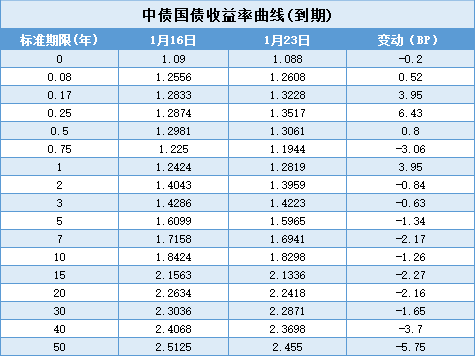
Core Viewpoint - The People's Bank of China (PBOC) has increased the volume of Medium-term Lending Facility (MLF) operations, leading to a more relaxed liquidity environment in the latter half of the week, which has positively impacted the bond market and caused a downward shift in the yield curve [1][9]. Market Overview - The yield on the 10-year government bond decreased by 1.3 basis points to 1.83%, reversing the gains made at the beginning of the year [1]. - The net financing of local bonds is expected to exceed 300 billion yuan this week, highlighting the need to focus on institutional absorption capacity and the impact of the end-of-month liquidity and equity market on the bond market [1]. Bond Market Performance - The yield curve for government bonds showed varied changes from January 16 to January 23, with the 1-year yield increasing by 3.95 basis points and the 30-year yield decreasing by 5.75 basis points [2][3]. - The bond futures market saw a general increase, with the 30-year main contract rising by 1.02% and the 10-year contract increasing by 0.12% [4]. Upcoming Issuance - For the week of January 26 to January 30, a total of 73 bonds are planned to be issued, amounting to 474.28 billion yuan, with no government bonds scheduled for issuance [5]. International Market Insights - The U.S. bond market experienced volatility, with the 10-year Treasury yield reaching a five-month high of 4.31% before stabilizing at 4.23% by the end of the week [6][7]. - Japanese government bonds saw significant fluctuations, with the 10-year yield rising to 3.38% before retreating, driven by concerns over fiscal deterioration and expectations of interest rate hikes [8]. Institutional Perspectives - West Securities noted that the pressure from local bond supply is increasing, with a total issuance of 4.393 billion yuan expected next week, which may elevate the pressure on banks to absorb these bonds [15]. - Huatai Securities indicated that the current yield on the 10-year government bond is approaching a lower boundary of the expected range, suggesting that without significant catalysts, yields may face resistance around the 1.8% level [16].
固收专题报告:银行自营债券投资有何特征?
Hua Yuan Zheng Quan· 2026-01-22 03:37
1. Report Industry Investment Rating No relevant content provided. 2. Core Viewpoints of the Report - In 2025, the bond market may mainly rely on increased allocation by bank self - operations. The balance of China's bond market increased by 19.7 trillion in the first 11 months of 2025, and the incremental investment in self - operated bonds by the banking industry in the same period reached 14.3 trillion, accounting for 72.7% of the bond scale increment [2][31]. - Bank self - operated bond investment is mainly in interest - rate bonds, which have a significant impact on the pricing of interest - rate bonds. As of Q3 2025, the proportion of interest - rate bond holdings in bank self - operated bonds was 80.7% [36]. - The bond investment behavior of banks is mainly affected by three types of indicators: capital adequacy ratio requirements, liquidity regulatory indicators, and bank book interest rate risk indicators [3][45]. - Joint - stock banks are the main players in the secondary trading of interest - rate bonds, while the trading scale of large - state - owned banks and policy banks is relatively small. Since Q1 2023, the overall market trading activity has increased, especially significantly after 2025 [3][52]. 3. Summary by Relevant Catalogs 3.1 Bank Self - Operated Financial Investment Composition, Scale Changes, and Structural Characteristics - **Composition and Scale Changes**: As of Q3 2025, the total financial investment scale of 42 listed banks was 101.5 trillion yuan. By statement account, the FVTPL account was 13.23 trillion yuan (13.0%), the FVOCI account was 29.87 trillion yuan (29.4%), and the AC account was 58.40 trillion yuan (57.5%). By asset category as of Q2 2025, bond investment was 79.08 trillion yuan (84.46%), equity investment was 0.86 trillion yuan (0.91%), and funds and other investments were 13.07 trillion yuan (13.96%). From Q4 2023 to Q3 2025, the investment scale of the FVOCI account increased significantly, mainly due to the growth of bond investment [8]. - **Structural Characteristics**: Credit bonds are mainly placed in the FVOCI account, and interest - rate bonds are mainly placed in the AC account. Among different types of banks, the proportion of the three accounts of large - state - owned banks and joint - stock banks is relatively stable, while the proportion of the AC category of city and rural commercial banks has decreased, and the FVOCI category of city commercial banks has increased, indicating a shift from allocation to trading thinking [2][14]. 3.2 Bond Market in 2025 - In 2025, the bond market may rely on increased allocation by bank self - operations. The government issued more bonds in 2025, and the weak credit demand led banks to significantly increase their bond investment. The year - on - year growth rate of the bond investment balance of various types of banks has increased significantly, and bond investment may become the main driving force for the expansion of bank asset scale [31][33]. 3.3 Bank Bond Investment Characteristics - **Investment Portfolio**: As of Q3 2025, bank self - operated bond holdings were 96.5 trillion yuan, mainly interest - rate bonds. Interest - rate bonds accounted for 80.7%, credit bonds accounted for 11.7%, negotiable certificates of deposit accounted for 5.7%, and other bonds accounted for 1.8%. Among interest - rate bonds, treasury bonds accounted for 33.3%, local government bonds accounted for 48.3%, and policy - bank bonds accounted for 17.8% [36]. - **Pricing Influence**: As of Q3 2025, bank self - operated bond holdings accounted for 48.21% of the total bond custody, having a significant impact on the bond market pricing, but the degree of influence varies by bond type. Bank self - operated interest - rate bond holdings accounted for 63.6% of the total interest - rate bond custody, having a significant impact on pricing [44]. 3.4 Bank Bond - Allocation Indicator Constraints - **Capital Adequacy Ratio Requirements**: The risk weights of treasury bonds and policy - bank bonds are 0, the risk weights of local general bonds and special bonds are 10% and 20% respectively, and the risk weights of general corporate bonds and non - bank financial institution ordinary bonds are 75% - 100% [3][47]. - **Liquidity Regulatory Indicators**: The liquidity coverage ratio is relatively relevant to bank self - operated bond investment behavior. Treasury bonds are included in qualified high - quality liquid assets at market price, while credit bonds are given a discount coefficient according to credit ratings [47]. - **Bank Book Interest Rate Risk Indicators**: For large - state - owned banks, joint - stock banks, and Postal Savings Bank, when the maximum economic value change exceeds 15% of their Tier - 1 capital (ΔEVE > 15%), regulatory attention will be drawn [47]. 3.5 Bank Self - Operated Secondary Trading Characteristics - **Interest - Rate Bond Secondary Trading**: Joint - stock banks are the main players in the secondary trading of interest - rate bonds. The trading activity of the whole market has increased since Q1 2023, especially significantly after 2025. The trading scale of large - state - owned banks and policy banks is relatively small [3][52]. - **Credit Bond Secondary Trading**: The trading scale of credit bonds is relatively limited, and the single - quarter trading amount of bank self - operations is generally below 1 trillion yuan [54]. - **Ultra - Long - Term Interest - Rate Bond Secondary Trading**: The secondary trading of ultra - long - term interest - rate bonds in the banking system shows the characteristics of "net reduction trend remains unchanged, and selling pressure converges marginally". Different types of banks have different trading behaviors [56].





【债市观察】央行重启14天期逆回购释放跨年流动性 利率短端走强超长端显配置价值
Zhong Guo Jin Rong Xin Xi Wang· 2025-12-22 03:08
Core Viewpoint - The central bank has resumed 14-day reverse repos to release year-end liquidity, maintaining stability in the money market, while short-term interest rates strengthen under expectations of loose monetary policy [1] Market Overview - The bond market saw fluctuations with the yield curve steepening, as the 10-year government bond yield decreased by nearly 1 basis point (BP) and the 30-year yield fell by over 2 BP during the week [1] - The yields for various maturities changed as follows: 1-year (-3.32 BP), 2-year (-1.99 BP), 3-year (-2.2 BP), 5-year (-2.58 BP), 7-year (-1.52 BP), 10-year (-0.88 BP), and 30-year (-2.35 BP) [2][3] Bond Market Dynamics - The bond market experienced a recovery mid-week after initial declines, with the 10-year government bond yield dropping to 1.836% [2] - The 30-year bond contract saw a slight increase of 0.02% over the week, while the 10-year and 5-year contracts rose by 0.14% each [5] Issuance in Primary Market - A total of 35 bonds were issued last week, amounting to 376.13 billion yuan, including 4 government bonds worth 296.04 billion yuan [7] - For the upcoming week, 8 bonds are planned for issuance, totaling 150.04 billion yuan, with 2 government bonds worth 148 billion yuan [7] International Bond Market - U.S. Treasury yields fell overall, with the 10-year yield down by 3 BP to 4.16% and the 2-year yield down by 4 BP to 3.48% [8] - In Japan, the central bank raised interest rates to 0.75%, leading to a sell-off in government bonds, with the 10-year yield reaching its highest level since 1999 at 2.023% [8] Economic Indicators - In November, the U.S. consumer price index (CPI) rose by 2.7%, lower than expected, which has increased bets on potential interest rate cuts by the Federal Reserve [10] - The U.S. unemployment rate rose to 4.6%, the highest since October 2021, indicating a weakening labor market [11] Institutional Perspectives - Analysts suggest that the bond market is currently in a consolidation phase, with expectations of continued monetary easing and potential trading opportunities emerging in the first quarter of the following year [15] - The market is characterized by high volatility, driven by differing behaviors of institutional investors and trading desks, with ongoing concerns about supply pressures and regulatory changes [16]

静待春暖花开,国开债券ETF(159651)冲击3连涨
Sou Hu Cai Jing· 2025-12-19 05:41
Group 1 - The core viewpoint suggests that if investors continue to trade based on easing expectations, interest rates may continue to decline, but any rate cuts are likely to occur only in the latter part of the first quarter of next year, indicating a weak rebound should be anticipated [1] - Recommendations include focusing on 2-3 year credit bonds, 5-year national development bonds, and 6-7 year national development bonds, with specific attention to active bonds such as 250208 and 250203, as well as hedging strategies involving 5-year national development bonds [1] - For 30-year bonds, the current spread between new and old bonds remains high, and non-active bonds with higher yields are considered to have good holding value, particularly bonds 250002 and 25T2, with a preference for 250002 based on liquidity expectations and speculative opportunities [1] Group 2 - As of December 19, 2025, the National Development Bond ETF (159651) has increased by 0.02%, marking a third consecutive rise, with the latest price at 106.8 yuan [2] - In terms of liquidity, the National Development Bond ETF had a turnover of 1.85% during the trading session, with a total transaction value of 8.9177 million yuan, and the average daily transaction value over the past year was 319 million yuan [2] - The maximum drawdown for the National Development Bond ETF over the past six months was 0.12%, which is the smallest drawdown compared to benchmark and comparable funds, with a recovery time of 8 days [2] Group 3 - The management fee for the National Development Bond ETF is 0.15%, and the custody fee is 0.05%, which are the lowest among comparable funds [3] - The tracking error for the National Development Bond ETF over the past month is 0.006%, indicating the highest tracking accuracy among comparable funds [3] - The ETF closely tracks the China Bond - 0-3 Year National Development Bank Bond Index, which includes policy bank bonds with a maturity of up to 3 years, serving as a benchmark for investments in this category [3]
固收指数月报 | 中国债市回暖!债券回购市场开放举措或成关键
彭博Bloomberg· 2025-11-17 11:54
Core Insights - Bloomberg is the first global index provider to include Chinese bonds in mainstream global indices, offering a unique perspective on the Chinese bond market through the Bloomberg China Fixed Income Index series [3] - The Bloomberg China Aggregate Index recorded a return of 0.65% in October, with a year-to-date return of 0.71% [5] - The return for the China Treasury and Policy Bank Index in October was 0.66%, while the year-to-date return for the Chinese yuan measured in local currency was 0.60%, improving its ranking from 26th to 25th among 27 currencies [5] Index Performance - Long-term bonds outperformed short-term bonds in October, with returns for various maturity indices as follows: - 1-3 years: 0.28% - 3-5 years: 0.45% - 5-7 years: 0.60% - 7-10 years: 0.83% - 10+ years: 1.54% [5][7] - The China Aggregate Index level stands at 244.67, with a year-to-date return of 0.71% [7] Market Dynamics - In August, the total outflow of funds from the Chinese bond market reached 99.7 billion yuan, a decrease from the record 303.8 billion yuan in July [13] - The outflow from Chinese government bonds slowed to 14.5 billion yuan, while foreign capital outflow from negotiable certificates of deposit (NCD) decreased to 67.8 billion yuan [13] - The opening of the bond repurchase market to foreign investors may help alleviate short-term outflows and support the long-term internationalization of the Chinese bond market [13] Credit Market Insights - Recent credit events in the U.S. have impacted Asian credit spreads, which widened to 66 basis points, indicating a potential risk in the market [13] - The geopolitical landscape, including U.S.-China trade tensions and the Dutch government's intervention in ASML, adds uncertainty to the global economic outlook [13]
【债市观察】债市低波横盘交投情绪谨慎 十债困于1.80%
Xin Hua Cai Jing· 2025-11-17 03:02
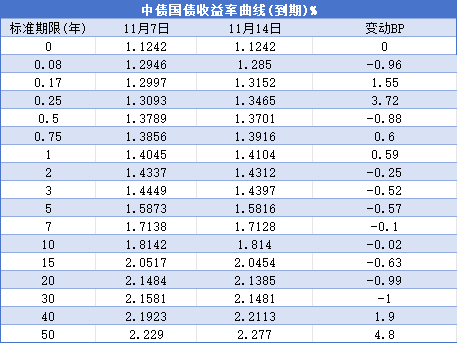
Core Viewpoint - The bond market experienced marginal tightening in liquidity last week, with the 10-year government bond yield closing at 1.805%, showing a slight decrease of 0.1 basis points, and the overall market remains in a sideways trend awaiting clearer signals [1][4]. Market Review - The yield changes for various maturities from November 7 to November 14, 2025, were as follows: 1-year (+0.59 BP), 2-year (-0.25 BP), 3-year (-0.52 BP), 5-year (-0.57 BP), 7-year (-0.1 BP), 10-year (-0.02 BP), 30-year (-1 BP), and 50-year (+4.8 BP) [2][3]. - The 10-year government bond yield fluctuated between 1.8% and 1.8125% during the week, ultimately closing at 1.805% [4]. Primary Market - A total of 100 bonds were issued last week, amounting to 726.87 billion yuan, including 6 government bonds worth 309.32 billion yuan, 21 policy bank bonds worth 132.48 billion yuan, and 73 local government bonds worth 285.07 billion yuan [7]. - For the upcoming week (November 17 to November 21), 60 bonds are planned for issuance, totaling 400.66 billion yuan [7]. International Market - The U.S. government shutdown ended, leading to concerns about economic impacts and a downward adjustment in expectations for a Federal Reserve rate cut in December. The 10-year U.S. Treasury yield rose to 4.15%, an increase of approximately 5 basis points for the week [8][10]. Monetary Policy - The People's Bank of China (PBOC) conducted a total of 1.122 trillion yuan in 7-day reverse repos last week, resulting in a net injection of 626.2 billion yuan [12]. - The PBOC plans to conduct an 800 billion yuan reverse repo operation on November 17 to maintain liquidity in the banking system [12]. Institutional Perspectives - Tianfeng Securities noted that the bond market remains in a narrow trading range, with both bulls and bears exercising caution. The potential for a seasonal rally at year-end may not materialize due to uncertainties in the banking sector and insurance liabilities [19]. - Huaxi Securities suggested that with financial data indicating a need for broader monetary easing, the likelihood of a rate cut by year-end or early next year is increasing, with the possibility of the PBOC prioritizing bond purchases to create a more accommodative environment [20]. - Industrial perspectives from Xingye Securities indicated that the current state of the bond market may not change soon, and investors should remain patient for improved opportunities [21].
固定收益定期:商业银行增配国债政金债,广义基金增持地方债:2025年8月中债登和上清所托管数据
Tianfeng Securities· 2025-09-24 15:19
Report Summary 1. Report Industry Investment Rating The document does not provide the industry investment rating. 2. Core View of the Report In August 2025, the leverage ratio of the inter - bank bond market increased slightly month - on - month and was lower than the same period in previous years. The total bond custody scale of China Central Depository & Clearing Co., Ltd. (CCDC) and Shanghai Clearing House increased. Different institutions had different investment preferences for various bonds, with commercial banks increasing their allocation of treasury bonds and policy - financial bonds, and broad - based funds increasing their holdings of local government bonds [1][2][50]. 3. Summary by Relevant Catalogs 3.1 Bank - Inter Leverage Ratio In late August, the inter - bank bond market leverage ratio was 106.88%, up 0.07 pct from the end of the previous month, and generally lower than the leverage ratio in the same period of previous years [1]. 3.2 Custody Data Overview In August 2025, the total bond custody scale of CCDC and Shanghai Clearing House was 174.54 trillion yuan, a month - on - month increase of 1.506 trillion yuan. Among them, CCDC's custody scale increased by 1.5382 trillion yuan, and Shanghai Clearing House's decreased by 32.2 billion yuan. Treasury bonds, local government bonds, policy - bank bonds, and medium - term notes contributed to the increase, while enterprise bonds, short - term financing bills, ultra - short - term financing bills, directional instruments, and inter - bank certificates of deposit contributed to the decrease [2][12]. 3.3 By Bond Type - **Interest - rate Bonds**: In August 2025, the total custody scale of major interest - rate bonds was 116.60 trillion yuan, a month - on - month increase of 1.7871 trillion yuan. Commercial banks were the main buyers, increasing their holdings by 1.2979 trillion yuan. Broad - based funds, insurance institutions, etc. also increased their holdings, while overseas institutions reduced their holdings [3][49]. - **Credit Bonds**: The total custody scale of major credit bonds was 16.06 trillion yuan, a month - on - month increase of 23 billion yuan. Commercial banks were the main buyers, increasing their holdings by 54.4 billion yuan. Broad - based funds and securities companies were the main sellers, reducing their holdings by 18.1 billion yuan and 14.8 billion yuan respectively. Insurance institutions and overseas institutions also reduced their holdings [3][49]. - **Inter - bank Certificates of Deposit**: The custody scale was 20.38 trillion yuan, a month - on - month decrease of 355.6 billion yuan. Broad - based funds and commercial banks were the main sellers [3][49]. 3.4 By Institution - **Commercial Banks**: The custody scale of major bonds was 85.29 trillion yuan, a month - on - month increase of 1.153 trillion yuan. They increased their holdings of interest - rate bonds and credit bonds by 1.2979 trillion yuan and 54.4 billion yuan respectively, and reduced their holdings of inter - bank certificates of deposit by 199.3 billion yuan [4][50]. - **Broad - based Funds**: The custody scale of major bonds was 37.38 trillion yuan, a month - on - month decrease of 172.3 billion yuan. They increased their holdings of interest - rate bonds by 120.7 billion yuan and reduced their holdings of credit bonds and inter - bank certificates of deposit by 18.1 billion yuan and 274.9 billion yuan respectively [4][50]. - **Overseas Institutions**: The custody scale of major bonds was 3.69 trillion yuan, a month - on - month decrease of 98.8 billion yuan. They reduced their holdings of interest - rate bonds, credit bonds, and inter - bank certificates of deposit by 27.5 billion yuan, 3.5 billion yuan, and 67.8 billion yuan respectively [4][54]. - **Insurance Institutions**: The custody scale of major bonds was 4.26 trillion yuan, a month - on - month increase of 43.2 billion yuan. They increased their holdings of interest - rate bonds by 49.5 billion yuan and reduced their holdings of credit bonds and inter - bank certificates of deposit by 5.9 billion yuan and 0.4 billion yuan respectively [4][54]. - **Securities Companies**: The custody scale of major bonds was 2.64 trillion yuan, a month - on - month decrease of 2 billion yuan. They increased their holdings of interest - rate bonds by 13.4 billion yuan and reduced their holdings of credit bonds and inter - bank certificates of deposit by 14.8 billion yuan and 0.6 billion yuan respectively [4][54]. - **Credit Unions**: The custody scale of major bonds was 2 trillion yuan, a month - on - month increase of 11.9 billion yuan. They increased their holdings of interest - rate bonds and credit bonds by 22.1 billion yuan and 0.7 billion yuan respectively, and reduced their holdings of inter - bank certificates of deposit by 10.8 billion yuan [5][55].

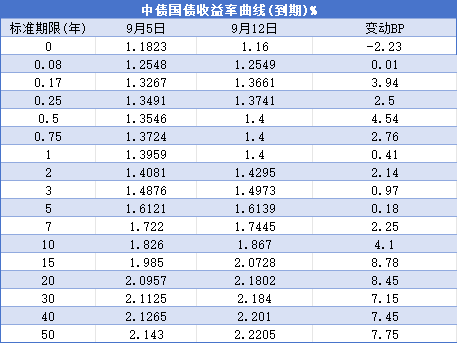
【债市观察】长端收益率上行拉动曲线趋陡 10年期国债周中上穿1.8%
Xin Hua Cai Jing· 2025-09-15 06:19
Market Overview - The funding environment was tight at the beginning of the week but eased later, maintaining overall balance [1] - The bond market experienced fluctuations due to news regarding fund fee rate adjustments and potential cancellation of tax exemptions for bond funds, leading to a rise in yields [1][4] - The 10-year government bond yield surpassed 1.8%, reaching a new high since April, before retreating later in the week due to weak export and financial data, as well as rumors of the central bank restarting bond purchases [1][4] Yield Changes - As of September 12, 2025, the yields for various maturities changed as follows: 1-year (0.41BP), 2-year (2.14BP), 3-year (0.97BP), 5-year (0.18BP), 7-year (2.25BP), 10-year (4.1BP), 30-year (7.15BP), and 50-year (7.75BP) compared to September 5, 2025 [2][3] Bond Market Dynamics - On Monday, the bond market weakened due to new fund fee regulations, with the 10-year bond yield rising to 1.784% [4] - On Tuesday, significant redemptions in index bond funds led to a quick rise in yields, with the 10-year bond yield reaching 1.795% [4] - By Wednesday, the yield peaked at 1.8325% before slightly retreating to 1.815% [4] - On Thursday, rumors of the central bank's bond purchases helped restore market sentiment, causing yields to drop [4] - By Friday, the central bank announced a 600 billion yuan reverse repurchase operation, contributing to further yield declines [4] Government Bond Issuance - A total of 83 bonds were issued last week, amounting to 10,345.42 billion yuan, including 5,663.70 billion yuan in government bonds [8] - For the upcoming week (September 15-19, 2025), 69 bonds are planned for issuance, totaling 5,005.19 billion yuan [8] International Bond Market - The U.S. Treasury market saw a slight rebound after reaching multi-month lows, with the 10-year Treasury yield dropping to 4.06% [9] - The U.S. August CPI rose by 2.9%, slightly above the previous value of 2.7%, while core CPI remained stable at 3.1% [10][12] Central Bank Operations - The central bank conducted 12,645 billion yuan in reverse repurchase operations last week, resulting in a net injection of 1,961 billion yuan [13] - An announcement was made for a 600 billion yuan buyout reverse repurchase operation scheduled for September 15, 2025 [13] Economic Indicators - The consumer price index (CPI) in August remained stable, with a year-on-year decrease of 0.4% [15] - The total social financing scale increased by 26.56 trillion yuan in the first eight months of 2025, showing a year-on-year growth of 8.8% [16] Institutional Perspectives - Huazhong Securities noted that the bond market sentiment remains fragile, with potential opportunities for long-term investments despite current volatility [19] - Financial institutions suggest a "barbell" strategy for bond investments, focusing on medium to high-grade credit bonds in the short term and long-term government bonds [19]