
新能源车船

Search documents
火石创造| 31省份“十五五”抢滩新兴产业和未来产业
Sou Hu Cai Jing· 2026-02-04 20:23
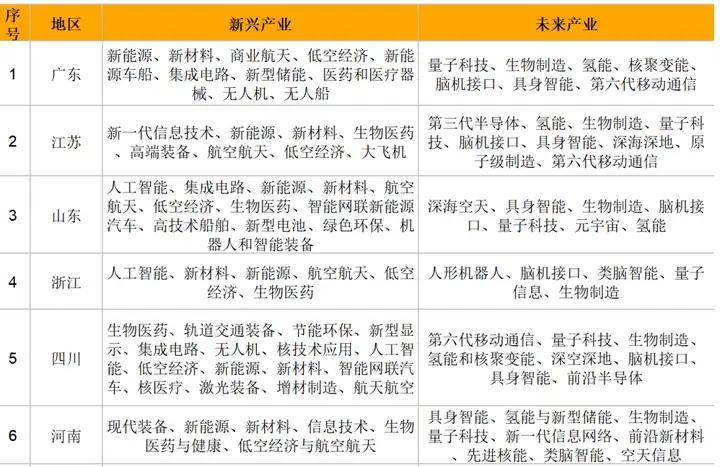
Core Insights - The "14th Five-Year Plan" marks the beginning of a new round of industrial transformation in China, with a clear focus on emerging and future industries across various provinces [1][10] - A comprehensive industrial map has emerged, showcasing strategic competition and collaboration among coastal economic provinces and emerging inland regions [1] Emerging Industries - Low-altitude economy is prioritized by over 28 provinces, making it a nearly universal focus, followed by new materials and new energy, each mentioned by 25 provinces [2] - Biomedicine is highlighted as the most covered future industry, appearing in the plans of 26 provinces, with embodied intelligence and hydrogen energy following closely with 20 and 19 provinces respectively [4] Regional Characteristics - Major economic provinces like Guangdong, Jiangsu, Shandong, and Zhejiang exhibit a comprehensive approach to industrial layout, focusing on both current and future industries [6][7] - Central and western provinces leverage their unique resources to carve out specialized paths, with Sichuan emphasizing nuclear technology and aerospace, while Hubei focuses on optoelectronic information [8] Future Industry Clusters - Six disruptive future industry clusters have been identified: - Intelligent integration cluster focusing on AI and embodied intelligence, with key regions including Zhejiang and Beijing [9] - Quantum information cluster led by Anhui and Beijing, focusing on quantum computing and communication [9] - Future energy cluster targeting hydrogen and nuclear fusion energy, with active participation from Inner Mongolia and Sichuan [9] - Aerospace and deep-sea cluster promoting commercial aerospace and low-altitude economy, with contributions from coastal and inland provinces [9] - Life sciences cluster redefining health and manufacturing, with strengths in Shanghai and Guangdong [9] - Advanced materials cluster providing foundational support for future industries, with significant efforts from Jiangsu and Zhejiang [9] Conclusion - The "14th Five-Year Plan" not only outlines an economic map but also serves as a strategic guide for China to seize opportunities in the global technological revolution and industrial transformation [10]

浙江省委书记王浩在“双碳”工作部署推进会上强调 加快构建新型能源体系 建设更高水平生态省
Zhong Guo Huan Jing Bao· 2026-02-03 02:28
Core Viewpoint - The Zhejiang Provincial Party Committee and Government emphasize the importance of "dual carbon" goals in leading a comprehensive green transformation and the construction of a new energy system to support high-quality development and common prosperity [1][2]. Group 1: Work Goals and Focus - The work goal is to establish a distinctive new energy system, modern industrial system, and modern logistics system in Zhejiang by 2030, significantly enhancing "dual carbon" governance capabilities and levels [2]. - The work focus includes promoting "three optimizations and one enhancement" to lead a comprehensive green transformation, implementing green low-carbon development, and ensuring stable energy supply and pricing [2]. Group 2: Infrastructure and Transportation - There is a push to accelerate the construction of a modern transportation system, leveraging world-class ports and a strong transportation province, with a focus on the "Four Ports" as core competitiveness [2]. - The initiative aims to maximize the integration of different transportation modes, such as "road to rail," "road to water," and "water to water," while promoting the application of new energy vehicles and vessels [2]. Group 3: Environmental and Economic Development - The strategy includes upgrading traditional industries, developing green low-carbon industries, and optimizing industrial parks to promote a shift towards a greener economy [2]. - Efforts will be made to enhance pollution prevention, increase forest carbon sink capacity, and promote a comprehensive strategy for energy conservation and green lifestyle changes [2].
财联社汽车早报12月25日
Xin Lang Cai Jing· 2025-12-25 02:15
Group 1: Transportation Industry Developments - The Ministry of Transport aims to accelerate the development of smart logistics, low-carbon economy, and digital transportation industries, initiating the construction of zero-carbon highway transport corridors [1] - The focus will be on integrating advanced technologies such as artificial intelligence, big data, and new-generation information technology into the transportation sector [1] - The promotion of clean and low-carbon transportation tools, including new energy vehicles and vessels, is a priority [1] Group 2: Automotive Market Performance - From December 1 to 21, the national retail sales of passenger cars reached 1.3 million units, a year-on-year decrease of 19%, but a month-on-month increase of 5% [3] - Cumulatively, retail sales for the year reached 22.783 million units, showing a year-on-year growth of 4% [3] - The retail sales of new energy vehicles in the passenger car market reached 788,000 units, with a year-on-year increase of 1% and a penetration rate of 60.6% [3] Group 3: Corporate Actions and Financial Developments - Changan Automobile announced that two investors have paid deposits for the capital increase and share expansion project of its subsidiary, Deep Blue Automobile [5] - The company will maintain a 50.9959% stake post-expansion, while the new investors will hold 12.0934% and 2.4187% respectively [5] - Zotye Automobile has reached a settlement with two banks regarding financial loan disputes, avoiding forced execution and asset seizure [10] Group 4: Company-Specific News - Avita responded to controversy regarding its "Antarctic journey," stating that its vehicle will remain in Antarctica for over 16 months for adaptive testing [6] - The departure of Li Auto's product line manager is reported to be voluntary and unrelated to the company's business, with plans for merging product lines [7][8] - Waymo is upgrading its autonomous vehicle fleet to enhance navigation capabilities during power outages [11]
展望“十五五” | 广东省发布“十五五”规划建议:着力打造新兴支柱产业,实施产业创新工程
Xin Lang Cai Jing· 2025-12-11 10:16
Core Viewpoint - The Guangdong Provincial Committee emphasizes the importance of the 15th Five-Year Plan in advancing China's modernization, highlighting the achievements during the 14th Five-Year Plan and setting ambitious goals for economic and social development in the upcoming period [3][4][7]. Group 1: Achievements During the 14th Five-Year Plan - Guangdong has achieved significant economic growth, reaching a total economic output of 14 trillion yuan, with over 7 million new urban jobs created and a rise in per capita disposable income outpacing economic growth [3][4]. - The province has made strides in high-quality development, technological innovation, and ecological improvements, showcasing a balanced and coordinated development approach [3][4][10]. Group 2: Historical Context and Development Environment - The 15th Five-Year Plan period is seen as crucial for consolidating the foundations of socialist modernization and creating new advantages for Guangdong [4][5]. - The province faces both opportunities and challenges, including global geopolitical shifts and the need for technological advancements to maintain competitive advantages [5][6]. Group 3: Guiding Principles and Goals for the 15th Five-Year Plan - The guiding principles include upholding the leadership of the Communist Party, prioritizing people-centered development, and focusing on high-quality growth [8][9]. - Key goals include achieving significant improvements in economic quality, enhancing self-reliance in technology, and promoting coordinated urban and rural development [10][11]. Group 4: Economic and Social Development Strategies - Strategies include deepening reforms, expanding openness, and enhancing the quality of the business environment to stimulate economic vitality [31][33]. - The plan emphasizes the importance of integrating domestic and international markets, fostering innovation, and developing a modern industrial system [30][36]. Group 5: Infrastructure and Technological Development - The plan outlines the need for a modern infrastructure system that supports economic activities and enhances resilience [21][22]. - It highlights the importance of technological self-reliance and innovation as key drivers for economic transformation and productivity enhancement [22][24]. Group 6: Consumer Market and Investment - The strategy focuses on boosting domestic consumption and investment, with initiatives aimed at enhancing consumer spending and optimizing investment structures [28][29]. - The plan aims to create a unified national market, facilitating resource sharing and economic integration across regions [30].
广东最新发布!含金量极大
Shang Hai Zheng Quan Bao· 2025-12-08 05:17
Group 1 - The core viewpoint of the article is the outline of Guangdong's future development blueprint, aiming to achieve socialist modernization within 13 years and double the economic output, reaching the GDP per capita level of moderately developed countries [1][5] Group 2 - The "15th Five-Year Plan" sets eight main goals for Guangdong's economic and social development, emphasizing high-quality growth, improved productivity, and increased domestic consumption [3] - Significant advancements in new-type industrialization, information technology, urbanization, and agricultural modernization are expected, with a focus on integrating into the national market [3] - The plan aims to enhance self-reliance in technology, with a collaborative innovation community in the Guangdong-Hong Kong-Macao Greater Bay Area and breakthroughs in key technologies [3] Group 3 - The proposal emphasizes the need for comprehensive reforms to modernize governance systems and enhance the socialist market economy [4] - It highlights the importance of cultural confidence and the promotion of socialist core values to improve social civilization [4] - The quality of life for residents is expected to improve, with synchronized growth in income and economic output, and a more optimized distribution structure [4] Group 4 - The ecological construction in Guangdong is projected to show significant results, with a focus on green production and living practices, achieving carbon peak goals, and reducing pollution [4] - The safety foundation for development is expected to be strengthened, with improved national security systems and risk management [4] Group 5 - The plan includes fostering more trillion-yuan and hundred-billion-yuan industrial clusters, focusing on advanced manufacturing as the backbone of the modern industrial system [7][9] - It aims to cultivate emerging and future industries, including new energy, new materials, and commercial aerospace, while promoting innovation and technology development [9] Group 6 - The proposal stresses the importance of deepening the digital economy and advancing smart economic development through data, computing power, and algorithms [12] - It calls for optimizing the consumption environment and enhancing consumer protection, while also expanding effective investment in infrastructure and public services [14] Group 7 - The plan advocates for the high-quality development of multi-level capital markets, enhancing the role of state-owned enterprises and supporting the growth of private enterprises [16][17] - It emphasizes the need for strategic cooperation with domestic and international financial institutions to strengthen Guangdong's financial system [17]
大力提振消费!清理汽车、住房等消费不合理限制性措施……广东重磅发布
证券时报· 2025-12-08 04:20
Core Viewpoint - The article emphasizes the importance of Guangdong's role in advancing China's modernization and outlines the strategic goals and guiding principles for the province's economic and social development during the "15th Five-Year Plan" period. Group 1: Achievements and Historical Context - Guangdong has achieved significant development during the "14th Five-Year Plan" period, with a GDP surpassing 14 trillion yuan, showcasing rapid economic growth and social stability despite challenges such as the pandemic and global changes [3][4]. - The "15th Five-Year Plan" period is seen as a critical time for consolidating achievements and creating new advantages for Guangdong, focusing on overcoming bottlenecks and enhancing development capabilities [4][5]. Group 2: Development Environment - The province faces both strategic opportunities and challenges, including global shifts in power dynamics, technological revolutions, and the need for sustainable development [5][6]. - Guangdong's economic foundation remains strong, with advantages such as proximity to Hong Kong and Macau, a robust industrial base, and a large population, but issues like unbalanced development and the need for innovation persist [5][6]. Group 3: Guiding Principles and Goals - The guiding principles for the "15th Five-Year Plan" include upholding the leadership of the Communist Party, prioritizing people's needs, promoting high-quality development, and deepening reforms [7][8]. - Key goals include achieving significant progress in high-quality development, enhancing technological self-reliance, improving urban-rural coordination, and advancing social civilization [10][11][12]. Group 4: Economic Development Strategies - The plan emphasizes building a modern industrial system centered on advanced manufacturing, optimizing traditional industries, and fostering emerging sectors [19][20][23]. - There is a focus on enhancing service industries, improving infrastructure, and leveraging digital technologies to drive economic growth [23][24][30]. Group 5: Innovation and Technology - Strengthening original innovation and key technology breakthroughs is a priority, with an emphasis on integrating technology with industry to enhance productivity [25][26][27]. - The development of a comprehensive innovation ecosystem is essential, involving collaboration between education, technology, and talent development [29][28]. Group 6: Domestic Market and Consumption - The strategy includes boosting domestic consumption and investment, enhancing the consumer environment, and promoting new consumption patterns [32][33]. - Efforts will be made to integrate domestic and international markets, facilitating trade and economic cooperation [34][35][41]. Group 7: Reform and Opening Up - The article highlights the need for deepening reforms and expanding openness to enhance economic vitality and competitiveness [36][37][38]. - Creating a market-oriented, law-based, and international business environment is crucial for attracting investment and fostering economic growth [38][39].

广东“十五五”规划建议:加快战略性新兴产业集群发展
2 1 Shi Ji Jing Ji Bao Dao· 2025-12-08 03:42
Core Viewpoint - The Guangdong Provincial Committee of the Communist Party of China has released recommendations for the 15th Five-Year Plan, emphasizing the cultivation and expansion of emerging and future industries [1] Group 1: Emerging Industries - Focus on developing strategic emerging industries such as new energy, new materials, commercial aerospace, and low-altitude economy [1] - Strengthening key industries including new energy vehicles, integrated circuits, new energy storage, pharmaceuticals and medical devices, drones, and unmanned ships [1] Group 2: Future Industries - Forward-looking layout for future industries, exploring diverse technological routes, typical application scenarios, feasible business models, and market regulatory rules [1] - Promoting quantum technology, biomanufacturing, hydrogen energy, nuclear fusion energy, brain-computer interfaces, embodied intelligence, and sixth-generation mobile communication as new economic growth points [1] Group 3: Support for SMEs - Encouraging the specialized and innovative development of small and medium-sized enterprises (SMEs) and nurturing "gazelle" and "unicorn" companies [1] - Strengthening institutional support for new tracks and fields, exploring the establishment of "Science and Technology Innovation Special Zones," and implementing inclusive and prudent regulation [1] - Accelerating the cultivation of new products, technologies, and business formats [1]
广东“十五五”规划建议:加快新能源、新材料、商业航天、低空经济等战略性新兴产业集群发展
Zheng Quan Shi Bao Wang· 2025-12-07 23:37
Core Viewpoint - The Guangdong Provincial Government is focusing on cultivating and expanding emerging and future industries as part of its 15th Five-Year Plan, emphasizing innovation and strategic industry clusters [1] Group 1: Emerging Industries - The plan aims to develop strategic emerging industry clusters, including new energy, new materials, commercial aerospace, and low-altitude economy [1] - Key industries identified for strengthening include new energy vehicles, integrated circuits, new energy storage, pharmaceuticals and medical devices, drones, and unmanned ships [1] Group 2: Future Industries - The government is looking to proactively layout future industries by exploring diverse technological routes, typical application scenarios, feasible business models, and market regulatory rules [1] - New economic growth points are expected to emerge from advancements in quantum technology, biomanufacturing, hydrogen energy, nuclear fusion energy, brain-computer interfaces, embodied intelligence, and sixth-generation mobile communication [1] Group 3: Support for SMEs - There is a focus on promoting the development of specialized, innovative small and medium-sized enterprises (SMEs) and nurturing "gazelle" and "unicorn" companies [1] - The plan includes strengthening institutional support for new tracks and fields, exploring the establishment of "special zones for scientific innovation," and implementing inclusive and prudent regulation to accelerate the development of new products, technologies, and business formats [1]
中共广东省委关于制定广东省国民经济和社会发展第十五个五年规划的建议
2 1 Shi Ji Jing Ji Bao Dao· 2025-12-07 23:35
Core Viewpoint - The Guangdong Provincial Committee emphasizes the importance of the "15th Five-Year Plan" in advancing China's modernization, highlighting the achievements during the "14th Five-Year Plan" and setting ambitious goals for economic and social development in the coming years [1][2]. Group 1: Achievements During the "14th Five-Year Plan" - Guangdong has made significant progress, achieving a GDP of 14 trillion yuan, with a focus on high-quality development and technological innovation [1]. - The province has effectively responded to challenges such as the pandemic and global changes, enhancing its economic resilience and social stability [1]. - Key initiatives include the promotion of the Guangdong-Hong Kong-Macao Greater Bay Area and improvements in public welfare, with over 7 million new urban jobs created [1]. Group 2: Historical Context for the "15th Five-Year Plan" - The "15th Five-Year Plan" is positioned as a critical period for consolidating the foundations of socialist modernization and creating new advantages for Guangdong [2]. Group 3: Development Environment for the "15th Five-Year Plan" - Guangdong faces both opportunities and challenges, including global shifts in power dynamics and the need for technological advancements [3]. - The province's strengths include its large economy, population, and proximity to Hong Kong and Macao, which provide a solid foundation for future growth [3]. Group 4: Guiding Principles and Goals for Economic and Social Development - The guiding principles include upholding the Party's leadership, prioritizing people-centered development, and focusing on high-quality growth [6][7]. - Goals for the "15th Five-Year Plan" include significant improvements in economic growth, technological self-reliance, and social welfare [9][10]. Group 5: Development of the Guangdong-Hong Kong-Macao Greater Bay Area - The Greater Bay Area is envisioned as a strategic hub for high-quality development and modernization, with efforts to enhance collaboration and resource sharing among the regions [12][13]. Group 6: Modernization of the Industrial System - The plan emphasizes building a modern industrial system centered on advanced manufacturing, with a focus on innovation and sustainability [18][19]. - Key initiatives include optimizing traditional industries and fostering emerging sectors such as new energy and biotechnology [20]. Group 7: Enhancing Domestic Demand and Consumption - Strategies to boost domestic consumption include improving public services and creating new consumption scenarios to stimulate economic growth [31][32]. Group 8: Reform and Opening Up - The plan outlines the importance of deepening reforms and expanding openness to enhance economic vitality and competitiveness [35][36]. - Measures include improving the business environment and fostering diverse economic ownership [37][38].
锚定新兴产业 多地谋划“十五五”发展路线图
Zhong Guo Zheng Quan Bao· 2025-12-03 20:28
Group 1: Artificial Intelligence Development - Nearly 30 provinces in China have included artificial intelligence in their "14th Five-Year" plans, indicating a significant trend towards new and intelligent industries [1] - Local governments are focusing on establishing technological advantages and expanding international influence in the AI sector, with Beijing aiming to cultivate a leading AI industry ecosystem and Zhejiang promoting an optimal open-source environment [1] - Some regions are exploring the integration of AI with local advantageous industries, such as Inner Mongolia's plan to create a "green computing power + AI" application base [1] Group 2: Sustainable Development of New Energy - Local governments are prioritizing new energy as a key production factor to drive the transformation of traditional industries, with Chongqing aiming to become a global hub for smart connected new energy vehicles [2][3] - The development of new energy industries is expected to shift regional economies from resource-dependent to technology-driven models, enhancing the economic value and sustainability of these regions [3] - Various regions are implementing systematic planning for carbon reduction, with initiatives like Chongqing's comprehensive carbon emission control mechanism and Ningxia's efforts to achieve carbon peak [3]