
木材及木制品

Search documents
2025年越南与日本双边贸易额超500亿美元
Shang Wu Bu Wang Zhan· 2026-01-10 03:38
Core Viewpoint - Vietnam's trade with Japan shows significant growth, with exports reaching $26.8 billion and imports at $24.7 billion, indicating a strong economic relationship between the two countries [1] Export Summary - Vietnam's exports to Japan reached $26.8 billion, a year-on-year increase of 8.8% [1] - Key export categories include: - Textiles: $4.6 billion, up 6.1% [1] - Transportation equipment and parts: $3.3 billion, up 8.6% [1] - Wood and wooden products: $2.2 billion, up 23.3% [1] - Mobile phones and accessories: $1.7 billion, up 17.7% [1] - Footwear: $1.6 billion, up 19% [1] - Agricultural, forestry, and fishery products also saw strong growth: - Coffee: $611 million, up 46.6% [1] - Cashews: $85.6 million, up 34.7% [1] - Pepper: $27 million, up 25.9% [1] Import Summary - Vietnam's imports from Japan totaled $24.7 billion, a year-on-year increase of 14.1% [1] - Major import categories include: - Computers, electronic products, and accessories: $8.347 billion, up 24.06% [1] - Machinery, equipment, and parts: $4.886 billion, up 21.69% [1] - These two categories account for approximately 54% of Vietnam's total imports from Japan, highlighting the close economic ties in the regional supply chain [1]
11月智利工业生产指数同比下降0.8%
Shang Wu Bu Wang Zhan· 2026-01-01 16:46
Core Viewpoint - Chile's industrial production index decreased by 0.8% year-on-year in November, primarily due to declines in manufacturing and mining sectors [1] Group 1: Manufacturing Sector - The manufacturing production index fell by 1.3%, attributed to reduced demand for machinery and paper products, leading to a decrease in wood and wood product output [1] Group 2: Mining Sector - The mining index also declined by 1.3%, driven by decreased mining output and processing activities, particularly in copper and other metal ores, although there was an increase in non-metallic minerals like lithium and natural gas production [1] Group 3: Utilities Sector - The water, electricity, and gas production index grew by 2.4%, supported by increased solar power generation and commercial electricity distribution, along with higher residential water allocation and liquefied natural gas regasification levels [1]
美国关税豁免清单持续扩容说“化”不多
Zhong Guo Hua Gong Bao· 2025-12-10 03:13
Group 1 - The U.S. is expanding the range of products exempt from reciprocal tariffs, particularly in aerospace and pharmaceuticals, while most general plastics and chemical products still incur these tariffs [1][2] - The reciprocal tariff rates range from 10% to 40%, and the U.S. has recently added more food and fertilizer imports to the exemption list due to domestic supply issues [1][2] - The exemption list includes various categories such as minerals, food, fertilizers, crude oil, refined products, pharmaceuticals, and semiconductor materials [1] Group 2 - The largest tariff exemptions come from imports from Canada and Mexico under the USMCA, with additional exemptions provided through various trade agreements [2] - The impact of tariff exemptions on the chemical industry is minimal, as most chemical products are excluded from the exemption lists, but key minerals that are exempt may influence the chemical market indirectly [2][3] - Limited chemical raw materials qualify for exemptions, and many essential chemicals like benzene and toluene still face tariffs despite domestic shortages [3] Group 3 - The reciprocal tariff policy is currently facing legal challenges, which may lead to a reevaluation of the tariff structure in the future [3] - The established exemption lists and trade agreements provide insights into the potential direction of U.S. trade policy [3]
爱沙尼亚2025年10月工业生产者价格同比上涨0.6%
Shang Wu Bu Wang Zhan· 2025-11-21 15:21
Group 1: Industrial Producer Price Index - In October 2025, Estonia's industrial producer price index increased by 0.6% year-on-year and 0.3% month-on-month [1] - The mining industry saw a year-on-year price increase of 3.5%, while manufacturing prices rose by 0.6% [1] - Energy production prices decreased by 1% [1] Group 2: Manufacturing Sector Price Changes - Within manufacturing, the wood and wood products industry experienced a year-on-year price increase of 4.7% [1] - The food production sector saw a price increase of 2.9% year-on-year [1] - The machinery repair and installation sector's prices rose by 2.1% year-on-year [1] - Conversely, the coke and refined petroleum products sector experienced a significant price drop of 17.9% year-on-year [1] - Basic metals manufacturing prices decreased by 6.9% year-on-year [1] - The computer and electronic products manufacturing sector saw a price decline of 2.3% year-on-year [1] Group 3: Export and Import Price Indices - In October 2025, Estonia's export price index increased by 1% year-on-year [2] - The import price index also rose by 0.7% year-on-year [2]
罗志恒:关税战下的美国——关税收入、实际税率与贸易格局演变
Sou Hu Cai Jing· 2025-10-13 04:55
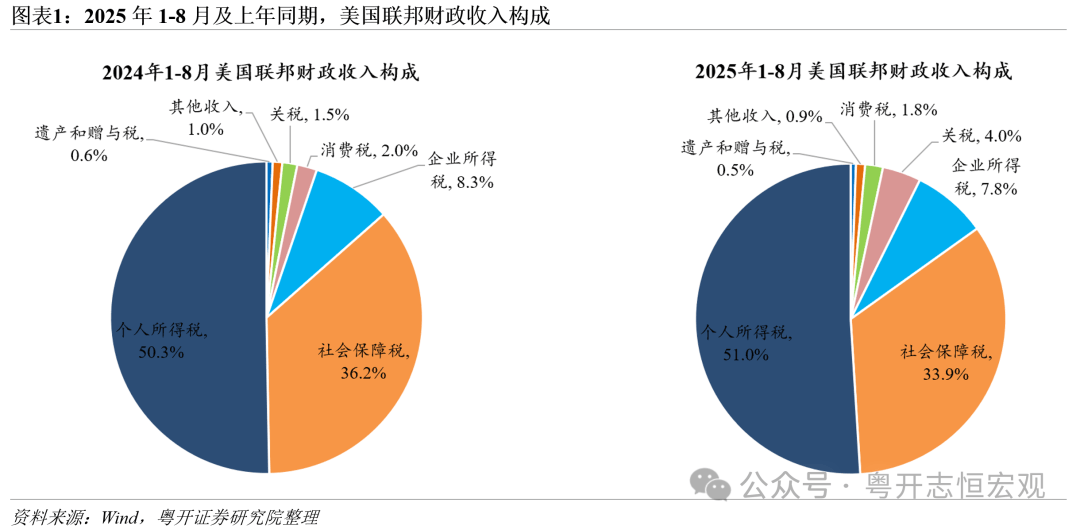
Core Viewpoint - The recent announcement by Trump to impose a 100% tariff on China and export controls on key software is seen as a significant escalation in the US-China trade conflict, which could have profound implications for bilateral trade and the global trade system [1] Group 1: Tariff Revenue and Rates - Since the onset of the trade war, US tariff revenue has surged, becoming the fourth largest source of federal revenue, following individual income tax, social security tax, and corporate income tax [6] - From January to June 2025, the average tariff rate in the US increased from 2.2% to 8.9%, with a notable rise in April due to expanded tariffs on a global scale [8][14] - By August 2025, US tariff revenue reached $144.4 billion, 2.8 times that of the previous year, accounting for 4.0% of federal revenue, an increase of 2.5 percentage points year-on-year [6] Group 2: Tariff Rates by Trade Partner - The actual average tariff rate imposed by the US on China reached 37.4% by June 2025, with significant increases observed for labor-intensive goods and products affected by Section 232 tariffs [24][29] - The average tariff rates for Japan and South Korea were 15.3% and 12.0%, respectively, while rates for the EU, Vietnam, and India ranged between 5% and 10% [24] - The US has seen a decline in its reliance on Chinese imports, with the share of imports from China dropping to 9.4% of total imports, a decrease of 3.4 percentage points year-on-year [28] Group 3: Trade Performance and Deficits - In the first seven months of 2025, US imports grew by 10.7% and exports by 4.8%, but the trade deficit expanded by 21.3% [19] - The US experienced a decline in trade volume with China and Canada, with imports from China down by 18.9% and exports down by 20.2% [19][20] - Despite high tariffs on China, the overall trade deficit with other countries has increased, indicating that the US still relies heavily on imports to meet domestic demand [20] Group 4: Future Tariff Trends - The actual tariff rates are expected to converge with nominal rates as various loopholes and exemptions are closed, leading to an increase in effective tariff rates across different economies [33][34] - Factors such as preemptive imports and exemptions for certain goods have contributed to the current lower effective tariff rates, but these are anticipated to diminish over time [33][35]

泰国和沙特阿拉伯加强贸易关系
Shang Wu Bu Wang Zhan· 2025-09-24 17:10
Core Insights - Thailand and Saudi Arabia are enhancing their economic and trade relations through trade exhibitions, emerging industries, and cooperation in halal food, pharmaceuticals, herbal products, and elderly care [1] Economic Cooperation - The Thai Commercial Affairs Permanent Secretary, Wuttikrai, chaired an online meeting of the Saudi-Thailand Coordination Committee on September 18 to strengthen economic and trade cooperation [1] - An agreement to eliminate double taxation and a customs cooperation memorandum were signed to simplify trade and investment processes between the two countries [1] Trade Statistics - Saudi Arabia is recognized as a high-income country and a strategic trade partner for Thailand, with strong demand for halal food and agricultural products [1] - In 2024, Saudi Arabia is projected to be Thailand's 19th largest trading partner and the second largest in the Middle East, with a bilateral trade volume of $7.56 billion, including exports of $2.86 billion and imports of $4.9 billion [1] - In the first half of this year, total trade amounted to $3.85 billion, with exports to Saudi Arabia at $1.25 billion and imports at $2.6 billion [1] - Major export products include automobiles, auto parts, wood and wood products, and rubber products, while key imports consist of crude oil, fertilizers, pesticides, and chemicals [1]
9月上半月越南进出口增速放缓
Shang Wu Bu Wang Zhan· 2025-09-23 15:52
Core Insights - Vietnam's total goods import and export value for the first half of September 2025 reached 39.05 billion USD, reflecting a month-on-month decrease of 3.25% [1] - The export value was 19.2 billion USD, down 4.3% month-on-month, primarily due to significant declines in four major product categories [1] - The import value was 19.85 billion USD, showing a month-on-month decrease of 2.21%, with declines concentrated in two main categories [1] Export Analysis - The decline in exports was driven by significant drops in textile and garment exports (335 million USD), footwear exports (250 million USD), mobile phones and components (120 million USD), and wood and wooden products (110 million USD) [1] - The data indicates a weakening external demand, particularly for labor-intensive products heavily reliant on large markets such as the US and Europe [1] - Foreign investment continues to play a dominant role in exports, accounting for 79.2% of total exports, highlighting a slow growth rate for domestic enterprises [1] Import Analysis - The decrease in imports was primarily focused on two categories: computers, electronic products, and components (210 million USD decrease), which, despite the largest drop, remained the highest import category; and machinery, tools, and components (120 million USD decrease) [1]
爱沙尼亚8月工业生产者价格同比下降1.6%
Shang Wu Bu Wang Zhan· 2025-09-23 04:12
Group 1 - The industrial producer price index in Estonia decreased by 1.6% year-on-year in August 2025, marking the third consecutive month of decline [1] - Energy production prices, including electricity, fell by 18.3% year-on-year, while manufacturing production prices saw a slight decrease of 0.1% [1] - Mining production prices increased by 2.7% year-on-year [1] Group 2 - In the manufacturing sector, food production prices rose by 3.7% year-on-year, clothing production prices increased by 4.2%, and wood and wood products processing prices went up by 4.7% [1] - Conversely, prices for coke and petroleum products dropped by 19.3%, and prices for machinery repair and installation decreased by 2.6% [1] - Paper product prices experienced a year-on-year decline of 11.3% [1] Group 3 - The export price index in Estonia fell by 0.4% year-on-year in August, while the import price index decreased by 1.1% [2]
2025年前8个月越南木材及木制品出口额突破110亿美元
Shang Wu Bu Wang Zhan· 2025-09-05 02:09
Core Insights - Vietnam's wood and wooden products export value is projected to reach 1.45 billion USD by August 2025, with total exports in the first eight months of 2024 amounting to 11.1 billion USD, reflecting a 6.3% increase compared to the same period in 2023 [1] Market Distribution - The United States remains the largest market for Vietnam's wood and wooden products, accounting for 56% of total exports, while Japan and China represent 12.4% and 10.9% respectively [1]
面对关税压力,应对经济“逆风”,东盟多国下调经济预期
Huan Qiu Shi Bao· 2025-05-20 22:49
Group 1 - The core viewpoint of the articles highlights the economic slowdown in Southeast Asia, with five out of six major economies experiencing a decline in GDP growth in the first quarter of the year due to trade uncertainties and U.S. tariff policies [1][2][4] - Thailand's GDP growth for Q1 2025 is reported at 3.1%, showing a slight decrease from 3.3% in Q4 2024, with exports growing by 12.3% but hindered by weak government spending and private consumption [1][4] - Indonesia's GDP growth has dropped to 4.87%, the lowest since Q3 2021, while Malaysia's growth decreased from 4.9% to 4.4%, and Singapore's preliminary data fell from 5% to 3.8% [1][4] Group 2 - The U.S. tariffs imposed on Southeast Asian countries are expected to create significant economic headwinds, with tariff rates announced as follows: Vietnam 46%, Thailand 36%, Indonesia 32%, Malaysia 24%, Philippines 17%, and Singapore 10% [2][3] - The tariffs are anticipated to severely impact Indonesia's manufacturing sector, particularly in the footwear and textile industries, as over 60% of its clothing and 33% of its footwear exports go to the U.S. [3] - Vietnam is also facing potential risks, with over 29% of its exports directed to the U.S., including electronics, textiles, and seafood [3] Group 3 - Southeast Asian countries are adjusting their economic growth forecasts in response to the trade uncertainties, with Singapore lowering its growth prediction from 1%-3% to 0%-2% [4] - Malaysia's central bank has revised its growth forecast to slightly below the previous range of 4.5%-5.5%, while Thailand's NESDC has adjusted its annual growth expectation from 2.3%-3.3% to 1.3%-2.3% [4][5] - Despite the challenges, Southeast Asia's economic development retains potential, with countries like Singapore and Indonesia investing in infrastructure and innovation to strengthen their digital economies [5]