
木糖

Search documents
惠农“税费通”|支持乡村振兴系列税费优惠政策(49)以部分农林剩余物为原料生产纤维板等资源综合利用产品实行增值税即征即退90%
蓝色柳林财税室· 2026-02-06 07:45
Core Viewpoint - The article discusses the VAT tax refund policy for the production of fiberboard using agricultural residues, which has been effective since March 1, 2022, allowing a 90% VAT refund for certain products made from specified raw materials [3]. Group 1: Tax Policy Details - The policy applies to products made from at least 95% of specified raw materials, including agricultural residues like straw and corn cobs [4]. - Taxpayers must obtain VAT invoices from sellers for recycled resources purchased domestically; if the seller cannot issue invoices, alternative documentation is required [5]. - The calculation for sales revenue not eligible for the VAT refund is based on the proportion of unverified resource costs to total resource costs [6]. Group 2: Compliance Requirements - Products must not fall under categories deemed as eliminated or restricted by the relevant regulatory bodies, ensuring they are not classified as high pollution or high environmental risk [6]. - If the recycled resources include hazardous waste, a license from environmental authorities is required [7]. - Taxpayers must maintain a detailed record of recycled resource purchases, including supplier information and invoice status [10]. Group 3: Application Conditions - Taxpayers must not have a credit rating of C or D and should not have faced penalties related to environmental or tax laws in the six months prior to applying for the VAT refund [9].

研判2025!中国秸秆行业市场政策、产业链图谱、综合利用量、利用率、市场规模、竞争格局及发展趋势分析:市场格局较为分散[图]
Chan Ye Xin Xi Wang· 2025-12-23 01:36
Core Viewpoint - The straw industry in China is deeply integrated with agriculture, energy, chemicals, and building materials, forming various industrial chains that enhance rural employment and farmers' income while creating indirect economic value through the substitution of petrochemical and wood resources [1][12]. Market Policies - A series of national policies have been implemented to promote comprehensive utilization of straw, with local governments providing subsidies, market construction, and incentive measures to support the development of the entire straw recycling, processing, and utilization industry chain [8][9]. Industry Chain - The straw industry chain consists of upstream resource supply and equipment manufacturing, midstream processing, and downstream diversified applications, evolving towards scale, high value, and intelligence [9][10]. Development Status - The comprehensive utilization of straw in China is projected to increase from 555 million tons in 2024 to 647 million tons, with a utilization rate rising from 77.7% to 88.3% and market size expanding from 147.63 billion yuan to 205.10 billion yuan [1][13]. Competitive Landscape - The straw comprehensive utilization market is characterized by a fragmented structure with many small-scale enterprises, including those focused on fertilizer, feed, and energy applications [13][14]. Development Trends - The future of straw utilization will shift towards high-value applications, including biodegradable tableware and bio-based composite materials, while also enhancing collaboration across the industry chain [16][17]. - Technological innovations will focus on key processes such as straw pretreatment and conversion, improving efficiency and reducing costs [19][20].

一个县城的"秸秆经济学":南乐如何用20年构建生物基产业闭环
合成生物学与绿色生物制造· 2025-12-08 09:12
Core Viewpoint - The article highlights the transformation of agricultural waste into a thriving bio-based materials industry in Nanle County, Henan Province, showcasing a complete industrial ecosystem that effectively addresses the challenges of technology, supply chain, and cost control [1][4][56]. Group 1: Industry Development - Nanle County has developed the first closed-loop bio-based materials industry chain in China, turning agricultural waste like straw and corn cobs into valuable products over 20 years [1][6]. - The county's wood sugar production capacity reaches 40,000 tons per year, making it the largest wood sugar production base globally [9]. - The county has established a global first non-grain crystalline glucose production line, certified by ISCC, enabling stable and large-scale conversion of non-grain raw materials into high-purity glucose [10]. Group 2: Technological Breakthroughs - Key technological advancements support each stage of the production process, with 34 proprietary intellectual property rights held by local bio-based material companies [19]. - The production of L-lactic acid has positioned Nanle County as the largest high-purity polymer-grade L-lactic acid production base globally [12]. - The county has developed a high-end polylactic acid (PLA) production technology with an annual capacity of 120,000 tons [14]. Group 3: Cost Control Measures - Nanle County has implemented five major guarantees to systematically reduce operational costs for enterprises, including raw material, land, steam, water, and electricity guarantees [21][38]. - The establishment of a steam public network provides three types of steam supply, keeping prices below 200 yuan per ton [30]. - Industrial water costs have been reduced by 60% through a circular system for industrial water, reclaimed water, and wastewater treatment [33]. Group 4: Investment Opportunities - Three key investment areas are recommended: fine chemicals and derivatives, polylactic acid and PEF fibers, and biomass energy, based on the county's industrial foundation and market demand [46]. - The fine chemicals sector has a strong market demand, particularly for bio-based fine chemicals, which are rapidly expanding under carbon reduction goals [47]. - The county's established partnerships with 128 textile and apparel enterprises create a favorable environment for businesses involved in polylactic acid fibers [48]. Group 5: Lessons from Nanle County - The success of Nanle County illustrates the importance of building a competitive industrial cluster through a comprehensive ecosystem rather than relying solely on investment attraction and policy subsidies [54]. - Key factors for success include technological breakthroughs, a closed industrial loop, cost control through public infrastructure, and strong support from technology and finance [56]. - The county's agricultural waste management, resource advantages, and supportive policies position it as a model for other regions aiming to develop similar bio-based industries [55].

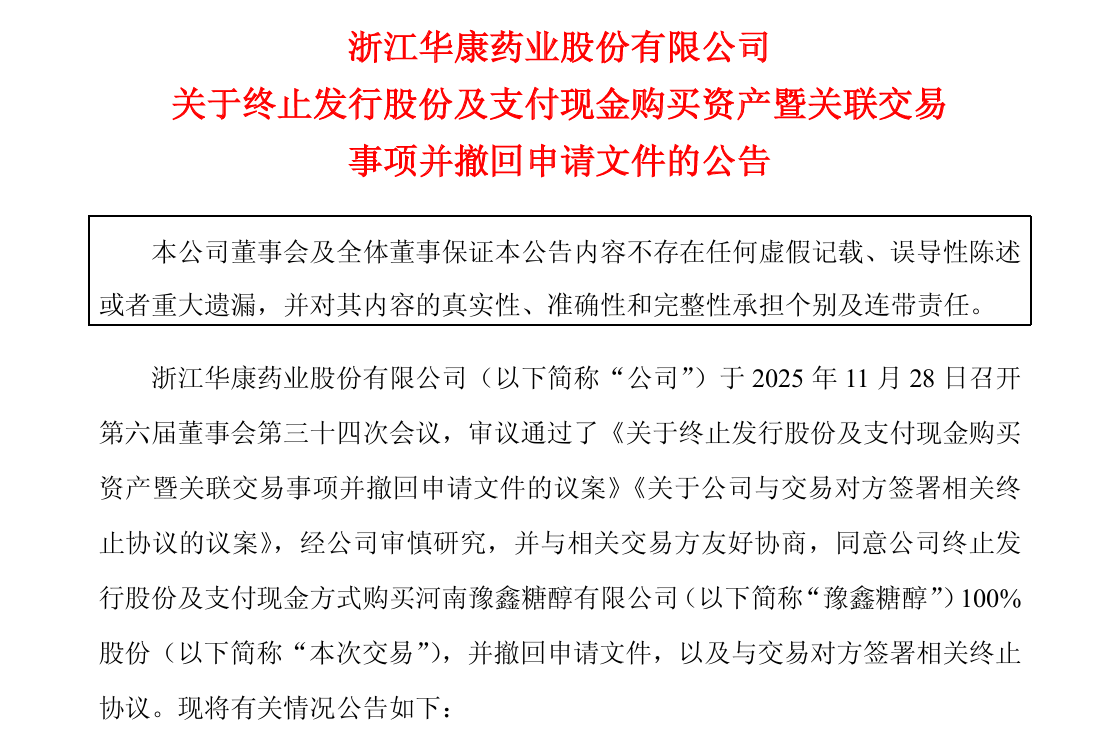
历时一年多,近11亿元收购案告吹
Shen Zhen Shang Bao· 2025-12-05 08:00
Core Viewpoint - Huakang Co., Ltd. has decided to terminate the planned acquisition of 100% equity in Yuxin Sugar Alcohol due to significant changes in the market environment since the initial planning phase, despite the transaction being in progress for over a year [2][4]. Group 1: Transaction Details - The company intended to acquire Yuxin Sugar Alcohol for a total price of 1.098 billion yuan through a combination of issuing shares and cash payments [2]. - The assessment value of Yuxin Sugar Alcohol's 100% equity as of December 31, 2024, was 1.101 billion yuan, reflecting an increase of 556 million yuan and an appreciation rate of 102.01% [2][3]. Group 2: Company Performance - Huakang Co., Ltd. has faced a situation of increasing revenue without corresponding profit growth, with a revenue increase of 0.93% to 2.808 billion yuan in 2024, while net profit decreased by 27.72% to 268 million yuan [4]. - In the first three quarters of 2025, the company reported a revenue of 2.959 billion yuan, a year-on-year increase of 40.52%, but net profit declined by 9.91% to 168 million yuan [4]. Group 3: Industry Context - The company and Yuxin Sugar Alcohol are recognized as leading firms in the production and technology of xylitol, with the acquisition aimed at enhancing market competitiveness and operational efficiency [4]. - The industry is currently facing challenges, including a major customer of Yuxin Sugar Alcohol experiencing a debt crisis, which may impact the market dynamics [4].

专访天工所张以恒 | 近100%转化率破秸秆制粮天花板,体外生物转化如何重构 “中国饭碗”?
合成生物学与绿色生物制造· 2025-11-23 01:58
Core Viewpoint - The research led by Zhang Yiheng's team at the Tianjin Institute of Industrial Biotechnology has achieved a breakthrough in converting cellulose into starch with a conversion rate of 93.3%, significantly improving the previous theoretical limit of 50% and addressing food security issues in China [4][11][12]. Group 1: Food Security Challenges - China faces a food security dilemma with 1.58 billion tons of imported grain in 2024, including 26.4 million tons of starch-based grains and approximately 100 million tons of soybeans, while 600 million tons of straw are wasted annually [9][10]. - The annual production of terrestrial plants generates about 2 billion tons of lignocellulose, which is 26 times the current grain production, indicating a potential to create a new agricultural scale by utilizing just 4% of this resource [10]. Group 2: Technological Breakthroughs - The new "multi-enzyme molecular machine" technology allows for the conversion of cellulose to starch with a theoretical yield of nearly 100%, overcoming the limitations of traditional microbial metabolism [4][11]. - The innovative design includes a "recycling system" for glucose, which was previously wasted, and employs a seven-enzyme system to achieve the conversion [11][12]. Group 3: Industrial Applications - The first application target is in the chiral drug separation market, where the newly synthesized starch can meet high precision separation needs, previously dominated by Japanese companies [14][19]. - The team has established a collaboration with Suzhou Nano Micro Technology to utilize their expertise in surface modification, enhancing the performance of the new starch for drug separation [14][19]. Group 4: Commercialization Strategy - Zhang Yiheng emphasizes the importance of aligning technology with market needs, introducing the concept of "PC value" (Product Cost ratio) to guide the commercialization of biomanufactured products [15][18]. - The strategy includes a three-step approach to maximize the value of lignocellulosic resources, starting with the extraction of hemicellulose for high-value products before processing cellulose into starch [17][18]. Group 5: Future Directions - The team aims to reduce enzyme costs and scale up the production process while exploring applications in plant-based capsules and biodegradable materials [18][19]. - Zhang Yiheng's vision includes transforming agricultural waste into valuable food sources, contributing to China's food security and economic growth [18][22].


创新项目涌现 CCUS技术迎来产业化浪潮
Zhong Guo Zheng Quan Bao· 2025-11-16 20:13
Core Viewpoint - The CCUS (Carbon Capture, Utilization, and Storage) technology is crucial for addressing climate change and reducing CO2 emissions, but its industrialization faces significant challenges, particularly funding issues [1][5]. Group 1: CCUS Technology and Applications - CCUS technology is essential for high-emission industries like steel and cement, where traditional methods cannot eliminate CO2 emissions effectively [3]. - Tencent's "Carbon Seeking Program" aims to foster low-carbon technology innovation, with the second phase receiving 660 applications from 54 countries, indicating growing interest in CCUS projects [2]. - Innovative projects include the use of local materials for carbon capture, conversion of captured CO2 into methane for steel production, and the development of sustainable industrial carbon materials [1][2]. Group 2: Challenges in Industrialization - Funding remains the most significant bottleneck for CCUS projects, as many laboratory technologies struggle to secure financial backing for industrial validation [1][5]. - Uncertainties in policy and carbon credit recognition hinder the development of CCUS, making it difficult for companies to realize the economic benefits of their low-carbon products [5][6]. Group 3: Recommendations for Industry Growth - The industry suggests establishing clearer carbon credit certification standards and aligning methodologies with international frameworks to enhance the credibility of CCUS projects [6]. - There is a call for increased public and private funding in energy-saving and carbon-reduction initiatives, along with incentives for low-carbon products to stimulate market demand [6].
圣泉集团(605589):AI放量先进电子材料高速发展,产能扩张电池材料成长可期
Shanxi Securities· 2025-11-03 09:51
Investment Rating - The report maintains an "Accumulate-A" rating for the company [2][8]. Core Views - The company is expected to benefit from the rapid growth in advanced electronic materials and battery materials, driven by increasing demand from AI servers and the rising penetration of new energy battery materials [5]. - The company has shown robust growth in synthetic resin sales and continues to expand its product categories, effectively responding to market changes [4]. - The company is enhancing its production capacity, with several projects underway that are expected to contribute significantly to future revenue and profit growth [5][6]. Financial Performance - For the first three quarters of 2025, the company achieved revenue of 8.072 billion yuan, a year-on-year increase of 12.87%, and a net profit attributable to shareholders of 760 million yuan, up 30.81% year-on-year [3]. - In Q3 2025, the company reported revenue of 2.722 billion yuan, a 7.75% increase year-on-year, but a 5.89% decrease quarter-on-quarter [3]. Product and Market Development - The company’s synthetic resin sales reached 588,700 tons in the first three quarters of 2025, representing a 13.90% year-on-year increase, with sales revenue of 4.096 billion yuan, up 4.64% year-on-year [4]. - The company is focusing on high-end product development and expanding its product applications in various sectors, including phenolic resin and casting materials [4]. Capacity Expansion and Future Outlook - The company is expanding its production capacity for advanced electronic materials and battery materials, with several projects expected to be completed by Q3 2026 [5]. - The company plans to raise up to 2.5 billion yuan through convertible bonds, with 2 billion yuan allocated for the industrialization of green new energy battery materials, projected to generate significant annual revenue and profit [5]. Financial Projections - The company is projected to achieve revenues of 11.786 billion yuan, 13.049 billion yuan, and 14.216 billion yuan for the years 2025, 2026, and 2027, respectively, with corresponding net profits of 1.181 billion yuan, 1.449 billion yuan, and 1.681 billion yuan [8][10].

圣泉集团(605589)季报点评:电子材料持续放量助力公司成长
Xin Lang Cai Jing· 2025-10-30 08:37
Core Viewpoint - The company reported a slight decline in Q3 net profit due to falling prices of synthetic resin products, but overall performance in the first three quarters shows growth in revenue and profit, indicating potential for recovery in the future [1][4]. Financial Performance - Q3 revenue reached 2.722 billion yuan, a year-on-year increase of 7.75% but a quarter-on-quarter decrease of 5.89% [1]. - Q3 net profit was 259 million yuan, up 3.73% year-on-year but down 12.10% quarter-on-quarter [1]. - For the first three quarters of 2025, revenue totaled 8.072 billion yuan, a year-on-year increase of 12.87%, with net profit at 760 million yuan, up 30.81% year-on-year [1]. Segment Performance - Advanced electronic materials and battery materials saw significant demand growth, with sales volume reaching 60,000 tons, a 19% year-on-year increase, and sales revenue of 1.2 billion yuan, up 32% [2]. - The synthetic resin sector maintained resilience, achieving sales volume of 590,000 tons, a 14% year-on-year increase, and sales revenue of 4.1 billion yuan, up 5% [2]. - Biomass products recorded sales volume of 170,000 tons, a 30% year-on-year increase, with sales revenue of 700 million yuan, up 25% [2]. Project Development - The company is advancing several key projects, including a 2,000 tons/year PPO/OPE resin project and a 1,000 tons/year carbon hydrogen resin project, expected to be operational by Q3 2026 [3]. - The biomass production base is running steadily, with expansion projects for xylitol expected to be operational by the end of 2025 and the second half of 2026 [3]. - The company plans to issue convertible bonds to invest in green energy battery material projects, which will enhance production capacity significantly [3]. Profit Forecast and Valuation - Due to short-term demand weakness, the net profit forecast for 2025 has been revised down to 1.09 billion yuan, a 9% decrease from the previous estimate [4]. - The company expects net profits for 2025, 2026, and 2027 to be 1.09 billion, 1.39 billion, and 1.61 billion yuan respectively, with corresponding EPS of 1.28, 1.64, and 1.90 yuan [4]. - A target price of 39.36 yuan has been set based on a 24x PE valuation for 2026, maintaining an "overweight" rating [4].
以部分农林剩余物为原料生产纤维板等资源综合利用产品实行增值税即征即退90%
蓝色柳林财税室· 2025-10-15 07:55
Core Viewpoint - The article discusses tax incentives aimed at promoting the development of rural specialty industries and the circular economy in agriculture, specifically through a VAT refund policy for certain resource utilization products made from agricultural by-products [2][7]. Summary by Sections Tax Incentives for Resource Utilization - A VAT refund of 90% is applicable for products made from specific agricultural by-products such as straw, corn cobs, and other residual materials [2]. - Eligible products include fiberboard, particleboard, biochar, activated carbon, and various sugars and alcohols derived from these materials [2]. Conditions for Enjoying Tax Benefits - Taxpayers must obtain VAT invoices from sellers when purchasing recycled resources domestically, or appropriate customs documentation when importing [3][4]. - A detailed record of recycled resource purchases must be maintained, including supplier information and transaction details [5]. - The products sold must not fall under categories deemed as eliminated or restricted by relevant regulatory bodies [5]. Compliance and Restrictions - Taxpayers must not have received administrative penalties for environmental violations or tax law violations in the six months prior to applying for the VAT refund [6]. - The raw materials used must consist of at least 95% of the specified resources to qualify for the tax incentives [7].

向“一棵树”要七十二般变化,山东加速造纸产业点“木”成金、跨界融合
Da Zhong Ri Bao· 2025-09-22 03:21
Core Viewpoint - The Shandong province is transforming its traditional paper industry into a high-end paper and biomass refining industry, focusing on diversification and green transformation through technological innovation and market segmentation [1][4]. Group 1: Industry Transformation - The Shandong province produces 1/6 of China's paper and paperboard, with a goal to enhance the industry by developing biomass refining and diversifying product offerings [1]. - The "Guidelines" issued by provincial authorities aim to accelerate the transformation of the paper industry into a leading domestic and globally competitive sector [1]. Group 2: Technological Innovation - The guidelines emphasize the importance of technological innovation across the entire paper industry chain, including pulping, biomass refining, and paper production [2]. - Key technological advancements include low-energy pulping, high-concentration pulping, and dry paper-making techniques [2]. - The province plans to enhance smart factory construction and implement real-time data collection and quality control in the production process [2][3]. Group 3: Market Segmentation - By 2024, China's per capita paper consumption is projected to reach 96.8 kg, indicating significant growth potential compared to developed countries [4]. - The guidelines encourage the development of specialized paper products, such as low-grammage high-strength packaging paper and medical-grade paper [4]. - There is a focus on non-paper products, including water treatment membranes and drug delivery systems, to meet the demands of various industries [4]. Group 4: Green and Sustainable Practices - Shandong's large paper companies are investing in green technologies to reduce pollution and improve water usage efficiency [7]. - The guidelines promote the development of advanced technologies in water conservation, environmental protection, and resource recycling [7]. - The province will support research and development in biomass refining and eco-friendly materials through financial incentives and collaboration with academic institutions [8].