
港股通消费ETF易方达

Search documents
消费板块走弱,关注港股通消费ETF易方达(513070)、消费ETF易方达(159798)等产品投资机会
Sou Hu Cai Jing· 2026-02-26 11:04
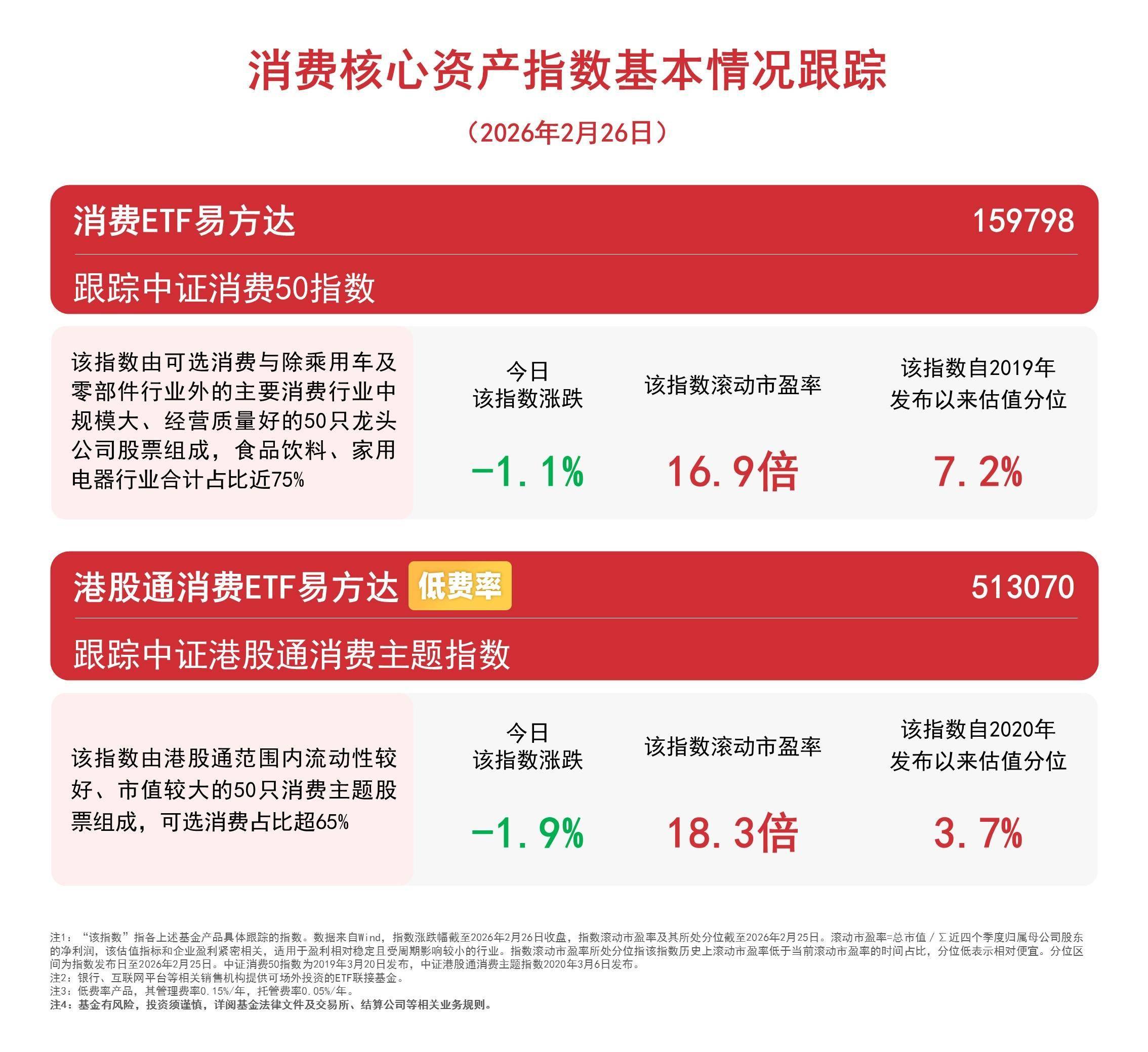
Group 1 - The core viewpoint of the articles indicates a decline in consumer indices, with the CSI Consumer 50 Index down by 1.1% and the CSI Hong Kong Stock Connect Consumer Theme Index down by 1.9% [1] - The E Fund Hong Kong Stock Connect Consumer ETF (513070) has attracted over 1.2 billion yuan in capital over the past 10 trading days, indicating strong investor interest [1] - According to CITIC Securities, the consumption performance during the Year of the Horse Spring Festival shows a mixed trend, aligning with expectations, where sectors like hotels, scenic spots, and high-end liquor exhibit better performance, while retail and box office results are generally average [1] Group 2 - The current macroeconomic environment remains weak, suggesting that the recovery of consumer sentiment may take time [1] - Short-term investment opportunities in consumption may arise from potential fiscal stimulus policies [1]

消费板块的春天到来了吗?
Sou Hu Cai Jing· 2026-02-13 07:57
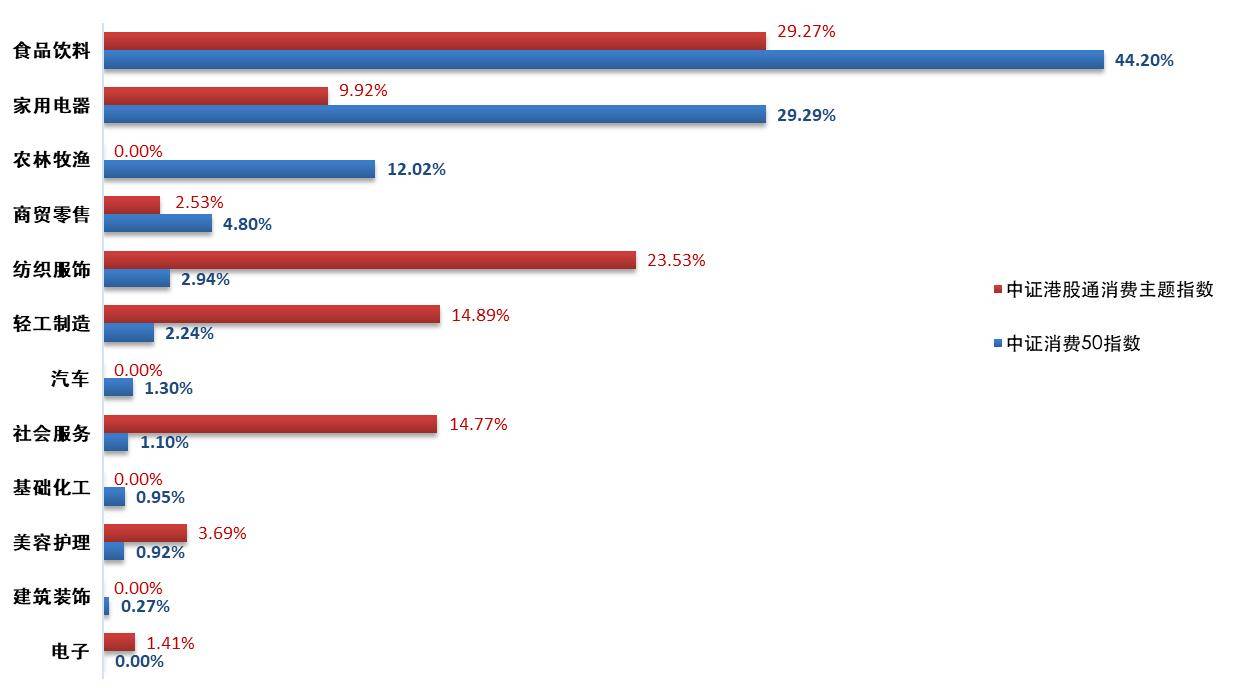
Core Insights - The consumer sector has seen a rise of over 3% in the Wind Consumer Major Index since the beginning of the year, indicating increasing market attention towards this sector. Consumer spending is fundamental to economic growth and serves as a lasting driver of the economy [1] Group 1: Characteristics of Consumer Indices - There are multiple consumer indices in the market, each focusing on different aspects such as traditional consumption (food and beverages) and emerging consumption. The CSI Consumer 50 Index and the CSI Hong Kong Stock Connect Consumer Theme Index are two representative indices, with a combined product scale exceeding 7 billion [2] - The CSI Consumer 50 Index selects large, high-quality listed companies from the A-share consumer sector, while the Hong Kong Stock Connect Consumer Index selects securities from the Hong Kong Stock Connect range. Both indices consist of 50 stocks, with individual stock weights not exceeding 15% [2] - The CSI Consumer 50 Index covers 11 consumer-related industries, with food and beverages and home appliances accounting for 75% of the index. In contrast, the Hong Kong Stock Connect Consumer Index covers 8 industries, with the same two sectors making up only 39.2% [2] Group 2: Composition of Indices - The top ten constituents of the CSI Consumer 50 Index include leading companies such as Kweichow Moutai, Wuliangye, and Midea Group. The top ten of the Hong Kong Stock Connect Consumer Index features companies like Pop Mart, Yum China, and Anta Sports, which complement A-share consumption leaders [4][5] - The CSI Consumer 50 Index has a cumulative weight of 74.81% for its top ten stocks, while the Hong Kong Stock Connect Consumer Index has a cumulative weight of 60.29% for its top ten stocks [5] Group 3: Valuation and Policy Support - As of February 11, the rolling P/E ratios for the CSI Consumer 50 Index and the Hong Kong Stock Connect Consumer Index are 17.0 and 18.6, respectively, both at historically low levels, with valuation percentiles of 7.91% and 3.87% over the past decade [6] - The low valuations are attributed to weak profit expectations for consumer sector companies amid insufficient domestic demand. The government has introduced various policies to stimulate consumption, including subsidies for replacing consumer goods and support for tourism and new energy vehicles [6] - The Central Economic Work Conference has included "deepening the implementation of special actions to boost consumption" as a key task for 2026, indicating ongoing policy support for consumption recovery [6] Group 4: Emerging Trends and Investment Opportunities - Positive structural changes in the consumer market include new consumption trends and overseas expansion, seen as a "second growth curve." Experience-based and emotional consumption led by younger generations is becoming popular, with companies like Pop Mart and Haier seeing over 40% of their revenue from overseas [7] - Index funds are highlighted as convenient and efficient investment tools for gaining exposure to the consumer sector. Given the current low valuations and policy support, investors are encouraged to consider opportunities in this sector, with products like the E Fund Hong Kong Stock Connect Consumer ETF and E Fund Consumer ETF available for tracking these indices [7]
港股震荡整理,恒生科技ETF易方达(513010)、港股通互联网ETF(513040)等产品受资金关注
Mei Ri Jing Ji Xin Wen· 2026-02-13 05:03
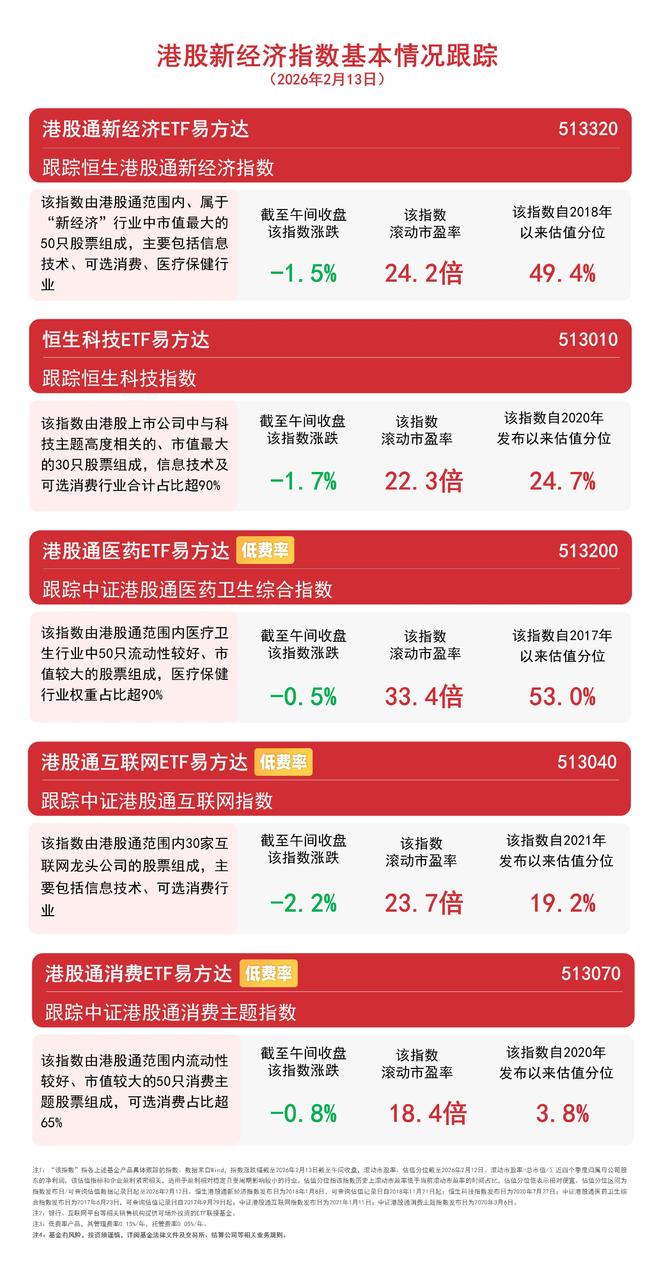
Group 1 - The core viewpoint of the article indicates a decline in various Hong Kong stock indices, with the Hang Seng Technology Index down by 1.7% and the Hang Seng Internet Index down by 2.2% as of midday closing [1] - The China Galaxy Securities report anticipates that macroeconomic policies will remain stable through 2026, with economic growth expected to maintain resilience and inflation likely to recover from low levels [1] - Earnings per share for the Hang Seng Index, Hang Seng Technology Index, and Hang Seng China Enterprises Index are projected to grow by 9.64%, 34.63%, and 9.90% year-on-year respectively by 2026, suggesting investment opportunities in technology innovation, cyclical sectors, and consumption themes [1] Group 2 - The Hong Kong Stock Connect Consumption ETF by E Fund has a low fee rate and tracks the China Securities Hong Kong Stock Connect Consumption Theme Index, which consists of 50 major consumer stocks with a significant portion in discretionary consumption [4] - The Consumption Theme Index has seen a decline of 0.8% as of midday closing, with a rolling price-to-earnings ratio of 18.4 times [4] - The index's performance since its inception shows a valuation percentile of 3.8%, indicating a relatively favorable valuation compared to historical data [4]
节前资金“加仓过年”,创业板、卫星产业ETF成“香饽饽”
Zhong Guo Jing Ji Wang· 2026-02-12 08:45
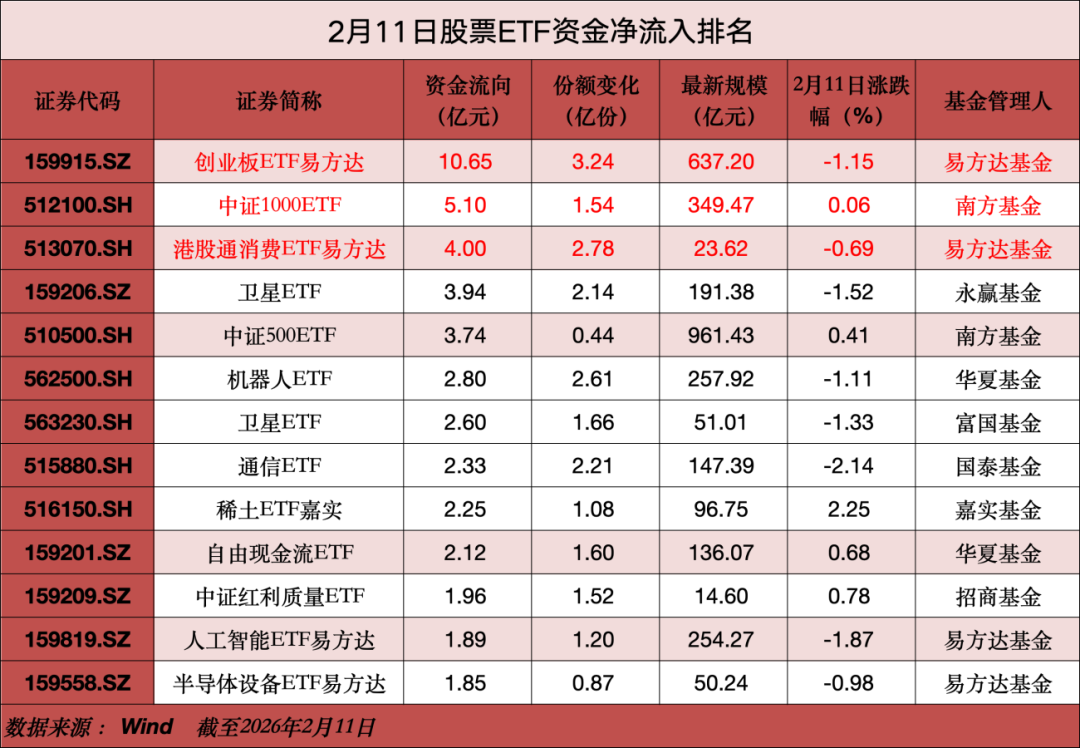
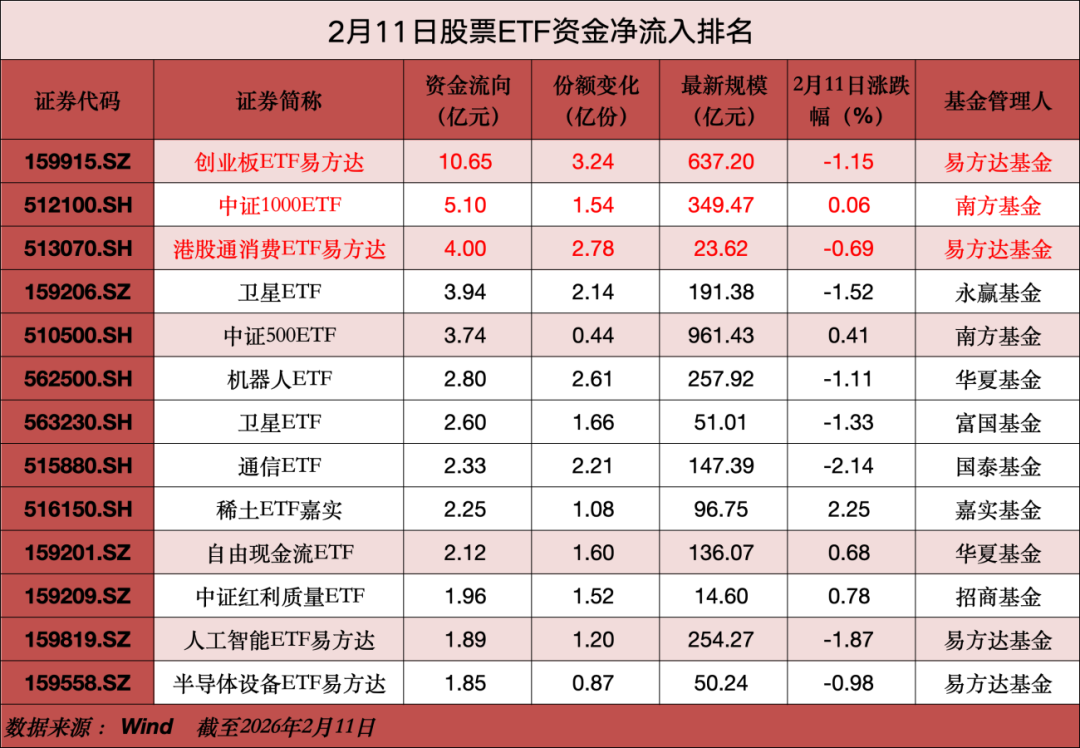
Group 1 - The A-share market showed mixed performance on February 11, with the three major indices fluctuating, and a slight net outflow of 236 million yuan from stock ETFs [1][2] - The ChiNext index saw significant net inflow of 1.14 billion yuan, while the CSI A500 index experienced net outflow [1][2] - The satellite industry and robotics sectors attracted notable capital inflows, while the new energy and dividend sectors faced outflows [1][2] Group 2 - As of February 11, the total scale of stock ETFs in the market reached 4.19 trillion yuan, with an overall net outflow of 236 million yuan for the day [2] - The ChiNext ETF led the inflows with a net inflow of 1.14 billion yuan, primarily driven by E Fund's ChiNext ETF, which saw inflows of 1.065 billion yuan [2][4] - The satellite industry also showed strong inflows, with a net inflow of 890 million yuan, including 394 million yuan into E Fund's satellite ETF [2][4] Group 3 - Over the past five days, the Hang Seng Technology Index ETF received over 6 billion yuan in inflows, while the SGE Gold 9999 Index ETF saw inflows exceeding 4.2 billion yuan [3] - The wide-based ETFs experienced a net outflow of 755 million yuan, with the CSI A500 ETF leading the outflows at 1.605 billion yuan [6][8] - The new energy sector had the highest outflow among thematic sectors, with a net outflow of 820 million yuan [7] Group 4 - The latest scale of E Fund's ETFs reached 661.02 billion yuan, with a total net inflow of 1.53 billion yuan on the previous trading day [4][5] - The robotics ETF and free cash flow ETF from Huaxia Fund saw significant inflows of 280 million yuan and 212 million yuan, respectively [5] - The market outlook suggests a focus on core growth assets, with stable earnings expectations and a potential return of foreign capital, indicating strong allocation properties in a volatile environment [9]

热门赛道,获加仓
Zhong Guo Ji Jin Bao· 2026-02-12 05:49
Core Viewpoint - The A-share market is experiencing mixed performance with significant inflows into the ChiNext and satellite industry ETFs, indicating a shift in investor sentiment towards these sectors as the market prepares for the upcoming holiday season [1][2]. ETF Fund Flows - As of February 11, the total scale of 1,339 stock ETFs in the market reached 4.19 trillion yuan, with an overall net outflow of 236 million yuan on that day [2]. - The ChiNext index ETF saw the most significant net inflow of 1.14 billion yuan, while the CSI A500 index ETF experienced a notable net outflow [3]. - The satellite industry also attracted substantial investment, with a net inflow of 890 million yuan on February 11 [3]. Notable ETF Performances - The top-performing ETFs included: - E Fund ChiNext ETF with a net inflow of 1.065 billion yuan [4]. - Southern CSI 1000 ETF with a net inflow of 510 million yuan [5]. - Yongying Satellite ETF with a net inflow of 394 million yuan [4]. - In the past five days, the Hang Seng Technology Index ETF saw inflows exceeding 6 billion yuan, and the SGE Gold 9999 Index ETF attracted over 4.2 billion yuan [3]. Outflows in Broader Market - The broad-based ETFs experienced a net outflow of 755 million yuan, with the CSI A500 ETF leading the outflows at 1.605 billion yuan [6][7]. - The new energy sector also faced significant outflows, totaling 820 million yuan [8]. Market Outlook - The market is expected to focus on macroeconomic data and industry trends post-holiday, with a potential shift towards structural changes in trading logic [9]. - Analysts suggest that the core growth assets are currently at historical median valuations, providing a potential for valuation recovery, while the technology sector remains strong amid ongoing innovations [10].
消费板块早盘震荡回调,港股通消费ETF易方达(513070)连续获资金布局
Mei Ri Jing Ji Xin Wen· 2026-02-12 05:12
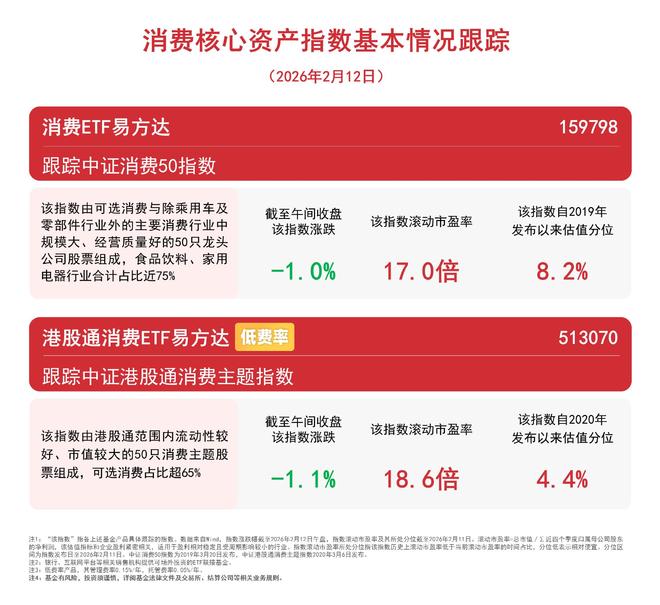
Core Viewpoint - The consumer sector is experiencing a decline, with the CSI Consumer 50 Index down by 1.0% and the CSI Hong Kong Stock Connect Consumer Theme Index down by 1.1% as of midday close [1]. Group 1: Market Performance - The CSI Consumer 50 Index, which tracks 50 leading companies in the consumer sector, has seen a decrease of 1.0% [2]. - The CSI Hong Kong Stock Connect Consumer Theme Index has also declined by 1.1% [1]. - The rolling price-to-earnings (P/E) ratio for the CSI Consumer 50 Index is currently at 17.0 times, with a valuation percentile of 8.2% since its inception in 2019 [2]. Group 2: Fund Flows - The E Fund Consumer ETF (513070) has recorded net inflows for six consecutive trading days, totaling over 1.1 billion yuan [1]. - The E Fund Consumer ETF tracks the CSI Hong Kong Stock Connect Consumer Theme Index, which consists of 50 liquid and large-cap consumer stocks, with over 65% in discretionary consumption [2]. - The rolling P/E ratio for the CSI Hong Kong Stock Connect Consumer Theme Index stands at 18.6 times, with a valuation percentile of 4.4% since its launch in 2020 [2].
超百亿,“跑了”!
Zhong Guo Ji Jin Bao· 2026-02-11 06:17
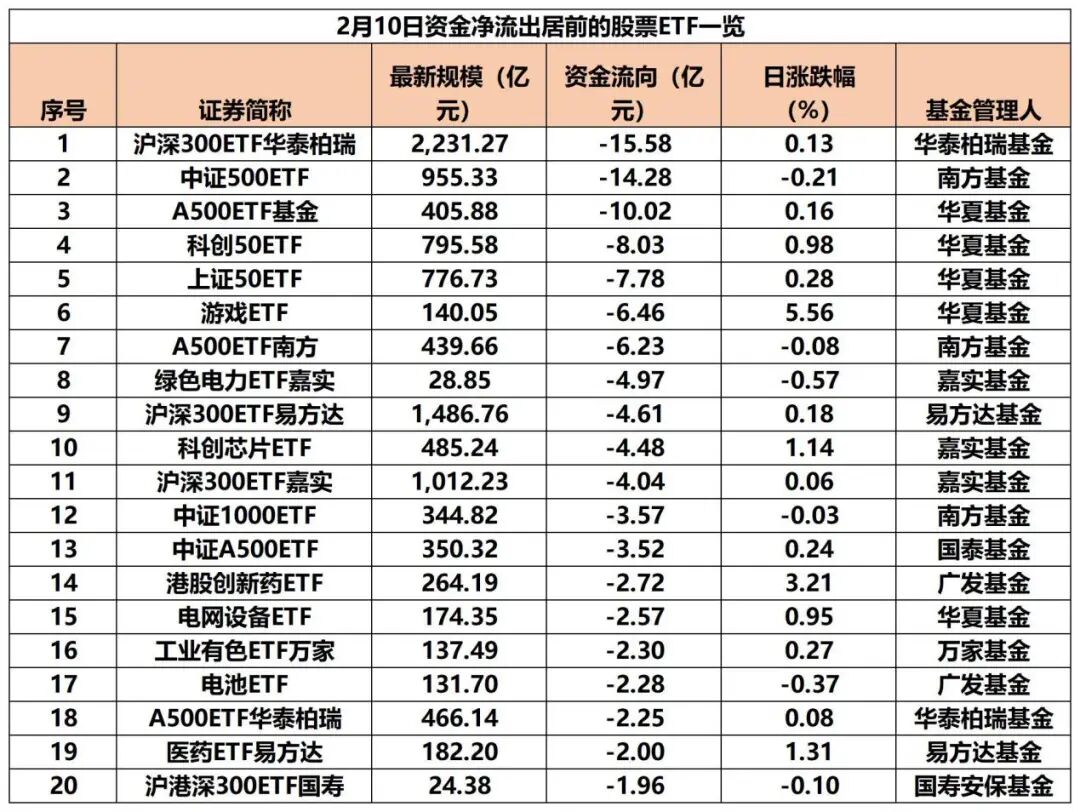
Core Viewpoint - The stock ETF market experienced a net outflow of over 10.26 billion yuan on February 10, with significant movements in various thematic ETFs and broad-based ETFs [2][4][5]. Group 1: Market Overview - On February 10, the three major A-share indices showed mixed results, with the Shanghai Composite Index rising by 0.13%, the Shenzhen Component Index increasing by 0.02%, and the ChiNext Index declining by 0.37% [2]. - The overall market saw a net outflow of 10.26 billion yuan in stock ETFs, including cross-border ETFs [2]. Group 2: ETF Performance - The net inflow for the China Film Index-related ETFs was the highest, reaching 1.339 billion yuan, while the net outflow for the CSI 300 Index-related ETFs was the largest at 2.904 billion yuan [2]. - Over the past five days, the Hang Seng Technology Index-related ETFs saw inflows exceeding 8.5 billion yuan, and the SGE Gold 9999 Index-related ETFs attracted over 6.2 billion yuan [2]. Group 3: Fund Company Insights - E Fund's ETF had a latest scale of 661.58 billion yuan, with an increase of 1.05 billion yuan. The China Internet ETF from E Fund had a scale of 41.921 billion yuan, with a net inflow of 158 million yuan [2]. - Huaxia Fund's Robot ETF and Sci-Tech Semiconductor ETF had significant net inflows of 527 million yuan and 117 million yuan, respectively, with latest scales of 25.818 billion yuan and 8.196 billion yuan [3]. Group 4: Thematic ETF Trends - Popular thematic ETFs such as the Film ETF, Robot ETF, and Satellite ETF saw the highest net inflows, while broad-based ETFs like the CSI 300 ETF and CSI 500 ETF were the biggest losers in terms of net outflows [4][5]. - The Media ETF from GF Fund received the most net inflow, amounting to 460 million yuan, and has seen a year-to-date increase of over 26%, making it one of the top performers in the market [3]. Group 5: Future Market Outlook - The investment focus may shift from January's credit and liquidity performance to macroeconomic and industrial cues as the market enters a relatively quiet period for macro data [6]. - The core assets in the market are currently at historical median valuation levels, suggesting potential for valuation recovery, supported by stable profit expectations and a warming trend in foreign capital inflows [6].
港股通消费指数冲击五连阳,港股通消费ETF易方达(513070)上周净流入超4亿元
Mei Ri Jing Ji Xin Wen· 2026-02-09 05:15
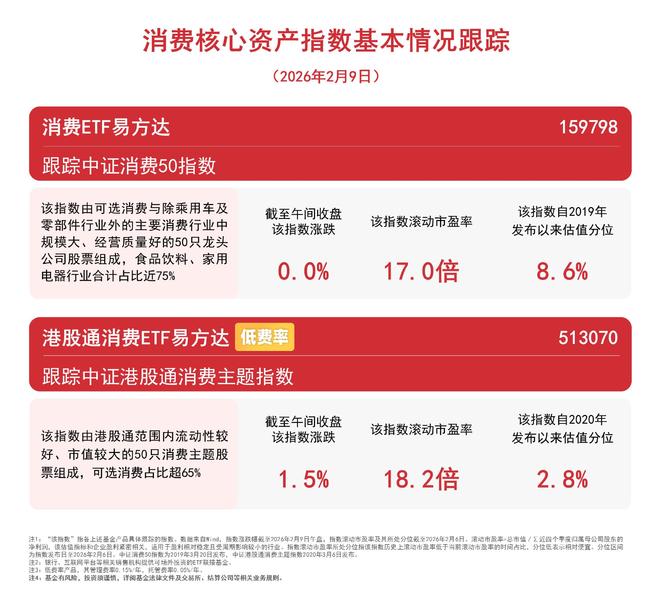
Core Viewpoint - The consumer sector in the Hong Kong stock market is showing positive momentum, with significant inflows into consumer ETFs, indicating investor confidence in this segment [1][2]. Group 1: Market Performance - The CSI Hong Kong Stock Connect Consumer Theme Index rose by 1.5%, marking a five-day winning streak [1]. - The CSI Consumer 50 Index experienced a slight increase of 0.04% [1]. Group 2: ETF Inflows - The E Fund Consumer ETF (513070) saw a net inflow of over 400 million yuan last week [1]. - This ETF tracks the CSI Consumer 50 Index, which consists of 50 leading companies in the consumer sector, primarily in food and beverage and home appliance industries, accounting for nearly 75% of the index [2]. Group 3: Index Valuation - The rolling price-to-earnings (P/E) ratio for the CSI Consumer 50 Index is currently at 17.0 times, with a valuation percentile of 8.6% since its inception in 2019 [2]. - The rolling P/E ratio for the CSI Hong Kong Stock Connect Consumer Theme Index stands at 18.2 times, with a valuation percentile of 2.8% since its inception in 2020 [2].
加仓!资金大幅涌入这些方向
Zhong Guo Zheng Quan Bao· 2026-02-08 23:07
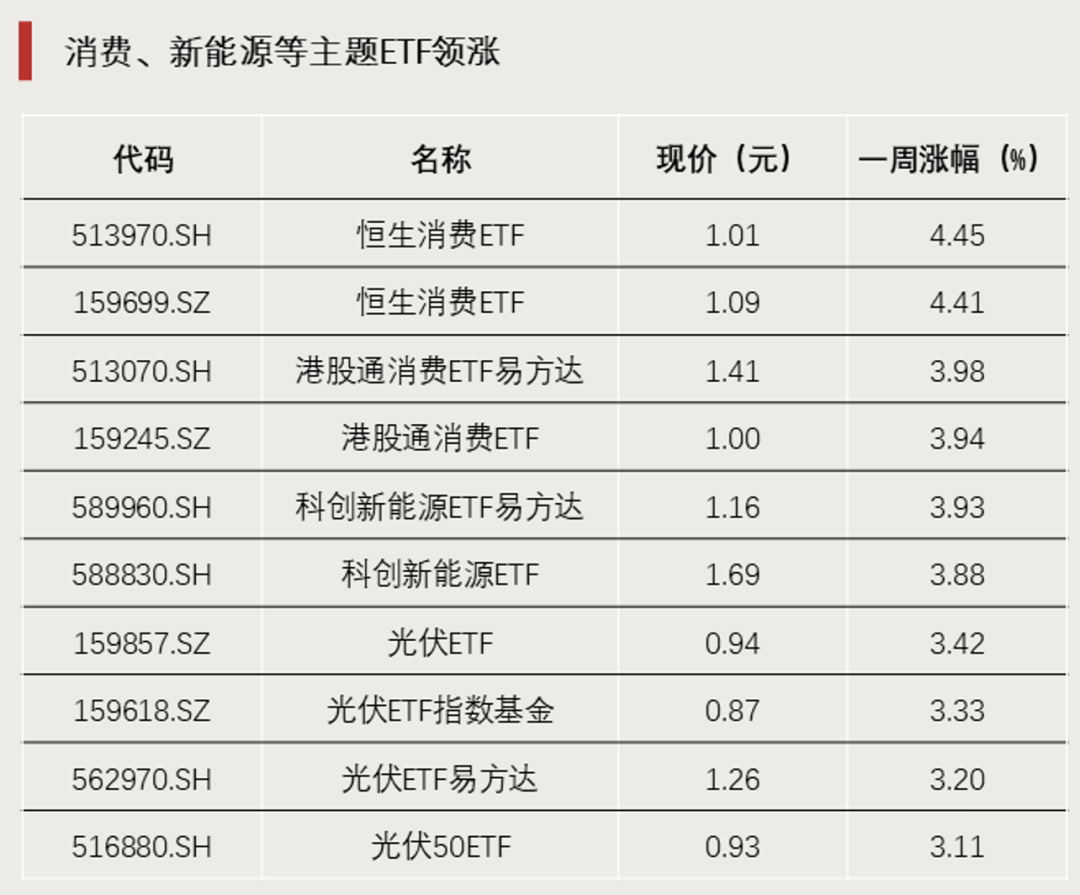
Group 1: Market Performance - The consumption and photovoltaic sectors saw significant gains last week, with several related ETFs, such as the E Fund Consumption ETF (513070) and E Fund New Energy ETF (589960), recording over 3% weekly increases [1][4] - Conversely, gold and artificial intelligence sectors experienced notable adjustments, with multiple related ETFs declining over 9% [1][6] Group 2: Trading Activity - The A-share market saw active trading in broad-based products, with the A500 ETF (159361) and others tracking the CSI A500 index achieving a total trading volume exceeding 254.8 billion yuan [2][8] - The Hang Seng Technology sector attracted significant capital inflow, with ETFs like the E Fund Hang Seng Technology ETF (513010) seeing substantial net inflows [3][10] Group 3: Sector Highlights - The Hang Seng Consumption ETF (513070) tracked the CSI Hong Kong Consumption Index, which rose over 4%, while the E Fund New Energy ETF (589960) and E Fund Photovoltaic ETF (562970) tracked indices that increased over 3% [4][5] - The gold sector showed weakness, with all 14 commodity gold ETFs declining over 5%, and some gold stock ETFs dropping more than 13% [6][7] Group 4: Future Outlook - Industry experts express optimism for the Hong Kong consumption sector in 2026, focusing on high-dividend consumer stocks, resilient domestic demand sectors like education, and timing strategies for new consumption sectors [5] - The market is expected to shift focus towards macroeconomic and industrial cues post-holiday, with a clearer framework for high-quality development and new-old kinetic energy conversion [12]
资金加仓恒生科技等赛道 宽基核心资产受关注
Zhong Guo Zheng Quan Bao· 2026-02-08 21:55
Group 1 - The consumer and photovoltaic sectors saw significant gains last week, with several related ETFs rising over 3% [1][2] - The A-share market's broad-based products experienced active trading, with ETFs tracking the CSI A500 index exceeding a total transaction volume of 250 billion yuan [1][2] - The market outlook for February suggests a continuation of the upward trend, driven by concentrated earnings forecasts and the recovery of leading companies' performance [1][4] Group 2 - The Hong Kong consumer sector performed strongly, with ETFs such as the Hang Seng Consumer ETF leading the gains [2] - Gold-related ETFs faced a downturn, with an average decline of over 5% across 14 commodity gold ETFs, and some gold stock ETFs dropping more than 13% [2] - The technology sector attracted significant capital inflow, with the Huatai-PineBridge Hang Seng Technology ETF seeing a net inflow of over 3.8 billion yuan last week [3] Group 3 - Several asset management institutions have released macro outlooks for China's equity market in 2026, highlighting diverse growth paths driven by the 14th Five-Year Plan [4][5] - Key investment areas identified include technology, manufacturing, renewable energy, healthcare, and emerging consumer sectors [4][5] - The market is expected to maintain a structural trend in February, with a focus on core growth assets that are currently at historical median valuation levels [5]