
澳元兑美元汇率

Search documents
Vatee外汇:美国PPI数据高于预期,澳元汇率维持在0.71附近
Sou Hu Cai Jing· 2026-02-28 03:32
Group 1 - The Australian dollar (AUD) is expected to rise for the eighth consecutive week, trading around 0.7112 against the US dollar (USD) [2] - The US Producer Price Index (PPI) data exceeded expectations, with a monthly increase of 0.5% compared to the forecast of 0.3%, and a year-on-year growth of 2.9% against the expected 2.6% [2] - Core PPI, excluding food and energy, rose by 0.8% month-on-month, significantly above the expected 0.3%, indicating persistent inflationary pressures in the US [2] Group 2 - The strength of the Australian dollar is supported by a weak US dollar and hawkish expectations from the Reserve Bank of Australia (RBA) [3] - The RBA is expected to pause interest rate hikes in March to assess the impact of the February increase, but major banks predict a 25 basis point hike in May, raising the cash rate to 4.10% [3] - Upcoming inflation data from Australia and the US manufacturing PMI will be crucial in influencing the AUD/USD exchange rate [3]


2026加息第一枪?澳洲央行下周二或逆势行动,澳元多头全线爆发
智通财经网· 2026-01-30 06:24
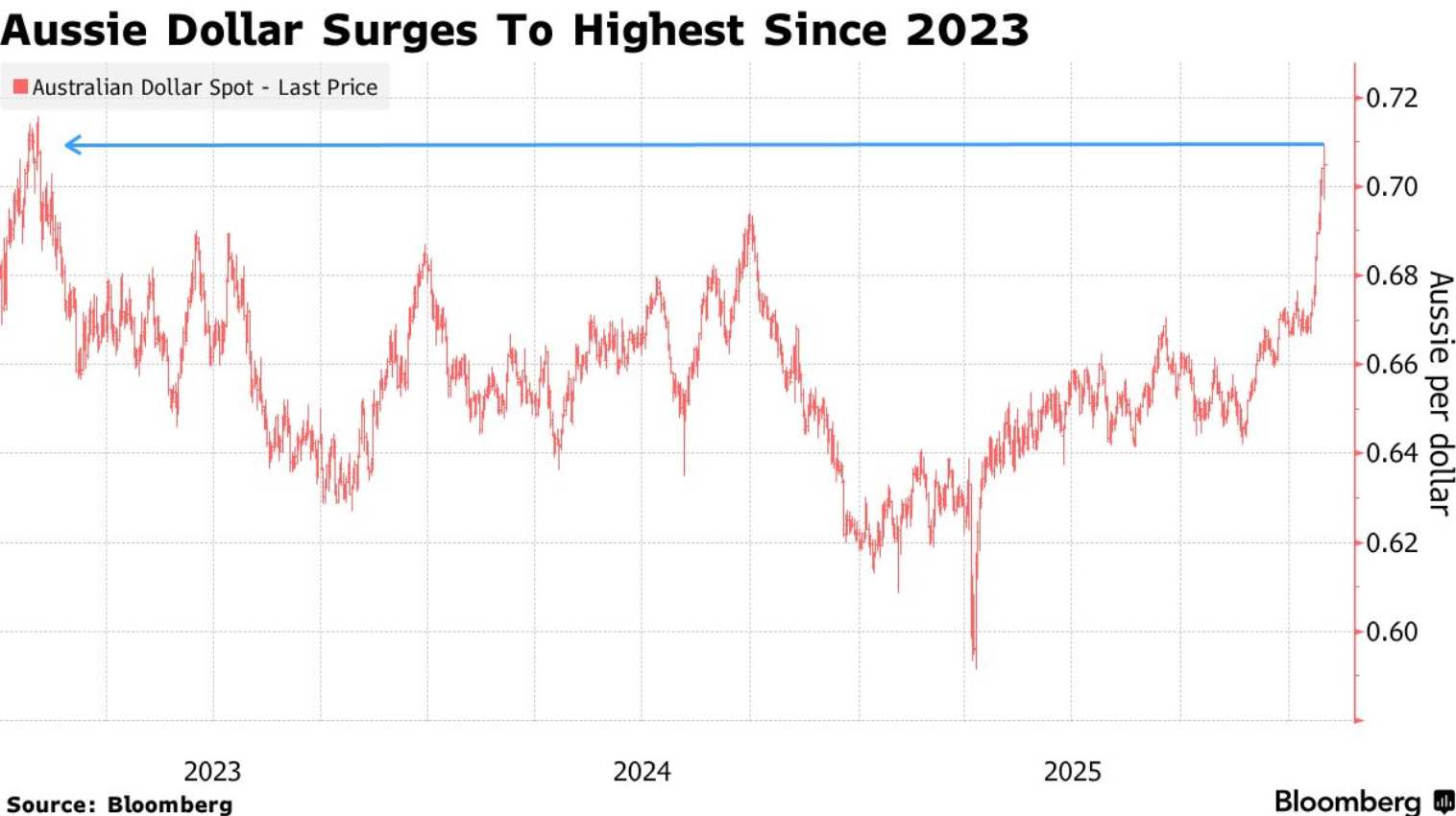
Group 1 - The market is anticipating an interest rate hike by the Reserve Bank of Australia (RBA) next Tuesday, leading forex traders to significantly increase bullish positions on the Australian dollar (AUD) [1] - Recent data shows that the volume of AUD call options has reached three times that of put options, indicating a strong bullish sentiment [1] - The risk reversal indicator has shown a key change, with traders paying a premium for AUD bullish bets that is significantly higher than for bearish bets, marking the first occurrence of this since 2018 [1] Group 2 - Strong employment and inflation data have increased the probability of an RBA rate hike, boosting demand for AUD against the US dollar [1] - The swap market is pricing in a 71% probability of a 25 basis point rate hike by the RBA on Tuesday [1] - The Australian dollar is nearing its highest point in 2023, supported by high inflation and rising commodity prices [4] Group 3 - The Australian dollar ranks among the top three currencies in the G10 this year, bolstered by various supportive factors [4] - The currency is projected to potentially reach 75 cents against the US dollar within six months, according to Westpac's forex strategy head [4] - As of the report, the AUD/USD exchange rate has decreased by 0.7% to 70 cents, following a nine-day consecutive rise [4]
IC Markets平台:澳元兑美元汇率近期为何维持高位波动?
Sou Hu Cai Jing· 2026-01-27 02:53
Group 1 - The Australian dollar (AUD) is fluctuating around 0.6920 against the US dollar (USD), having previously reached a 16-month high of 0.6940, supported by cautious market sentiment influenced by domestic economic data, central bank policy expectations, and uncertainties in US politics and monetary policy [1][3] - Recent strong performance in Australia's PMI and employment data has bolstered market expectations for the Reserve Bank of Australia (RBA) to maintain a tightening policy, with the three-year government bond yield rising to 4.27%, the highest since November 2023, reflecting investor interest in AUD assets [3] - The upcoming December CPI data is highly anticipated, as November inflation has decreased to 3.4%, still above the RBA's target range of 2-3%. An upward trend in inflation could reinforce market expectations for sustained high interest rates [3] Group 2 - The USD is currently under pressure due to domestic political factors, including the risk of a government shutdown, which could weaken investor confidence in the USD and provide rebound space for non-USD currencies like the AUD [3][4] - There are uncertainties regarding the Federal Reserve's policy direction, with speculation about a potential change in leadership raising questions about future monetary policy. Although such discussions have not materialized, they may still impact short-term sentiment towards the USD [3] - The AUD is in a high-level consolidation phase, supported by domestic economic fundamentals and interest rate outlook, but faces dual risks: lower-than-expected Australian inflation could weaken AUD rate hike expectations, while easing US political risks or hawkish Fed statements could strengthen the USD [4]
政策分化经济结构转型 澳元走势现新变局
Jin Tou Wang· 2025-12-23 02:26
Core Viewpoint - The Australian dollar (AUD) is experiencing a slight increase against the US dollar (USD), with the exchange rate rising from 0.6655 to 0.6659, reflecting a daily increase of 0.06% [1] Monetary Policy Divergence - The divergence in monetary policy among major global central banks is a key variable influencing the AUD/USD exchange rate, with the Reserve Bank of Australia (RBA) expected to shift towards rate hikes in 2026 despite currently maintaining a rate of 3.6% after three rate cuts in 2025 [1] - In contrast, the Federal Reserve has cut rates by 75 basis points this year and is one of the few central banks expected to continue cutting rates in 2026, creating uncertainty in the AUD/USD exchange rate [2] Economic Fundamentals - Australia's economic fundamentals are undergoing structural changes, supporting the AUD. The GDP growth rate for Q3 was 2.1%, the fastest since Q3 2023, with new private demand growing by 3.1% and strong business investment shifting from traditional mining to emerging sectors like data centers and civil aviation [2] - Economic stimulus measures from major trading partners, such as China, are bolstering demand for Australian commodities, further enhancing economic recovery momentum [2] Technical Analysis - Technical analysis indicates that the AUD/USD is accumulating upward momentum, with a potential breakthrough of the key resistance level at 0.6595, which could lead to a target of 0.6685 [3] - The current price has stabilized above the 0.66 mark, which serves as an important short-term support level, while the 0.67 level presents some resistance [3] Market Outlook - The AUD/USD exchange rate has shifted from a traditional "interest rate differential" model to a dual logic driven by "policy path divergence" and "economic structural transformation" [3] - In the short term, the exchange rate is likely to remain within the 0.66-0.67 range, but mid-term upward potential has increased due to improvements in Australia's economic fundamentals [3] - Key factors to monitor include the RBA's guidance on potential rate hikes and the pace of adjustments in Federal Reserve policy, along with Australian business investment data and changes in demand for Australian commodities [3]
STARTRADER星迈:澳联储会议纪要偏鹰,澳元兑美元汇率走高
Sou Hu Cai Jing· 2025-12-23 02:22
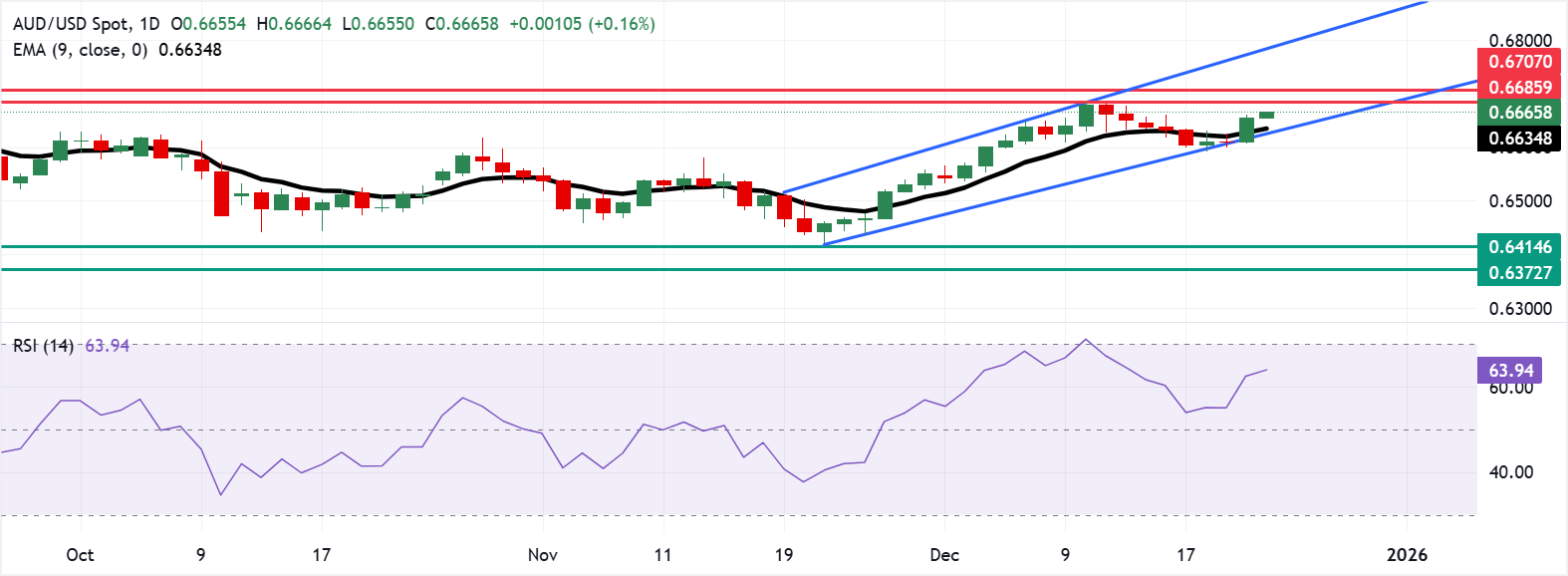
Group 1 - The Australian dollar (AUD) is experiencing an upward trend against the US dollar (USD), influenced by the Reserve Bank of Australia's (RBA) latest monetary policy meeting minutes [1] - The RBA's meeting minutes indicate a cautious stance regarding the current monetary policy's restrictiveness, with members expressing concerns about persistent inflation pressures [2] - Market expectations for the next RBA rate hike remain around 27% as of December 18, according to cash rate futures [3] Group 2 - The USD index has slightly declined, trading around 98.20, as investors await the upcoming US Q3 GDP data, which is projected to show a slowdown in annualized growth to 3.2% [4] - Recent data shows a slight decrease in the US consumer confidence index for December, while short-term inflation expectations have risen slightly [4] - The People's Bank of China has maintained its loan market quotation rate, while Australian data indicates a slight rebound in consumer inflation expectations for December, supporting the RBA's cautious position [4] Group 3 - The AUD/USD exchange rate is currently below 0.6660, with technical charts indicating an upward channel and a relative strength index reflecting bullish sentiment [6] - If the AUD continues to rise, it may test levels around 0.6685 and approach the 0.6707 region, while 0.6630 serves as short-term support [6]
TMGM外汇:澳洲联储表态谨慎,为何澳元反而走强?
Sou Hu Cai Jing· 2025-12-22 06:27
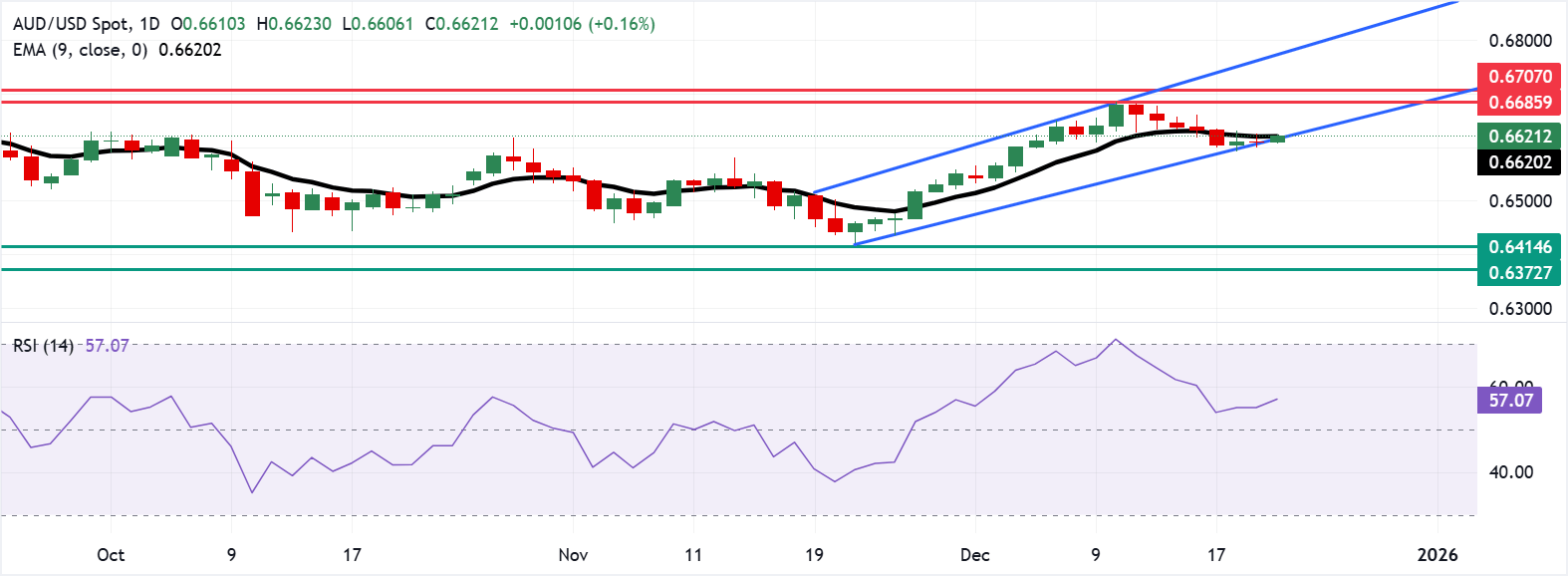
Core Viewpoint - The Australian dollar continues to strengthen against the US dollar, influenced by the Reserve Bank of Australia's (RBA) monetary policy and market expectations regarding interest rates and inflation [1][4]. Group 1: Monetary Policy and Interest Rates - The People's Bank of China has maintained the Loan Prime Rate (LPR) unchanged, with the one-year LPR at 3.00% and the five-year LPR at 3.50% [1]. - Traders are focusing on the upcoming RBA meeting minutes to gauge the central bank's policy direction and stance on inflation [2]. - As of December 18, the ASX 30-day interbank cash rate futures for February 2026 indicate a 27% probability of the RBA raising rates to 3.85% [3]. Group 2: US Economic Indicators - The US dollar has ended a three-day rally, with the dollar index (DXY) trading around 98.60, as market participants await the release of the US Q3 GDP annualized data [4]. - Cleveland Federal Reserve Bank President Loretta Mester stated that current monetary policy is appropriate for pausing rate hikes to assess the impact of previous rate cuts [4]. - The November Consumer Price Index (CPI) in the US showed a year-on-year increase of 2.7%, below the expected 3.1%, marking the lowest growth rate since 2021 [4]. Group 3: Leadership Changes in the Federal Reserve - The next Federal Reserve Chair is expected to be someone who supports significant rate cuts, with Christopher Waller being a potential candidate who has reiterated a dovish stance on interest rates [5]. Group 4: Australian Inflation Data - Australian consumer inflation expectations have risen from 4.5% in November to 4.7% in December, supporting a hawkish stance from the Reserve Bank of Australia [6]. Group 5: Australian Dollar Technical Analysis - The Australian dollar is currently trading around 0.6620, maintaining an overall upward trend, with key resistance levels at 0.6685 and 0.6707 [8]. - The 14-day RSI is at 57.05, indicating a neutral to bullish sentiment, while the 9-day EMA shows an upward trend but may exert short-term pressure on prices [8].
澳洲联储鹰派转向支撑澳元
Jin Tou Wang· 2025-12-22 02:40
Core Viewpoint - The Australian dollar (AUD) has shown a moderate upward trend against the US dollar (USD), with a current exchange rate of 0.6617, driven by differences in monetary policy, economic data divergence, and global risk sentiment [1] Monetary Policy - The interest rate differential expectations have become the core driver of the exchange rate. The Federal Reserve restarted its rate-cutting cycle in September 2025, implementing three cuts within three months, with the current policy rate at 3.5%-3.75%. Despite hawkish signals from Fed officials in December, market expectations indicate at least two additional rate cuts in 2026, with the terminal rate expected to fall to 3.00%-3.25% [2] - The Reserve Bank of Australia (RBA) has maintained a hawkish stance, pausing adjustments since lowering the cash rate to 3.60% in August 2025. The RBA's December statement emphasized the possibility of rate hikes to address inflation pressures, with the October CPI rising to 3.8% [2] Economic Data - Economic data divergence has intensified short-term exchange rate volatility. Australia's December manufacturing PMI rose to 52.2, indicating expansion, while the services PMI fell to 51.0, dragging the composite PMI to a seven-month low. Consumer confidence dropped significantly by 9% to 94.5, indicating a pessimistic outlook [3] - The US economy also showed mixed signals, with November non-farm payrolls slightly exceeding expectations but the unemployment rate rising to 4.6%, the highest since 2021. Retail sales stagnated, highlighting a slowdown in consumer spending [3] Technical Analysis - The AUD/USD remains in an upward channel, with a neutral short-term momentum. Key support is at 0.6620, with potential declines to 0.6414. Resistance levels are at 0.6685 and the previous high of 0.6707, with a breakthrough potentially targeting the 0.6740 range. Institutions have differing views, with some predicting a rise to 0.69 in the next three months due to ongoing policy differences [3] Market Outlook - Short-term focus should be on the upcoming Australian Q4 CPI data, Fed officials' speeches, and commodity price fluctuations. In the medium to long term, the leadership change at the Fed in May 2026, the effectiveness of Australia's inflation control, and economic recovery resilience will be key variables determining the exchange rate direction [4]
澳洲消费者信心跌回悲观区间,澳币AUDUSD正在为“高通胀”重新定价
Xin Lang Cai Jing· 2025-12-16 23:42
Economic Overview - Australia's December PMI preliminary value shows a divergence in the private sector economy, with the composite PMI expansion momentum slowing to a seven-month low [1] - Manufacturing PMI increased from 51.6 in November to 52.2, supported by growth in new orders and strong exports, while the services PMI fell from 52.8 to 51.0, dragging down overall economic expansion [1][34] - The composite PMI dropped from 52.6 to 51.1, remaining above the 50 mark for the 15th consecutive month but marking the lowest growth rate in seven months [1][34] Market Insights - New orders in the Australian private sector remain solid, providing a foundation for output growth, although the overall growth rate has slowed [2] - Employment data continues to show growth as companies hire more staff to meet existing workloads, with business confidence rising to its highest level since June [2] - However, there is a divergence in backlogs, with manufacturing backlogs increasing while service sector backlogs have decreased for eight consecutive months, leading to an overall reduction in backlog volume [2] Cost and Pricing Dynamics - Input cost inflation has intensified in both sectors, with commodity input costs rising at the fastest pace in eight months, leading companies to pass some costs onto consumers, pushing sales price inflation to a three-month high [2][35] - The Australian dollar has depreciated against the US dollar, falling below the 0.662 mark due to the composite PMI slowdown and declining consumer confidence [2][35] Consumer Confidence - Consumer confidence in Australia has declined in December, reversing the previous month's gains, with the index dropping 9% to 94.5 points, indicating a return to pessimism [3][36] - Households are increasingly worried about inflation and interest rate prospects, with expectations for personal financial situations and economic outlooks declining significantly [3][36] US Retail Sales and Economic Activity - US retail sales in October remained flat, indicating consumer spending is under pressure, particularly affecting lower-income households, while high-income households continue to show spending resilience [4][37] - The October core retail sales, excluding volatile categories, increased by 0.8%, suggesting consumer spending is still supporting economic growth [5][38] - In December, US business activity slowed to a six-month low, with the composite PMI dropping to 53.0, indicating a weakening economic momentum [6][39] Inventory Trends - US business inventories grew by 0.2% in September, slightly above expectations, indicating potential support for GDP growth, but also reflecting underlying demand pressures [8][41] - Retail inventories increased by 0.4%, with significant growth in motor vehicle inventories, while wholesale inventories rose by 0.5% [9][42]

澳元央行政策分化成核心推手
Jin Tou Wang· 2025-12-15 02:57
Group 1 - The Australian dollar (AUD) has been recovering against the US dollar (USD) since December 2025, with a reported exchange rate of 0.6647 as of December 15, reflecting a slight increase of 0.0007 from the previous trading day [1] - The core driver of the AUD's strength is the policy divergence between the Reserve Bank of Australia (RBA) and the Federal Reserve (Fed), with the RBA maintaining its benchmark interest rate and signaling a potential rate hike if inflation remains stubborn [1][2] - Following the RBA's hawkish stance on December 9, the AUD gained 0.3% to 0.6645, while the 3-year Australian government bond yield surged by 11 basis points to 4.152% [1] Group 2 - Australia's inflation rate reached 3.8% year-on-year in October, prompting the RBA to raise its medium-term inflation expectations and support its decision to rule out rate cuts [2] - The Australian economy is experiencing a dichotomy of high inflation and weak growth, with a projected budget deficit of AUD 14.39 billion over the next four years, while the labor market remains tight [2] - The technical analysis indicates that the AUD/USD has risen nearly 0.8% since the low on December 9, breaking through several short-term resistance levels, with 0.6650 becoming a key level to watch [2] Group 3 - The future trajectory of the AUD/USD exchange rate is highly dependent on the policy directions of both the RBA and the Fed, as well as global risk sentiment and commodity price fluctuations [3] - Investors should closely monitor the Fed's future rate cut pace, RBA communications, and changes in inflation and labor data to gauge the sustainability of the RBA's hawkish stance [3]
澳元汇率反弹的核心驱动力
Jin Tou Wang· 2025-12-02 03:00
Group 1 - The Australian dollar (AUD) against the US dollar (USD) is experiencing narrow fluctuations, currently at 0.6544, reflecting a cautious trading sentiment ahead of the monetary policy decisions from the Reserve Bank of Australia (RBA) and the Federal Reserve [1] - The Australian economy shows a divergence with high inflation but constrained growth, where weak trade data significantly limits the AUD's appreciation potential [1] - Australia's merchandise trade surplus for August 2025 was only AUD 1.825 billion, a substantial decrease of AUD 4.787 billion from July's adjusted figures, falling short of market expectations of AUD 6.2 billion [1] Group 2 - The US dollar index has shown a downward trend, with a decrease from 97.5950 at the beginning of September to 97.4950 by the end of the month, correlating with rising expectations for Federal Reserve easing [2] - Morgan Stanley maintains an optimistic outlook for the AUD/USD exchange rate, predicting it could rise to 0.72 by the end of 2025, while the Commonwealth Bank of Australia is more cautious, highlighting risks from weak economic growth and global trade uncertainties [2] - Technically, the AUD/USD has formed a complete upward channel, currently near the upper boundary, with a golden cross between the 20-day and 60-day moving averages, although resistance is noted around 0.6560, indicating potential limitations on further gains [2]
