美元指数(DXY)

Search documents
未知机构:下跌56个基点收于6831点收盘竞价M-20260306
未知机构· 2026-03-06 02:30
Summary of Conference Call Records Industry Overview - The records indicate a general downturn in the U.S. stock market, with significant declines across major indices, including a drop of 56 basis points to 6,831 points and a total trading volume of 22.2 billion shares, surpassing the year-to-date average of 19.45 billion shares [1][4]. Key Points and Arguments - **Market Performance**: - The U.S. stock market experienced widespread declines, with notable drops in major indices: down 29 basis points to 25,020 points, down 191 basis points to 2,586 points, and down 161 basis points to 47,955 points [1][4]. - The market is characterized by profit-taking behavior, particularly in defensive sectors such as property and casualty insurance, real estate, consumer staples, and healthcare, which were sold off despite previous strong performance [2]. - **Sector Movements**: - Defensive sectors faced selling pressure, while previously underperforming sectors like alternative investments, fintech, payments, and software showed strong performance [2]. - Healthcare saw buying interest, contrasting with macro and communication services, which faced net selling pressure from hedge funds [5]. - **Economic Indicators**: - Employment data is anticipated, with expectations of +45,000 new jobs against a market expectation of +55,000, and an average hourly earnings (AHE) increase of 0.3% [3]. - The unemployment rate is expected to rise slightly to 4.4%, but as long as the data remains positive, it is not expected to trigger significant market risk [3]. - **Trading Activity**: - The trading environment is described as lackluster, with a net selling of $1 billion by asset managers and a net selling of $700 million by hedge funds, indicating a lack of confidence among investors [3][5]. - The liquidity in the market remains high, with ETFs accounting for 40% of total trading volume, although top-of-book liquidity is low at $4.8 million [5]. - **Volatility and Options Trading**: - There is a notable increase in volatility, with strong buying of put options as the market experiences downward pressure [5]. - The S&P 500's put spread options are viewed as the most attractive short-term trade due to current skew levels [5]. Other Important Insights - The market is currently in an oversold condition, as indicated by Goldman Sachs' PB data showing positions at historical lows [2]. - Individual stocks have shown resilience in the face of negative news, with some, like WDAY, rebounding 25% after earnings reports [2]. - The overall trading sentiment is cautious, with a score of 4 out of 10 for trading activity, reflecting a lack of confidence in both bullish and bearish directions [3].
ETO Markets 出入金:纽元兑美元汇率小幅上涨 交投较为温和
Sou Hu Cai Jing· 2026-02-25 05:23
Group 1 - The New Zealand dollar (NZD) appreciated by 0.16% against the US dollar (USD), reaching around 0.5980, primarily due to a weakening USD following President Trump's State of the Union address [2] - The USD index (DXY) fell by 0.15% to 97.75, influenced by Trump's emphasis on tariff policies and the market's mixed response to his economic achievements [2] - The Federal Reserve is expected to maintain interest rates in the coming months, contributing to the stability of the USD, especially in light of strong employment data [2] Group 2 - The Reserve Bank of New Zealand (RBNZ) Governor Anna Bremmer indicated that while the New Zealand economy is recovering, there are no strong inflationary pressures, leading to weak expectations for interest rate hikes [3] - New Zealand's monetary policy remains relatively accommodative, but global economic changes could impact the NZD, particularly as it is a risk-sensitive currency [3] - The RBNZ's optimistic stance on economic recovery supports the NZD's strength, despite the potential for adjustments due to global demand fluctuations [3] Group 3 - The current global economic landscape is complex, with Trump's economic policies potentially exerting short-term pressure on the USD, while the Federal Reserve's position provides strong support for the currency [4] - Despite good economic growth in New Zealand, the central bank's moderate policies are likely to keep the NZD's volatility low in the short term [4]


BLUEBERRY:美元兑瑞郎因降息预期小幅走低
Sou Hu Cai Jing· 2026-02-06 09:20
Core Viewpoint - The recent fluctuations in the USD/CHF currency pair reflect a cautious investor sentiment towards the Swiss franc, influenced by a temporary slowdown in the dollar's strength and expectations of a potential shift in the Federal Reserve's monetary policy [1][6]. Group 1: Federal Reserve Policy Expectations - The probability of a rate cut by the Federal Reserve in the upcoming March meeting has increased from 9.4% to 22.7%, indicating a growing market expectation for a more accommodative monetary policy [3]. - Recent labor market data shows signs of a slowdown in hiring demand, with December JOLTS job openings at 6.542 million, below the expected 7 million and the previous value of 6.928 million [4]. - The ADP report indicates that only 22,000 jobs were added in January, significantly lower than the 37,000 jobs added in December, further supporting the notion of a decelerating job market [4][5]. Group 2: Swiss National Bank (SNB) Policy - The Swiss National Bank is likely to maintain interest rates at 0% in the short term, focusing on inflation and price stability despite a complex global economic environment [6]. - SNB Chairman Martin Schlegel emphasized the bank's commitment to ensuring price stability, which may lead to limited support for the Swiss franc in the near term [6]. - The fluctuations in the USD/CHF pair reflect a dynamic interplay between expectations of the Federal Reserve's policy shift and the SNB's stance on interest rates and inflation [7].

美元在连日回升后转跌
Xin Lang Cai Jing· 2026-02-03 08:44
Core Viewpoint - The US dollar has turned down after a period of recovery, influenced by President Trump's nomination of Kevin Walsh as the Federal Reserve Chairman, which raised expectations for a "hawkish" leadership at the Fed [1][2] Group 1: Market Reactions - The nomination briefly reversed market sentiment regarding the weakening of the dollar, but fundamental conditions remain unchanged [1][2] - The dollar index (DXY) fell by 0.2% to 97.419 [1][2] Group 2: Economic Conditions - Michael Pfister from Deutsche Bank noted that the dollar has depreciated against the average of G10 currencies this year [1][2] - There is high uncertainty in US policy, with the Labor Department announcing a delay in the non-farm payroll report due to a partial government shutdown [1][2]
澳元在CPI通胀数据公布后保持低迷
Sou Hu Cai Jing· 2026-01-28 02:11
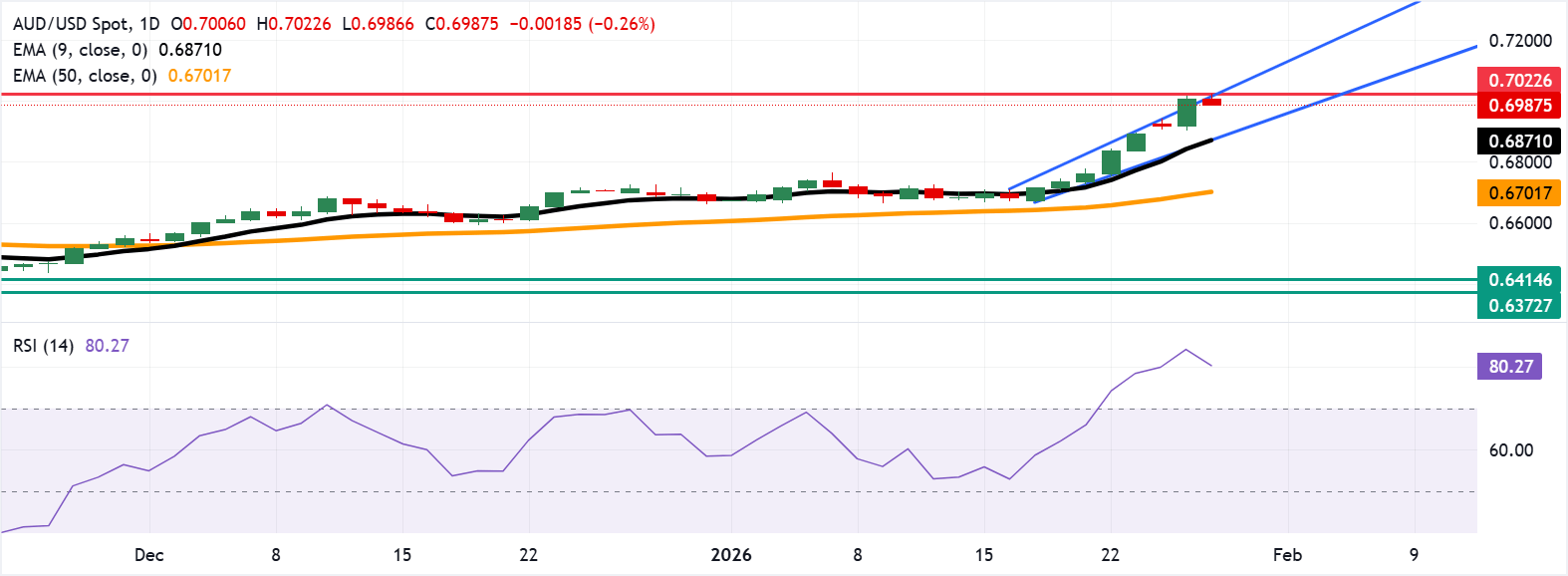
Group 1 - The Australian dollar (AUD) remains subdued following the release of December CPI data, with the inflation rate rising to 3.6% year-on-year, aligning with market expectations [2] - The Reserve Bank of Australia (RBA) is likely to tighten monetary policy due to inflation rates exceeding the target of 2-3%, supported by recent PMI and employment data [2] - The AUD/USD currency pair showed a slight decline after a previous increase of over 1%, trading around 0.6990, indicating a bullish bias within an ascending channel [3] Group 2 - The US Dollar Index (DXY) experienced a drop of over 1% in the previous trading session, reflecting a prevailing "sell the US" sentiment, with DXY nearing its lowest level since February 2022 [4] - Market expectations suggest that the Federal Reserve will maintain interest rates between 3.50%-3.75% after a series of rate cuts, with attention on the subsequent press conference for future policy guidance [4] - Australia's employment change in December rebounded significantly to 65.2K, surpassing the revised figure of 28.7K in November, while the unemployment rate fell from 4.3% to 4.1%, below market consensus [4]
美元指数大跳水
Di Yi Cai Jing· 2026-01-28 00:44
Group 1 - President Trump expressed confidence in the performance of the US dollar, stating it is not a concern for him and that a return to its "proper level" is reasonable [2] - Following Trump's comments, the US dollar index (DXY) initially rose but then fell sharply, dropping over 50 points to a new low since February 2022, closing at 96.219 [2] - The euro and British pound strengthened against the dollar, with the euro rising to 1.1979 and the pound to 1.3780 [2] Group 2 - The weakening dollar has led to a rebound in non-US currencies, with the offshore yuan approaching the 6.93 mark [4] - Safe-haven assets like gold have benefited, with spot gold reaching a historical high above $5,180 per ounce [4] Group 3 - Market sentiment is influenced by uncertainty surrounding Trump's trade policies and the independence of the Federal Reserve, contributing to the ongoing "sell America" trend [5] - Concerns over a potential government shutdown due to disagreements in Congress have further pressured the dollar [5] - Investors are closely monitoring the Federal Reserve's upcoming policy meeting, with expectations that interest rates will remain unchanged [5][6] Group 4 - The focus in the forex market has shifted to the Japanese yen, which has appreciated approximately 3% over the past two trading days, with the dollar falling to 152.77 yen [8] - Reports of the New York Federal Reserve inquiring about dollar-yen quotes have raised expectations of potential intervention, impacting broader dollar assets [8][9] - Barclays suggests that potential intervention in the yen market could further weaken the dollar's flow picture, despite no official confirmation of such actions [9]

TMGM:美元兑瑞士法郎汇率延续上行,瑞郎展现韧性
Sou Hu Cai Jing· 2026-01-08 05:47
Core Viewpoint - The USD/CHF exchange rate is showing an upward trend, influenced by strong US economic data and expectations regarding Federal Reserve policy adjustments [1][3][4] Group 1: USD Performance - The US dollar index (DXY) has slightly increased, hovering around 98.70, following a strong ISM services PMI report that rose from 52.6 in November to 54.4 in December, surpassing economists' expectations of 52.3 [3] - The robust performance of the services PMI, which is a significant component of the US economy, indicates stability supported by the high-tech sector [3] - Market expectations suggest at least two 25 basis point interest rate adjustments by the Federal Reserve within the year, influenced by the strong PMI data [3] Group 2: CHF Performance - The Swiss franc (CHF) has shown resilience against the US dollar, with expectations of a slight increase in the Swiss inflation rate from 0% in November to 0.1% in December, which may lead to a relatively stable policy direction from the Swiss National Bank (SNB) [3][4] - The CHF's stability is attributed to cautious trading behavior as the market awaits key economic data releases, including the US non-farm payrolls and Swiss CPI [4] - If the Swiss CPI data meets expectations, it is anticipated that the SNB will maintain a moderate policy stance for an extended period, which could influence short-term trading sentiment for the CHF [4]
TMGM外汇:澳洲联储表态谨慎,为何澳元反而走强?
Sou Hu Cai Jing· 2025-12-22 06:27
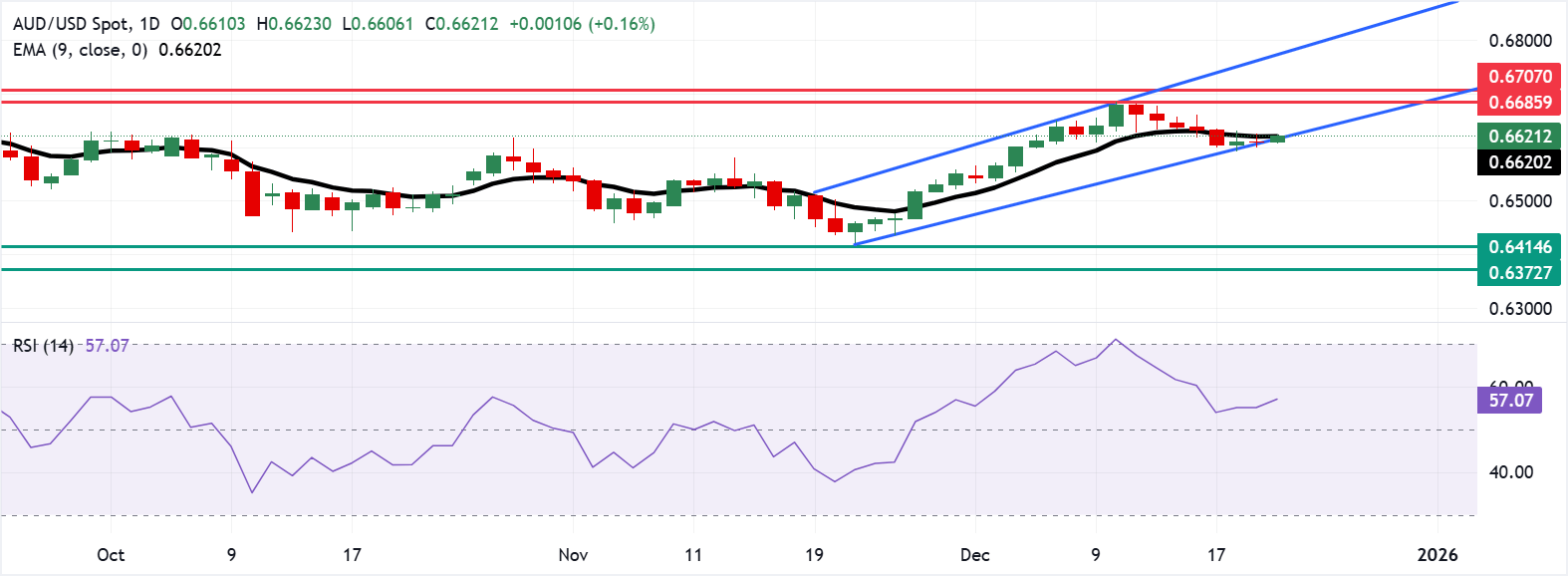
Core Viewpoint - The Australian dollar continues to strengthen against the US dollar, influenced by the Reserve Bank of Australia's (RBA) monetary policy and market expectations regarding interest rates and inflation [1][4]. Group 1: Monetary Policy and Interest Rates - The People's Bank of China has maintained the Loan Prime Rate (LPR) unchanged, with the one-year LPR at 3.00% and the five-year LPR at 3.50% [1]. - Traders are focusing on the upcoming RBA meeting minutes to gauge the central bank's policy direction and stance on inflation [2]. - As of December 18, the ASX 30-day interbank cash rate futures for February 2026 indicate a 27% probability of the RBA raising rates to 3.85% [3]. Group 2: US Economic Indicators - The US dollar has ended a three-day rally, with the dollar index (DXY) trading around 98.60, as market participants await the release of the US Q3 GDP annualized data [4]. - Cleveland Federal Reserve Bank President Loretta Mester stated that current monetary policy is appropriate for pausing rate hikes to assess the impact of previous rate cuts [4]. - The November Consumer Price Index (CPI) in the US showed a year-on-year increase of 2.7%, below the expected 3.1%, marking the lowest growth rate since 2021 [4]. Group 3: Leadership Changes in the Federal Reserve - The next Federal Reserve Chair is expected to be someone who supports significant rate cuts, with Christopher Waller being a potential candidate who has reiterated a dovish stance on interest rates [5]. Group 4: Australian Inflation Data - Australian consumer inflation expectations have risen from 4.5% in November to 4.7% in December, supporting a hawkish stance from the Reserve Bank of Australia [6]. Group 5: Australian Dollar Technical Analysis - The Australian dollar is currently trading around 0.6620, maintaining an overall upward trend, with key resistance levels at 0.6685 and 0.6707 [8]. - The 14-day RSI is at 57.05, indicating a neutral to bullish sentiment, while the 9-day EMA shows an upward trend but may exert short-term pressure on prices [8].
美元指数(DXY)跌至10周低点97.902,此前为98.061 。
Xin Lang Cai Jing· 2025-12-16 13:44
Core Viewpoint - The US Dollar Index (DXY) has fallen to a 10-week low of 97.902, down from a previous level of 98.061 [1] Group 1 - The decline in the DXY indicates a weakening of the US dollar against a basket of currencies [1] - The drop to 97.902 represents a significant movement in the currency market, reflecting potential shifts in investor sentiment and economic outlook [1] - This change in the dollar's value may have implications for international trade and investment flows [1]
IC外汇平台预测走势:美元兑加元四连跌,跌势能否延续?
Sou Hu Cai Jing· 2025-12-12 09:48
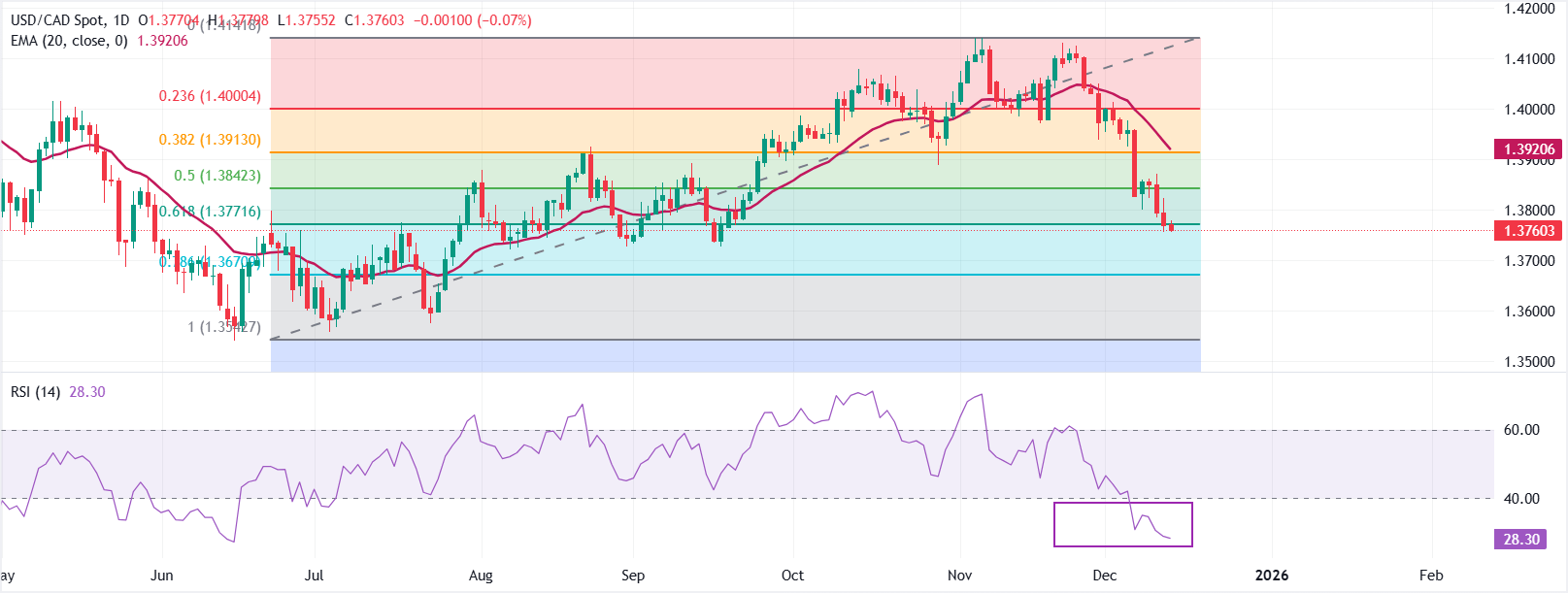
Group 1 - The USD/CAD currency pair has declined for the fourth consecutive trading day, influenced by the weakening of the US dollar, reaching around 1.3750 [1] - The Federal Reserve signaled plans to lower the federal funds rate to 3.4% by 2026, while the Bank of Canada indicated that current interest rates should be maintained in the short term [1] - The US dollar index (DXY) remains weak, hovering near a seven-week low of 98.13, as market expectations suggest more rate cuts by the Federal Reserve than indicated in the latest dot plot [1] Group 2 - The Canadian dollar is performing strongly against most major currencies, except for currencies from Australasia, due to the low likelihood of interest rate cuts by the Bank of Canada [2] - The Bank of Canada reaffirmed that current interest rates are sufficient to keep inflation near the target of 2%, as long as economic and inflation trends meet expectations [2] Group 3 - The USD/CAD pair has dropped to 1.3760, remaining below the 20-day exponential moving average (EMA) of 1.3921, indicating a bearish short-term trend [5] - The 14-day Relative Strength Index (RSI) is at 28, indicating an oversold condition, while the 61.8% Fibonacci retracement level at 1.3772 serves as short-term support [5] - If the pair closes below the 1.3772 support level, it may open up further declines towards the 78.6% retracement level at 1.3671 [5]