
电动沙发

Search documents
宜家,在下一盘大棋
盐财经· 2026-01-07 09:05
Core Insights - The core viewpoint of the article is that IKEA's decision to close seven stores in China is not a retreat from the market but a strategic shift towards a more fragmented and immediate consumer demand landscape, reflecting a broader trend in the retail industry towards smaller, more accessible store formats [2][3][11]. Group 1: Strategic Shift - IKEA's closure of stores represents a transition from a "scale-oriented" model to a "precise connection" approach in retail, indicating a redefinition of the "business circle" concept in the new retail ecosystem [3][10]. - The rise of instant retail and changing consumer habits are driving IKEA to create a more community-focused store network, enhancing customer interaction and reducing access costs [11][12]. Group 2: Retail Industry Trends - The retail industry is experiencing a "reverse growth" trend, where smaller stores are expanding while larger stores are downsizing, as seen with brands like MINISO and MUJI adapting their store formats to meet local consumer needs [5][7]. - The shift from "destination shopping" to "daily penetration" reflects a deeper understanding of consumer emotional needs, with IKEA aiming to enhance emotional connections through its new brand positioning [8][18]. Group 3: Local Market Adaptation - China is becoming a key testing ground for global retail strategies, with IKEA's local innovations being adapted for global markets, showcasing the importance of localized product development and digital integration [20][22]. - The transformation of the Chinese real estate market presents structural growth opportunities for the home retail sector, prompting IKEA to focus on specific living scenarios like "complete sleep" and "kitchen life" [25]. Group 4: Future Outlook - IKEA's strategic shift towards a multi-channel ecosystem aims to enhance resilience in a dynamic retail environment, positioning the company as a preferred partner in consumers' home lives [26]. - The future of the home retail industry in China is expected to be more diversified, fragmented, and emotionally driven, requiring companies to balance global scale with local relevance [25][26].


对话宜家庞安泽:“中国市场没有统一的标准答案”
21世纪经济报道· 2025-12-31 03:08
Core Viewpoint - IKEA's commitment to the Chinese market is long-term and strategic, focusing on enhancing competitiveness and creating value for consumers [1][4] Group 1: Strategic Partnerships and Local Adaptation - IKEA China is collaborating with Ingka Centers and Gaohe Capital to establish a real estate fund, enhancing its presence in key cities like Wuxi, Beijing, and Wuhan [1] - The company is actively engaging in partnerships with local firms, such as investing in a plastic recycling company and collaborating with the Ministry of Ecology and Environment for wildlife protection [3][4] - IKEA's approach emphasizes local adaptation, with products tailored to Chinese consumer needs, such as electric sofas and special collections for Chinese New Year [4][12] Group 2: Store Format and Consumer Engagement - IKEA is shifting its focus from large stores to smaller formats, planning to open over ten small stores in the next two years to better connect with consumers [5][7] - The company is testing new store formats, including design order centers that provide personalized services, aiming to enhance customer interaction and brand engagement [7][9] - IKEA's sales volume in China has been growing steadily, with an increase of approximately 5% to 8% in visits to both online and offline platforms [9] Group 3: Brand Positioning and Market Trends - IKEA has introduced a new brand positioning, "Home, for a better life," reflecting the evolving values of Chinese consumers who seek meaning and emotional value in their daily lives [10][12] - The company is addressing societal changes, such as aging populations and the demand for sustainable solutions, by offering age-friendly products and participating in community initiatives [12] - IKEA's ongoing transformation is driven by a commitment to understanding and responding to the dynamic Chinese market, focusing on consumer-centric strategies [8][12]

破解电动沙发“不可能三角”,顾家家居开启电动沙发新时代
Xin Jing Bao· 2025-11-20 23:59
Core Insights - The Chinese home furnishing industry is undergoing a significant value reshaping due to consumer differentiation and real estate cycle adjustments, with traditional business models facing challenges and new market opportunities emerging based on consumer needs and product innovation [1][10] - Electric sofas are highlighted as a key category driving home consumption upgrades and corporate growth, with the global market size exceeding $32 billion in 2023, and a projected penetration rate of 49.7% in the U.S. by 2024, compared to only 22% in China [1][3] Company Developments - Kuka Home (顾家家居) has been a pioneer in the electric sofa sector, continuously exploring market potential and recently launching three upgraded flagship products at a press conference in Hangzhou [3][4] - The new products address the traditional "impossible triangle" of electric sofas, achieving compatibility among "zero gravity," "zero wall," and "true high legs," while significantly enhancing user comfort [3][4] Technological Innovations - Kuka Home's new electric sofas feature a self-developed K-TRON Space Z framework, which resolves traditional pain points such as wall distance requirements and stability issues, thus enhancing user experience [7][9] - The "immersive floating" experience is achieved through innovative design principles that optimize body posture and support, addressing common discomforts associated with traditional sofas [5][6] Strategic Insights - Kuka Home's strategic foresight in identifying the growth potential of electric sofas as early as 2015 has allowed the company to establish a competitive edge and avoid later market homogenization [10][12] - The company has adopted a cross-industry innovation approach, integrating automotive engineering principles to overcome supply-side bottlenecks and achieve significant technological breakthroughs [12][13] Organizational Efficiency - Kuka Home has restructured its organizational framework to enhance decision-making efficiency and reduce product development cycles, ensuring rapid response to market demands [12][13] - The integration of various departments into cohesive units has facilitated quicker product iterations and innovation implementation [12][13] Industry Implications - Kuka Home's approach serves as a model for the broader home furnishing industry, illustrating a shift from scale competition to value competition driven by core technology and user-centric innovation [14]


速卖通:海外双11期间ILIFE等品牌实现倍数增长,紧急追加库存
Xin Lang Ke Ji· 2025-11-18 09:05
Core Insights - During the overseas Double 11 shopping festival, several leading brands on platforms similar to Amazon experienced stock shortages and began urgent restocking efforts [1] Group 1: Sales Performance - The cycling gear brand ROCKBROS saw its transaction volume double on the day of the Double 11 sales event on AliExpress [1] - The robotic vacuum brand ILIFE reported a 140% year-on-year increase in sales on AliExpress, leading to urgent restocking of popular models [1] - The electric sofa brand COMHOMA experienced a fivefold increase in sales compared to last year on AliExpress [1] Group 2: Market Trends - The leading smart cycling trainer brand ThinkRider achieved a fourfold increase in sales compared to last year's Double 11, with some high-end models selling out completely on the first day in Europe and Brazil [1] - Merchants indicated that with the onset of winter, cycling enthusiasts in certain countries are considering indoor training, prompting them to urgently add inventory for AliExpress [1]
易观“双11”报告:天猫家电家居市场份额达47.9% 全网第一
Zheng Quan Shi Bao Wang· 2025-11-10 06:46
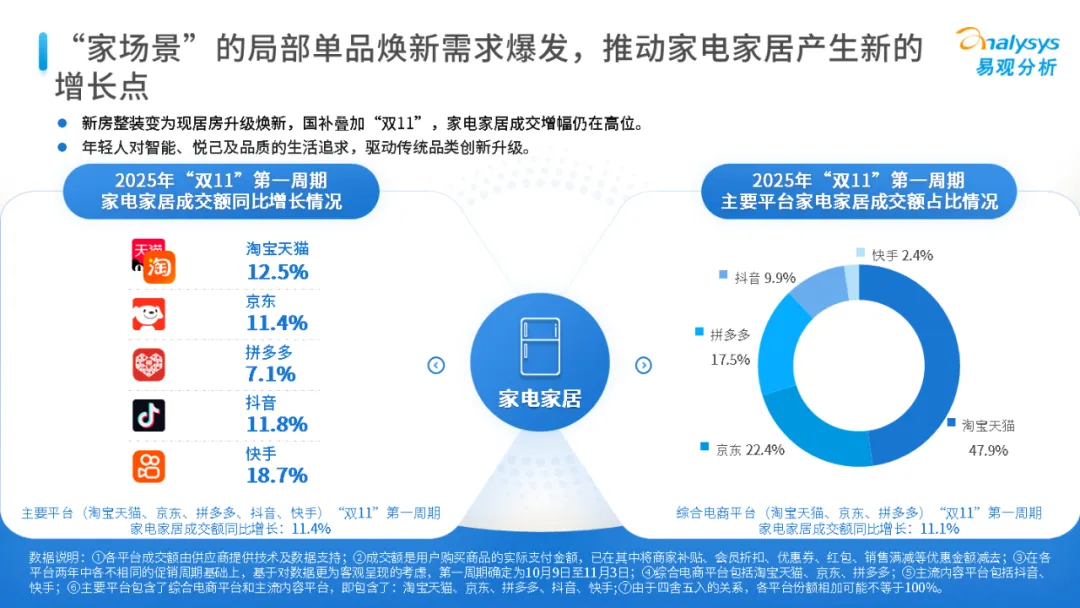
Core Insights - The "Double 11" shopping festival is entering its final phase, with Taobao Tmall's home appliance and home goods transaction share reaching 47.9% and a growth rate of 12.5%, maintaining the highest market share and growth rate across all platforms [1][3]. Group 1: Market Trends - The consumption structure in the home scene has shifted from new home renovations to upgrading existing homes, driven by young consumers' pursuit of smart, self-indulgent, and quality living [3]. - The combination of national subsidies and the "Double 11" event has stimulated consumer activity, leading to high growth in core categories supported by national subsidies [3]. Group 2: Brand Performance - Major brands such as Haier, Midea, and Source Wood broke the 100 million mark in sales during the first hour of the "Double 11" event, with significant growth in home decoration and home goods categories [3]. - Over 4,000 brands saw their sales double, with brands like Source Wood, Lin's Home, and Jiumu achieving remarkable sales figures [3]. Group 3: Promotional Strategies - This year's "Double 11" features over 3,700 categories, 9,000 brand merchants, and 500,000 brand products participating in national subsidies, with discounts reaching up to 50% [3]. - The combination of brand discounts of 20%, platform subsidies of 10%, and national subsidies of up to 20% has created the largest discount event of the year [3]. Group 4: Technological Integration - The "Double 11" event marks the first full implementation of AI and the first participation of Taobao Flash Sale, which are becoming new growth engines for brands [4]. - AI has improved transaction conversion rates for home decoration brands, while the average daily order volume from Flash Sale increased by 680% during the event [4].

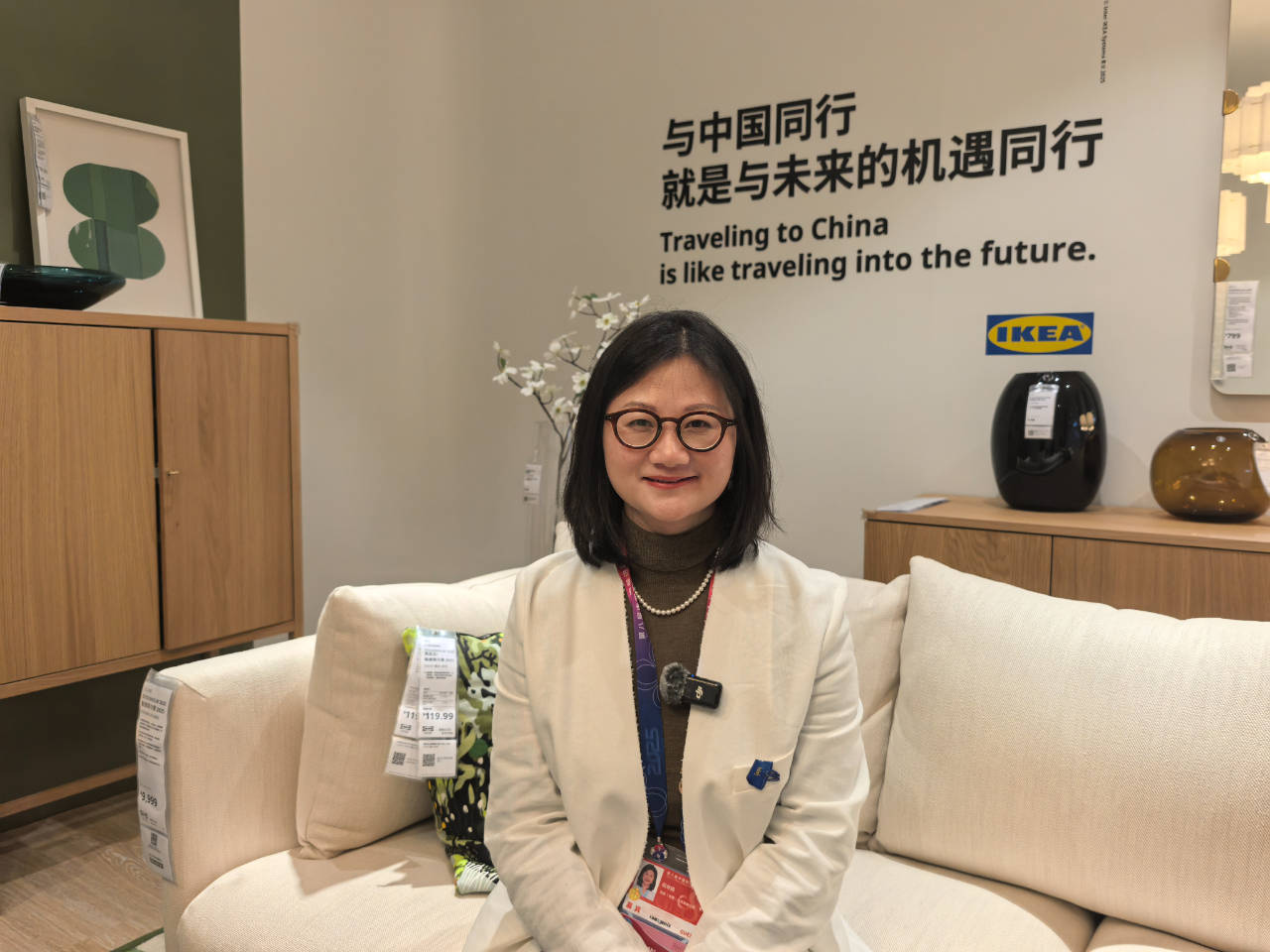
进博面对面|宜家阮林娟:以本土化创新回应中国消费者需求
Sou Hu Cai Jing· 2025-11-08 17:41
Core Insights - The eighth China International Import Expo (CIIE) opened on November 5, showcasing IKEA's commitment to co-creating in China through new products and solutions [1] - IKEA's role has evolved from a participant to a co-creator at the CIIE, emphasizing the importance of dialogue and market insights gained from the event [2][3] Group 1: Value of CIIE - The CIIE serves as a platform for valuable dialogues and exchanges that extend beyond product displays, impacting IKEA's business strategies [2] - Last year, IKEA's booth attracted approximately 45,000 visitors, facilitating discussions on topics like the silver economy and circular economy [2] Group 2: Brand Positioning - IKEA China introduced a new brand positioning, "Home, Enriching Life," to resonate with the emotional needs of consumers, particularly the younger demographic [4][6] - The new positioning aims to address the changing consumer behaviors and the need for meaningful living experiences [4] Group 3: Localization and Innovation - IKEA emphasizes the importance of localized innovation in the Chinese market, exemplified by the collaboration with cultural experts for the "Festa" Chinese New Year series [7] - A successful case from the CIIE includes the launch of an electric sofa that became a best-seller, showcasing IKEA's responsiveness to local consumer needs [7] Group 4: Omnichannel Strategy - IKEA is accelerating its omnichannel integration, opening design order centers and smaller stores in cities like Shenzhen and Beijing to meet community needs [7] - The company has expanded its online presence by launching a flagship store on JD.com, aiming for deeper connections with consumers [7] Group 5: Future Outlook - The Chinese market is viewed as a "future laboratory" for IKEA, with strong consumer vitality and innovation ecosystems driving global solutions in product development and retail automation [8] - IKEA aims to continue leveraging the CIIE to reflect Chinese consumer trends and foster sustainable practices [8]
开源晨会 1105-20251104
KAIYUAN SECURITIES· 2025-11-04 15:21
Group 1: Market Overview - The Hong Kong stock market performed poorly in October 2025, with the Hang Seng Index declining by 3.5% and the Hang Seng Technology Index falling by 8.6% [5] - The average daily trading volume in October was HKD 211.3 billion, a decrease of 16.6% compared to September 2025 [5] - Value sectors outperformed growth sectors, with coal, oil and petrochemicals, electricity, and utilities leading the gains [5] Group 2: Fund Flow Analysis - Southbound capital saw a total net inflow of HKD 925 billion in October 2025, with a cumulative net inflow of HKD 1.26 trillion for the year, marking a 156% increase compared to 2024 [6] - The market value proportions of southbound funds, foreign capital, domestic capital, and Hong Kong capital as of October 28, 2025, were 21.49%, 58.86%, 12.66%, and 6.99% respectively [6] Group 3: Industry Insights Consumer Goods - The oral care market in China reached a retail scale of CNY 30.2 billion in 2023, with a growth rate of 0.2% year-on-year [16] - The sanitary napkin market is projected to grow to CNY 105 billion in 2024, with a year-on-year growth of 2.9% [17] - The global wet wipes market is expected to reach USD 18.4 billion in 2024, growing at 2.7% year-on-year [17] Military Industry - The demand for titanium materials in aerospace and naval applications is expected to reach 49,000 tons by 2027 [22] - The titanium material usage in the shipbuilding sector is projected to grow significantly, driven by national strategies for marine development [24] - Beneficiary stocks in the titanium sector include BaoTi Co., West Superconducting, and West Materials [26] Automotive Industry - SAIC Group reported a revenue of CNY 468.99 billion for the first three quarters of 2025, a year-on-year increase of 9.0% [31] - The company’s Q3 sales volume reached 1.1407 million vehicles, reflecting a 38.7% increase year-on-year [32] - The company is focusing on enhancing decision-making efficiency and optimizing resource allocation through the establishment of a new passenger vehicle division [33] Nonferrous Metals - Yun Aluminum Co. achieved a revenue of CNY 44.072 billion in the first three quarters of 2025, with a year-on-year increase of 12.47% [35] - The company’s net profit for Q3 was CNY 1.63 billion, a year-on-year increase of 25.31% [35] - The company plans to increase its dividend payout ratio, enhancing investor confidence [38] Semiconductor Testing - The company reported a revenue of CNY 737 million for the first three quarters of 2025, a year-on-year increase of 44.01% [40] - The company has successfully developed the first domestic open X-ray source, marking a significant advancement in high-end detection equipment [41] - The acquisition of SSTI is expected to enhance the company's performance in the high-end semiconductor testing equipment sector [42]
顾家家居2025年三季报:前三季度营收突破150亿,战略转型成效持续释放
Jing Ji Guan Cha Wang· 2025-10-27 10:49
Core Insights - The company reported steady operational performance in Q3 2025, with total revenue reaching 15.012 billion yuan, a year-on-year increase of 8.77%, and net profit attributable to shareholders at 1.539 billion yuan, up 13.24%, indicating improved operational quality and efficiency [1] - In Q3 2025 alone, the company achieved revenue of 5.211 billion yuan, a 6.50% increase year-on-year, and net profit of 518 million yuan, growing by 11.99%, continuing the stable growth trend observed in the first half of the year [1] - The company demonstrated strong cost and expense management, with operating costs for the first three quarters at 10.151 billion yuan, a 7.69% increase, which is lower than the revenue growth rate, and total expenses of approximately 2.990 billion yuan, up 5.26%, also below revenue growth [1] Strategic Focus and Product Innovation - The company's steady performance is attributed to its ongoing investment in strategic focus and product innovation, emphasizing a "focus strategy" centered around user value [2] - The company has been advancing its focus on three strategic product categories: electric sofas, mattresses, and whole-home customization, addressing user needs and pain points through systematic innovation [2] - In the electric sofa segment, the company recently launched the "Cloud Comfort" flagship product, featuring the self-developed K-TRON Space Z function, which addresses long-standing industry challenges and enhances user experience with a "zero-gravity" feel [2]
乐歌股份分析师会议-20251024
Dong Jian Yan Bao· 2025-10-24 14:36
Group 1: Research Basic Information - The research object is Leguo Co., Ltd., belonging to the household light industry, and the reception time was on October 24, 2025. The listed company's reception staff included the board secretary Yu Haoying and the securities affairs representative Qu Qilong [16] Group 2: Detailed Research Institutions - The research institutions included fund management companies (Huaxia, Guangdong Zhengyuan Private Equity, Huisheng, etc.), asset management companies (Qingrong, Yangtze River Securities (Shanghai)), investment companies (Guangdong Yuancheng Private Securities Investment, Shenzhen Hunt Investment Capital), securities companies (Guoxin Securities, Tianfeng Securities, Shanghai Securities, etc.), insurance asset management companies (China Life, Pacific), and others (Development Research Center, Guangdong Hengjian) [17][18][19] Group 3: Main Content Overseas Warehouse - In Q3, the gross profit margin of the company's overseas warehouse business was basically flat quarter - on - quarter. The current average utilization rate of overseas warehouses exceeded 70%, and the profitability of new non - US warehouses in Germany, the UK, and Canada had been continuously improving. The company will continue to invest in automation and informatization to improve storage operation efficiency and cost control capabilities [24] - As of the end of September 2025, the company had 19 self - operated overseas warehouses globally, with a total area of 650,000 square meters. The revenue of the overseas warehouse segment maintained a high growth rate. In the first three quarters, it had served 1,932 overseas enterprises, and the parcel volume increased by over 100% year - on - year. In the future, with the commissioning of self - built warehouses, the scale effect will gradually appear, and the profit margin is expected to further increase [26] US Terminal Demand under Sino - US Tariff Disturbance - The uncertainty in the Sino - US trade environment remains high. For optional consumer goods and products in offline supermarket channels, tariff adjustments and cost increases have led to price hikes, affecting the sales volume of OEM customers and putting periodic pressure on the company's OEM business. However, cross - border e - commerce has maintained steady growth, with the core category of intelligent lifting desks stable and rising, and the revenue of electric sofas and ergonomic chairs increasing significantly. It is expected that with the Fed entering the interest - rate cut cycle, consumer confidence will be boosted [25] OEM Business Development Trend - Affected by tariff policy adjustments, the offline supermarket OEM business is facing certain pressure on price transmission and sales volume. The company expects this business to gradually recover after the industry demand stabilizes. Meanwhile, the company is actively expanding emerging markets in Asia, Africa, and Latin America through brand agency and cooperation models to disperse trade risks and cultivate new performance growth points [25][26] Cross - border E - commerce Business - During the reporting period, the company's cross - border e - commerce business maintained steady growth. The sales revenue of independent websites accounted for over 40% of the total cross - border e - commerce revenue, with a year - on - year increase of about 12%. Independent websites have significant advantages in new product promotion, scenario - based marketing, and brand building. The Amazon channel has intense industry competition and obvious price involution. The company will continue to strengthen brand differentiation positioning and product innovation capabilities [27]
乐歌股份(300729) - 300729乐歌股份投资者关系管理信息20251024
2025-10-24 07:24
Group 1: Overseas Warehouse Operations - The gross margin of the overseas warehouse business remained stable in Q3, with an average utilization rate exceeding 70% [2] - The company has established 19 self-operated overseas warehouses covering a total area of 650,000 square meters as of September 2025, with revenue from this segment continuing to grow significantly [4] - The company served 1,932 outbound enterprises in the first three quarters, with shipment volume increasing by over 100% year-on-year [4] Group 2: Impact of Tariffs and Market Trends - The ongoing uncertainty in the China-U.S. trade environment has led to varying impacts on different consumer categories, particularly affecting optional consumer goods and offline supermarket products [3] - Despite challenges, the cross-border e-commerce sector remains robust, with core categories like smart standing desks showing steady growth [3] - The company anticipates a recovery in demand for its OEM business as the industry stabilizes post-tariff adjustments [4] Group 3: E-commerce Performance - Independent site sales accounted for over 40% of total cross-border e-commerce revenue, growing approximately 12% year-on-year [5] - The independent site channel demonstrates strong customer loyalty, with higher repurchase rates and average transaction values compared to platform-based channels [5] - The company aims to enhance brand differentiation and product innovation to maintain market share while focusing on profit quality in a competitive landscape [5]