科创综指ETF嘉实

Search documents
资本热话 | ETF市场开年狂飙:万亿巨头诞生,科技赛道受捧
Sou Hu Cai Jing· 2026-01-15 09:36
Core Insights - The ETF industry is experiencing a significant expansion, with A-share market trading reaching historical highs and ETF total scale increasing to 6.24 trillion yuan as of January 13, marking a surge of 221.7 billion yuan in just half a month [2][4] - The emergence of the first trillion-yuan ETF manager, Huaxia Fund, signifies a milestone in the industry, with the second-largest player, E Fund, trailing by less than 100 billion yuan [6][7] - The competition among leading institutions has evolved beyond mere market share to include product standardization, investor returns, and ecosystem development [2][9] Market Performance - A-share market remains robust, with daily trading volumes consistently exceeding 3 trillion yuan, reaching nearly 4 trillion yuan on January 14 [4] - The ETF market is a key channel for capital inflow, with stock ETFs being the primary drivers of growth, adding over 220 billion yuan since the beginning of the year [4][5] - Technology-related sectors, including satellite and media, are attracting significant investment, with specific ETFs receiving over 80 billion yuan in net inflows [4][5] Fund Management Trends - The top three ETF managers control over 40% of the total market, with Huaxia Fund leading at over 1 trillion yuan, followed by E Fund and Huatai-PB [6][7] - The rapid growth of these leading firms is attributed to both net subscriptions and net asset value increases, with Huaxia Fund growing by 360.8 billion yuan and E Fund by 326.3 billion yuan in the past year [8] - Smaller ETF managers face challenges, with many having assets below 10 billion yuan, highlighting a trend of resource concentration among top firms [8] Competitive Landscape - The competition in the ETF market is shifting towards diversified strategies, including product naming standardization and enhanced dividend policies [9][10] - Recent announcements of significant dividend distributions by major funds indicate a trend towards improving product attractiveness [9] - The industry is witnessing a wave of rebranding efforts, with several funds standardizing their product names to enhance clarity and marketability [9] Future Outlook - The ETF market is expected to continue its rapid growth, driven by increasing penetration of public funds in asset allocation and a growing acceptance of index investing among investors [10] - Future competition will likely focus on the comprehensive capabilities of fund managers, emphasizing the importance of research, operations, and service integration [10]


ETF市场开年狂飙
Di Yi Cai Jing Zi Xun· 2026-01-14 16:09
Group 1 - The A-share market has seen a significant increase in trading activity, with daily transaction volumes reaching historical highs, surpassing 30 trillion yuan for four consecutive days [2][3] - The total scale of ETFs in the market has reached 6.24 trillion yuan as of January 13, marking an increase of 221.7 billion yuan since the end of last year, indicating a rapid expansion [3][4] - Stock ETFs have been the primary driver of this growth, with over 220 billion yuan added to their scale since the beginning of the year, supported by net inflows exceeding 25 billion yuan [3][4] Group 2 - The emergence of the first trillion-yuan ETF manager, Huaxia Fund, marks a milestone in the industry, holding over 10.08 trillion yuan in ETF assets, accounting for 16.16% of the total market [6][7] - E Fund follows closely with over 9.17 trillion yuan in ETF assets, while the third-largest, Huatai-PB Fund, has 6.43 trillion yuan, highlighting a significant concentration of resources among top firms [6][7] - The top three firms collectively manage over 2.57 trillion yuan, representing more than 40% of the total market scale, indicating a trend of resource concentration towards leading institutions [6][8] Group 3 - The ETF market is evolving beyond mere scale competition, with firms focusing on product naming standardization, dividend distribution, and ecosystem development [9][10] - Dividends have become a crucial method for funds to reward investors, with significant distributions announced, including a record single dividend of 11 billion yuan from Huatai-PB's ETF [10] - The industry is witnessing a wave of name changes for ETFs to enhance product recognition and reduce selection costs for investors, with several leading firms already implementing these changes [10][11] Group 4 - Smaller ETF managers face significant challenges, with 27 out of 58 firms having less than 10 billion yuan in assets, indicating a tough competitive landscape [8][9] - The competition is shifting towards a comprehensive evaluation of fund managers' capabilities, including research, operations, and service quality, rather than just asset size [11][12] - The future of the ETF market is expected to remain robust, driven by increasing penetration of public funds in asset allocation and a growing acceptance of index investing among investors [11]

密集分红 嘉实基金17只产品齐发“红包”涵盖多类型产品
Shang Hai Zheng Quan Bao· 2026-01-14 15:27
Core Viewpoint - The public fund industry is transitioning towards a high-quality ecosystem, with regular dividend distribution becoming a standard practice, as evidenced by the increase in the number of funds announcing dividends and the total amount distributed in 2025 compared to 2024 [1][2]. Group 1: Dividend Distribution Trends - In 2025, a total of 3,652 fund products announced dividends, marking a 15% increase from 2024 [1] - The total dividend amount reached 242.56 billion yuan, a 7.5% increase from 225.77 billion yuan in 2024 [1] - Jiashi Fund's recent dividend announcements cover a wide range of products, including active equity, bond, and passive index funds, indicating a diversified and stable dividend product matrix [1] Group 2: Active Equity Funds - Active equity funds continue to show strong dividend activity, with Jiashi Theme Selection, Jiashi Growth Mixed, and Jiashi Quantitative Alpha among those announcing dividends [1] - Jiashi Theme Selection has implemented dividends four times in 2025, with a cumulative total exceeding 10 billion yuan since its inception [1] Group 3: Bond Funds - Bond funds remain a significant contributor to dividend distributions, with Jiashi Ultra-Short Bond, Jiashi Bond, and Jiashi Multi-Asset Income among those announcing dividends [1] - Jiashi Ultra-Short Bond had 10 dividend distributions in 2025, with a total of 246 distributions since inception, amounting to over 3.4 billion yuan [1] Group 4: Index Funds - The A500 ETF Jiashi (159351) has a quarterly dividend mechanism, evaluating excess returns against its benchmark index, and has announced its fourth dividend for 2025 [1] - Other index products, such as Jiashi CSI 300 ETF Link (160706) and Jiashi Sci-Tech Innovation Index ETF (589300), have also announced dividends [1] Group 5: Institutional Changes - An increasing number of fund products are incorporating dividend mechanisms directly into their contracts, making dividend distribution more systematic and predictable for investors [2] - This contractual dividend mechanism enhances product attractiveness, especially as index investment tools gain popularity among long-term investors [2] Group 6: Industry Philosophy - The public fund industry is focusing on high-frequency dividends as a core social responsibility, with Jiashi Fund having distributed dividends over 1,530 times since its establishment [2] - In 2025, Jiashi Fund's products had over 200 dividend distributions, totaling more than 13.3 billion yuan [2] Group 7: Investor-Centric Approach - The shift towards a return-oriented approach in the public fund industry emphasizes dividends as a key link in rebuilding investor trust and reshaping the industry ecosystem [3] - A stable and predictable dividend mechanism aligns the assessment focus of fund managers with the genuine sense of gain for investors, contributing to a reduction in overall holding costs [3]
增强投资者获得感 嘉实基金一日17只产品分红
Zhong Zheng Wang· 2026-01-14 13:19
Group 1 - The core viewpoint of the news is that Jiashi Fund has announced a wide range of fund distribution announcements, covering various types of products including active equity, bond, and passive index funds, thereby enhancing investor satisfaction [1][2] Group 2 - Jiashi Fund has released 17 fund distribution announcements, including multiple active equity funds such as Jiashi Theme Selection and Jiashi Growth Mixed, with Jiashi Theme Selection having distributed over 10 billion yuan since its inception [1] - Bond funds remain the mainstay of public fund distributions, with Jiashi Ultra Short Bond and Jiashi Bond Fund announcing distributions, and Jiashi Ultra Short Bond achieving 10 distributions in 2025, totaling over 3.4 billion yuan since inception [1] Group 3 - In the index fund category, A500 ETF Jiashi has a quarterly distribution mechanism, and this marks its fourth distribution in 2025, with no handling fees for distributions [2] - More fund products are institutionalizing the distribution mechanism in their contracts, making distributions a predictable source of income for investors, which enhances product attractiveness [2] - Jiashi Fund has cumulatively distributed over 1,530 times since its establishment, with over 200 distributions and more than 13.3 billion yuan in total distributions in 2025 [2]
ETF市场开年狂飙:万亿巨头诞生,科技赛道受捧
Di Yi Cai Jing· 2026-01-14 12:39
Core Viewpoint - The ETF industry is experiencing a significant expansion, marked by record trading volumes and the emergence of the first trillion-yuan ETF manager in China, indicating a milestone in the industry [2][3][6]. Group 1: Market Performance - The A-share market has shown strong trading activity, with daily transaction volumes exceeding 3 trillion yuan for four consecutive days, reaching nearly 4 trillion yuan on January 14 [3]. - The total scale of ETFs in the market reached 6.24 trillion yuan as of January 13, increasing by 221.7 billion yuan in just half a month, indicating a rapid expansion [2][3]. - Stock ETFs are the primary drivers of this growth, with an increase of over 220 billion yuan since the beginning of the year, supported by net inflows exceeding 25 billion yuan [3][4]. Group 2: Fund Inflows and Performance - Specific ETFs such as the Guangfa Media ETF and Yongying Satellite ETF saw net inflows of 7.321 billion yuan and 6.765 billion yuan respectively since the start of the year [4]. - Over 97% of stock ETFs have achieved positive returns this year, with 13 ETFs gaining over 20%, led by Guangfa Media ETF with a 29.16% increase [4]. Group 3: Industry Structure and Competition - The leading ETF manager, Huaxia Fund, has surpassed 1 trillion yuan in ETF assets, holding a 16.16% market share, while E Fund follows closely with over 917 billion yuan [6]. - The top three firms collectively manage over 2.57 trillion yuan, accounting for more than 40% of the total market size, highlighting a trend of resource concentration among leading firms [6][8]. - Smaller ETF managers face significant challenges, with 27 out of 58 firms managing less than 10 billion yuan, indicating a need for differentiation and niche focus [8]. Group 4: Evolving Competition Dynamics - The competition in the ETF market is shifting from mere scale to more diverse aspects such as product naming standardization, dividend distribution, and ecosystem development [9][10]. - Recent trends show an increase in dividend distributions among ETFs, with significant announcements from major fund companies [9]. - The industry is also witnessing a wave of renaming initiatives aimed at standardizing product names to enhance investor recognition and reduce selection costs [9][10]. Group 5: Future Outlook - The ETF market is expected to continue its rapid growth, driven by increasing penetration of public funds in household asset allocation and a growing acceptance of index investing among investors [10]. - The focus of competition may shift towards a comprehensive evaluation of fund managers' capabilities across research, operations, and service delivery, rather than just scale [10][11].
ETF开盘:创业板50ETF国泰涨2.99% 医疗器械ETF跌0.94%
Shang Hai Zheng Quan Bao· 2025-08-13 02:50
Group 1 - The ETF market opened with mixed performance on August 13, with notable gains in certain ETFs such as the ChiNext 50 ETF from Guotai, which rose by 2.99% [1] - The soybean meal ETF increased by 2.62%, while the STAR Market Composite Index ETF from Harvest saw a rise of 2.01% [1] - Conversely, the medical device ETF declined by 0.94%, the semiconductor equipment ETF dropped by 0.81%, and the rare metals ETF fell by 0.76% [1]

马太效应凸显!做市商成ETF“救命稻草”?
券商中国· 2025-08-04 10:20
Core Viewpoint - The article discusses the challenges faced by many ETFs due to significant homogenization and poor management, leading to a decline in their market presence and liquidity issues [1][7]. Group 1: ETF Market Dynamics - Many ETFs, including the popular CSI A500 ETFs, have experienced a sharp reduction in shares this year, with some products facing liquidity shortages due to small scale [1][7]. - The "Matthew Effect" in the ETF market is becoming more pronounced, with larger funds attracting more investment while smaller funds struggle to gain traction, leading to potential liquidation risks for underperforming products [7][8]. Group 2: Introduction of Market Makers - Several public funds have announced the addition of brokerages as market makers for their ETF products to enhance liquidity in the secondary market [2][3]. - As of August 1, multiple funds, including those from Guolian Fund and Huatai-PineBridge Fund, have signed agreements with brokerages to facilitate trading operations for their ETFs [3]. Group 3: Liquidity Services and Market Coverage - By June 2025, the Shanghai Stock Exchange had 20 primary market makers and 12 general market makers providing liquidity services for 746 fund products, with 98% of all ETFs having market maker coverage [4][5]. - The Shenzhen Stock Exchange had 27 liquidity service providers covering 491 ETF products, with many ETFs supported by multiple market makers [5]. Group 4: Importance of Market Makers - Analysts emphasize that the introduction of brokerages as primary market makers is crucial for improving trading efficiency and responding to complex trading demands [6]. - The growing role of liquidity service providers in the ETF ecosystem is highlighted, with a focus on the need for public funds to prioritize the management of ETF liquidity to seize growth opportunities [6].

多家公募增加做市商 提升旗下ETF流动性
Zheng Quan Shi Bao· 2025-08-03 19:32
Group 1 - The rapid development of ETFs has led to many products facing issues of homogenization and poor management, resulting in significant share reductions and liquidity problems for some smaller products [1][5] - Several public funds have announced the addition of brokerages as market makers for their ETF products to enhance liquidity in the secondary market [1][2] Group 2 - On August 1, Guolian Fund announced an agreement with Ping An Securities and Great Wall Securities to act as market makers for its ETF, effective from August 1, 2025 [2] - Other funds, such as Huatai-PineBridge and E Fund, have also added brokerages as market makers for their ETFs, with over 40 announcements made in July alone [2] Group 3 - The presence of market makers is crucial for maintaining active trading in ETFs, with data showing that as of June 30, 2025, the Shanghai Stock Exchange had 20 primary market makers and 12 general market makers covering 746 fund products [3] - The Shenzhen Stock Exchange reported having 27 liquidity service providers for 491 ETF products as of mid-2023 [3] Group 4 - Analysts suggest that increasing the number of brokerages as primary market makers can significantly improve trading efficiency and quality, ensuring quick and accurate responses to large fund inflows and complex transactions [4] - The growing role of liquidity service providers in the ETF ecosystem is emphasized, with wealth management platforms increasingly using liquidity metrics to select quality ETFs [4] Group 5 - The "Matthew Effect" in the ETF industry is becoming more pronounced, with some ETFs facing shrinking scales and liquidity crises, particularly among previously popular products [5][6] - Statistics indicate that the number of ETFs choosing to liquidate has increased, with 20 index funds opting for liquidation as of August 1, including some high-performing thematic funds [6]
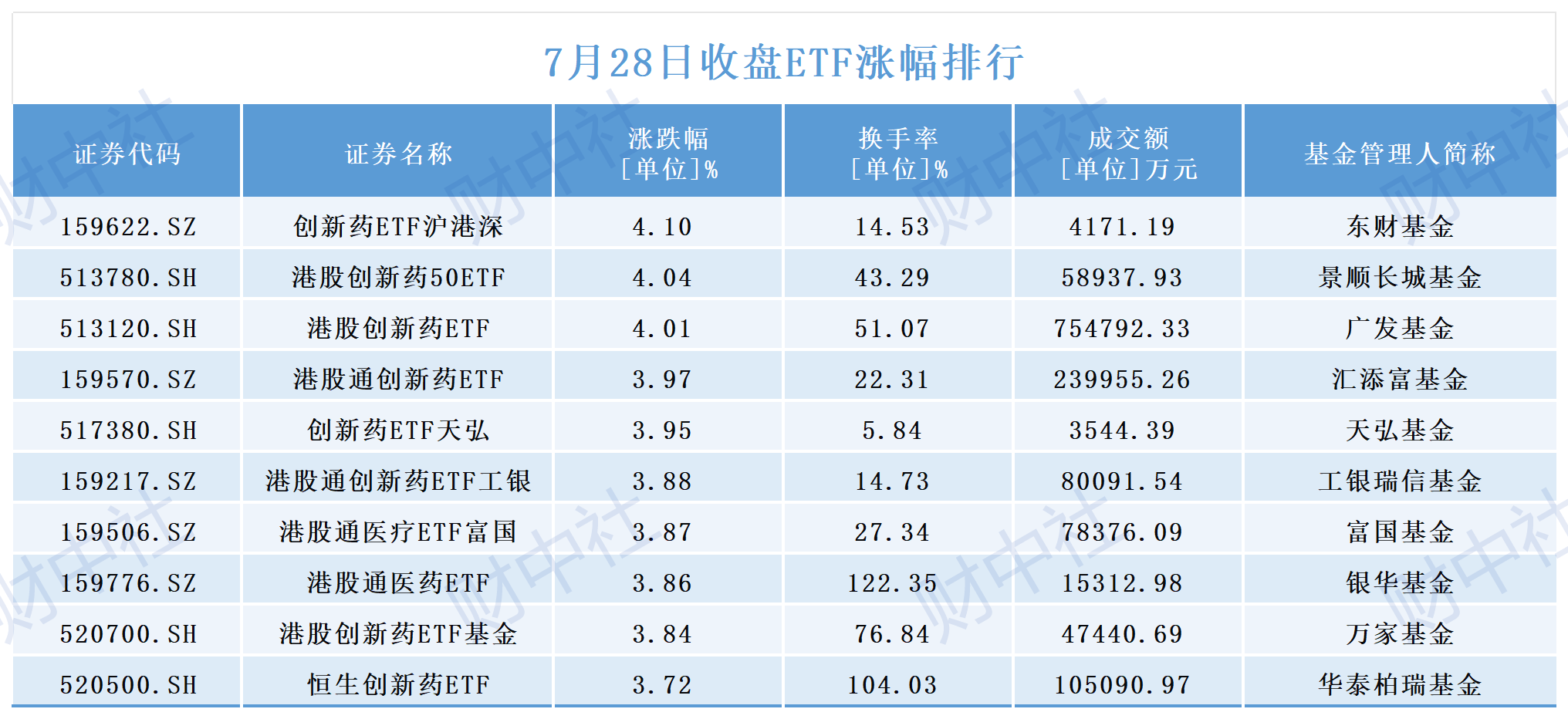
ETF涨跌幅排行丨涨幅榜均为创新药相关ETF 科创综指ETF嘉实(589300)收跌14.01%
Sou Hu Cai Jing· 2025-07-28 12:16
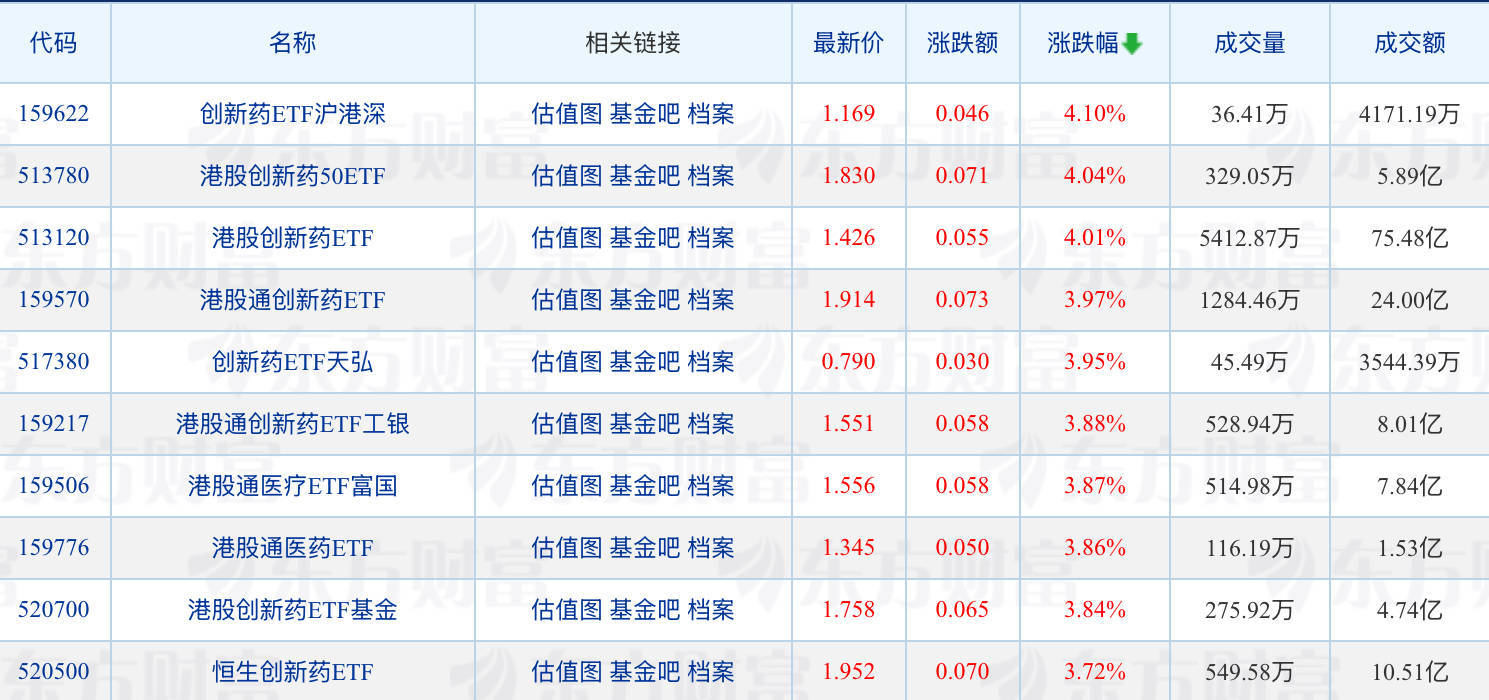
Market Performance - The market experienced a rebound on July 28, with the ChiNext Index leading the gains, closing up by 0.96% [1] - The Shanghai Composite Index rose by 0.12%, and the Shenzhen Component Index increased by 0.44% [1] Sector Performance - The computing hardware sector saw a significant surge, while innovative drug concept stocks maintained strong performance [1] - Active performance was noted in military and commercial aerospace concept stocks [1] - Conversely, cyclical stocks such as steel and coal experienced collective adjustments [1] ETF Performance - All ETFs that rose were related to innovative drugs, with the East Money Fund's Innovative Drug ETF (159622) leading the market with a 4.1% increase [3] - Other notable ETFs in the innovative drug sector also saw gains, with the Hong Kong Innovative Drug 50 ETF (513780) up by 4.04% and the Hong Kong Innovative Drug ETF (513120) up by 4.01% [3] Policy Updates - On July 24, the National Medical Insurance Administration announced the initiation of the 11th batch of centralized procurement, optimizing specific rules regarding the selection process [2] - The new rules will no longer simply use the lowest bid as a reference point, and companies with the lowest bids must publicly justify their pricing [2] Industry Insights - According to a report by Industrial Securities, the AACR and ASCO meetings this year showcased numerous domestic innovative drugs exceeding expectations, with anticipation for data releases from upcoming industry conferences [4] - There has been ongoing progress in foreign licensing transactions for innovative drugs, with expectations for more high-quality domestic products to explore international opportunities [4]
安联基金董事长变更;月内超百只公募基金新增销售机构
Sou Hu Cai Jing· 2025-07-28 07:40
Group 1 - Allianz Fund announced a change in leadership, with Wu Jiayao resigning as chairman and General Manager Shen Liang taking over the role [1] - Over 100 public funds have added new sales institutions in July, with more than 156 announcements made by over 20 fund management companies [2] - The number of applications for ChiNext-related index funds has surged 3.7 times year-on-year, with 42 funds submitted for registration this year [3] Group 2 - Fund manager Zheng Ning focuses on innovative drug investments, highlighting a fundamental-driven market with significant growth in R&D and favorable policies [4] - Zheng Ning identifies two main types of players in the innovative drug sector: new entrants and traditional pharmaceutical companies undergoing transformation [4] - The innovative drug sector remains strong, with stocks like Heng Rui Pharmaceutical hitting the limit up, and related ETFs showing gains of up to 4.10% [5][6] Group 3 - The market experienced a rebound, with the Shanghai Composite Index rising by 0.12% and the ChiNext Index increasing by 0.96%, while total trading volume decreased by 450 billion yuan [4] - Innovative drug ETFs showed strong performance, with several funds reporting gains around 4% [6][8] - Conversely, the STAR 50 ETF led declines with a drop of 14.01%, while energy and coal ETFs also fell by over 2.5% [7]