精制茶

Search documents
如何推动茶产业和酿酒产业提质升级?官方解读来了→
Nan Fang Nong Cun Bao· 2026-02-14 13:32
Group 1 - The core viewpoint of the article emphasizes the importance of upgrading the tea and liquor industries in China to enhance quality and drive economic growth [4][11] - The tea and liquor industries are traditional advantageous sectors in China, contributing significantly to economic stability, consumer demand, and cultural heritage [8][12][20] - The total scale of the tea and liquor industries exceeds 2 trillion yuan, with revenue from large-scale tea processing and liquor enterprises surpassing 940 billion yuan and profits exceeding 220 billion yuan [13][14] Group 2 - Upgrading these industries is crucial for stabilizing industrial economic operations and supporting continuous economic recovery [12][15] - High-quality supply from these industries can stimulate consumption and expand domestic demand, particularly through new product innovations like "new-style tea drinks" and "craft beer" [16][19] - The tea and liquor sectors serve as vital economic pillars for rural areas, enhancing local food industries and promoting regional economic development [21][24][26] Group 3 - The article outlines the current development status of the tea and liquor industries, noting that quality has improved and transformation has accelerated since the 18th National Congress [48][49] - By 2025, the revenue from large-scale tea processing enterprises is expected to exceed 120 billion yuan, while the liquor industry is projected to achieve over 820 billion yuan in revenue [51][53] - The guidance documents set ambitious goals for the industries, aiming for a tea industry scale of 1.5 trillion yuan and significant revenue growth for key enterprises by 2030 [65][66] Group 4 - The guidance documents propose 19 key tasks for the tea industry and 21 for the liquor industry, focusing on technological innovation, brand culture, and structural optimization [72][76] - Emphasis is placed on enhancing brand culture to improve market competitiveness and adapt to consumer trends [78][83] - The documents advocate for a collaborative environment involving government, market, and society to support the development of these industries [84][88]


2025年我国规上酿酒企业实现营业收入8200多亿元,规上精制茶加工企业营收超1200亿元
Xin Lang Cai Jing· 2026-02-14 04:05
Group 1 - The tea industry and liquor industry in China have a combined scale exceeding 2 trillion yuan, with significant contributions to tax revenue and economic stability [1][2] - By 2025, the revenue of large-scale refined tea processing enterprises is expected to exceed 120 billion yuan, with the entire industry chain scale surpassing 1 trillion yuan and creating over 6 million jobs annually [1][2] - The liquor industry is projected to achieve revenues of over 820 billion yuan by 2025, with advancements in digital transformation, green development, and brand building [2] Group 2 - The development quality of the tea and liquor industries has been continuously improving since the 18th National Congress, with a rapid pace of transformation and upgrade [2] - A significant portion of tea and liquor brands have been recognized on international platforms, showcasing Chinese cultural charm [2] - New business models such as "satellite+" tea planting, smart factories, new-style tea drinks, and tea tourism integration are accelerating in the tea industry [1][2]
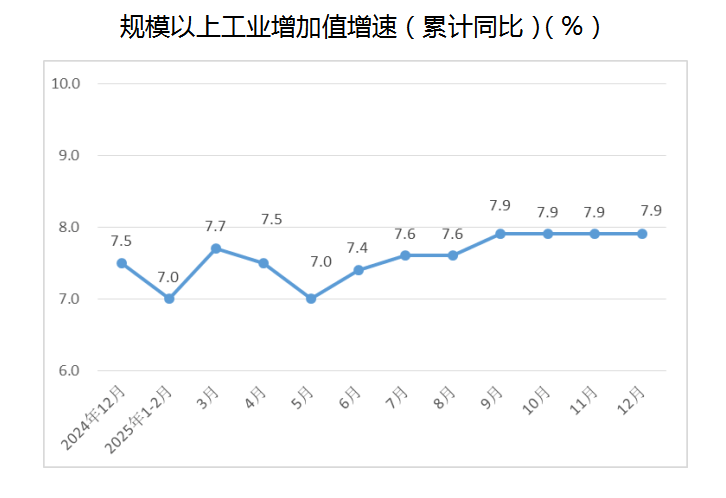
【数据发布】2025年全省规模以上工业增加值增长7.9%
Sou Hu Cai Jing· 2026-01-23 01:55
Group 1 - The mining industry grew by 7.5%, manufacturing by 8.7%, and the production and supply of electricity, heat, gas, and water by 3.5% [2] - State-owned enterprises grew by 6.0%, joint-stock enterprises by 8.1%, foreign and Hong Kong, Macao, and Taiwan-invested enterprises by 10.0%, and private enterprises by 8.9% [2] - Among 40 major industrial categories, 30 showed year-on-year growth, resulting in a growth rate of 75.0% [2] Group 2 - Seven key industries contributed to a 5.5 percentage point increase in the industrial added value, accounting for 68.8% of the total contribution [2] - In the production of 445 products, 255 showed growth, with a growth rate of 57.3% [2] - In raw materials, steel increased by 7.8%, ten non-ferrous metals by 18.0%, and tempered glass by 10.2% [2] Group 3 - In consumer products, refined tea grew by 190%, raw salt by 14.2%, and light leather by 13.0% [2] - In equipment products, feed production equipment grew by 15.3%, food manufacturing machinery by 29.5%, and automobiles by 2.0% [2]
——11月经济数据点评:需求延续弱势,生产保持韧性
Shenwan Hongyuan Securities· 2025-12-16 11:28
Group 1 - The report highlights a continued weakness in demand, particularly in consumer spending, which has been significantly impacted by a decline in automobile sales and the reduction of government subsidies for trade-ins [2][3] - Cumulative retail sales growth for January to November 2025 is reported at 4.0%, a decrease of 0.3 percentage points compared to the previous month, with automobile sales showing a cumulative year-on-year decline of 1.0% [3][22] - Industrial value-added growth for November 2025 is at 6.0%, down 0.1 percentage points from October, indicating a divergence between traditional industries related to real estate and high-tech sectors [3][4] Group 2 - The report notes a rebound in inflation, primarily driven by rising food prices, with the Consumer Price Index (CPI) increasing to 0.7% year-on-year in November, marking a 0.5 percentage point rise [3][5] - Fixed asset investment shows a cumulative year-on-year decline of 2.6% for November, with real estate investment down 15.9% and infrastructure investment at 0.13% [3][7] - The report indicates that the overall economic fundamentals are weakening, with investment growth and consumer spending declining, while inflation recovery remains uncertain [3][23]
不是所有车辆都要缴纳车辆购置税!常见误区要注意
蓝色柳林财税室· 2025-11-18 01:18
Group 1 - The core viewpoint of the article is that not all vehicles are required to pay vehicle purchase tax, with specific exemptions and regulations outlined in the relevant laws and announcements [4][5][6]. - According to the Vehicle Purchase Tax Law, taxable vehicles include cars, trams, trailers, and motorcycles with an engine capacity exceeding 150cc, while certain vehicles like subways and specialized machinery are exempt [4]. - The announcement regarding the extension and optimization of the new energy vehicle purchase tax exemption states that vehicles purchased between January 1, 2024, and December 31, 2025, will be exempt from the tax, with a maximum exemption of 30,000 yuan per vehicle [4]. Group 2 - When purchasing a second-hand vehicle, the vehicle purchase tax is not required if the tax has already been paid on that vehicle [5]. - The Vehicle Purchase Tax Law specifies that the tax is collected once, and if a vehicle that was previously exempt or had a reduced tax status is transferred or repurposed, the tax must be paid before registration [5]. - The tax must be paid at the time of vehicle registration, and it is important to note that the tax obligation arises within 60 days of the taxable event [8]. Group 3 - There is a common misconception that all vehicle purchase tax declarations must be made at the vehicle registration authority; however, it depends on whether the vehicle requires registration [6]. - For vehicles that require registration, the tax must be paid at the location where the vehicle is registered, while for those that do not require registration, the tax should be paid at the taxpayer's location [6]. - It is also a misconception that vehicle purchase tax can be paid after vehicle registration; in fact, it must be paid before the registration process [7].

瓜果丰收季,带您了解农产品增值税适用税率
蓝色柳林财税室· 2025-09-18 13:22
Group 1 - The article discusses the scope of agricultural products and the applicable VAT rate of 9% for various primary products from agriculture, forestry, animal husbandry, and aquaculture [2] - Common misconceptions are addressed, clarifying that some processed products still qualify as agricultural products, such as dumpling skins and dehydrated vegetables, which are subject to the 9% VAT rate [2] - Specific examples of agricultural products include fresh tea leaves, processed medicinal plants, and certain types of tobacco leaves, all of which fall under the 9% VAT category [2] Group 2 - Goods that do not qualify as agricultural products, such as refined tea, canned vegetables, and traditional Chinese medicine, are subject to a higher VAT rate of 13% [4] - The article outlines several VAT exemption policies for agricultural producers, including sales of self-produced agricultural products and certain sales by agricultural cooperatives [5] - Additional exemptions apply to specific sales of vegetables and live meat products by wholesalers and retailers, as well as sales of certain tea products by designated producers [5]

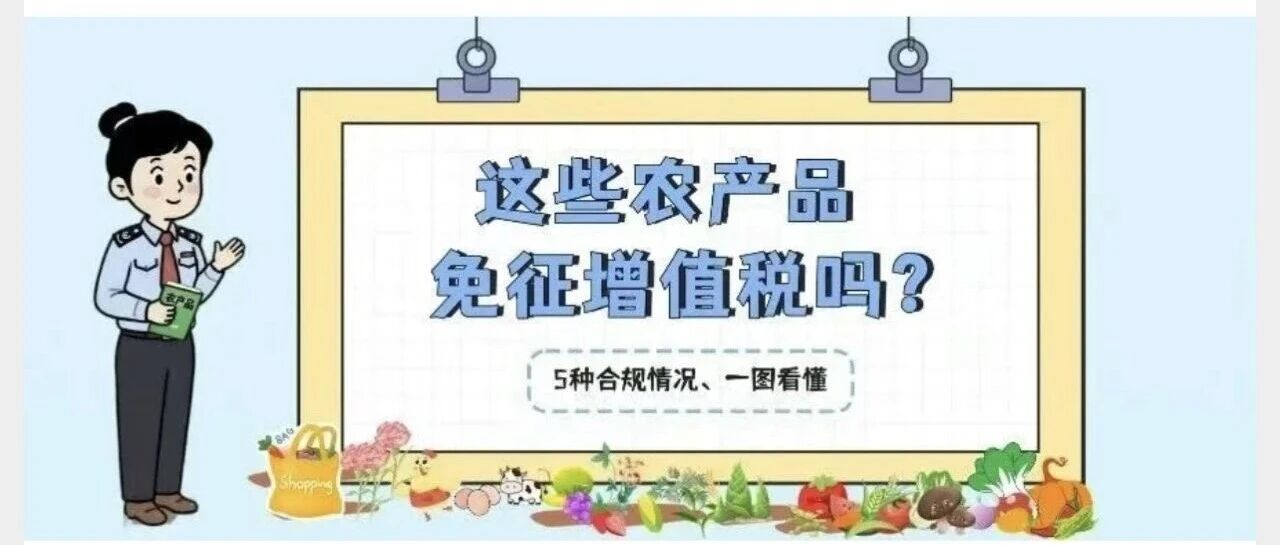
这些农产品免征增值税吗?
蓝色柳林财税室· 2025-09-02 00:55
Core Viewpoint - The article discusses the tax exemption policies for agricultural products sold by farmers' cooperatives and the conditions under which these exemptions apply [5][6]. Group 1: Tax Exemption for Agricultural Products - Agricultural producers selling their own products are exempt from value-added tax (VAT) [5]. - Farmers' cooperatives selling products produced by their members are also considered as agricultural producers and are exempt from VAT [5]. - Companies using a "company + farmer" model for selling livestock are eligible for VAT exemption as they are deemed to be selling self-produced agricultural products [6]. Group 2: Processed Agricultural Products - Once agricultural products are processed (e.g., tea leaves into refined tea), they no longer qualify for VAT exemption and must be taxed at the applicable rate [6]. - Sales of externally purchased agricultural products do not qualify for VAT exemption [6].