
超长期日本国债

Search documents
财政担忧缓解之际 日本超长期国债延续涨势
Xin Lang Cai Jing· 2026-02-12 02:31
Group 1 - The core viewpoint of the articles is that Japan's ultra-long-term government bonds have continued to rise following Prime Minister Kishida Fumio's historic election victory, alleviating investor concerns regarding fiscal policy [1][3]. - On Thursday, the yield on Japan's 40-year bonds fell by 10 basis points, while the 30-year bonds dropped by 9.5 basis points, returning to levels seen in early January when news of Kishida's early election was first reported [1][3]. - The bond market's reaction indicates that some investors are betting that Kishida's victory will lead to clearer policies and reduce the risks of worst-case fiscal scenarios [1][3]. Group 2 - Kishida stated that the Ministry of Finance will not fill the spending gap by issuing new bonds, and the government will reassess subsidies, special tax measures, and non-tax revenue to find "sustainable" funding sources [2][4]. - Despite the strengthening of the yen against the dollar for three consecutive days, Japan's foreign exchange affairs chief, Jun Mimura, emphasized that the government remains vigilant [1][3]. - Investors are still concerned about a potential market collapse, as the government needs to find alternative financing channels if it intends to cut consumption taxes without increasing debt [2][4].
瑞穗旗下资管AM-One:若日本央行于4月加息 美元兑日元有望跌破150大关
智通财经网· 2026-02-02 06:57
Group 1 - The Chief Investment Officer of Asset Management One, Shigeki Muramatsu, indicated that if the Bank of Japan raises interest rates in April, the yen could strengthen to 150 yen per dollar [1] - Asset Management One manages approximately $512 billion in assets and is inclined to purchase ultra-long Japanese government bonds due to their relatively high yields compared to Japan's growth prospects [1] - Concerns about the slow pace of monetary policy tightening by the Bank of Japan have led to a weaker yen, although Muramatsu believes the situation is not as dire as perceived [1] Group 2 - The weak yen is expected to be a significant factor necessitating interest rate hikes by the Bank of Japan and the government, with a 69% probability of a rate increase before April, up from 40% at the end of last year [2] - Muramatsu noted that the coordination between the U.S. and Japan increases the likelihood of an earlier rate hike by the Bank of Japan, especially with U.S. Treasury Secretary urging Japan to allow further rate increases [2] - A drop in the dollar-yen exchange rate below 150 could pressure the Japanese stock market, but Asset Management One remains optimistic about long-term investments in risk assets by Japanese households [2] Group 3 - Following the Bank of Japan's January policy meeting, institutions like BNP Paribas and SMBC Nikko Securities have brought forward their expectations for the next policy adjustment to April [3] - The minutes from the January meeting indicated an increasing recognition among decision-makers of the necessity for timely interest rate hikes due to the impact of a weak yen on inflation [3] - Muramatsu highlighted the attractiveness of 30-year Japanese government bonds, which stabilized at around 3.64% after a previous surge, despite concerns over fiscal sustainability due to proposed tax cuts [3]

日元目标150!瑞穗资管巨头:日本4月加息不可避免,看好日债
Hua Er Jie Jian Wen· 2026-02-02 06:51
Core Viewpoint - The market is underestimating the Bank of Japan's (BOJ) determination to tighten monetary policy, with expectations that the yen will surpass the 150 mark following an interest rate hike in April [1] Group 1: Market Expectations and Policy Changes - The probability of a BOJ interest rate hike before April has increased to approximately 69%, up from about 40% at the end of last year [3] - U.S. Treasury Secretary Bessent's recent comments urging Japan to allow further BOJ rate hikes to combat inflation have unexpectedly influenced market sentiment [3] - The New York Fed's recent currency checks indicate a surprising alignment between U.S. and Japanese efforts to curb yen weakness, suggesting a potential for earlier BOJ rate hikes [3] Group 2: Investment Opportunities - Asset Management One remains optimistic about ultra-long Japanese government bonds, noting that yields are high relative to Japan's growth prospects [4] - The 30-year Japanese government bond yield has stabilized around 3.64% after a spike last month, which is higher than comparable German bonds [4] - Despite potential pressures from a stronger yen on Japanese export-oriented companies, Asset Management One maintains a positive long-term outlook for the Japanese stock market due to increased household investment in risk assets [4][5]

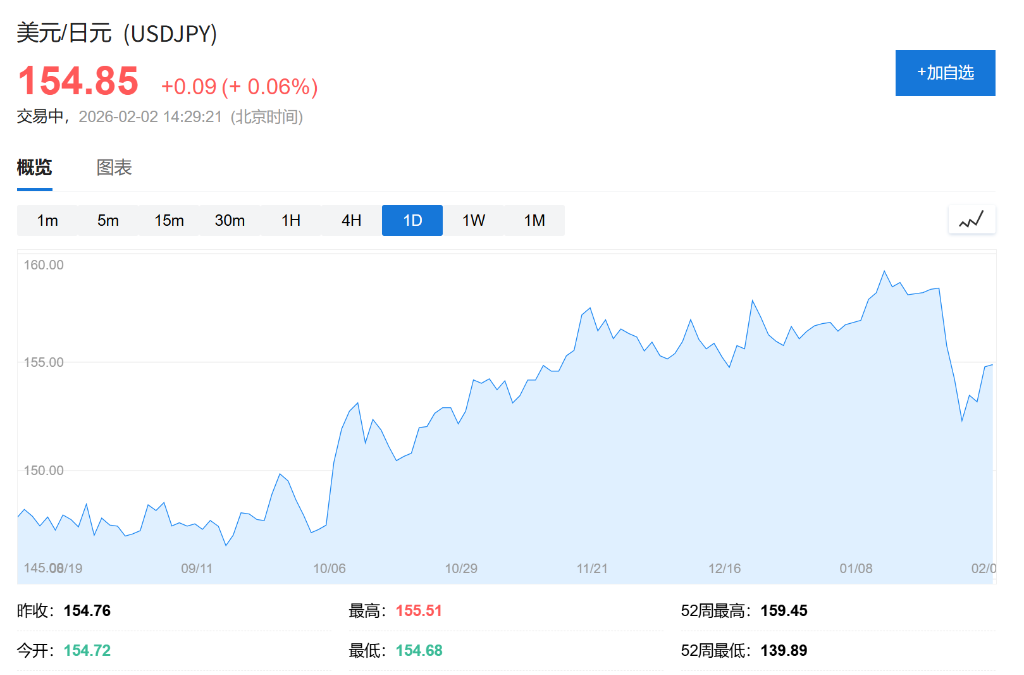
瑞穗:美日政策协调显成效,看好日元升破150大关
Sou Hu Cai Jing· 2026-02-02 05:07
Core Viewpoint - The Chief Investment Officer of Mizuho, Shigeki Muramatsu, indicates that the Japanese yen is expected to strengthen and potentially break the 150 mark as the Bank of Japan is anticipated to raise interest rates in April [1] Group 1: Market Conditions - Mizuho manages approximately $512 billion in assets as of the end of September last year [1] - There were previous market concerns regarding the current government's ability to raise interest rates, which contributed to the yen's weakness; however, the situation is changing [1] - The likelihood of interest rate hikes by the Bank of Japan has increased in the context of coordinated actions between Japan and the U.S. [1] Group 2: Investment Strategy - Mizuho currently favors purchasing ultra-long Japanese government bonds [1] - The yields on these bonds are considered attractive relative to Japan's growth prospects, particularly the 30-year bonds, which have stabilized around 3.64% after recent market turbulence [1] - The 30-year Japanese government bond yields are now higher than those of German bonds of the same maturity, despite Japan's lower potential growth rate, enhancing the appeal of Japanese bonds [1] Group 3: Fiscal Policy Impact - The stability of the bond market is expected to continue unless the government's tax reduction efforts exceed the current commitment of a "two-year food tax exemption" [1]
供应下降缓解市场紧张情绪 全球长期债券重回投资者视野
Zhi Tong Cai Jing· 2025-09-26 06:58
Group 1 - The global long-term bond market is experiencing a rebound as investors seek buying opportunities after a sell-off, with U.S. and Japanese 30-year bond yields dropping approximately 20 basis points since early September, and UK yields falling over 10 basis points [1] - The recent decline in long-term bond yields is partly driven by reduced supply, as some countries shift their issuance focus to cheaper short-term bonds, with Japan proposing to cut long-term bond issuance and the UK central bank reducing long-term bond sales in its quantitative tightening plan [1][2] - There is a growing optimism in the long-term bond market, highlighting the significant role of supply concerns in recent sell-offs, despite ongoing worries about rising fiscal deficits [2] Group 2 - Strong economic growth globally is alleviating concerns about fiscal deficits and prompting investors to reconsider long-term interest rate trends, with recommendations for Australian investors to adopt positions that benefit from a flattening yield curve [3] - The Bloomberg Global Aggregate Index indicates that bets on long-term bonds are starting to pay off, with 10-year and longer bonds returning 0.7% this month, outperforming shorter-term bonds [6] - Recent auctions show strong demand for long-term bonds, with Japan's 40-year bonds seeing enthusiastic buying and the strongest demand for 20-year bonds since 2020 [6]
8月28日汇市晚评:日本央行中川顺子重申加息立场 美元/日元呈现震荡偏弱格局
Jin Tou Wang· 2025-08-28 09:18
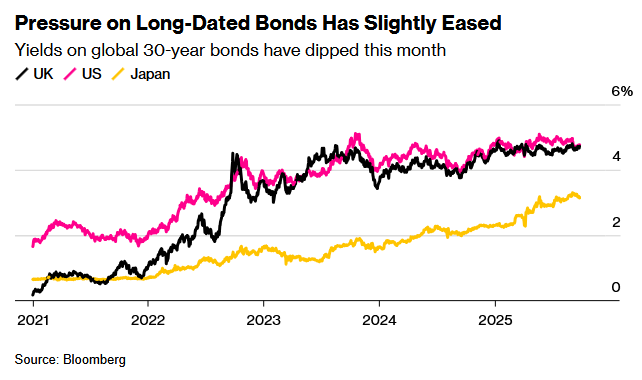
Market Overview - The GBP/USD is showing a fluctuating pattern, while the USD/JPY is exhibiting a weak trend. The EUR/USD has potential for upward movement, and the AUD/USD is under significant downward pressure from a trendline. The dollar index is supported by the middle band in the short term [1] Key Economic Insights - Federal Reserve's Williams stated that the policy remains moderately tight and inflation is gradually decreasing. Each meeting is considered "real-time" [2] - Brazil's Finance Minister emphasized that the dollar will continue to be a reserve of value for many years unless the U.S. makes significant mistakes [2] - Japan's Chief Cabinet Secretary announced the cancellation of a planned visit to the U.S. by the trade negotiation representative, insisting on lower U.S. tariffs [2] - The Bank of Japan's committee member reiterated the stance on interest rate hikes, noting concerns over tariff impacts [2] - Japan's two-year government bond auction demand hit a new low since 2009 [2] - The Russian Finance Minister projected that Russia's economic growth will not be less than 1.5% by 2025 [3] - The Slovak central bank governor appealed to the Supreme Court regarding a bribery case [4] - The Bank of Korea maintained its benchmark interest rate at 2.5%, aligning with market expectations, and expressed caution regarding potential exchange rate volatility [5] - The Bank of Korea's governor defended foreign exchange interventions aimed at preventing the depreciation of the won, which subsequently strengthened [6] Technical Analysis - GBP/USD is in a delicate balance, likely to fluctuate between 1.3405 and 1.3585. A clear market driver could break this balance and set a new direction [7] - The USD/JPY has a 14-day RSI of 45.967, indicating a neutral to slightly weak state, suggesting a potential for continued fluctuation [7] - The EUR/USD's 14-day RSI has just entered 50, indicating a need to monitor for upward movement, with a bullish flag pattern suggesting a breakout target of 1.2120 if it closes above 1.1740 [7] - The dollar index has key resistance levels at 98.83 and 98.95, with support levels at 98.27 and 97.5877. A drop below 97.54-97.59 could redefine the market structure [8] Upcoming Economic Data - The European Central Bank will release the minutes from the July monetary policy meeting at 19:30 [10] - Canada’s Q2 current account data and U.S. initial jobless claims for the week ending August 23 will be released at 20:30 [10] - The U.S. will also revise its Q2 annualized GDP rate at 20:30 and report on the July pending home sales index at 22:00 [10] - The EIA natural gas inventory data will be available at 22:30, followed by a speech on monetary policy by Fed Governor Waller at 06:00 the next day [10]
巴克莱:超长期日债收益率或面临温和上行压力
news flash· 2025-07-22 01:54
Core Viewpoint - Barclays strategists indicate that ultra-long Japanese government bond yields may face mild upward pressure following the recent Senate elections in Japan [1] Summary by Relevant Sections - **Market Reaction** - The balance of power between the ruling and opposition parties post-election suggests that the reasonable valuation for the 30-year Japanese government bond yield premium should be around 150 basis points [1] - This indicates an upward pressure of approximately 5 basis points from the previous level of 145 basis points [1] - **Temporary Factors** - The report mentions that some temporary factors could contribute an additional 5 basis points of upward pressure on yields [1]

日本财务大臣加藤胜信:超长期日本国债收益率已出现大幅上升。
news flash· 2025-06-24 02:19
Group 1 - The Japanese Finance Minister, Kato Katsunobu, has indicated a significant rise in ultra-long-term Japanese government bond yields [1] - This increase in yields reflects broader trends in the financial markets and may impact government borrowing costs [1] - The rise in bond yields could influence investor sentiment and market dynamics in Japan [1]
据悉日本政府考虑回购部分超长期日本国债
news flash· 2025-06-09 08:24
Core Viewpoint - The Japanese government is considering repurchasing some of the ultra-long Japanese government bonds issued at low interest rates in response to a sharp rise in yields [1] Group 1: Government Actions - The move to repurchase bonds aligns with the government's existing plan to reduce the issuance of ultra-long bonds amid rising yields [1] - The Ministry of Finance is attempting to collaborate with the Bank of Japan, which is also reevaluating its reduction plans for the upcoming year [1] Group 2: Economic Context - The repurchase initiative is part of a broader strategy to manage Japan's substantial public debt, which remains a significant concern for the government [1]
市场消息:日本政府考虑回购过去发行的超长期日本国债。
news flash· 2025-06-09 08:19
Core Viewpoint - The Japanese government is considering repurchasing previously issued ultra-long-term Japanese government bonds, indicating a potential shift in monetary policy and market dynamics [1] Group 1: Government Actions - The potential repurchase of ultra-long-term bonds suggests a proactive approach by the government to manage debt and interest rates [1] - This move may reflect concerns over rising interest rates and their impact on the economy [1] Group 2: Market Implications - The repurchase could lead to increased liquidity in the bond market, affecting yields and investor sentiment [1] - It may also signal a change in the government's strategy towards long-term debt management, which could influence future bond issuance [1]