
金属期货

Search documents
安粮期货:原油
An Liang Qi Huo· 2026-03-18 02:28
Report Industry Investment Ratings No relevant content provided. Core Views of the Report - The ongoing war between the US, Israel, and Iran has made the blockade of the Strait of Hormuz a gray rhino event, causing oil prices to remain high. The supply of crude oil is expected to decline, and the market is in a state of shortage. The release of strategic oil reserves can only temporarily alleviate the supply gap. The price of crude oil will depend on the situation of the Strait of Hormuz and the balance between supply and demand [3][4]. - The Chinese government will continue to implement a more proactive fiscal policy in 2026, which will support the equity market, especially the infrastructure, consumption, and technology sectors. However, the overseas "stagflation" risk and the market's demand for verifying the economic recovery strength will suppress the global risk preference, and the market will continue to adjust with structural differentiation [5]. - Geopolitical risks have not pushed up the price of gold as expected. Instead, the soaring oil price has strengthened inflation expectations, leading to a significant cooling of the market's expectation of the Fed's interest rate cut. The dollar index and the 10 - year US Treasury yield have put pressure on the price of gold. The price of gold is expected to fluctuate in the short term, and there may be an opportunity to buy at a low price in the medium - to - long term [6][7]. - The price of silver is under pressure from the strengthening dollar and the market's short positions, but it is also supported by strong industrial demand and supply shortages. Traders should pay attention to the breakthrough of key intervals and control their positions [8]. - The prices of various chemical products are affected by factors such as the blockade of the Strait of Hormuz, supply and demand, and cost. The market trends of different chemical products vary, and investors need to pay attention to relevant factors [9][10][11][12][13][14][15][16][17][18]. - The prices of agricultural products are affected by factors such as international geopolitical situations, supply and demand, and policies. Different agricultural products have different market trends, and investors need to pay attention to relevant information [19][20][21][22][23][24][25]. - The prices of metals are affected by factors such as supply and demand, geopolitical risks, and inventory. Different metals have different market trends, and investors need to pay attention to relevant factors [26][27][28][29][30][31][32]. - The prices of black commodities are affected by factors such as policy expectations, supply and demand, and cost. Different black commodities have different market trends, and investors need to pay attention to relevant information [33][34][35][36][37][38][39]. Summaries by Relevant Catalogs Crude Oil - **Macro and Geopolitical Factors**: The war between the US, Israel, and Iran continues, and the blockade of the Strait of Hormuz has become a gray rhino event, causing oil prices to remain high. The US president's call for joint escort has received few responses, and it is difficult to resume navigation in the short term. The reduction in production by Middle Eastern oil - producing countries and the increased transportation costs due to rerouting after the blockade will give crude oil a certain premium [3]. - **Market Analysis**: The IEA predicts that the crude oil supply will decrease by 8 million barrels per day in March. If the blockade continues, the supply may continue to decline. The market has shifted from oversupply to shortage, with a gap of 10 - 20 million barrels per day, accounting for 10% of the dynamic balance. The release of strategic oil reserves can only make up for one - month's export gap if the Strait of Hormuz has zero traffic. The price of crude oil may drop significantly if the Strait is reopened after the refineries reduce their loads and demand declines further. If the Strait's traffic and the supply - demand balance do not return to normal during the peak summer season, the oil price will remain high [4]. - **Reference View**: Pay attention to whether the WTI main contract can hold the key position around $95 - 100 per barrel. The volatility of crude oil has increased [4]. Stock Index - **Macro Information**: The Chinese government will continue to implement a more proactive fiscal policy in 2026, aiming to stabilize the macro - economic situation and support the equity market, especially the infrastructure, consumption, and technology sectors [5]. - **Market Analysis**: The overseas "stagflation" risk has suppressed the global risk preference. The market's demand for verifying the economic recovery strength has increased. Some growth sectors are facing performance tests and changes in external liquidity expectations. Funds tend to flow to large - cap, low - valuation, and high - performance - stability sectors, and the market risk preference has decreased [5]. - **Reference View**: The main broad - based indexes will continue to adjust in a volatile manner, and structural differentiation may continue [5]. Gold - **Macro and Geopolitical Factors**: Geopolitical risks have not pushed up the price of gold as expected. Instead, the soaring oil price has strengthened inflation expectations, leading to a significant cooling of the market's expectation of the Fed's interest rate cut. The dollar index and the 10 - year US Treasury yield have put pressure on the price of gold [6]. - **Market Analysis**: The price of spot gold fluctuates within a range and once fell below $5000 per ounce this week. The main pressure on the gold market comes from the reconstruction of interest rate expectations. The SPDR Gold ETF has continuously reduced its positions slightly. If the oil price continues to rise slowly, the dollar and the US Treasury yield may continue to be supported, and the price of gold may continue to fluctuate in the short term to digest the selling pressure [7]. - **Operation Suggestion**: Maintain a neutral position before the Fed's interest rate meeting. If the geopolitical situation eases and the oil price drops, there may be an opportunity to buy at a low price. In the medium - to - long term, the allocation value of gold still exists [7]. Silver - **External Price**: On March 17, the silver market continued to be under pressure, and the London silver was struggling around the $80 per ounce mark. The macro - suppression factors are still obvious, and the Fed's interest rate cut expectation has been continuously suppressed due to inflation concerns caused by the Middle East situation. The strengthening dollar has made silver more expensive for non - US buyers [8]. - **Market Analysis**: Silver is experiencing a fierce game between its "commodity attribute" and "financial attribute". The support comes from strong industrial demand and continuous supply deficits, while the pressure comes from the increase in real interest rates and the long - short game in the speculative market. Although there is a supply shortage, a large number of short positions in the paper - silver market have formed a price - suppression mechanism. If the dollar index continues to rise, the silver price may test lower support levels; if the geopolitical situation eases and the dollar falls, the continuous supply shortage may push up the price [8]. - **Operation Suggestion**: Short - term traders should pay attention to the breakthrough of key intervals and be flexible within the range. Before the Fed's monetary policy path becomes clear, strictly control the position to deal with the current high - volatility environment [8]. Chemical Industry Rubber - **Market Price**: The spot prices of domestic whole - latex, Thai smoked three - piece, Vietnamese 3L standard rubber, and 20 - grade rubber are 16,700 yuan/ton, 19,900 yuan/ton, 17,000 yuan/ton, and 15,200 yuan/ton respectively. The raw material prices in Haikou are 74.3 Thai baht/kg for smoked sheets, 73 Thai baht/kg for latex, 58.5 Thai baht/kg for cup rubber, and 70 Thai baht/kg for raw rubber [9]. - **Market Analysis**: The Shanghai rubber market remains neutral. The continuous blockade of the Strait of Hormuz may have a negative impact on the demand for Shanghai rubber, but due to the off - season of rubber tapping, the raw material prices are still rising, so the downside space is limited. The raw material prices in Thailand are still at a high level, providing support for the rubber price. However, the domestic production areas are gradually starting to tap, and the supply is becoming more abundant. The blockade of the strait has increased the premium of energy - chemical products but also worried the market about the demand for natural rubber. The downstream demand shows that the capacity utilization rate of China's semi - steel tire sample enterprises last week was 78.73%, a month - on - month increase of 4.20% and a year - on - year decrease of 0.36%; the capacity utilization rate of full - steel tire sample enterprises was 71.80%, a month - on - month increase of 6.42% and a year - on - year increase of 2.81%. The inventory in Qingdao Bonded Area increased by 1.27% to 11.96 tons, and the general trade inventory increased by 0.04% to 68.04 tons. Under the influence of multiple factors, the upward trend of Shanghai rubber may slow down and turn into a wide - range shock [10]. - **Reference View**: The main contract of Shanghai rubber will fluctuate around 16,400 - 17,500 yuan/ton [10]. Plastic - **Spot Information**: The mainstream spot prices in North China, East China, and South China are 8,414 yuan/ton, 8,665 yuan/ton, and 8,977 yuan/ton respectively, with month - on - month decreases of 60 yuan/ton, 126 yuan/ton, and 105 yuan/ton [11]. - **Market Analysis**: On the supply side, the operating rate of China's polyethylene plants last week was 82.39%, a month - on - month decrease of 4.5171%; the production affected by plant maintenance was 9.104 tons, a month - on - month increase of 2.076 tons. On the demand side, the overall operating rate of polyethylene downstream enterprises last week was 33.83%. As of March 13, 2026, the inventory of Chinese polyethylene production enterprises was 57.54 tons. On March 17, the closing price of L2605 was 8,496 yuan/ton, and the futures price declined. Geopolitical factors are expected to support the high price of crude oil, the cost side is strong, the downstream rigid demand may improve slightly but the procurement is cautious, the supply is expected to decrease, the inventory is maintained at a reasonable level, and the macro - situation is still uncertain. The polyethylene market is expected to fluctuate in a relatively strong range under the game of multiple factors, and the price is difficult to continue to rise significantly [11]. - **Reference View**: It is expected that plastics will fluctuate in a relatively strong range in the short term, and attention should be paid to geopolitical disturbances [12]. Methanol - **Spot Information**: The spot price of methanol in Zhejiang is 2,865 yuan/ton, an upward fluctuation of 20 yuan/ton from the previous trading day. The spot price in Xinjiang is 1,750 yuan/ton, the same as the previous trading day. The spot price in Hebei is 2,340 yuan/ton, the same as the previous trading day [13]. - **Market Analysis**: The closing price of the main methanol futures contract MA605 is 2,847 yuan/ton, an upward fluctuation of 0.35% from the previous trading day. In terms of inventory, the total port inventory is 131.28 tons, with a significant reduction of 13.07 tons compared with the previous period. Among them, the inventory in South China decreased by 3.51 tons, and the inventory in East China decreased by 9.56 tons. On the supply side, the upstream coal - to - methanol still has profits, and the operating rate of the domestic methanol industry is 90.15%, maintaining a high level; on the demand side, the loss of MTO profits has increased, the operating rate of the device is maintained at 84.08%; the operating rate of the MTBE device is 68.94%, and the demand for traditional downstream products (acetic acid, formaldehyde) is still weak, mainly for rigid - demand procurement, suppressing the price elasticity. Internationally, the Middle East conflict has blocked the shipping in the Strait of Hormuz, and the Brent crude oil has rebounded again, with the increase once expanding to about 4%. The cost support of methanol has been strengthened; the risk of supply interruption of Iranian methanol supports the price [13]. - **Reference View**: Methanol futures may fluctuate at a high level in the short term, presenting a pattern of strong geopolitics and weak reality. Pay close attention to the navigation situation of the Strait of Hormuz and the dynamics of Iranian devices. Track the Middle East situation and the destocking of port inventory, and be vigilant against the intensification of the negative feedback in the industrial chain [13]. PTA - **Spot Information**: The spot price in East China is 6,770 yuan/ton, a decrease of 190 yuan/ton [14]. - **Market Analysis**: The logistics risk in the strait has led to a shortage of PX supply, and domestic refineries have reduced their loads preventively, so the short - term cost support is strong. The supply of PTA is steadily increasing. In terms of device operation, a 3.6 - million - ton device in East China reduced its load on March 12, but other devices such as Yisheng New Materials and Dushan Energy have restarted or increased their loads one after another, and the overall supply has maintained a growth trend. The demand of the downstream polyester industry is slowly recovering. Among the sub - products, the output of polyester industrial yarn has increased significantly; the capacity utilization rate of PET chip fiber has increased from 81.37% to 86.22%, indicating that the downstream operation is gradually improving. However, the inventory of PTA factories has accumulated, mainly because the recovery rhythm of downstream demand is slower than the supply growth rate, and the market's concern about supply interruption has prompted more inventory building [14]. - **Reference View**: In the short term, continue to pay attention to geopolitical disturbances. In addition, the recovery of downstream demand is still the key [14]. Ethylene Glycol - **Spot Information**: The spot price in East China is 4,780 yuan/ton, a decrease of 75 yuan/ton [15]. - **Market Analysis**: In March, multiple domestic coal - based and oil - based devices are planned for maintenance, and external Iranian devices are shut down (with an annual capacity of 450,000 tons). Coupled with the blockade of the Strait of Hormuz, the import expectation has decreased, and the domestic ethylene glycol production has decreased significantly, and the supply side has continued to tighten. The demand of the downstream polyester industry remains stable, and the capacity utilization rate is maintained at around 83.83%. The downstream inventory - building willingness has increased. It is worth noting that the polyester industry accounts for 94% of ethylene glycol consumption and is greatly affected by the cost side in the short term [15]. - **Reference View**: Pay attention to the trend of the cost - side oil price and downstream demand, and it will fluctuate in a short - term range [15]. Soda Ash - **Spot Information**: The mainstream price of heavy soda ash in the Shahe area is 1,236 yuan/ton, the same as the previous period. There are slight differences among different regions. The mainstream price of heavy soda ash in East China is 1,250 yuan/ton, in North China is 1,280 yuan/ton, and in Central China is 1,230 yuan/ton, all the same as the previous period [16]. - **Market Analysis**: On the supply side, the overall operating rate of soda ash last week was 87%, a month - on - month increase of 0.23%. The soda ash output was 80.92 tons, a month - on - month increase of 0.22 tons. There were few maintenance enterprises during the week, and the supply remained at a high level. In terms of inventory, the manufacturer's inventory last week was 1.9317 million tons, a month - on - month decrease of 15,500 tons, a decrease of 0.80%, and the inventory decreased slightly. It is understood that the social inventory has increased steadily and is close to 280,000 tons. The demand performance is average. Overall, there is no major change in the soda ash market, and the fundamentals are still weak. However, the international situation is changeable, and it is expected that the market will still fluctuate highly, but the upside space may be limited due to the fundamental pressure. Pay attention to macro and policy dynamics, enterprise maintenance situations, and inventory changes [16]. - **Reference View**: The market continued to decline slightly yesterday. It is recommended to be cautious about chasing high in the short term [16]. Glass - **Spot Information**: The market price of 5 - mm large - plate glass in the Shahe area is 1,044 yuan/ton, the same as the previous period. There are slight differences among different regions. The market price of 5 - mm large - plate glass in East China is 1,250 yuan/ton, in North China is 1,070 yuan/ton, and in Central China is 1,090 yuan/ton, all the same as the previous period [17][18]. - **Market Analysis**: On the supply side, the operating rate of float - glass last week was 71.05%, a month - on - month increase of 0.24%. The weekly glass output was 1.0333 million tons, a month - on - month decrease of 6,400 tons. One production line in North China was ignited, and one production line in North China and one in Northwest China were shut down
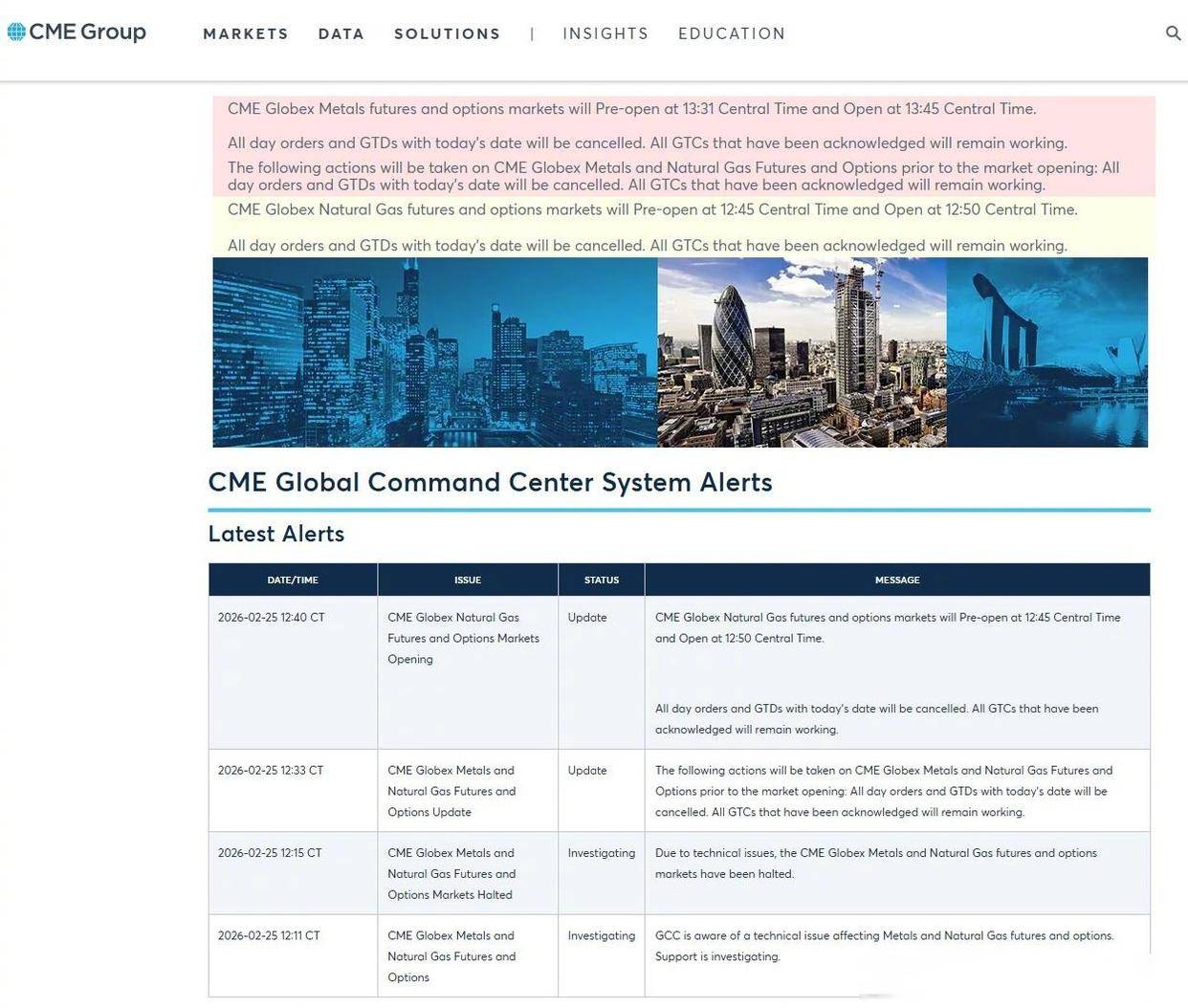
【芝商所技术故障致天然气与金属期货交易中断 ,周三委托单全数取消】这是CME约一个月内第二次系统性交易中断,周三恰逢3月天然气期货合约到期日。市场人士称,在市场收盘前出现“冻结”是“极糟糕的时机”,“所有以期货作为定价和对冲工具的参与者都受到了影响”。详见
Sou Hu Cai Jing· 2026-02-26 00:54
Group 1 - CME experienced a technical failure that led to the interruption of natural gas and metals futures trading, marking the second systemic trading disruption within a month [1] - The interruption occurred on the expiration date of the March natural gas futures contract, which was considered a particularly poor timing for market participants [1] - All day orders and Good Till Date (GTD) orders for the affected trading day were canceled, while Good Till Canceled (GTC) orders remained active [2][2] Group 2 - The technical issues were acknowledged by CME, and support teams were investigating the cause of the disruption [2][2] - The natural gas futures and options markets were scheduled to pre-open shortly after the disruption, indicating a prompt response to restore trading [2]


中国期货运行月报-20260204
Zhong Xin Qi Huo· 2026-02-04 05:19
1. Report Industry Investment Rating There is no information about the report industry investment rating in the provided content. 2. Core Viewpoints The report provides a comprehensive overview of the Chinese futures market in January 2026, including key events, price changes, initial margin, trading volume, and turnover. It also presents detailed data on different types of futures, such as financial futures, metal futures, energy & chemicals futures, agricultural products futures, and indices futures. 3. Summary by Directory 3.1 Futures Overview - **Key Events**: In January 2026, there were significant geopolitical events, including the US's strike against Venezuela, potential actions against Iran, and tariff disputes between the US and Europe. Domestically, China had high - level meetings with Canada and the UK, renewing currency swap agreements and achieving positive outcomes. The US President nominated Kevin Warsh as the new Federal Reserve Chair, and the Federal Reserve maintained the federal funds rate target range at 3.5% - 3.75% [9][12][13]. - **Financial Futures**: In January 2026, equity index futures rose, with IC increasing by 13.6% and IM by 11.1%. CGB futures also rose, with TL increasing by 0.5% and TS decreasing by 0.1% [19]. - **Commodity Futures**: Among commodity futures, the top three gainers were silver (63.6%), tin (26.7%), and lithium carbonate (21.9%), while the top three losers were SCFIS(Europe) (-31.9%), poly - silicon (-18.6%), and sodium hydroxide (-11.9%) [23]. - **Initial Margin**: In January 2026, the initial margin of different futures sectors increased. Energy & Chemicals increased by 30.1%, Indices by 1.3%, Metal by 31.4%, Agricultural Products by 8.4%, Equity Index by 31.2%, and Interest Rates by 15.6% [40]. - **Trading Volume and Turnover**: In January, the trading volume of the Chinese futures market reached 723.14 million lots, with a year - on - year growth of 57.8%. The turnover reached 997,529.92 billion yuan, with a year - on - year growth of 104.6% [45][51]. 3.2 Financial Futures - **Equity Index Futures**: In January 2026, SSE 50 (IH) increased by 1.6%, CSI 300 (IF) by 2.4%, CSI 500 (IC) by 13.6%, and CSI 1000 (IM) by 11.1%. The open interest and initial margin of these futures also increased to varying degrees [61]. - **Interest Rates Futures**: The 2 - Year CGB (TS) decreased by 0.1%, the 5 - Year CGB (TF) increased by 0.1%, the 10 - Year CGB (T) increased by 0.4%, and the 30 - Year CGB (TL) increased by 0.5%. The open interest and initial margin of these futures also changed accordingly [65]. 3.3 Metal Futures - **Precious Metals Futures**: Gold increased by 18.8%, silver by 63.6%, palladium by 9.1%, and platinum by 19.6%. The open interest and initial margin of these futures also had different changes [70]. - **Nonferrous Metals Futures**: Copper(BC) increased by 4.6%, copper by 5.5%, aluminum by 7.1%, etc. The open interest and initial margin of non - ferrous metals futures also changed [75]. - **Ferrous Metals Futures**: Iron ore changed by 0.3%, steel rebar by 0.2%, hot - rolled coil by 0.6%, etc. The open interest and initial margin of ferrous metals futures also changed [81]. - **Novel Materials Futures**: Lithium carbonate increased by 21.9%, silicon metal changed by - 0.1%, and poly - silicon decreased by 18.6%. The open interest and initial margin of these futures also changed [85]. 3.4 Energy & Chemicals - **Oil & Gas Futures**: Crude oil increased by 8.9%, fuel oil by 15.2%, LSFO by 11.3%, etc. The open interest and initial margin of these futures also changed [91]. - **Olefins Futures**: Propylene increased by 6.6%, LLDPE by 8.4%, PP by 7.5%, and polyvinyl chloride by 5.4%. The open interest and initial margin of these futures also changed [95]. - **Aromatics Futures**: Benzene increased by 12.8%, ethenylbenzene by 13.6%, paraxylene by 0.3%, etc. The open interest and initial margin of these futures also changed [99]. - **Organics Futures**: Methanol increased by 4.7%, ethylene glycol by 2.9%, and urea by 2.3%. The open interest and initial margin of these futures also changed [103]. - **Inorganics Futures**: Soda ash changed by - 0.4%, sodium hydroxide decreased by 11.9%, and glass decreased by 2.9%. The open interest and initial margin of these futures also changed [108]. - **Coals Futures**: Coking coal increased by 3.6%, and coke increased by 1.7%. The open interest and initial margin of these futures also changed [111]. 3.5 Agricultural Products - **Oil Crops Futures**: No.1 soybean increased by 3.3%, No.2 soybean by 2.7%, soybean oil by 5.3%, etc. The open interest and initial margin of these futures also changed [117]. - **Grains Futures**: Corn increased by 2.0%, and corn starch by 0.2%. The open interest and initial margin of these futures also changed [122]. - **Rubber & Woods Futures**: Woodpulp decreased by 4.2%, offset paper by - 0.7%, TSR 20 by 4.6%, etc. The open interest and initial margin of these futures also changed [126]. - **Animals Futures**: Live hog decreased by 4.9%, and egg increased by 1.7%. The open interest and initial margin of these futures also changed [131]. - **Economic Crops Futures**: Cotton changed by 0.6%, cotton yarn by - 0.4%, peanut kernel by 0.9%, etc. The open interest and initial margin of these futures also changed [135]. 3.6 Indices Futures - **SCFIS(Europe)**: SCFIS(Europe) decreased by 31.9%. The open interest increased by 11.2%, and the initial margin increased by 1.3% [144].
谷物期货大多走高,美伊关系紧张
Jin Rong Jie· 2026-01-30 15:37
Group 1 - Grain futures mostly rose due to market concerns that a potential war between the U.S. and Iran could disrupt supply chains [1] - Wheat continued its upward trend driven by geopolitical tensions, while corn was boosted by President Trump's support for increasing ethanol content in gasoline [1] - Soybeans fell due to expectations of a bumper crop in Brazil [1] Group 2 - On the macroeconomic front, wholesale inflation exceeded expectations, and the market believes that Kevin Warsh, Trump's nominee for Federal Reserve Chairman, is unlikely to accelerate interest rate cuts [1] - This supported the U.S. dollar and tempered the rise in metal prices [1] - In the Chicago futures market, soybeans dropped by 0.6%, corn rose by 0.5%, and wheat increased by 0.2% [1]
LME2025年金属交易量创历史新高
Ge Long Hui A P P· 2026-01-08 10:10
Core Insights - The London Metal Exchange (LME) reported a record high in metal trading volume for 2025, with a year-on-year increase of 7.9% [1] Industry Summary - The LME's trading volume reached a historical peak in 2025, indicating strong market activity and demand for metals [1] - The 7.9% growth in trading volume reflects positive trends in the metals market, suggesting increased investor interest and potential opportunities for stakeholders [1]
本周热点前瞻20251015
Qi Huo Ri Bao Wang· 2025-10-15 00:55
Group 1 - The People's Bank of China is expected to release financial statistics for September, including M2 growth, new RMB loans, and social financing scale, with M2 expected to grow by 8.5% year-on-year, down from 8.8% [1] - New RMB loans for September are anticipated to be 1.375 trillion yuan, significantly higher than the previous month's 590 billion yuan [1] - The expected increase in social financing scale for September is 3.45 trillion yuan, compared to 2.5668 trillion yuan in the previous month [1] Group 2 - The World Bureau of Metal Statistics (WBMS) is set to publish a global metal supply and demand report, which will be closely monitored for its impact on metal futures prices [2] Group 3 - The Federal Reserve will release its Beige Book on economic conditions, with attention on how the results may influence related futures prices [3] Group 4 - The U.S. Department of Commerce is expected to announce September retail sales data, with a month-on-month increase forecasted at 0.4%, down from 0.6% [4] - Core retail sales for September are projected to rise by 0.3%, a decrease from the previous 0.7% [4] - A slight decline in retail sales data could moderately suppress the prices of commodities, excluding gold and silver [4] Group 5 - The U.S. Energy Information Administration (EIA) will report on crude oil inventory changes for the week ending October 10, with the previous increase recorded at 3.715 million barrels [5] - An increase in crude oil inventory could hinder the rise in oil and related commodity futures prices [5] Group 6 - The U.S. Department of Commerce will release data on new housing starts and building permits for September, with new housing starts expected to total 1.31 million units, slightly up from 1.307 million units [6] - Building permits are anticipated to be 1.343 million units, an increase from the previous 1.33 million units [6] - A slight increase in new housing starts and building permits could support basic metal futures prices but may suppress gold and silver futures prices [6]
流动性日报:股指板块增仓首位,能源化工板块减仓首位-20250917
Hua Tai Qi Huo· 2025-09-17 07:58
Report Summary 1. Report Industry Investment Rating No relevant content provided. 2. Core View The report presents the market liquidity situation of various sectors on September 16, 2025, including trading volume, holding amount, trading - holding ratio, and their changes compared to the previous trading day. 3. Summary by Directory I. Plate Liquidity - The report shows data on the trading - holding ratio, trading volume change rate, holding volume, holding amount, trading volume, and trading amount of each sector, with data sources from Flush and Huatai Futures Research Institute [8]. II. Stock Index Plate - On September 16, 2025, the stock index plate had a trading volume of 869.549 billion yuan, a +21.91% change from the previous trading day; the holding amount was 1384.757 billion yuan, a +5.50% change; the trading - holding ratio was 62.40% [1]. - There are also data on the rise - fall rate, trading - holding ratio, precipitation fund change, precipitation fund trend, trading amount change, and the top 20 net holding ratio trend of each variety in the stock index plate, with data sources from Flush and Huatai Futures Research Institute [16][11][13]. III. Treasury Bond Plate - On September 16, 2025, the treasury bond plate had a trading volume of 574.17 billion yuan, a +56.80% change from the previous trading day; the holding amount was 767.467 billion yuan, a +4.46% change; the trading - holding ratio was 76.10% [1]. - There are data on the rise - fall rate, trading - holding ratio, precipitation fund change, precipitation fund trend, trading amount change, and the top 20 net holding ratio trend of each variety in the treasury bond plate, with data sources from Flush and Huatai Futures Research Institute [18][23][22]. IV. Basic Metals and Precious Metals (Metal Plate) - On September 16, 2025, the basic metals plate had a trading volume of 396.256 billion yuan, a +23.43% change from the previous trading day; the holding amount was 523.156 billion yuan, a - 0.65% change; the trading - holding ratio was 92.22%. The precious metals plate had a trading volume of 411.974 billion yuan, a +22.96% change; the holding amount was 512.779 billion yuan, a +1.64% change; the trading - holding ratio was 96.16% [1]. - There are data on the rise - fall rate, trading - holding ratio, precipitation fund change amount, precipitation fund trend, trading amount change rate, and the top 20 net holding ratio trend of each variety in the metal plate, with data sources from Flush and Huatai Futures Research Institute [32][21][22]. V. Energy and Chemical Plate - On September 16, 2025, the energy and chemical plate had a trading volume of 429.819 billion yuan, a +2.24% change from the previous trading day; the holding amount was 431.891 billion yuan, a - 1.40% change; the trading - holding ratio was 88.26% [1]. - There are data on the rise - fall rate, trading - holding ratio, precipitation fund change amount, precipitation fund trend, trading amount change rate, and the top 20 net holding ratio trend of the main varieties in the energy and chemical plate, with data sources from Flush and Huatai Futures Research Institute [36][27][28]. VI. Agricultural Products Plate - On September 16, 2025, the agricultural products plate had a trading volume of 306.461 billion yuan, a - 11.36% change from the previous trading day; the holding amount was 559.628 billion yuan, a +1.77% change; the trading - holding ratio was 49.84% [1]. - There are data on the rise - fall rate, trading - holding ratio, precipitation fund change amount, precipitation fund trend, trading amount change rate, and the top 20 net holding ratio trend of the main varieties in the agricultural products plate, with data sources from Flush and Huatai Futures Research Institute [46][42][35]. VII. Black Building Materials Plate - On September 16, 2025, the black building materials plate had a trading volume of 383.711 billion yuan, a +24.29% change from the previous trading day; the holding amount was 388.441 billion yuan, a +1.89% change; the trading - holding ratio was 95.71% [2]. - There are data on the rise - fall rate, trading - holding ratio, precipitation fund change amount, precipitation fund trend, trading amount change rate, and the top 20 net holding ratio trend of each variety in the black building materials plate, with data sources from Flush and Huatai Futures Research Institute [51][39][40].
中国期货每日简报-20250627
Zhong Xin Qi Huo· 2025-06-27 05:21
1. Report Industry Investment Rating No relevant content in the provided documents. 2. Report's Core Viewpoint On June 26, 2025, equity index futures declined, while 30 - year CGB rose; metal futures trended strongly, and agricultural product futures fell. The top three gainers were coking coal, poly - silicon, and silicon metal, and the top three decliners were rapeseed meal, soybean meal, and No.2 Soybean [10][11][12]. 3. Summary According to Related Catalogs 3.1 China Futures 3.1.1 Overview On June 26, equity index futures declined, 30 - year CGB rose, metal futures were strong, and agricultural product futures fell. Coking coal, poly - silicon, and silicon metal were the top gainers, with coking coal rising 3.6% and positions increasing 7.7% month - on - month, poly - silicon rising 3.5% and positions decreasing 3.7% month - on - month, and silicon metal rising 2.7% and positions increasing 4.8% month - on - month. Rapeseed meal, soybean meal, and No.2 Soybean were the top decliners, with rapeseed meal falling 2.7% and positions increasing 8.9% month - on - month, soybean meal falling 2.4% and positions decreasing 0.8% month - on - month, and No.2 Soybean falling 1.6% and positions decreasing 12.0% month - on - month [10][11][12]. 3.1.2 Daily Rise - **Silicon Metal**: On June 26, it increased by 2.7% to 7720 yuan/ton. There was news of a furnace shutdown at an enterprise, but the supply - demand contradiction remained unrelieved, keeping silicon prices under pressure. On the supply side, northern large - scale manufacturers resumed production, and southwest China entered the wet season with reduced electricity prices and new capacity launches. On the demand side, downstream demand was weak, with polysilicon producers cutting output. Social inventories continued to accumulate, but futures prices made the market more cost - effective, and warehouse receipt inventory was liquidated faster, supporting near - month contracts [16][17][18]. - **TSR20**: On June 26, it increased by 2.6% to 12145 yuan/ton, and natural rubber increased by 2.1% to 14040 yuan/ton. External shocks subsided, and prices may follow overall commodity volatility. The trading focus may return to fundamentals, but rubber's fundamentals had limited short - term variables. Supply was affected by the rainy season, and demand was relatively stable in the short - term but weak in expectation. In the third quarter, de - stocking trades may prevent a deep decline [23][24][25]. 3.1.3 Daily Drop - **Rapeseed Meal**: On June 26, it decreased by 2.7% to 2550 yuan/ton, and soybean meal decreased by 2.4% to 2936 yuan/ton. Domestically, soybean meal had both supply and demand growth, while rapeseed meal faced weakening in both. In the short - to - medium term, soybean arrivals were expected to increase, oil mill operating rates would remain high, and soybean meal inventories were rising seasonally. In the long term, breeding sow inventory growth indicated stable and increasing rigid demand for soybean meal, and there were expected supply gaps in the fourth quarter [31][32][33]. 3.2 China News 3.2.1 Macro News The Ministry of Commerce has approved a certain number of compliant applications for rare earth exports to the EU and will strengthen approval work. The NDRC will allocate the third batch of funds for consumer goods trade - in program in July and will launch and intensify the implementation of the equipment renewal loan interest discount policy [38]. 3.2.2 Industry News The Hong Kong Special Administrative Region Government issued the "Hong Kong Policy Declaration on Digital Asset Development 2.0". The Shanghai Futures Exchange plans to list offset printing paper futures and options [39][40].
中国期货每日简报-20250528
Zhong Xin Qi Huo· 2025-05-28 05:41
1. Report Industry Investment Rating - No relevant information provided 2. Core Viewpoints - From January to April, the profit of industrial enterprises above designated size nationwide increased by 1.4% year-on-year [3][35] - On May 27, equity index and CGB futures declined. Agricultural product futures performed well, while most metal and energy & chemical futures dropped [2][3][11][13] 3. Summary by Directory 3.1 China Futures 3.1.1 Overview - On May 27, equity index and CGB futures declined. Agricultural product futures performed well, while most metal and energy & chemical futures dropped [11][13] - The top three gainers were TSR 20, rapeseed meal, and glass. TSR 20 rose by 2.6% with a 6.9% month-on-month increase in open interest; rapeseed meal increased by 1.5% with a 1.5% month-on-month increase in open interest; and glass advanced by 1.2% with a 1.9% month-on-month decrease in open interest [11][13] - The top three decliners were the SCFIS(Europe), silicon metal, and woodpulp. The SCFIS(Europe) fell by 3.7% with a 7.2% month-on-month decrease in open interest; silicon metal dropped by 3.6% with a 10.2% month-on-month increase in open interest; and woodpulp declined by 2.8% with a 9.0% month-on-month decrease in open interest [12][13] 3.1.2 Daily Rise - Lithium Carbonate - On May 27, lithium carbonate increased by 0.9% to 60,920 yuan/ton. Weak fundamentals keep lithium prices under pressure [17][19] - On the supply side, weekly production decreased by 537 tons month-on-month to 16,000 tons, still at a relatively high level. On the demand side, domestic positive electrode materials maintained growth from January to April but with a slowdown in growth rate. Demand is expected to enter a slack season in June, and demand expectations are not optimistic. From the perspective of inventory, social inventory saw a small weekly reduction of 141 tons, and warehouse receipt inventory also decreased slightly. Regarding the cost aspect, after the recent drop of ore prices below $700, the decline has slowed, but current ore prices have not reached mine cost levels. In the follow-up, the cost support near $600 may be tested, further depressing lithium carbonate prices [18][19] 3.1.3 Daily Drop 3.1.3.1 Poly-silicon - On May 27th, polysilicon price dropped by 1.2% to 35,290 yuan per ton. The game between bulls and bears has intensified, causing the polysilicon price to fluctuate widely. The registration of warehouse receipts should be continuously monitored [23][25] - Recently, the registration speed of polysilicon warehouse receipts has accelerated. Meanwhile, there is great uncertainty regarding the resumption of polysilicon production during the flood season. According to the Silicon Industry Branch, it is expected that during the flood season, the production capacity of large - scale manufacturers will mainly be for replacement, and the supply pressure is expected to be greatly alleviated. Under the influence of both bullish and bearish news, the price fluctuation of polysilicon has increased. From the supply - side perspective, as most polysilicon manufacturers are still in a loss - making state, coupled with the dry season in Southwest China, the polysilicon production capacities in Yunnan Province and Sichuan Province have been shut down successively. The output of polysilicon is currently at a low level in the short term. The output in April was less than 100,000 tons, and it is expected to remain at a low level in May. On the demand side, the rush - installation of photovoltaic projects has ended, and the prices of downstream photovoltaic products such as modules have started to decline. Considering the expected decrease in photovoltaic installations in the second half of the year, there is a risk of weakening demand for polysilicon [24][25] 3.1.3.2 Silicon Metal - On May 27, silicon metal decreased by 3.6% to 7,440 yuan/ton. Supply pressure of silicon metal has intensified, and the price is under pressure [28][32] - On the supply side, large - scale factories in the north plan to resume production in the near future. Meanwhile, as the abundant - water period in the southwest is approaching, the operating rate in Sichuan has taken the lead in rebounding. Subsequently, the operating rate in Yunnan is also expected to rise. The domestic supply pressure of silicon metal is anticipated to increase in June. In April, China's monthly output of silicon metal was 301,000 tons, a month-on-month decrease of 12.1% and a year-on-year decrease of 16.1%; exports of silicon metal were 60,500 tons, a month - on - month increase of 1.6% and a year-on-year decrease of 9.2% [29][32] - On the demand side, the current downstream demand for silicon metal remains weak. Poly - silicon plants continue to cut production, and subsequent supply is expected to remain relatively low, reducing the demand for silicon metal. The operating rate of the organosilicon industry has slightly recovered, and subsequent demand is expected to remain stable. The demand for silicon metal from the aluminum alloy industry has a limited impact. The recent inventory of silicon metal has seen a slight decline, but the current inventory level is still high, and further accumulation is expected. According to data from Baichuan, the domestic inventory is 419,000 tons, a month-on-month decrease of 0.02%, among which the market inventory is 168,000 tons and the factory inventory is 252,000 tons [30][31][32] 3.2 China News 3.2.1 Macro News - From January to April, industrial enterprises above designated size nationwide achieved a total profit of 2,117.02 billion yuan, a year - on - year increase of 1.4%. Among them, state - holding enterprises achieved a total profit of 702.28 billion yuan, a year - on - year decrease of 4.4%; joint - stock enterprises achieved a total profit of 1,559.64 billion yuan, an increase of 1.1%; foreign - funded enterprises and enterprises with investment from Hong Kong, Macao and Taiwan achieved a total profit of 542.92 billion yuan, an increase of 2.5%; and private enterprises achieved a total profit of 570.68 billion yuan, an increase of 4.3% [35] 3.2.2 Industry News - On May 26 (local time in Brazil), the ChiNext ETF issued by Bradesco, a Brazilian asset management company, was successfully listed on the Brazilian Securities, Commodities and Futures Exchange. This product invests in the "ChiNext ETF Huaxia" listed on the Shenzhen Stock Exchange in the form of a feeder fund [36][37]
【金十期货图示】金十期货APP独家整理:04月14日国内期货基差数据已更新,点击查看。
news flash· 2025-04-14 07:45
Group 1: Futures Market Overview - The article provides updated basis data for various domestic futures as of April 14, highlighting the current spot prices, futures prices, and basis values across different commodities [1][2][4][6][8]. - Notable commodities include stainless steel with a basis of 1045 Yuan/ton (7.5%), coking coal at 344.5 Yuan/ton (27.6%), and iron ore at 20 Yuan/ton (7.7%) [2][4]. Group 2: Agricultural Futures - Agricultural futures show varied performance, with cotton priced at 14,293 Yuan/ton and a basis of -1,303 Yuan/ton (9.1%), while live pigs are at 14,870 Yuan/ton with a basis of 400 Yuan/ton (2.7%) [4][5]. - The price of eggs is reported at 3,403.8 Yuan/500g, with a basis of 264.8 Yuan (7.8%) [4]. Group 3: Energy and Chemical Futures - Energy and chemical futures indicate significant basis values, with pulp at -960 Yuan/ton (15.1%) and PX at 788 Yuan/ton (11.6%) [6][7]. - LPG is priced at 5,200 Yuan/ton with a basis of 713 Yuan/ton (13.7%) [6]. Group 4: Financial Futures - Financial futures data shows the Shanghai Composite Index futures (IH) at 2,628.21 points with a basis of -21.61 points (-0.8%) [8]. - The CSI 300 index futures are at 3,759.14 points with a basis of -64.34 points (-1.7%) [8].
