AI Box

Search documents
汽车智能化月报系列(三十三):12 月城区 NOA 渗透率 23%,小鹏汽车第二代VLA 正式发布-20260310
Guoxin Securities· 2026-03-10 00:47
Investment Rating - The report maintains an "Outperform" rating for the automotive industry [5][6]. Core Insights - The penetration rate of NOA (Navigation on Autopilot) in urban areas reached 23% in December, with the second-generation VLA from Xpeng officially launched [1]. - The report highlights significant advancements in smart driving technologies, with L2 and above penetration rates for passenger vehicles increasing by 23 percentage points year-on-year [3]. - Key companies recommended for investment include Xpeng Motors, Jianghuai Automobile, and Geely Automobile for complete vehicles, while Pony.ai and WeRide are recommended for L4 technologies [4]. Summary by Sections Industry News - Tesla accelerates the rollout of FSD (Full Self-Driving) outside North America [1]. - Xpeng's second-generation VLA is officially launched, and the 2026 X9 electric version is set to hit the market [1]. - Significant milestones in autonomous driving include profitability for the seventh-generation Robotaxi from Pony.ai and the first Robotaxi operations in Abu Dhabi by WeRide [1]. High-Frequency Core Data Updates - By December 2025, the penetration rate of 8 million pixel cameras in passenger vehicles is projected to reach 72.1%, with a 49.9% share for 8 million pixel cameras, reflecting a year-on-year increase of 29.8 percentage points [2]. - The market share of lidar technology in passenger vehicles is expected to rise to 18.5% by December 2025, with a year-on-year increase of 11.9 percentage points [2]. Smart Driving - The penetration rate of L2 and above smart driving features in passenger vehicles is projected to reach 39.5% by December 2025, with urban NOA penetration at 22.8% [3]. - Sensor penetration rates for front-view cameras, forward millimeter-wave radars, and lidar are expected to be 72%, 61%, and 18.5% respectively by December [3]. Investment Recommendations - Recommended companies for investment include Xpeng Motors, Jianghuai Automobile, and Geely Automobile for complete vehicles, and for components, companies like SUTENG, Hesai Technology, and Horizon Robotics are highlighted [4].


全球大公司要闻 | 胡润富豪榜中国重回第一,OpenAI发布GPT-5.4
Wind万得· 2026-03-06 00:46
Key Points - The 2026 Hurun Global Rich List reveals that the number of billion-dollar entrepreneurs worldwide has surpassed 4,000 for the first time, reaching a record 4,020, an increase of 578 from last year. China leads with 1,110 billion-dollar entrepreneurs, surpassing the U.S. at 1,000, with a net increase of 287 [2] - Elon Musk retains his title as the world's richest person for the fifth time in six years, with a wealth of 5.5 trillion RMB, marking an 89% increase. ByteDance founder Zhang Yiming becomes the richest in China with a wealth of 550 billion RMB, a 32% increase [2] - Seven major companies, including Microsoft, Google, OpenAI, Amazon, Meta, xAI, and Oracle, signed a commitment at the White House to address the growing power demands of data centers and take responsibility for AI safety and sustainable development [2] - U.S. officials are drafting regulations to restrict the global shipment of AI chips without U.S. approval, expanding current controls to cover all countries, requiring companies to apply for licenses to export AI accelerators produced by firms like NVIDIA and AMD [2] China Region Company News - JD Group reported a full-year revenue of 1.31 trillion RMB for 2025, a 13% year-on-year increase, with Q4 revenue of 352.3 billion RMB, up 1.5%, and a net loss of 2.7 billion RMB [3] - Alibaba refuted rumors regarding the collective departure of the core team of its Qianwen model and confirmed that the team remains stable, with all products and services operating normally [3] - Bilibili achieved a turnaround with a net profit of 1.19 billion RMB for 2025, with a total net revenue of 30.35 billion RMB, a 13% year-on-year increase [5] - China Tobacco Hong Kong reported a 14.82% year-on-year increase in shareholder profit to 980 million HKD, with total revenue of 14.579 billion HKD, up 11.51% [5] Americas Region Company News - OpenAI launched GPT-5.4, introducing a "Thinking" mode and optimizing workflows for complex tasks, with plans for an IPO potentially in Q4 of this year [8] - Google announced a strategic blueprint focusing on quantum computing, robotics, and AI-driven drug development as core growth engines [8] - Meta is allowing AI competitors to access WhatsApp to avoid EU investigations and is expanding its internal AI chip development [8] - NVIDIA faces potential global export controls on AI chips, requiring approval for all countries, and has ceased funding for Anthropic [9] Asia-Pacific Region Company News - SK Hynix showcased its sixth-generation high-bandwidth memory (HBM4) and LPDDR6 products at the 2026 World Mobile Communications Conference, enhancing its AI capabilities [12] - BYD launched its second-generation blade battery, achieving rapid charging times, and announced plans to build 20,000 fast-charging stations by the end of 2026 [6] - Toyota's GAC Toyota Platinum 7 is now available for pre-sale, featuring Huawei's HarmonyOS and Momenta's smart driving technology [12] Europe and Oceania Region Company News - ASML is advancing next-generation EUV equipment development, aiming for a 90% utilization rate by the end of 2026 [15] - BMW will debut its new i3 sedan on March 18, featuring a new design language and a battery supporting ultra-fast charging [16] - Volkswagen announced the first vehicle off the production line for its ID. ERA 9X model, marking the implementation of its "Joint Venture 2.0" strategy [16]


决胜2026:科技出行十大战略技术趋势
3 6 Ke· 2026-01-26 05:09
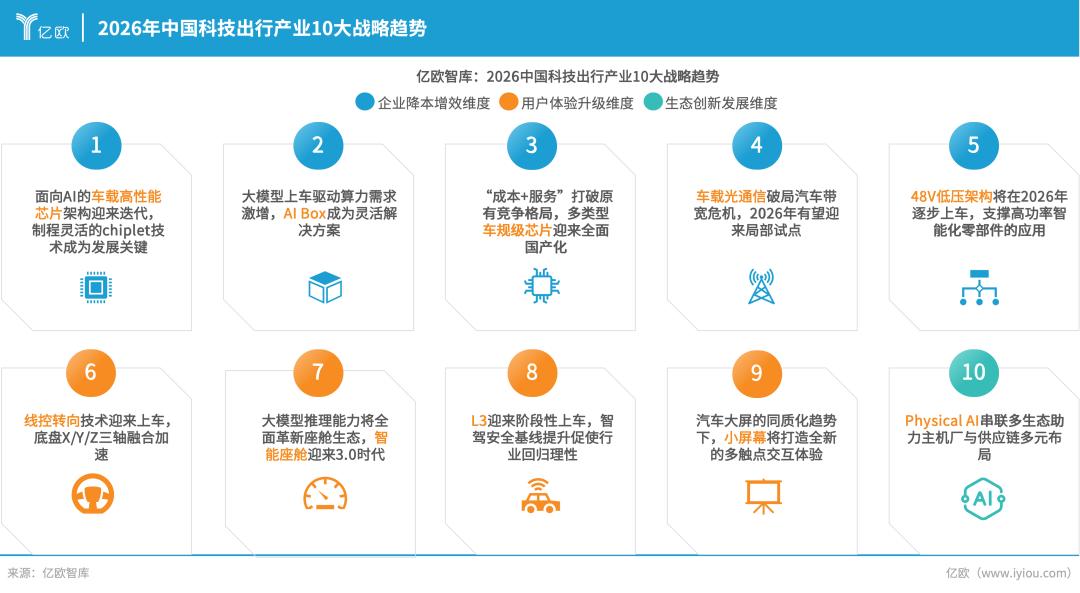
Core Insights - The report "2026 China Technology Mobility Industry 10 Strategic Technology Trends Outlook" aims to provide a key action guide for decision-makers in the industry chain, focusing on cost reduction, enhanced user experience, and ecological collaborative innovation [1][1] - The Chinese technology mobility industry is undergoing a profound systemic transformation driven by the accelerated integration of intelligence, electrification, and artificial intelligence technologies [1][1] - The industry is transitioning from a phase of incremental expansion to a high-quality development stage centered on efficiency, scale, and systemic capabilities amid intensified global automotive competition and evolving profit models [1][1] Trend Summaries - **Trend 1: Chiplet Restructuring Vehicle Chip Architecture** The traditional single-chip SoC is inadequate for L3+ autonomous driving and advanced cockpit requirements. Chiplet architecture is emerging as a mainstream solution for high-performance intelligent driving chips, enabling cost optimization and demand-driven scalability [4] - **Trend 2: AI Box Decoupling Computing Power Deployment** AI Box is becoming a key transitional solution for OEMs to achieve flexible computing power expansion, supporting local AI capabilities without major changes to vehicle electronic architectures [6] - **Trend 3: Accelerated Localization of Automotive Chips** Driven by supply chain security and cost optimization, communication chips and power semiconductors are leading the way in domestic chip localization, transitioning from technical feasibility to large-scale implementation [10] - **Trend 4: Optical Communication in Vehicles** Optical communication is moving from technology validation to mass production, addressing bandwidth limitations and electromagnetic interference in traditional vehicle networks, with significant advancements expected by 2026-2027 [13] - **Trend 5: 48V Low-Voltage Architecture** The 48V architecture is becoming essential for high-power intelligent components in electric vehicles, with initial applications in high-end models expected to scale by 2026 [15] - **Trend 6: Nearing the Inflection Point for Steer-by-Wire** With the maturation of technology and regulatory frameworks, steer-by-wire systems are transitioning from small-scale validation to mass production, becoming critical for advanced driving capabilities [19] - **Trend 7: Large Models Driving Intelligent Cockpits** The evolution of large models is transforming intelligent cockpits into system-level intelligent entities, enhancing user interaction and service optimization [22] - **Trend 8: Phased Implementation of L3 Autonomous Driving** L3 autonomous driving will be introduced gradually under regulatory constraints, focusing on safety and responsibility alignment, with commercial applications expected to begin in 2024-2025 [25] - **Trend 9: Redefining Interaction with Small Screens** The shift from centralized large screens to distributed small screens in vehicle interfaces aims to enhance user experience and reduce cognitive load during driving [28] - **Trend 10: Physical AI Driving Second Growth Curve** Physical AI capabilities are evolving into transferable competencies, enabling automotive technologies to extend across various intelligent terminals, fostering ecosystem collaboration [30] Overall Industry Outlook - The trends indicate a systemic restructuring in the Chinese technology mobility industry, focusing on integrated systems engineering and collaborative efficiency, with a shift from isolated performance to comprehensive system capabilities [32][34] - The next phase of competition will favor organizations that can build replicable, scalable, and evolvable system capabilities, marking 2026 as a pivotal year for technological scaling and global competitive landscape reshaping [34]
调研速递|华阳集团接待彬元资本等5家机构调研 HUD累计出货超400万台 AR-HUD、AI Box等多产品获新突破
Xin Lang Zheng Quan· 2026-01-24 12:42
Core Viewpoint - Huayang Group has recently engaged in intensive institutional research, highlighting significant advancements in its core business areas, including HUD products, AI Box innovations, two-wheeler market expansion, and precision die-casting business development [1][3]. Group 1: Investor Activity - The investor relations activity was categorized as "specific object research" and took place at Huayang Industrial Park in Huizhou, Guangdong Province, with participation from five institutions including Bin Yuan Capital and Huaxi Securities [2]. Group 2: Core Business Progress - Huayang Group reported substantial progress in its automotive electronics and precision manufacturing sectors, with multiple products achieving breakthroughs in market expansion and technological application [3]. - HUD Products: The company has shipped over 4 million units globally, with new orders for AR-HUD and VPD products from major automotive clients such as Geely, Xpeng, and BYD. The market position remains strong, with expectations for further growth as new projects enter mass production [3][4]. - AI Box Products: The company has launched AI Box to address edge computing needs in automotive intelligence, securing platform-level projects with well-known domestic car manufacturers. This product enhances data processing capabilities while ensuring user data security [3][4]. - Two-Wheeler Market: Huayang Group has successfully entered the two-wheeler market, obtaining multiple projects for LCD instruments and domain controllers, leveraging over 20 years of experience in automotive electronics [4]. - Precision Die-Casting Business: The company has seen significant growth in magnesium and zinc alloy orders, with magnesium alloys being used in lightweight automotive components and zinc alloys expanding into telecommunications and 3C sectors [4].

亿欧智库:2026中国科技出行产业10大战略技术趋势展望
Sou Hu Cai Jing· 2026-01-22 11:41
Core Insights - The report by Yiou Research Institute outlines ten strategic technology trends in China's technology mobility industry for 2026, focusing on autonomous driving, mobility technology, and new energy sectors, providing insights for industry players and investors [1][9]. Group 1: Cost Reduction and Efficiency - Chiplet technology is expected to become the standard for vehicle high-performance computing (HPC) by 2026, addressing the challenges of traditional SoC in terms of cost and power consumption [2][13]. - AI Box is projected to become a market breakout solution in 2026, providing flexible computing power without altering existing vehicle architectures, initially focusing on smart cockpits and later expanding to intelligent driving and body control domains [2][16]. - The domestic production of automotive-grade chips is advancing, with a focus on cost-effective, stable delivery, and local service, leading to a competitive landscape between international giants and local manufacturers [2][20]. - The 48V low-voltage architecture is set to be adopted in more flagship models by 2026, supporting high-power intelligent components, transitioning from initial partial adoption to a main distribution structure over time [2][26]. Group 2: User Experience Enhancement - Vehicle optical communication is expected to begin pilot projects in 2026, offering advantages such as high bandwidth and low latency, potentially replacing traditional vehicle Ethernet [3][23]. - The smart cockpit is entering its 3.0 era, evolving from a functional tool to a system-level intelligent entity capable of task planning and cross-domain collaboration, supported by an integrated "end-cloud-vehicle" architecture [3][31]. - The L3 autonomous driving technology is anticipated to enter a "small-scale, conditional" commercialization phase in 2026, with a focus on safety features like AEB becoming central to industry efforts [3][36]. - Small screens are emerging as a new interaction point in the cockpit, reducing cognitive load during driving and shifting the interaction logic from centralized to multi-screen collaboration [3][42]. Group 3: Ecological Innovation and Development - Physical AI technology is facilitating multi-ecosystem layouts, allowing automotive manufacturers to transition from vehicle integrators to cross-terminal AI capability platforms, promoting a second growth curve in the industry [5][39].
智能驾驶专题:2026中国科技出行产业10大战略技术趋势展望
Sou Hu Cai Jing· 2026-01-19 17:08
Core Insights - The report outlines ten strategic technology trends in China's technology mobility industry for 2026, focusing on cost reduction, user experience enhancement, and ecological innovation [1][4][5]. Group 1: Cost Reduction and Efficiency Enhancement - The Chiplet technology is expected to drive the iteration of vehicle chip architecture, addressing the conflict between computing power and energy efficiency [1][7]. - The automotive industry is moving towards comprehensive domestic production of automotive-grade chips, with a significant shift in the communication and power semiconductor sectors anticipated by 2026 [1][13][16]. Group 2: User Experience Enhancement - The AI Box is emerging as a flexible solution for on-vehicle AI computing, enabling local operation of large models (7B and above) without altering existing vehicle hardware [1][11][12]. - The transition to a 3.0 era of smart cockpits is expected, driven by the innovative reasoning capabilities of large models, enhancing user interaction and experience [1][25][27]. Group 3: Ecological Innovation Development - The introduction of vehicle-mounted optical communication technology is projected to alleviate bandwidth crises, with pilot projects expected to commence in 2026 [1][17][21]. - The 48V low-voltage architecture is anticipated to gradually be adopted in vehicles, supporting the application of high-power intelligent components [1][19][22]. - The line control steering technology is set to scale up, with the integration of chassis control across X/Y/Z axes accelerating [1][23][24]. Group 4: Safety and Rational Development - The L3 level of autonomous driving is expected to see phased implementation, with a focus on safety and rational development in the industry [1][28][32]. - The industry is shifting from an overemphasis on technology competition to a balanced approach prioritizing safety and user experience [1][28][32]. Group 5: Interaction and Experience Innovation - In the context of homogenization of central screens, smaller screens are expected to create differentiated multi-touchpoint interaction experiences [1][30][33]. - The evolution of smart cockpits is moving towards a system that perceives, thinks, and collaborates, enhancing the interaction between humans, vehicles, and the environment [1][30][33]. Group 6: Physical AI and Ecosystem Collaboration - Physical AI technology is anticipated to facilitate multi-ecosystem collaboration, aiding manufacturers and supply chains in diversifying their business layouts [1][34][36]. - The core capabilities of Physical AI are expected to be rapidly reused across various applications, including humanoid robots and low-altitude flying vehicles, enhancing the value potential of the supply chain [1][36][38].

华为HMS for Car智行论坛落幕,赋能车企智能化转型与出海新征程
Xin Lang Cai Jing· 2025-12-09 05:19
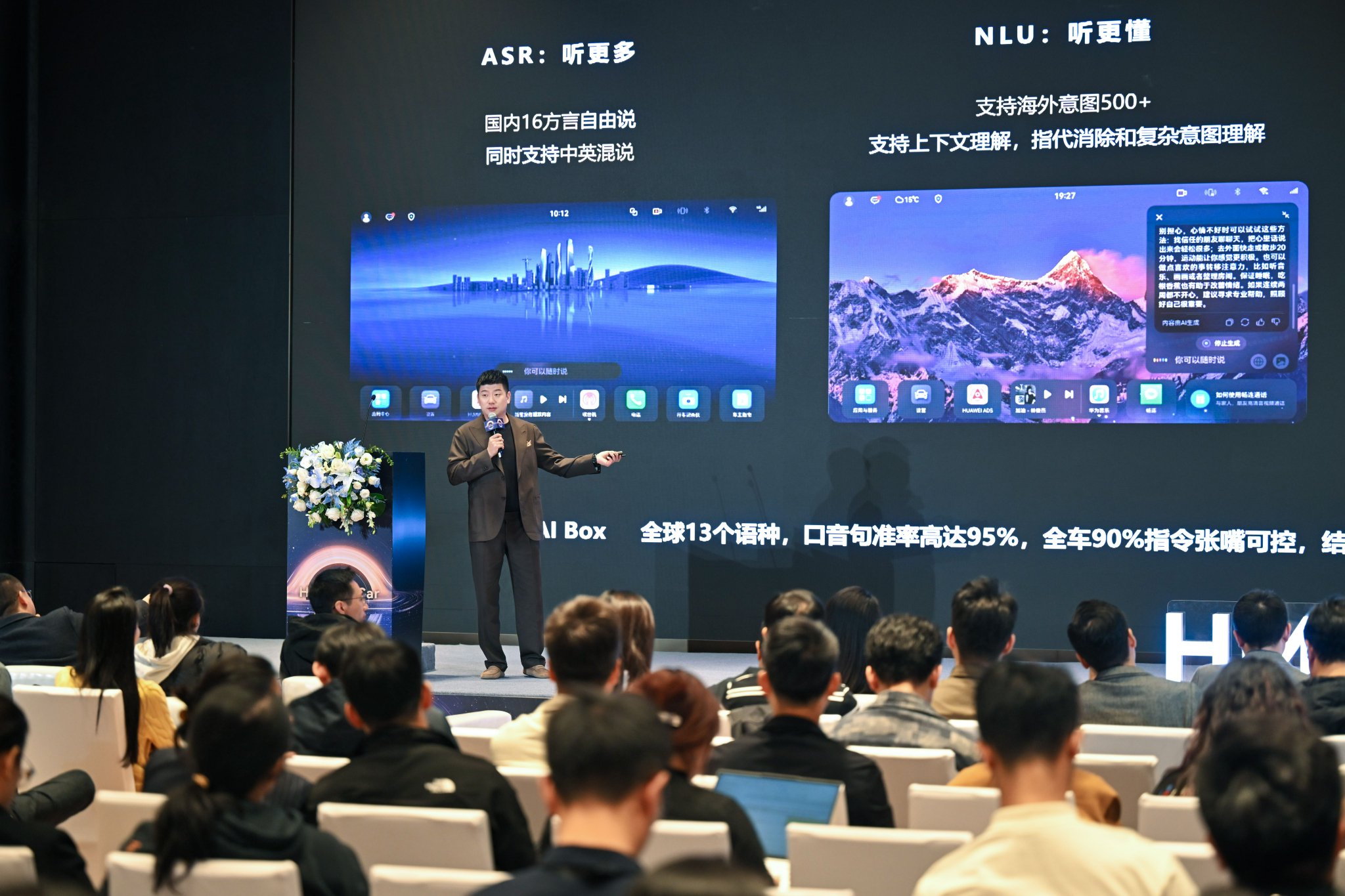
Core Insights - The automotive industry is rapidly transitioning towards digitalization, intelligence, connectivity, and electrification, with a focus on building a globally competitive smart in-car service system [1] - Huawei's HMS for Car aims to enhance the localized experience of smart cockpits to address the diverse user habits and ecosystem applications across different regional markets [2] Group 1: HMS for Car Overview - Huawei has developed the HMS for Car integrated smart in-car solution, which includes four core capabilities: maps, voice, ecosystem, and connectivity services, to help automotive companies establish a differentiated competitive advantage globally [2] - The focus has shifted from merely addressing the "existence" of services to integrating into local ecosystems and enhancing product localization [2][4] Group 2: Core Capabilities - The AI Box upgrade allows for proactive understanding and natural communication, achieving a 90% accuracy rate in recognizing local accents and supporting 16 Chinese dialects and 13 global languages [4] - The Service Box serves as a bridge for localizing in-car ecosystems, adapting top-tier applications based on user habits in different countries [4][5] - The Net Box enhances network stability by leveraging 11 years of technology accumulation and integrating resources from over 150 operators across 100+ countries [5] - The Map Box focuses on real-time updates and local map data accuracy, supported by research centers in Munich and the Netherlands, and integrates over 280 million POI data for precise navigation [5] Group 3: Integration and Collaboration - HMS for Car is evolving into a "personal travel assistant" by integrating multiple business functions and enabling seamless connections between navigation, vehicle control, and services [7] - The system provides compliance and security assurances, having supported over 70 vehicle models globally [8] Group 4: Industry Collaboration and Innovations - The collaboration with automaker Seres has led to the development of a smart automotive ecosystem, enhancing user experience through AI algorithms and multi-scenario intelligent functions [9] - Long-term cooperation with Great Wall Motors has resulted in significant improvements in navigation accuracy and stability, with new capabilities being introduced in upcoming products [11] - Partnerships with content providers like Tencent Music have enabled the creation of an AI music recommendation system that enhances the in-car entertainment experience [13] Group 5: Enhancing User Experience - The collaboration with Shenzhen Shunyi Technology has led to the development of convenient parking services, allowing users to reserve parking spots and pay fees through voice commands [15] - TomTom's integration of dynamic mapping capabilities supports real-time navigation and traffic updates, enhancing the overall driving experience [17] Group 6: Future Outlook - HMS for Car is set to continue its evolution from "going out" to "going in," focusing on systematic capability development and co-creating new smart travel experiences with partners [18]
华为HMS for Car智行论坛举办,携手全球伙伴探索生态共赢之路
Xin Lang Cai Jing· 2025-12-05 15:14
Core Insights - The automotive industry is rapidly transitioning towards digitalization, intelligence, connectivity, and electrification, with a focus on building a globally competitive intelligent in-car service system [1] - Huawei's HMS for Car aims to enhance the localization experience of smart cockpits to meet diverse regional market needs, moving from merely supporting car companies to integrating into local ecosystems [2] Group 1: HMS for Car Capabilities - HMS for Car integrates four core capabilities: maps, voice, ecosystem, and connectivity services, providing a comprehensive intelligent in-car solution that has already supported multiple car manufacturers [1] - The AI Box upgrade allows for proactive understanding and natural communication, achieving a 90% accuracy rate in recognizing local accents and supporting 16 Chinese dialects and 13 global languages [4] - Service Box acts as a bridge for local ecosystem adaptation, enhancing user familiarity with local applications and supporting diverse interaction methods [4] - Net Box enhances network stability for in-car services, covering over 100 countries and integrating resources from 150 operators [4] Group 2: Navigation and Mapping Enhancements - Map Box focuses on creating a differentiated product experience with real-time updates, supported by local research institutes in Munich and the Netherlands [5] - The collaboration with overseas map providers has resulted in over 280 million Points of Interest (POI) data, improving navigation accuracy and efficiency [5] Group 3: Integration and User Experience - HMS for Car is evolving into a "personal travel assistant," integrating various services such as navigation, vehicle control, and entertainment into a seamless user experience [7] - The system can understand the entire travel cycle, automatically planning routes and recommending services along the way [7] - Over 70 vehicle models globally have successfully integrated HMS for Car solutions [7] Group 4: Collaborative Innovations - The partnership with automaker Seres has led to the development of a smart automotive ecosystem, enhancing user experience through AI algorithms and multi-scenario intelligent functions [8] - Long-term collaboration with Great Wall Motors has resulted in significant improvements in navigation precision and stability, with new capabilities set to debut in December [10] - Collaborations with content partners like Tencent Music have led to the creation of an AI music recommendation system tailored to user travel scenarios [13] Group 5: Parking and Navigation Solutions - The partnership with Shenzhen Shunyi Tong has resulted in a convenient parking experience through features like space reservation and voice-activated payment [15] - TomTom's integration of radar perception and data fusion has enhanced the accuracy and reliability of global map data for the "live map" capabilities [17] Group 6: Future Outlook - The forum highlighted the evolution of HMS for Car from "going out" to "going in," emphasizing ongoing upgrades and partnerships to create new intelligent travel experiences [19]
中科创达20251127
2025-11-28 01:42
Summary of Zhongke Chuangda Conference Call Company Overview - Zhongke Chuangda focuses on AIOS as its core strategy, integrating AI chip trends to innovate and launch M1 to M4 series products primarily for the automotive sector [2][5] - The company has established a complete product line centered around computing in the IoT business, including handheld terminals, smart vision, edge computing, smart meeting systems, and AI-enabled devices [2][6] Key Industry Insights - The automotive industry is transitioning from software-defined vehicles to AI-defined vehicles, with Zhongke Chuangda's AIOS and AI Box driving this change [2][8][16] - The industrial mobile robotics sector is seeing Zhongke Chuangda position itself as a comprehensive robotics company, integrating software development, hardware design, and manufacturing to meet automation needs [2][7] Financial Performance - In 2025, Zhongke Chuangda's overall operating conditions remain healthy despite some pressure on operating cash flow due to project and payment cycles [3] - The company expects overseas market growth to outpace domestic market growth, particularly in the automotive sector [3] Strategic Collaborations - Zhongke Chuangda employs an ecosystem sales strategy, collaborating with chip manufacturers, OS vendors, large model vendors, and internet companies to build a robust ecosystem [4][15] - The partnership with ByteDance in the IoT sector has deepened, establishing a joint laboratory to empower automotive and IoT clients [4][21] Product Development and Innovation - The AIOS strategy drives the development of various products, including the AI Box, which offers up to 200 TOPS computing power and supports 7B models on the edge [5][16] - The company has launched new AMR robots at the 2025 Asia Logistics Exhibition, showcasing its commitment to innovation in robotics [2][24] Market Trends and Future Outlook - The IoT business is expected to continue its rapid growth, driven by a strong AIoT platform and diversified product offerings [10][12] - Zhongke Chuangda anticipates significant growth in AI PCs, AR glasses, and handheld terminal devices in 2025, with a focus on integrating new solutions for clients [14] Sales and Marketing Strategy - The sales strategy is centered on ecosystem collaboration rather than increasing the number of sales personnel, relying on core technology and engineering culture [4][15] - The company maintains a stable sales team while leveraging partnerships to drive product adoption [15] Conclusion - Zhongke Chuangda is well-positioned for future growth with a strong focus on AIOS, strategic partnerships, and a commitment to innovation across various sectors, particularly in automotive and IoT [2][8][22]

调研速递|立讯精密接待高盛等超200家机构调研 AI算力业务处2016年消费电子阶段 汽车/光模块明后年望放量
Xin Lang Cai Jing· 2025-11-26 04:12
Core Insights - The company, Luxshare Precision (002475.SZ), conducted an investor relations activity from November 20 to 26, 2025, in Dongguan, Guangdong, attracting over 200 renowned domestic and international institutions, including Goldman Sachs and BlackRock [1] Business Strategy and Development - The company emphasizes cross-domain collaboration and long-termism as key traits for its success in new markets, particularly in automotive and AI computing sectors, aiming to be among the top three in each field within five years [2] - The automotive segment has established four product lines: connectors, wiring harnesses, domain controllers, and intelligent chassis, with a goal to become the largest automotive connector manufacturer in China by 2027 [5] Consumer Electronics - The company is leveraging both OEM and ODM strategies to shorten product development cycles and enhance manufacturing processes, with a focus on AI hardware such as AI Boxes and smart glasses [3] Data Center Business - The data center segment is experiencing growth driven by advancements in power supply and cooling technologies, with the 448G CPC copper connection technology expected to become mainstream [4] AI and Robotics - The company is enhancing manufacturing efficiency through an "AI smart employee" system and plans to launch a highly automated "Manufacturing 2.0" production line by 2026, with a focus on industrial applications [6] Growth Expectations - The management anticipates significant growth across power modules, optical modules, electrical connections, and cooling solutions, with power modules expected to see the fastest growth [8] Technical Strategy - The company maintains that copper connection technology will coexist with optical technology, emphasizing the continued relevance of 448G copper connections in the market [9] Profit Structure in Automotive Business - The wiring harness segment provides stable cash flow, while domain controllers and intelligent chassis are expected to become major growth drivers post-2026 [10] Overseas Expansion - Vietnam remains the preferred location for capacity transfer, but the company is diversifying its production footprint in Southeast Asia to mitigate geopolitical risks [11]