
Blackwell处理器

Search documents
Wall Street Doubles Down On Nvidia Amid AI Stock Slump
Investors· 2025-11-14 15:27
Core Viewpoint - Wall Street analysts remain optimistic about Nvidia's potential to recover ahead of its upcoming earnings report, despite recent stock declines attributed to concerns over a bubble in AI investments [1][2]. Nvidia Stock Performance - Nvidia stock initially dropped but stabilized later in the morning, closing down 3.6% at $186.86 on Thursday [2]. - The stock has faced selling pressure alongside other AI chip stocks, raising concerns about inflated valuations in the sector [2]. Analyst Ratings and Price Targets - Wells Fargo analyst Aaron Rakers raised Nvidia's price target from $220 to $265, maintaining an overweight rating, and expects Nvidia to outperform consensus estimates in its fiscal third-quarter results [2][3]. - Morgan Stanley's Joseph Moore also increased his price target from $210 to $220, anticipating strong results driven by the production of Blackwell processors [5]. Earnings Expectations - Analysts project Nvidia to report adjusted earnings of $1.25 per share on sales of $54.8 billion for the quarter ending October 26, reflecting year-over-year growth of 55% in earnings and 56% in sales [4]. - Rakers highlighted the expectation for Nvidia to showcase strong AI momentum as the company enters a new phase of scaling [4]. Market Context - Nvidia is featured on multiple IBD lists, indicating its strong market position and investor interest [5].

黄仁勋盛赞华为芯片:实力强大,低估他们是愚蠢的
半导体行业观察· 2025-11-01 01:07
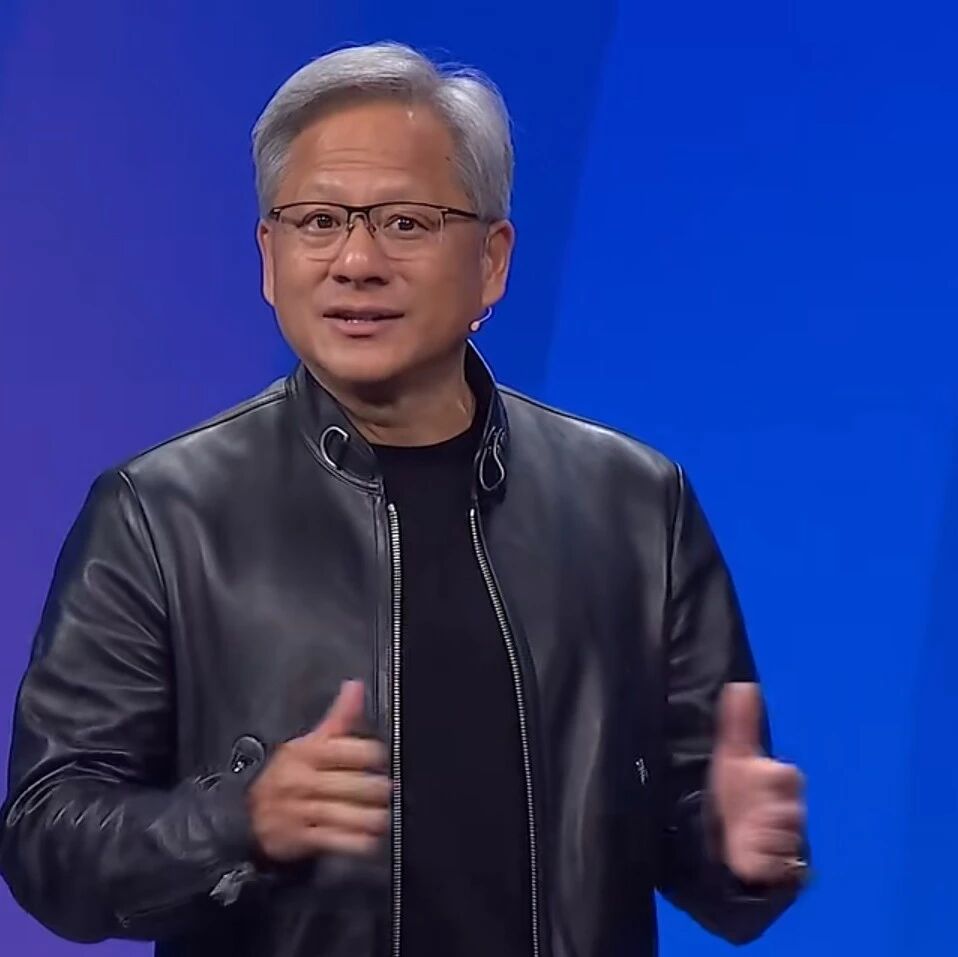
Core Viewpoint - Nvidia's CEO Jensen Huang expresses optimism about re-entering the Chinese market despite U.S. export restrictions, emphasizing the importance of collaboration between U.S. tech companies and China for mutual benefits [2][4]. Group 1: Nvidia's Position on China - Huang has not received updates on discussions regarding the easing of export restrictions but hopes for Nvidia's return to the Chinese market, highlighting its vibrant and innovative environment [2]. - He argues that the U.S. restrictions based on national security concerns are misguided, stating that engaging with the Chinese market aligns with the best interests of both nations [4]. - Huang acknowledges Huawei's growing capabilities in AI chip technology, suggesting that underestimating Huawei is unwise, especially after U.S. sanctions prompted China to enhance its domestic technology [2][4]. Group 2: Nvidia's Collaboration with South Korea - Nvidia plans to maintain long-term partnerships with South Korean semiconductor giants Samsung and SK Hynix, focusing on the development of advanced memory technologies [7]. - The company has signed significant supply agreements with South Korean firms to provide GPUs for AI applications, aiming to address the ongoing GPU supply shortage [9][10]. - Analysts view Nvidia's collaboration with South Korea as a strategic move to compensate for its shrinking market share in China due to U.S. trade tensions [10]. Group 3: Market Dynamics and Concerns - Huang points out that China is capable of producing a substantial amount of AI chips independently, which raises questions about the validity of U.S. national security concerns regarding chip exports [5]. - There are concerns about potential "circular trading," where South Korean companies might use profits from selling memory chips to Nvidia to purchase GPUs, complicating the nature of the transactions [9][11]. - The collaboration with South Korea is seen as a critical opportunity for Nvidia amidst the global demand for AI semiconductors, especially as competition in the market intensifies [10][11].

AI日报丨马斯克旗下AI驱动的维基百科竞品历经坎坷后正式上线,苹果加速OLED升级
美股研究社· 2025-10-29 10:34
Group 1 - The rapid development of artificial intelligence (AI) technology is creating widespread opportunities in the market [3] - OpenAI's total investment in AI infrastructure is approximately $1.4 trillion, with plans for an IPO as a likely option due to funding needs [5] - Blackstone and Saudi AI company Humain have signed a $3 billion agreement to build data centers in Saudi Arabia, aiming to support the rapid growth of AI and cloud computing [6] Group 2 - Nvidia's CEO Jensen Huang stated that new chips will generate $500 billion in revenue over the next five quarters, dismissing concerns about an AI bubble [10] - Apple is planning to upgrade its devices to OLED displays, with the iPad mini expected to adopt OLED as early as next year [10] - Tesla is considering internal candidates for CEO succession in response to potential leadership changes, emphasizing Elon Musk's irreplaceable role in the company [11][12] Group 3 - Microsoft has invested in OpenAI's transition to a profit-oriented organization, holding a 27% stake valued at $135 billion, with IP licensing extended to 2032 [13]




芯片订单超5000亿美金,英伟达市值直逼五万亿
半导体行业观察· 2025-10-29 02:14
Core Viewpoint - Nvidia's CEO Jensen Huang announced new partnerships and alleviated concerns about an AI bubble, stating that the company's AI processor orders have reached $500 billion and that it will build seven new supercomputers for the U.S. Department of Energy, positioning Nvidia to become the first company with a market value of $5 trillion [2][4]. Group 1: Partnerships and Collaborations - Nvidia is collaborating with Uber, Palantir, and CrowdStrike to ensure its technology remains central to the AI boom [3]. - A €1 billion ($1.2 billion) data center is planned in Germany with Deutsche Telekom, and an investment agreement with Nokia has been announced [3]. - Nvidia will support 100,000 Uber autonomous vehicles with its technology, and it is developing an autonomous driving platform with Lucid Group [5]. - A $1 billion investment in Nokia aims to assist its transition from mobile networks to AI [5]. - CrowdStrike is developing a continuous learning AI agent in collaboration with Nvidia, while Palantir will integrate Nvidia's technology with its Ontology platform [5]. Group 2: Market Position and Sales Projections - Nvidia's latest chips are expected to ship 20 million units, a significant increase from the previous generation's 4 million units [4]. - The demand for Nvidia's GPUs remains strong, with 6 million units shipped in the last four quarters [9]. - Nvidia anticipates that sales from Blackwell and the upcoming Rubin chips will reach $500 billion [9]. Group 3: Manufacturing and Production - Nvidia's fastest AI chip, the Blackwell GPU, is now fully produced in Arizona, marking a shift from previous production in Taiwan [8]. - The company emphasizes the importance of bringing manufacturing back to the U.S. for national security and economic reasons [8]. Group 4: AI Market Outlook - Huang expressed confidence that the AI market is not in a bubble, citing strong customer willingness to pay for AI models [4][15]. - Nvidia plans to release a blueprint for building large-scale "gigabit" AI data centers, which will be referred to as "AI factories" [15]. Group 5: Challenges and Competition - Despite its dominance in the AI accelerator market, Nvidia faces increasing competition from AMD, Qualcomm, and others [6][15]. - The company has experienced significant sales losses due to U.S. export restrictions, particularly concerning its H20 chip [11].
24小时环球政经要闻全览 | 10月29日
Ge Long Hui· 2025-10-29 01:35
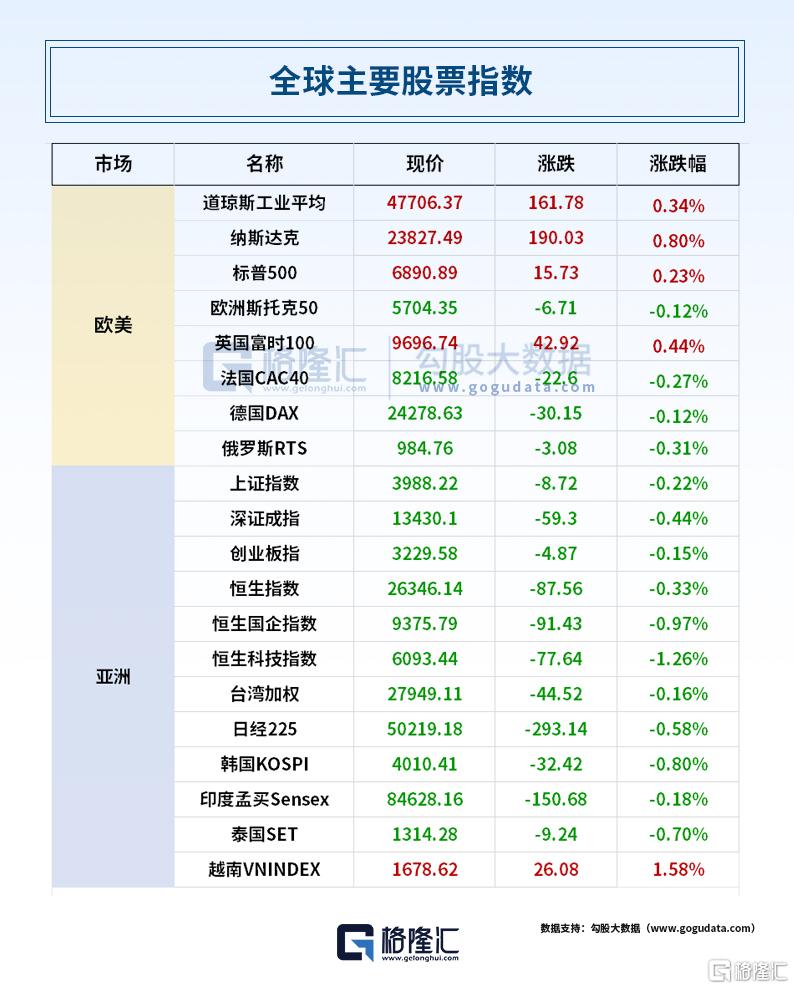
Market Overview - Major indices in the US showed mixed performance, with the Dow Jones Industrial Average at 47,706.37, up by 161.78 points or 0.34%, and the Nasdaq at 23,827.49, up by 190.03 points or 0.80% [2] - European indices experienced slight declines, with the European Stoxx 50 down by 6.71 points or 0.12% and the German DAX down by 30.15 points or 0.12% [2] - Asian markets also faced losses, with the Shanghai Composite Index down by 8.72 points or 0.22% and the Hang Seng Index down by 87.56 points or 0.33% [2] Financial Planning - The "15th Five-Year Plan" released by the Central Committee of the Communist Party of China emphasizes the importance of finance, mentioning "finance" 17 times and calling for the acceleration of building a financial powerhouse [2] Investment Initiatives - Japan's government unveiled a $550 billion investment plan in the US, detailing potential projects involving companies like SoftBank, Westinghouse Electric, and Toshiba, with individual project sizes ranging from $350 million to $100 billion [4] AI Industry Insights - NVIDIA's CEO Jensen Huang dismissed concerns about an AI bubble, projecting that the company's latest chips will generate $500 billion in revenue over the next five quarters, highlighting significant growth in sales driven by new technologies [6] - NVIDIA also announced a $1 billion equity investment in Nokia, further solidifying its position in the AI and computing sectors [6] Corporate Agreements - Microsoft acquired a 27% stake in OpenAI, valued at approximately $135 billion, and secured rights to use OpenAI's technology until 2032, while OpenAI committed to investing an additional $250 billion in Azure services [7]
隔夜美股 | 三大指数续创新高 苹果(AAPL.US)市值突破4万亿美元
Zhi Tong Cai Jing· 2025-10-28 22:28
Market Performance - The three major indices reached new highs, with Apple (AAPL.US) briefly surpassing a market capitalization of $4 trillion, becoming the third large tech company to achieve this milestone [1] - As of the close, the Dow Jones increased by 161.78 points (0.34%) to 47,706.37, the Nasdaq rose by 190.04 points (0.8%) to 23,827.49, and the S&P 500 gained 15.73 points (0.23%) to 6,890.89 [1] Stock Movements - Nvidia (NVDA.US) saw a nearly 5% increase, closing at a market cap of $4.89 trillion [1] - Tesla (TSLA.US) rose nearly 2%, while Intel (INTC.US) and Nokia (NOK.US) increased by 5% and 23%, respectively [1] - The Nasdaq Golden Dragon China Index fell by 1.2%, with Alibaba (BABA.US) dropping over 1% and Bilibili (BILI.US) rising by 5% [1] Economic Indicators - The U.S. consumer confidence index fell to a six-month low in October, dropping from a revised 95.6 in September to 94.6, below the economist's median forecast of 93.4 [4] - The S&P/Case-Shiller National Home Price Index indicated a 1.5% year-over-year increase in U.S. home prices as of August, down from 1.6% in July, marking the slowest growth in over two years [5] Company Developments - Apple is preparing to upgrade its MacBook Air and iPad Air with OLED screens, which are expected to enhance color vibrancy and contrast compared to current LCD displays [6] - Nvidia's CEO Jensen Huang dismissed concerns about an AI bubble, stating that the company's new chips are projected to generate $500 billion in revenue over the next five quarters [8] - Tesla is reportedly considering internal candidates for CEO succession in light of potential changes to Elon Musk's compensation plan [9] - Lucid Group (LCID.US) announced plans to launch Level 4 autonomous vehicles in collaboration with Nvidia, aiming to provide advanced self-driving capabilities [10]
英伟达被批准出售50万颗GPU
半导体行业观察· 2025-10-10 00:52
Core Points - The U.S. government has granted NVIDIA an export license to ship advanced AI GPUs worth hundreds of billions to the UAE, marking the beginning of a significant bilateral technology cooperation [1] - The agreement allows the UAE to purchase up to 500,000 advanced NVIDIA processors annually, with a commitment to invest $1.4 trillion in the U.S. over the next decade [1] - The deal is seen as a shift in U.S. policy, moving from restricting AI chip exports to establishing a bilateral framework with allies [2] Group 1 - The initial shipment of AI accelerators will not be delivered to G42, an AI company in Abu Dhabi, but will be operated by U.S. companies with data centers in the UAE [1] - The U.S. aims to counter China's influence in the region by embedding American cloud service providers and hardware into UAE infrastructure [2] - Future authorizations will depend on the progress of UAE's investments, potentially serving as a model for similar agreements with other allies seeking advanced AI hardware [3] Group 2 - The agreement includes a provision for G42 to eventually receive 20% of the AI processors in the UAE [1] - The U.S. Commerce Secretary confirmed that only approved U.S. operators managing data centers will be eligible to run these systems [2] - Critics argue that the agreement lacks sufficient safeguards to ensure the AI accelerators operate in reviewed environments, especially given the UAE's economic ties with Beijing [3]

黄仁勋:看好中国AI市场明年增50%的业务机会,通信ETF(515880)大涨5%
Mei Ri Jing Ji Xin Wen· 2025-08-28 03:53
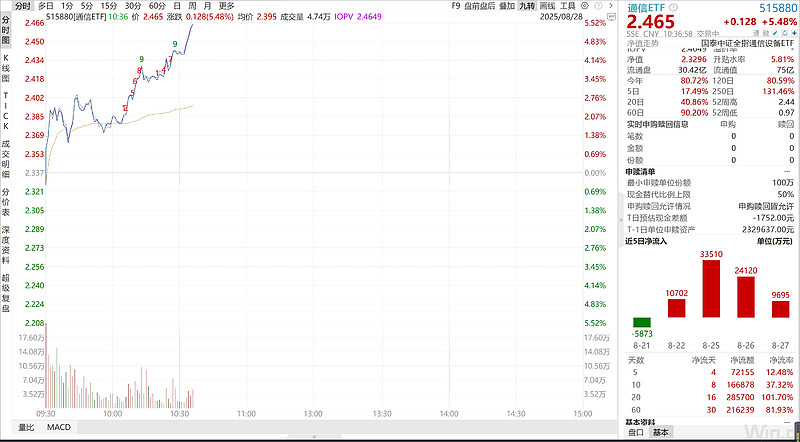
Core Viewpoint - Nvidia's latest financial report for Q2 FY2026 shows revenue of $46.743 billion, a 56% year-over-year increase, slightly exceeding analyst expectations of $46.23 billion. However, concerns arose regarding a slowdown in AI spending growth due to lower-than-expected data center revenue and lackluster guidance, leading to a significant drop in Nvidia's stock price and a decline in other chip stocks in after-hours trading [1][2]. Group 1: Nvidia's Financial Performance - Nvidia reported Q2 FY2026 revenue of $46.743 billion, a 56% increase year-over-year, slightly above the expected $46.23 billion [1]. - Data center revenue for the second quarter was $41 billion, slightly below the analyst forecast of $41.29 billion [1]. - The company's guidance for future performance was not optimistic, raising concerns about the momentum of AI spending growth [1]. Group 2: Market Reactions and Trends - Following Nvidia's report, its stock fell over 5% in after-hours trading, impacting other chip stocks negatively [1]. - In contrast, the A-share chip industry saw a significant rise, particularly the communication ETF (515880), which increased by over 5% amid strong capital inflows totaling over 2.8 billion in the last 20 trading days [1][2]. Group 3: China Market Outlook - Nvidia's CEO Jensen Huang indicated a potential introduction of the advanced Blackwell processor to the Chinese market, predicting about $50 billion in business opportunities from China this year [2]. - The Chinese AI market is expected to grow by 50% next year, contributing to optimism in the domestic chip industry [2]. Group 4: Industry Fundamentals - According to Q2 financial reports from domestic and international cloud service providers, AI capital expenditure growth remains high [3]. - Goldman Sachs' recent survey in Silicon Valley indicates a positive sentiment among AI companies and venture capitalists, with expectations of continued growth in enterprise-level generative AI adoption [3]. - The North American cloud providers' capital expenditures are projected to reach $319 billion to $327 billion in 2025, a year-over-year increase of 30.2% to 33.5% [5]. Group 5: Policy and Infrastructure Developments - The Chinese government has issued policies to enhance AI infrastructure, including optimizing national computing resources and promoting the integration of data, computing, electricity, and networks [5]. - The demand for optical modules, crucial for AI computing transmission, is expected to rise as operators accelerate the construction of a national integrated intelligent computing network [5][6]. Group 6: Investment Opportunities - The communication sector is driven by the continuous growth of global data traffic, with significant demand for communication equipment like optical modules and servers [6]. - The communication ETF (515880) is highlighted as a potential investment opportunity, with over 70% of its index comprising optical modules, servers, copper connections, and fiber optics [8].
特朗普拟允许英伟达(NVDA.US)和AMD(AMD.US)售降级AI芯片入华,涉15%收入分成
智通财经网· 2025-08-12 11:29
Core Viewpoint - The U.S. government, led by President Trump, may allow NVIDIA to export downgraded versions of its advanced AI chips to China, with performance reductions of 30% to 50% [1][2] Group 1: Export Agreement Details - Trump indicated that a potential agreement would allow NVIDIA to export previously banned chips to China, with the U.S. government receiving 15% of the sales revenue as a condition [1][2] - The agreement specifically applies to the H20 chip model, which Trump claims is outdated and that China has already developed similar technologies [1] Group 2: Industry Reactions and Implications - Bernstein analysts expressed skepticism about the agreement, suggesting it sets a poor precedent, but acknowledged that receiving 85% of revenue is better than none [2] - The U.S. Department of Commerce has initiated the approval process for this agreement, although the specific use of the funds remains unclear [2] Group 3: Underlying Motivations - The policy shift is driven by U.S. concerns over rare earth supply chains, as domestic production is heavily reliant on China, impacting defense contractors like Lockheed Martin [2]
