
Rubin处理器

Search documents
AI军备竞赛进入白热化!Meta豪掷1350亿美元再创纪录,三星电子等硬件供应商迎来“黄金时代”
Sou Hu Cai Jing· 2026-01-29 07:27
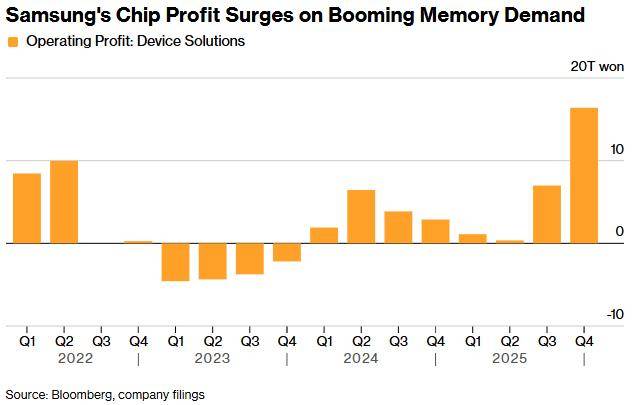
Group 1 - Major tech companies are showing no signs of reducing AI spending, with record investments driving growth for hardware suppliers like Samsung and SK Hynix [1] - Meta has disclosed a spending plan of up to $135 billion for this year, marking one of the largest capital expenditure plans in the business sector [1] - The demand for AI hardware is expected to continue until 2026, as highlighted by the earnings reports of industry giants like Meta, Microsoft, Amazon, and Alphabet [1] Group 2 - Samsung and SK Hynix are key manufacturers of storage chips required for Nvidia's AI accelerators and data center servers, with both companies experiencing significant profit growth [2] - The ongoing demand for AI is exacerbating the global chip supply-demand imbalance, impacting various industries from smartphones to automotive manufacturing [2] - Elon Musk indicated that semiconductor supply could become a major bottleneck for companies like Tesla, potentially necessitating the establishment of a factory capable of producing logic and storage chips [2] Group 3 - Manufacturers of storage chips are shifting production lines to high-bandwidth memory (HBM) to meet AI data center demands, which is reducing supply for consumer electronics [3] - Microsoft reported a 66% increase in capital expenditure, exceeding expectations, but its Azure cloud revenue growth slowed to 38% [3] - Meta's CEO discussed the significant AI acceleration in the tech industry, emphasizing the rapid development trajectory [3] Group 4 - Samsung's chip division reported a fivefold profit increase, significantly surpassing analyst expectations, and announced a stock buyback of 3.57 trillion won along with a special dividend [4] - The focus in Asia is on the competition for the next-generation HBM4, which will integrate with Nvidia's upcoming flagship processor [7] - Samsung's foundry business is expected to see a 130% increase in 2nm orders by 2026, with active discussions with clients in the US and China [7]






美股开门红!标普道指联袂创新高 板块轮动行情加速上演
Zhi Tong Cai Jing· 2026-01-07 00:23
Group 1 - The U.S. stock market reached a historical high, with materials, industrial, and financial sectors leading the gains, indicating a rotation of investments towards previously lagging sectors [1] - The S&P 500 index rose by 0.6%, marking its third consecutive day of gains, while the equal-weighted index increased by 1.2%, suggesting a broader market rally beyond tech stocks [1] - Weak U.S. services PMI data has fueled hopes for further interest rate cuts by the Federal Reserve, contributing to the upward movement of major stock indices [1] Group 2 - Goldman Sachs' new chief U.S. equity strategist predicts a year of "micro-rotation" in the stock market due to extreme concentration and the evolution of AI trading, with the top ten S&P 500 stocks accounting for 41% of market capitalization [2] - Increased cash inflows related to pension contributions and year-end bonuses are supporting a broad market rally, as the "January effect" appears particularly strong this year [2] - Despite geopolitical tensions following the capture of Venezuelan President Nicolás Maduro, Wall Street's reaction has been muted, with some safe-haven assets like gold and U.S. Treasuries rising [2] Group 3 - Investors are optimistic about the stock market's potential for further gains in 2026, with 60% of surveyed investors expecting the S&P 500 to rise by up to 20% [3] - Historical trends indicate that after a significant market pullback, strong rebounds typically follow, suggesting a favorable outlook for the upcoming year [3] - The International Consumer Electronics Show (CES) is providing a platform for AI-themed trading, with tech companies showcasing new products and business announcements [3] Group 4 - Advanced Micro Devices (AMD) showcased a new chip for enterprise data centers, while NVIDIA's CEO announced the anticipated deployment of the Rubin processor in the second half of the year [4] - Sandisk Corp. and its peers were among the best-performing stocks in the S&P 500, with Sandisk's stock surging approximately 47% in the first three trading days of 2026 [4] Group 5 - Following the ousting of Maduro, oil traders like the Tok Group are set to negotiate with the U.S. government on resuming oil purchases from Venezuela [5] - Under Armour (UA) saw a significant stock price increase after Fairfax Financial Holdings disclosed a substantial stake in the company [5]
英伟达未交付 AI 芯片订单达5000亿美元,排期至2026年
Huan Qiu Wang· 2025-11-20 02:35
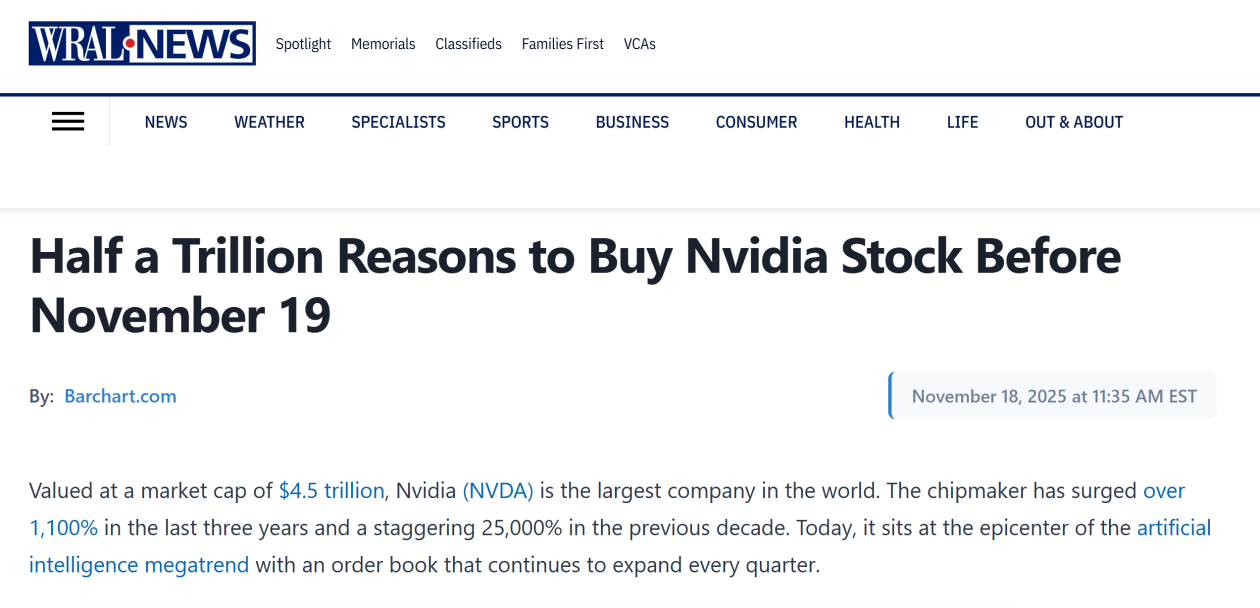
Core Insights - Nvidia reported a significant backlog of $500 billion in undelivered AI chip orders, with delivery schedules extending to 2026, including the next-generation Rubin processor set to begin production next year [1][3] - Major tech companies such as OpenAI, Google, Microsoft, Amazon, and Meta rely on Nvidia's hardware for training next-generation AI models, driven by the infrastructure expansion needs of large-scale data center operators [1] - Nvidia's data center business remains the core growth engine, achieving $51.2 billion in sales for the quarter, a 66% year-over-year increase, significantly surpassing analyst expectations [3] Industry Dynamics - The expansion of infrastructure around Nvidia's technology is unprecedented, with industry insiders revealing commitments of hundreds of billions of dollars from companies to build new facilities [1] - Nvidia's investment strategy has accelerated, including a $10 billion investment in AI startup Anthropic, partnerships with Nokia, and collaboration with former competitor Intel [3] - The GPU-centric "compute" business generated $43 billion in revenue, primarily driven by initial sales of the GB300 series chips, while the "network" business contributed $8.2 billion [3]
英伟达CEO黄仁勋:并没有看到AI泡沫,已进入良性循环期
Sou Hu Cai Jing· 2025-11-20 00:47
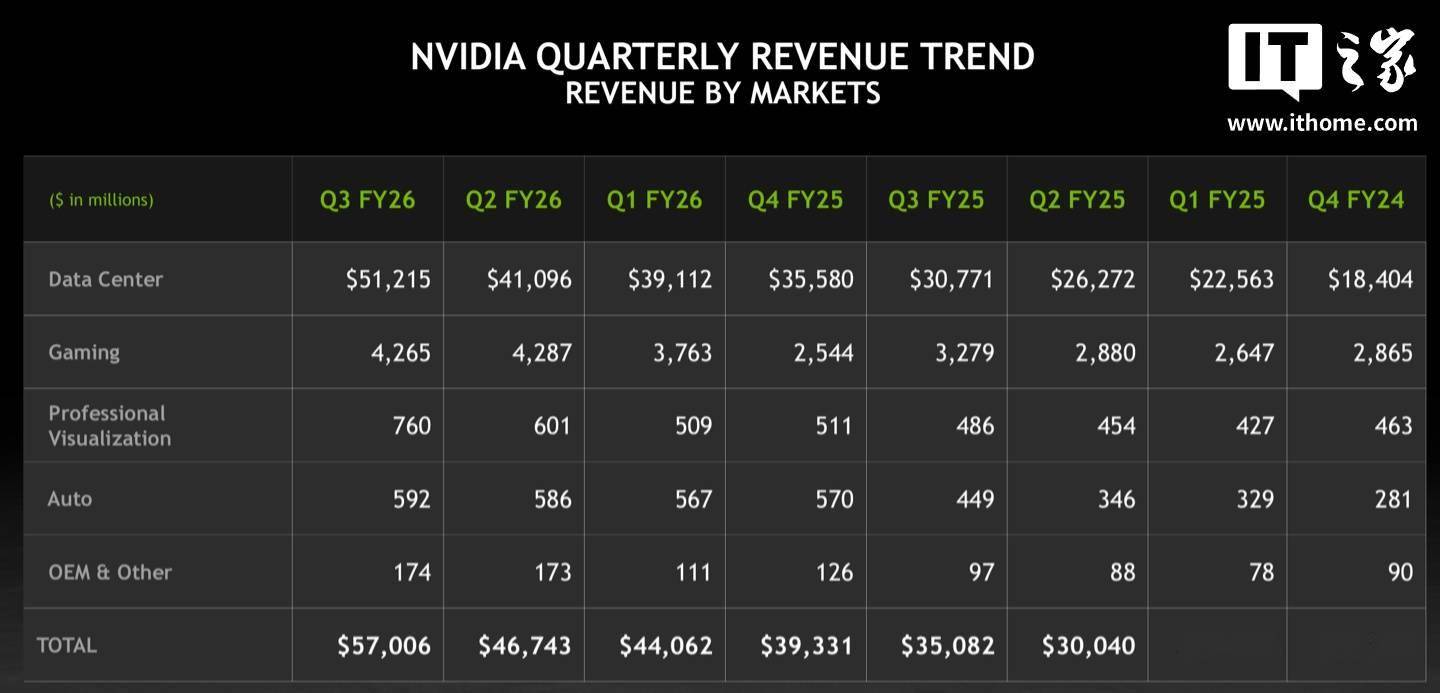
Core Insights - NVIDIA's Q3 FY26 revenue reached a record $57 billion, representing a 62% increase year-over-year and a 22% increase quarter-over-quarter [1][2] - CEO Jensen Huang emphasized that the current AI landscape is fundamentally different from the internet bubble, asserting that AI is transforming existing workloads without signs of a bubble [1] - The company reported a net profit of $31.91 billion, with diluted earnings per share of $1.30, reflecting a 67% year-over-year growth, indicating strong profitability and operational efficiency [2] Revenue Breakdown - Data Center revenue for Q3 FY26 was $51.215 billion, up from $41.096 billion in Q2 FY26 [1] - Gaming revenue was $4.265 billion, slightly down from $4.287 billion in Q2 FY26 [1] - Professional Visualization revenue increased to $760 million from $601 million in Q2 FY26 [1] - Automotive revenue was $592 million, a slight increase from $586 million in Q2 FY26 [1] - OEM & Other revenue remained stable at $174 million compared to $173 million in Q2 FY26 [1] Order Backlog - NVIDIA currently holds $500 billion in undelivered chip orders, with deliveries scheduled through 2026, including the next-generation Rubin processor set to begin mass production next year [2]
AI的“审判日”来了?英伟达财报将决定华尔街万亿赌注“生死”
Jin Shi Shu Ju· 2025-11-18 12:52
Core Viewpoint - The upcoming earnings report from Nvidia will be a critical moment for Wall Street's significant bets on artificial intelligence, as investors seek evidence to support or refute concerns about a potential bubble in the AI sector [2] Group 1: Market Sentiment and Investor Behavior - Investors are increasingly anxious about the AI hype potentially detaching from fundamentals, with some business leaders highlighting "circular trading" among partners that could exacerbate bubble risks [2] - Major investors, including Peter Thiel's hedge fund, have sold all their Nvidia shares, raising concerns about a broader market sell-off [2] - Nvidia's stock has dropped 7.9% in November, following a 1200% increase over the past three years, while the broader market has declined by 2.5% in the same period [2] Group 2: Financial Performance and Projections - Nvidia is expected to report a revenue increase of over 56% year-on-year for the August to October quarter, reaching $54.92 billion, although this growth is significantly lower than previous quarters [3] - The company has consistently exceeded earnings expectations for the past 12 quarters, but the magnitude of these beats has been narrowing [3] - Nvidia's CEO has stated that the order volume for advanced chips is projected to reach $500 billion by 2026 [3] Group 3: Supply Chain and Profitability Challenges - Nvidia is facing challenges in resolving chip supply shortages, despite TSMC increasing advanced packaging capacity [4] - The introduction of more complex and larger systems, which bundle various components, is putting pressure on profit margins [4] - Nvidia's adjusted gross margin is expected to contract by nearly 2 percentage points year-on-year to 73.6%, while net profit may grow by 53% to $29.54 billion [4] Group 4: Strategic Investments - Investors are closely monitoring Nvidia's significant investments, including a $100 billion stake in OpenAI and a $5 billion holding in Intel, to assess their impact on the company's balance sheet [5] - As of July 27, Nvidia held $11.64 billion in cash and cash equivalents [5]
英伟达被批准出售50万颗GPU
半导体行业观察· 2025-10-10 00:52
Core Points - The U.S. government has granted NVIDIA an export license to ship advanced AI GPUs worth hundreds of billions to the UAE, marking the beginning of a significant bilateral technology cooperation [1] - The agreement allows the UAE to purchase up to 500,000 advanced NVIDIA processors annually, with a commitment to invest $1.4 trillion in the U.S. over the next decade [1] - The deal is seen as a shift in U.S. policy, moving from restricting AI chip exports to establishing a bilateral framework with allies [2] Group 1 - The initial shipment of AI accelerators will not be delivered to G42, an AI company in Abu Dhabi, but will be operated by U.S. companies with data centers in the UAE [1] - The U.S. aims to counter China's influence in the region by embedding American cloud service providers and hardware into UAE infrastructure [2] - Future authorizations will depend on the progress of UAE's investments, potentially serving as a model for similar agreements with other allies seeking advanced AI hardware [3] Group 2 - The agreement includes a provision for G42 to eventually receive 20% of the AI processors in the UAE [1] - The U.S. Commerce Secretary confirmed that only approved U.S. operators managing data centers will be eligible to run these systems [2] - Critics argue that the agreement lacks sufficient safeguards to ensure the AI accelerators operate in reviewed environments, especially given the UAE's economic ties with Beijing [3]

港股异动 | 天岳先进(02631)早盘涨近7% 碳化硅光学眼镜前景广阔 公司正与客户紧密推进产品导入
智通财经网· 2025-10-09 03:53
Core Viewpoint - Tianyue Advanced (02631) is experiencing a significant stock price increase due to advancements in silicon carbide (SiC) technology, which is expected to expand the market for optical applications from high-end to consumer use [1] Group 1: Company Developments - Tianyue Advanced's chairman, Zong Yanmin, stated that silicon carbide is an ideal material for optical waveguide lenses, overcoming previous limitations related to substrate size and defects [1] - The company has introduced a 12-inch substrate that can produce 10-12 lenses per substrate, significantly increasing production capacity compared to the previous 8-inch substrate, which could only produce 3-5 pairs of glasses [1] - Tianyue Advanced is closely collaborating with leading global optical clients to expedite product introduction, with expectations that silicon carbide optical glasses will soon enter the market [1] Group 2: Market Potential - The market size for silicon carbide optical waveguide glasses is projected to reach hundreds of millions of pairs in the future [1] - SiC's high thermal conductivity and wide processing window are anticipated to enhance the thermal management of CoWoS (Chip-on-Wafer-on-Substrate) structures and reduce packaging size [1] - Reports indicate that NVIDIA plans to switch the intermediate substrate material for its next-generation Rubin processor design from silicon to silicon carbide to improve thermal performance, with large-scale adoption expected by 2027 [1]

天岳先进再涨超7%破顶 机构看好碳化硅材料在高端算力芯片中的应用潜力
Zhi Tong Cai Jing· 2025-09-12 02:14
Core Viewpoint - Tianyue Advanced (02631) has seen a significant increase in stock price, reaching a new high of 57.9 HKD, driven by its advancements in silicon carbide (SiC) substrate applications in various industries [1] Company Summary - Tianyue Advanced's silicon carbide substrates are widely applicable in power semiconductor devices, RF semiconductor devices, optical waveguides, TF-SAW filters, and heat dissipation components [1] - The main application industries for the company's products include electric vehicles, photovoltaics, energy storage systems, power grids, rail transportation, communications, AI glasses, smartphones, and semiconductor lasers [1] - The company has established itself as a significant supplier to internationally renowned semiconductor companies, with its products gaining broad recognition globally [1] Industry Summary - Recent reports indicate that NVIDIA plans to replace silicon with silicon carbide in the intermediate substrate materials of its next-generation Rubin processors to enhance performance [1] - Huaxin Securities highlights that Tianyue Advanced is a global leader in SiC substrate materials, positioning the company to benefit from the technological iteration of terminal AI chips [1] - Dongfang Securities notes that the potential applications of silicon carbide materials in high-end computing chips have not been fully explored, suggesting future growth opportunities in advanced packaging and other areas [1]
天岳先进尾盘涨超12%创新高 英伟达封装或采用碳化硅 公司为碳化硅衬底头部企业
Zhi Tong Cai Jing· 2025-09-11 07:52
Group 1 - Tianyue Advanced (02631) saw a significant stock price increase, rising over 12% to a new high of 54.55 HKD, with a trading volume of 259 million HKD [1] - The company has strategically positioned itself in the silicon carbide (SiC) substrate market, offering a product matrix of 6/8/12 inch SiC substrates, including high-purity semi-insulating, conductive P-type, and conductive N-type substrates [1] - The company has established business partnerships with over half of the top ten global power semiconductor manufacturers and is actively expanding its overseas market presence [1] Group 2 - The company's high-quality conductive SiC substrates are gaining traction in international markets, with collaborations established with renowned companies such as Infineon, Bosch, and ON Semiconductor in the power electronics and automotive electronics sectors [1] - The applications of the company's products span across electric vehicles, AI data centers, and photovoltaic systems, indicating a diverse market reach [1]
英伟达+台积电最新动作,碳化硅材料有望应用于先进封装
Xuan Gu Bao· 2025-09-07 23:16
Group 1 - Nvidia plans to replace silicon with silicon carbide (SiC) in the intermediate substrate material of its next-generation Rubin processors to enhance performance, with SiC expected to be integrated by 2027 [1] - TSMC is also planning to use 12-inch single crystal silicon carbide for heat dissipation substrates, replacing traditional materials like alumina and sapphire [1] - Silicon carbide has a thermal conductivity of 500 W/mK, significantly higher than silicon's thermal conductivity of approximately 150 W/mK, indicating its potential in high-heat environments [1] Group 2 - As Nvidia's GPU chips increase in power, integrating multiple chips into a silicon interlayer will raise thermal performance requirements, making SiC interlayers a promising solution to reduce heat sink size and optimize overall packaging [1] - The application potential of silicon carbide in high-end computing chips is not fully realized, suggesting future growth opportunities in advanced packaging and other segments [1] - Silicon carbide is expected to improve heat dissipation efficiency when used in heat dissipation substrates, as current ceramic materials have lower thermal conductivity than single crystal silicon carbide [1] Group 3 - Companies like 瑞纳智能, 错威特, and 宇环数控 are actively advancing silicon carbide technology and products, indicating a growing interest in this material within the semiconductor industry [3][4][5] - The market for silicon carbide devices is expanding, with various companies like 得润电子 and 甘化科工 achieving significant milestones in production and development of SiC components [4][5][6] - The overall trend in the semiconductor industry is shifting towards third-generation semiconductor materials, particularly silicon carbide, which is being adopted for various applications including automotive and power electronics [4][5][6]

