
DSA

Search documents
营收13.47亿!万东医疗发布2025年报
思宇MedTech· 2026-03-27 07:20
文章来源: 医影像 转载要求:可以直接转载,请在文首注明来源 2026年3月25日, 北京万东医疗科技股份有限公司发布2025年年度报告。 从年报披露来看,公司在报告期内围绕影像设备主业推进产品迭代与技术升级,同时在AI影像、基层市场及海外 市场方面持续布局。 # 业绩表现:收入有所下滑,费用端明显上升 2025年,公司实现营业收入13.47亿元,上年同期为15.24亿元,整体规模有所下降。 成本端方面,全年营业总成本为16.34亿元。费用结构中: | 主要会计数据 | 2025年 | 2024年 | 本期比 上年同 | 2023年 | | --- | --- | --- | --- | --- | | | | | 期增减 | | | | | | (%) | | | 营业收入 | 1, 346, 993, 071. 19 | 1,524,354,161.43 | -11.64 | 1, 236, 669, 630. 89 | | 扣除与主营业务无关的业 | | | | | | 务收入和不具备商业实质 | 1, 215, 067, 024. 87 | 1, 428, 080, 775. 77 | -14.92 ...



万东医疗20260326
2026-03-26 13:20
万东医疗 20260326 增加的费用,也共同影响了当期利润和经营性现金流。 摘要 2025 年业绩受结构性转型承压,净利润-2.28 亿元,主因私立医院需求 下滑 55%及集采导致毛利率下降约 11-12 个百分点。 公立医院渗透显著提升,中标量增 200%,市场份额超 20%;CT 份额 从<7%升至 24%,1.5T MRI 升至 23%,业务重心由私立转向公立。 收入确认存在显著滞后,截至 2025 年末在手未确认订单约 4.8 亿元, 主因公立医院及集采项目装机验收周期较长,预计 2026 年上半年集中 体现。 海外市场成核心增长极,外销收入增超 50%,亚太区增近 300%;目标 通过自建体系与美的集团并购协同,三年内实现海外设备销售超 10 亿 元。 产品向高端化转型,无液氦 MRI 收入翻倍,3.0T 项目获国家支持; 2026 年策略将收缩低毛利集采业务,聚焦高毛利 ToB 及差异化创新产 品。 资产整合提速,转让苏州万影至美的影像以获取研发资金支持;美的医 疗事业部引入资深高管,强化万东作为集团唯一医疗资本平台的战略地 位。 Q&A 请详细说明 2025 年度公司的整体经营状况,包括财务数 ...
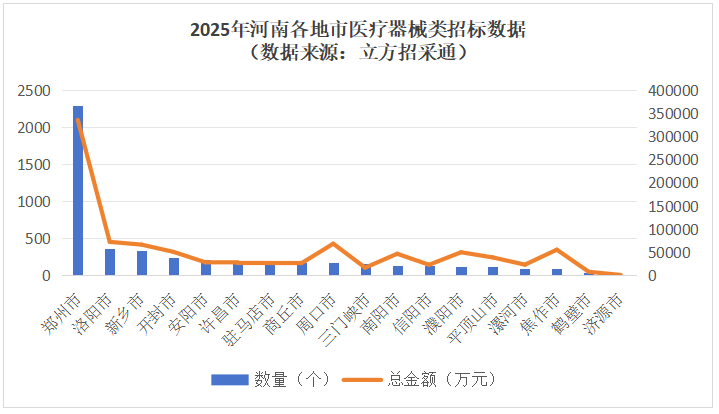
2025年河南医疗招采市场:器械招标项目超5000个,金额约95.89亿
Sou Hu Cai Jing· 2026-02-26 10:25
Core Insights - The healthcare procurement landscape in Henan Province is expanding significantly, with over 600 medical institutions expected to issue more than 8,000 tender announcements for medical devices and over 2,000 for medical consumables in 2025 [1][2]. Group 1: Medical Device Procurement - In 2025, there will be a total of 5,061 medical device tender projects with a budget of approximately 95.89 billion yuan, marking an increase of over 10% in the number of projects and over 30% in budget compared to 2024 [2][4]. - Zhengzhou leads with 2,297 tender projects and a budget of about 33.62 billion yuan, accounting for over 35% of projects with budgets exceeding 10 million yuan [4][6]. - The highest budget project is the new medical equipment procurement for the First People's Hospital of Mengzhou, totaling 155 million yuan [1][15]. Group 2: Medical Consumables Procurement - A total of 2,165 tender announcements for medical consumables were made, with 1,296 being tender announcements and 758 being awarded contracts, covering 219 medical institutions across 18 regions [16]. - The procurement volume shows a quarterly increasing trend, with the fourth quarter reaching a peak of 729 announcements, a 63.1% increase from the first quarter [16]. - The leading institution in procurement announcements is the First Affiliated Hospital of Xinxiang Medical University, with 362 announcements [16]. Group 3: Tender and Award Statistics - In 2025, there are 24 tender units with budgets exceeding 100 million yuan, and 20 units with budgets between 50 million and 100 million yuan [6]. - The total amount for awarded medical device tenders in 2025 is approximately 65.13 billion yuan, reflecting a more than 20% increase from 2024 [9][11]. - The top awarded project is the procurement of a 3.0T MRI system by the First Affiliated Hospital of Xinxiang Medical University, with a winning bid of 82.565 million yuan [14].
万东医疗20260202
2026-02-03 02:05
Summary of WanDong Medical Conference Call Company Overview - **Company**: WanDong Medical - **Parent Company**: Midea Group - **Industry**: High-end medical equipment, focusing on CT, MR, and DSA technologies Key Points and Arguments Strategic Shift and Market Positioning - Since joining Midea Group in 2021, WanDong Medical has shifted its strategic focus towards the high-end medical equipment market, particularly in CT, MR, and DSA sectors, aiming to transition from traditional low to mid-end markets to high-end clients [2][5] - The company is actively expanding its overseas market presence, aligning with the "Belt and Road" initiative, which supports its internationalization strategy [2][5] Response to Market Challenges - The centralized procurement policy has provided WanDong Medical with opportunities to enter mainstream public hospital markets, despite facing pressure on gross margins [2][5] - The company is overcoming challenges by offering high cost-performance products and a flexible product matrix, launching new products like the 64-slice 128-layer cardiac CT and high-end 3T MRI [2][5] Internationalization and Collaboration - Midea Group's acquisition of Reiko International aims to enhance international business, with both companies complementing each other in product positioning and market reach [2][7] - Future capital operations may be implemented to avoid competition between WanDong and Reiko, ensuring optimal resource utilization [2][7] Innovation and R&D Focus - WanDong Medical is increasing its R&D investments, particularly in high-end medical imaging equipment, establishing a technology reserve system to enhance future product competitiveness [3][11] - The company is developing innovative products, including a helium-free MRI, which is expected to lead the market trend towards more sustainable technologies [12][18] Financial Performance and Market Strategy - Despite short-term profit pressures due to increased R&D and marketing expenses, the company is focused on long-term growth and value creation for shareholders [4][13] - WanDong Medical anticipates significant market share growth in mid to low-end CT and MRI markets, aiming for a top-three position in its segments by 2025 [15] AI and Smart Technology Integration - The company is investing in AI technologies for smart scanning, imaging, and management, aiming to transform imaging devices into intelligent systems [16][17] - Current projects include the development of smart DR systems and integrated diagnostic solutions for specific conditions like adolescent scoliosis [16][17] Future Outlook - WanDong Medical expects to maintain a strong growth trajectory, with a focus on high-end and innovative products, while expanding its international market share to 40-45% of total revenue by 2026 [15][19] - The company is committed to enhancing its operational efficiency and cost structure to improve overall profitability [11][14] Additional Important Insights - The company is strategically positioning itself to adapt to the ongoing changes in the medical equipment market, particularly with the implementation of centralized procurement policies [9][11] - WanDong Medical's approach to product differentiation and innovation is crucial for maintaining competitiveness against established players in the industry [12][19]
万东医疗:2025年预计亏损1.99亿元至2.57亿元,持续加大研发投入同时积极拓展海外市场
Cai Jing Wang· 2026-02-02 07:44
Core Viewpoint - WanDong Medical (600055) expects a net profit loss of approximately 199 million to 257 million yuan for the fiscal year 2025, with a net profit loss excluding non-recurring gains and losses estimated at 213 million to 271 million yuan [1] Group 1: Financial Performance - The company has adjusted its marketing strategy to adapt to market changes, successfully winning imaging equipment projects with more competitive pricing, which has impacted gross margins and compressed net profit margins [1] - The anticipated losses for 2025 reflect the challenges faced in maintaining profitability amid strategic shifts and market conditions [1] Group 2: Strategic Initiatives - The company is increasing its R&D investment and actively expanding into overseas markets while strengthening marketing efforts in high-grade domestic hospitals, contributing to its strategic transformation towards high-end and international markets [1] - To address structural challenges in the industry, the company is hiring specialized R&D personnel and enhancing its comprehensive layout in high-end medical imaging equipment, particularly in CT, MR, and DSA categories [1] Group 3: Technological Development - The company focuses on the R&D of core components and high-performance equipment, establishing a technology reserve framework of "research generation, reserve generation, and development generation" [1] - Efforts to deepen overseas market penetration include improving the overseas marketing organizational structure and functions, implementing overseas station expansions, and building regional service centers to enhance medical accessibility [1]
北京万东医疗科技股份有限公司 2025年年度业绩预告
Zhong Guo Zheng Quan Bao - Zhong Zheng Wang· 2026-01-30 23:26
本公司董事会及全体董事保证本公告内容不存在任何虚假记载、误导性陈述或者重大遗漏,并对其内容 的真实性、准确性和完整性依法承担法律责任。 重要内容提示: 一、本期业绩预告情况 (一)业绩预告期间 2025年1月1日至2025年12月31日。 (二)业绩预告情况 经财务部门初步测算,预计2025年度实现归属于母公司所有者的净利润为-19,873万元到-25,683万元, 与上年同期相比,将出现亏损。 预计2025年度实现归属于母公司所有者的扣除非经常性损益后的净利润为-21,323万元到-27,133万元, 与上年同期相比,将出现亏损。 (三)本期业绩预告数据未经会计师事务所审计。 二、上年同期经营业绩和财务状况 (一)公司2024年度利润总额为16,686万元,归属于母公司所有者的净利润为15,735万元,归属于母公 司所有者的扣除非经常性损益的净利润为14,242万元。 ● 业绩预告的具体适用情形:净利润为负值。 ● 北京万东医疗科技股份有限公司(以下简称"公司")预计2025年度实现归属于母公司所有者的净利润 为-19,873万元到-25,683万元。预计2025年度实现归属于母公司所有者的扣除非经常性损益 ...
万东医疗:预计2025年全年归属净利润亏损1.99亿元至2.57亿元
Sou Hu Cai Jing· 2026-01-30 11:23
2025年度,公司持续加大研发投入,同时积极拓展海外市场并强化国内高等级医院的营销力度,助力公 司向大放、向高端、向海外的战略转型,但也导致净利润承压。面对行业结构性升级挑战,公司引进专 业研发技术人员,深化高端医学影像设备的全面布局,尤其是大放品类的CT、MR和DSA。公司聚焦核 心零部件及高性能设备研发,构建"研究一代、储备一代、开发一代"的技术储备格局。同时,公司加速 海外市场的覆盖和深耕,持续完善海外营销组织架构和职能体系,通过实施海外驻点扩容、构建地域性 服务中心等举措,有助提升"一带一路"国家和地区的医疗可及性。 证券之星消息,万东医疗发布业绩预告,预计2025年全年归属净利润亏损1.99亿元至2.57亿元。 公告中解释本次业绩变动的原因为: 2025年度,公司深度参与医疗设备集中采购,为适应市场变化,适时优化了营销策略,通过更具竞争力 的价格方案成功中标影像设备项目,价格调整对毛利率产生了一定影响,导致净利润空间有所压缩。 万东医疗2025年三季报显示,前三季度公司主营收入11.89亿元,同比上升8.73%;归母净利润-2720.98 万元,同比下降123.51%;扣非净利润-4457.54万元 ...
医疗设备以旧换新专题系列六:12月数据同比-8%,25年全年同比+25%
Southwest Securities· 2026-01-23 10:36
Investment Rating - The report indicates a positive outlook for the medical equipment industry, with an expected year-on-year growth of 25% for the year 2025 [22]. Core Insights - The medical equipment industry is experiencing a slight decline in December data year-on-year, attributed to a high base effect from the previous year. However, there is a significant month-on-month increase of 38% due to accelerated budget spending at year-end [3]. - The report highlights that the current round of medical equipment upgrades is nearing its end, with expectations for a new round of equipment replacement in 2025, which is projected to be no less than the previous round [4]. - The report emphasizes the importance of government policies, including the issuance of long-term special bonds to support large-scale equipment upgrades and consumer replacement programs [15]. Summary by Relevant Sections Medical Imaging - December figures for medical imaging reached 9.8 billion yuan, a decrease of 11%, while the forecast for 2025 is 69.3 billion yuan, reflecting a growth of 37% [5]. Life Information and Support - In December, life information and support equipment generated 2.6 billion yuan, an increase of 8%, with a projected total of 16.7 billion yuan for 2025, marking a 28% growth [5]. Endoscopes - Soft endoscopes reported 1.1 billion yuan in December, down 9%, while hard endoscopes reached 1.2 billion yuan, down 7%. The 2025 projections for both are 7.8 billion yuan for soft endoscopes (+12%) and 7.8 billion yuan for hard endoscopes (+3%) [5]. Radiation Therapy - December figures for radiation therapy stood at 1.6 billion yuan, a slight increase of 1%, with a forecast of 9.6 billion yuan for 2025, indicating a growth of 32% [48]. Surgical Robots - Surgical robots saw a significant decline in December, with figures at 600 million yuan, down 24%, but are expected to reach 5.2 billion yuan in 2025, reflecting a robust growth of 54% [51]. Key Companies - Major companies in the sector include Mindray, which reported 1.9 billion yuan in December (+20%) and is projected to reach 11.2 billion yuan in 2025 (+35%), and United Imaging, with December figures of 2.2 billion yuan (0% change) and a forecast of 12.6 billion yuan (+37%) for 2025 [55][58].




住院患者突发肾肿瘤破裂,多学科协作精准救治化险为夷
Xin Lang Cai Jing· 2026-01-01 05:25
Core Viewpoint - The case of Mr. Chai highlights the critical nature of timely medical intervention in urological emergencies, specifically renal tumor rupture, which, while rare, can be life-threatening if not addressed promptly [1][3]. Group 1: Patient Case Summary - Mr. Chai, aged 42, was hospitalized for evaluation of a left kidney mass and experienced a spontaneous rupture leading to hemorrhagic shock [1]. - Symptoms included sudden left flank pain, hematuria with blood clots, dizziness, and tachycardia, which were not initially reported to medical staff [1]. - The medical team, led by Dr. Xu Yufeng, quickly identified the signs of early hemorrhagic shock and activated an emergency response, resulting in a multidisciplinary team intervention [1]. Group 2: Medical Intervention and Outcome - The interventional team successfully controlled the active bleeding through precise embolization of the renal artery [1]. - Post-surgery, the pathology confirmed a diagnosis of renal clear cell carcinoma with no residual tumor at the margins and no lymph node metastasis [2]. - Mr. Chai was able to mobilize the day after surgery and was discharged three weeks later, indicating a successful recovery [2]. Group 3: Recommendations for Patients - Symptoms such as sudden abdominal pain, hematuria, dizziness, and tachycardia should prompt immediate medical attention [3]. - Patients with tumors should avoid strenuous activities and impacts to prevent rupture [3]. - Regular follow-ups with imaging studies like ultrasound or CT scans are essential, especially if there are changes in tumor characteristics [3]. - Choosing a hospital with comprehensive capabilities and a robust emergency response system is crucial for improving treatment outcomes [3].
医疗影像设备需求更新
2025-12-12 02:19
Summary of Medical Imaging Equipment Demand Update Industry Overview - The medical imaging equipment market is experiencing varied growth across different segments, with specific focus on CT, MRI, DSA, DR, and PET-CT devices. [1][3][10] Key Points Market Size and Growth Projections - The MRI equipment market is expected to remain stable in 2025, with a market size projected at 102-103 (based on 2024 as 100) and no significant growth anticipated through 2026 [1][4] - The CT equipment market is projected to see a slight decline in sales, estimated at 97-98 units in 2025, with a similar trend expected in 2026 [1][5] - The DR market is forecasted to shrink, with expectations of a decrease to 85-90 in 2025 and further down to 80-85 in 2026 [1][6] - The DSA market is expected to grow slightly, reaching 107-108 in 2025 and potentially 108-110 in 2026, driven by the expansion of interventional surgery and new product launches from domestic brands [1][7] - The PET-CT market is anticipated to grow by 7%-8% in 2025, reaching 107-108, and further to around 110 in 2026, while the PET-MR market is expected to decline to 80-90 units in 2025 and 60-70 in 2026 [1][9] Demand Drivers - Demand for high-end products is primarily coming from large hospitals (level 1 and above), while grassroots hospitals contribute minimally to overall growth [1][11] - The overall growth rate for medical equipment is projected at approximately 3% for 2025, with a slight increase of 1%-2% expected in the following years [1][10] Procurement Policies - A national centralized procurement policy is being implemented, with about one-third of provinces having completed the first round of procurement, accounting for 15%-20% of total procurement value, expected to rise to 30%-35% by the end of next year [1][12] - Average price reductions post-procurement are reported at 20%-30%, with factory prices dropping by 15%-20% [2][14] Competitive Landscape - The leading domestic company, Lianying, is currently the most profitable among local manufacturers due to centralized procurement, but faces long-term challenges from both international giants and domestic competitors [4][20][21] - Lianying's product development and sales capabilities are strong, with a comprehensive product line and rapid innovation, positioning it as one of the strongest companies in the domestic market [4][22] Future Trends - Photon CT is gaining traction, with current installations at around 30-40 units and expected to increase by 60-70 units. Prices are projected to drop from approximately 50 million to 25-30 million yuan as domestic brands enter the market [4][17] - The MRI sector is also evolving, with advancements in high-field MRI systems (5T and 7T) expected to gain market acceptance due to their clinical applicability [4][18] Additional Insights - The centralized procurement process is expected to standardize pricing and reduce costs across the board, impacting both high-end and low-end product segments [12][15] - Support policies for upgrading equipment are still in place but are less effective than initially anticipated, focusing more on mid to low-end products for grassroots hospitals [16] This summary encapsulates the key insights from the medical imaging equipment demand update, highlighting market trends, growth projections, and competitive dynamics within the industry.