
PVC期权

Search documents
大越期货商品期权日报-20260331
Da Yue Qi Huo· 2026-03-31 03:13
Group 1: Report Industry Investment Rating - No relevant content Group 2: Core View of the Report - No relevant content Group 3: Summary of Related Catalogs Option Quotes - The daily percentage changes of call options for various commodities are as follows: aluminum 110.63%, cast aluminum alloy 52.98%, log 30.00%, polysilicon 25.07%, zinc 24.79%, tin 22.41%, palm oil 21.40%, lithium carbonate 21.29%, gold 20.78%, and ferrosilicon 19.83% [1] - The daily percentage changes of put options for various commodities are as follows: corn 53.85%, caustic soda 43.50%, industrial silicon 41.67%, soda ash 26.67%, corn starch 24.07%, offset printing paper 20.00%, eggs 17.83%, sugar 11.24%, lead 8.19%, and PVC 4.85% [1] Option Positions - The daily changes in call option positions for various commodities are as follows: glass 72484, soda ash 20918, PTA 17053, polysilicon 14673, aluminum 14245, coking coal 14096, rapeseed meal 14071, industrial silicon 12621, corn 12202, and caustic soda 11155 [2] - The daily changes in put option positions for various commodities are as follows: methanol 29780, PTA 14011, glass 11164, lithium carbonate 9399, styrene 7237, ethylene glycol 7034, rapeseed meal 5637, soybean meal 5482, sugar 5166, and iron ore 4908 [2] Option Position Put - Call Ratio (PCR) - High - position PCR varieties and their PCR values are: fuel oil 1.7887, short - fiber 1.5487, styrene 1.5322, methanol 1.5248, crude oil 1.3809, ethylene glycol 1.3654, propylene 1.323, lithium carbonate 1.2158, polypropylene 1.2116, and PTA 1.188 [5] - Low - position PCR varieties and their PCR values are: red dates 0.2068, live pigs 0.207, polysilicon 0.2947, alumina 0.3083, soda ash 0.3261, log 0.3686, urea 0.3696, coking coal 0.3824, apples 0.393, and glass 0.3965 [5] Option Volume Put - Call Ratio (PCR) - High - volume PCR varieties and their PCR values are: propylene 16.4375, short - fiber 7.36, polypropylene 2.0329, iron ore 1.0411, p - xylene 0.9516, cast aluminum alloy 0.9234, copper 0.8426, offset printing paper 0.8077, lead 0.8031, and PTA 0.7501 [6] - Low - volume PCR varieties and their PCR values are: urea 0.1848, polysilicon 0.1914, alumina 0.1967, coking coal 0.2011, live pigs 0.234, palladium 0.2404, tin 0.2569, red dates 0.2611, nickel 0.2795, and aluminum 0.2847 [6] Daily Selections - Call options: manganese silicon (SM606, SM606C6700, trend degree 53, put - call ratio 0.63, remaining days 44), lithium carbonate (lc2607, lc2607 - C - 174000, trend degree 49, put - call ratio 1.22, remaining days 67), synthetic rubber (br2606, br2606C17800, trend degree 49, put - call ratio 0.96, remaining days 56), peanuts (PK610, PK610C8500, trend degree 49, put - call ratio 0.5, remaining days 165), methanol (MA609, MA609C3200, trend degree 45, put - call ratio 1.52, remaining days 135), styrene (eb2606, eb2606 - C - 10800, trend degree 45, put - call ratio 1.53, remaining days 52), urea (UR606, UR606C1900, trend degree 43, put - call ratio 0.37, remaining days 44), polypropylene (pp2606, pp2606 - C - 9600, trend degree 43, put - call ratio 1.21, remaining days 52) [7] - Put options: rapeseed meal (RM609, RM609P2325, trend degree - 55, put - call ratio 0.55, remaining days 135), soybeans No.1 (a2607, a2607 - P - 4400, trend degree - 53, put - call ratio 0.77, remaining days 78), corn (c2607, c2607 - MS - P - 2360, trend degree - 53, put - call ratio 0.53, remaining days 52), alumina (ao2606, ao2606P2850, trend degree - 47, put - call ratio 0.31, remaining days 56), live pigs (lh2607, lh2607 - P - 10800, trend degree - 47, put - call ratio 0.21, remaining days 78), soybean meal (m2607, m2607 - P - 2800, trend degree - 43, put - call ratio 0.85, remaining days 78), soybeans No.2 (b2606, b2606 - P - 3550, trend degree - 37, put - call ratio 0.86, remaining days 52), SSE 50 (IH2606, HO2606 - P - 2800, trend degree - 37, put - call ratio 0.62, remaining days 84) [7] Expiring Options - There are no expiring options on the day [7]
波动率数据日报-20260330
Yong An Qi Huo· 2026-03-30 06:10
Group 1: Volatility Index Explanation - The implied volatility index of financial options reflects the 30 - day implied volatility trend as of the previous trading day. The implied volatility index of commodity options is obtained by weighting the implied volatilities of the two - strike options above and below the at - the - money option of the main contract month, reflecting the implied volatility change trend of the main contract [1] - The difference between the implied volatility index and historical volatility indicates the relative level of implied volatility compared to historical volatility. A larger difference means the implied volatility is relatively higher, and a smaller difference means it is relatively lower [1] Group 2: Implied Volatility Quantile Explanation - The implied volatility quantile represents the current level of a variety's implied volatility in history. A high quantile means the current implied volatility is high, and a low quantile means it is low [3] - Volatility spread is the implied volatility index minus historical volatility [3]
大越期货商品期权日报-20260325
Da Yue Qi Huo· 2026-03-25 05:26
Group 1: Report Industry Investment Rating - No relevant content found Group 2: Core View of the Report - The report presents the daily data of commodity options on March 25, 2026, including option quotes, positions, position put - call ratios (PCR), trading volume PCR, daily selections, and near - expiration options [1][2][5][6][7][8][9] Group 3: Summary by Directory Option Quotes - For call options, tin had the highest daily increase of 173.43%, followed by silver (44.54%), copper (32.25%), etc. For put options, soybeans No.1 had a daily increase of 85.45%, p - xylene 81.80%, and ethylene glycol 54.60% [1] Option Positions - In call options, glass had the largest daily change in position of 18,336, followed by coking coal (14,436) and soybean meal (11,830). In put options, lithium carbonate had a daily change of 9,219, methanol 7,659, and fuel oil 7,363 [2] Option Position Put - Call Ratio (PCR) - High - position PCR varieties included fuel oil (2.0307), p - xylene (1.5707), and short - fiber (1.5258). Low - position PCR varieties included live hogs (0.1924), red dates (0.244), and coking coal (0.368) [5] Option Trading Volume Put - Call Ratio (PCR) - High - trading volume PCR varieties included short - fiber (5.7926), propylene (1.8022), and polypropylene (1.5394). Low - trading volume PCR varieties included coking coal (0.1851), red dates (0.1967), and soda ash (0.217) [6] Daily Selections - Call options: synthetic rubber, coking coal, ferrosilicon, etc. were selected, with trend degrees mostly around 50 and different put - call ratios and remaining days. Put options: aluminum, gold, SSE 50, etc. were selected, with negative trend degrees and corresponding put - call ratios and remaining days [7] Near - Expiration Options - For call options, apples, red dates, p - xylene, etc. were listed, showing the remaining days, option closing prices, underlying settlement prices, break - even points, and target prices and increases for option doubling. For put options, similar information for various varieties was provided, including break - even points and target prices and decreases for option doubling [8][9]
商品期权周报-20260323
Guo Tai Jun An Qi Huo· 2026-03-23 06:39
1. Report Industry Investment Rating No relevant content provided. 2. Core Viewpoints of the Report No relevant content provided. 3. Summary by Directory 3.1 Market Overview - The trading volume of the entire market this week was 9,012,194.8, a decrease of 0.88% from last week; the open interest was 9,470,619.0, an increase of 0.04% from last week. Among them, the trading volume of agricultural products decreased by 0.97%, energy and chemical products decreased by 1.45%, black products decreased by 0.36%, precious metals increased by 3.71%, and non - ferrous and new energy products increased by 1.36% [4]. 3.2 Market Data 3.2.1 Market Overview - Lists the flat - value volatility, 60 - day quantile, Skew, and 60 - day quantile of various commodity options, such as the flat - value volatility of corn options is 12.54%, and the Skew is 34.99% [7]. 3.2.2 - 3.2.61 Various Commodity Options - For each type of commodity option (such as corn, soybean meal, etc.), it provides detailed data including the closing price, trading volume, open interest, volume PCR, open interest PCR, flat - value volatility, HV - 10 days, HV - 20 days, and Skew of the main and secondary contracts, as well as the overall contract data. For example, for soybean meal options, the main contract m2605 had a closing price of 3029 this week, a decrease of 99 from last week; the trading volume of call options this week was 276,811, a decrease of 221,158 from last week [8][9].
波动率数据日报-20260319
Yong An Qi Huo· 2026-03-19 05:05
Group 1: Volatility Index Explanation - The implied volatility index of financial options reflects the 30 - day implied volatility trend as of the previous trading day, while the implied volatility index of commodity options is obtained by weighting the implied volatilities of the two - step up and down of the at - the - money options of the main contract month, reflecting the implied volatility change trend of the main contract [1] - The difference between the implied volatility index and historical volatility: a larger difference indicates that the implied volatility is relatively higher than historical volatility, and a smaller difference means the opposite [1] Group 2: Volatility Data Visualization - The document presents multiple charts showing the implied volatility (IV), historical volatility (HV), and the difference between them (IV - HV) for various financial and commodity options, including 300股指, 50ETF, 1000股指, 500ETF, corn, cotton, Chinese Yen, rubber, iron ore, PTA, crude oil, aluminum, PVC, rebar, urea, rapeseed, and palm oil [2] Group 3: Implied Volatility Quantile - Implied volatility quantiles represent the current level of a variety's implied volatility in history. A high quantile indicates high implied volatility, and a low quantile indicates low implied volatility [3] - The document also shows the ranking of implied volatility quantiles [3]
波动率数据日报-20260316
Yong An Qi Huo· 2026-03-16 05:37
Group 1: Volatility Index Explanation - The implied volatility index of financial options reflects the 30 - day implied volatility trend as of the previous trading day. The implied volatility index of commodity options is obtained by weighting the implied volatilities of the two - strike options above and below the at - the - money option of the main contract, reflecting the implied volatility change trend of the main contract [3] - The difference between the implied volatility index and historical volatility: a larger difference indicates that the implied volatility is relatively higher than historical volatility, while a smaller difference means the opposite [3] Group 2: Volatility Data Graphs - There are graphs showing the implied volatility (IV), historical volatility (HV), and the difference between them (IV - HV) for various financial and commodity options, including 300股指, 1000股指, 50ETF, 500ETF, corn, cotton, methanol, rubber, iron ore, PTA, crude oil, aluminum, PVC, rebar, urea, and palm oil [4] Group 3: Implied Volatility Quantile and Volatility Spread Quantile - Implied volatility quantile represents the current level of a variety's implied volatility in history. A high quantile means high implied volatility, and a low quantile means low implied volatility [5] - Volatility spread is the difference between the implied volatility index and historical volatility [5]
商品期权周报-20260316
Guo Tai Jun An Qi Huo· 2026-03-16 05:18
1. Market Overview - The trading volume of the market this week was 11,521,370.6, with a week - on - week increase of 0.51%, and the open interest was 8,953,943, with a week - on - week decrease of 0.01% [4]. - The trading volume of agricultural products this week was 2,487,110.4, with a week - on - week increase of 2.76%, and the open interest was 3,248,462, with a week - on - week increase of 0.16% [4]. - The trading volume of energy and chemical products this week was 7,108,318.2, with a week - on - week increase of 0.61%, and the open interest was 3,498,076, with a week - on - week decrease of 0.15% [4]. - The trading volume of black commodities this week was 531,268.4, with a week - on - week increase of 1.04%, and the open interest was 825,749, with a week - on - week decrease of 0.05% [4]. - The trading volume of precious metals this week was 325,839.8, with a week - on - week decrease of 1.22%, and the open interest was 341,823, with a week - on - week increase of 0.05% [4]. - The trading volume of non - ferrous metals and new energy products this week was 1,068,833.8, with a week - on - week decrease of 1.45%, and the open interest was 1,039,833, with a week - on - week increase of 0.14% [4]. 2. Market Data 2.1 Market Overview - The report provides the implied volatility, quantile, and skew of various commodity options, such as the implied volatility of corn options was 15.72%, and the skew was 47.0% [5]. 2.2 - 2.61 Option Data of Each Commodity - For each commodity option (such as corn, soybean meal, etc.), the report details the closing price, trading volume, open interest, volume PCR, open interest PCR, implied volatility, HV - 10 days, HV - 20 days, and skew of the main and secondary contracts, as well as the overall contract data [6][7][8]...[65].
大越期货商品期权日报-20260227
Da Yue Qi Huo· 2026-02-27 02:40
Group 1: Report Industry Investment Rating - No information provided Group 2: Core View of the Report - The report presents data on commodity option daily market conditions, including option price changes, option positions, and Put - Call Ratios (PCR) for various commodity options on February 27, 2026, as well as daily preferred options and information on expiring options [1][2][5][6][7] Group 3: Summary by Related Catalogs Option Quotes - For call options, manganese silicon had the highest daily increase of 133.33%, followed by ferrosilicon with 37.72% and lithium carbonate with 25.94%. For put options, PVC had a daily increase of 41.32%, polycrystalline silicon 39.68%, and palm oil 37.41%. The calculation is based on the closing price of the at - the - money options of the main contracts of each variety [1] Option Positions - For call options, glass had the largest daily change in position of 45,943, followed by methanol with 35,737 and manganese silicon with 35,447. For put options, lithium carbonate had a daily position change of 21,389, iron ore 13,959, and PTA 13,864 [2] Option Position Put - Call Ratio (PCR) - High - position PCR varieties included apple with 1.9461, lithium carbonate with 1.2111, and short - fiber with 1.1513. Low - position PCR varieties included alumina with 0.2496, jujube with 0.2897, and live pigs with 0.2946 [5] Option Volume Put - Call Ratio (PCR) - High - volume PCR varieties included polycrystalline silicon with 1.7396, propylene with 1.479, and apple with 1.3897. Low - volume PCR varieties included jujube with 0.2004, manganese silicon with 0.2173, and live pigs with 0.2551 [6] Daily Preferred Options - Call options: The selected varieties were lithium carbonate, CSI 1000, soybean meal, fuel oil, cotton, soybean No. 2, soybean No. 1, and corn, with a trend degree of 53 - 55 and different put - call ratios and remaining days [7] - Put options: The selected varieties were polycrystalline silicon, coking coal, PVC, live pigs, palm oil, iron ore, ethylene glycol, and plastic, with a negative trend degree of - 39 to - 55 and different put - call ratios and remaining days [7] Expiring Options - There were no expiring options on the day [7]
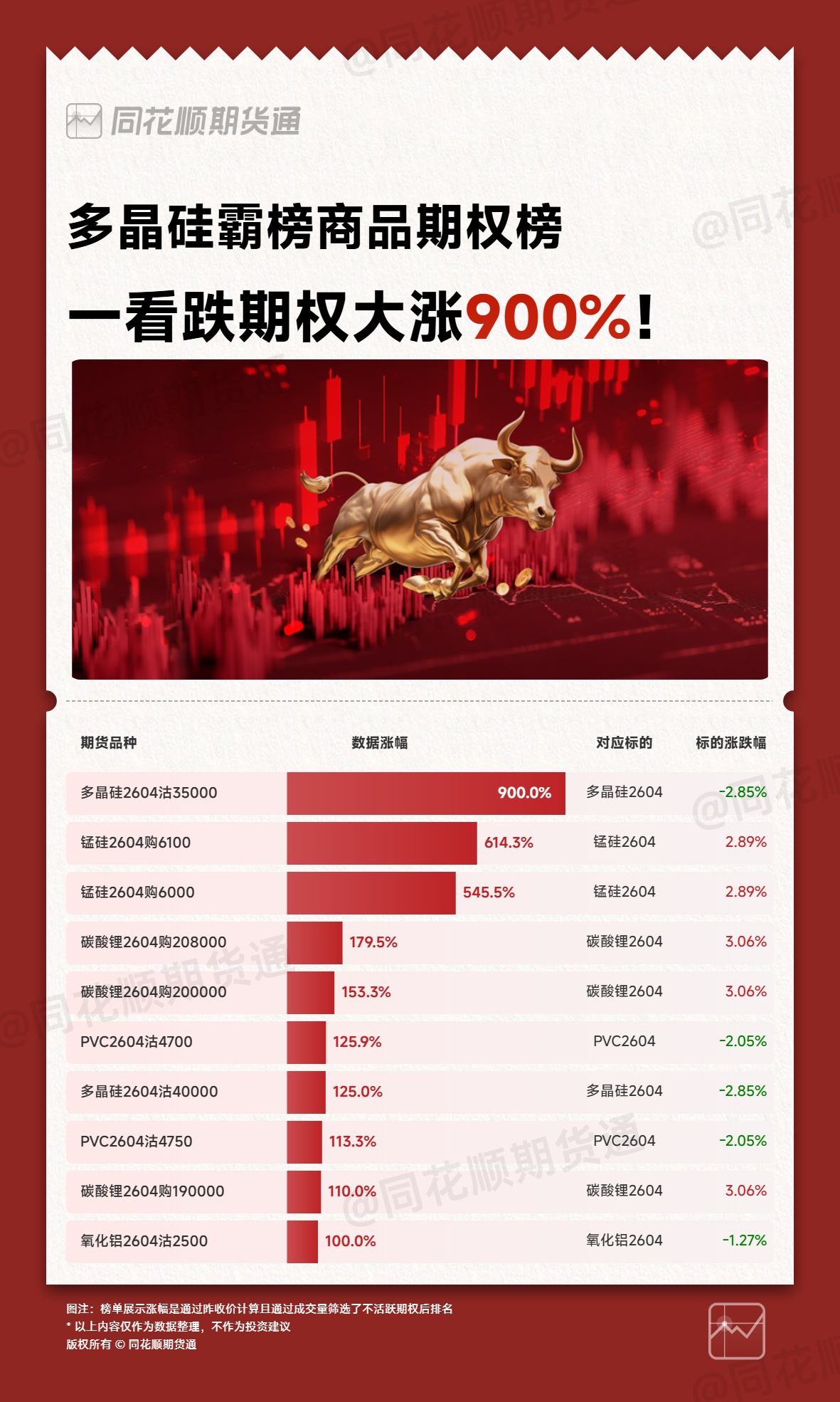
多晶硅期权大涨900%夺得期权榜首
Xin Lang Cai Jing· 2026-02-26 10:27
Core Insights - The commodity options market has experienced significant volatility, with the price of polysilicon put options surging nearly 900% in a single day, highlighting the potential for high returns from small price movements [5][9] - The top three options that saw the largest increases were all out-of-the-money options, indicating that low initial prices and premiums can lead to substantial gains when the underlying asset experiences minor fluctuations [7][9] Market Performance - Polysilicon put option 2604 at 35000 increased by 900% while the underlying asset decreased by 2.85% [3] - Manganese silicon call option 2604 at 6100 rose by 614.3% with the underlying asset increasing by 2.89% [3] - Manganese silicon call option 2604 at 6000 saw a 545.5% increase, also with the underlying asset up by 2.89% [3] Market Dynamics - The current market conditions are driven by a combination of high implied volatility, the nature of out-of-the-money options, and supportive policies affecting supply and demand [5][9] - The increase in volatility is attributed to high inventory levels of polysilicon and export policy disruptions for manganese silicon, leading to heightened market expectations for future price movements [7][9] - The fundamental factors, including supply surplus and policy changes, have led to increased investment in polysilicon, while manganese silicon is supported by export controls and supply-side reforms [7][9]

商品期权周报-20260224
Guo Tai Jun An Qi Huo· 2026-02-24 06:24
1. Report Industry Investment Rating - Not provided in the content 2. Core Viewpoints of the Report - Not provided in the content 3. Summary by Relevant Catalogs 3.1 Market Overview - The report presents the trading volume and open interest data of the commodity options market, including the overall market and different sectors such as agriculture, energy and chemicals, black metals, precious metals, and non - ferrous metals and new energy. The overall trading volume of the market this week was 6,628,465.8, a decrease of 0.95% from last week, and the open interest was 7,083,253, a decrease of 0.24% from last week. Among them, the trading volume of agricultural products increased by 0.48%, while the trading volume of other sectors decreased to varying degrees [5]. 3.2 Market Data 3.2.1 Market Overview - The report provides the quantitative data of commodity options, including the at - the - money volatility, 60 - day quantile, skew, and 60 - day skew quantile of various options. For example, the at - the - money volatility of corn options is 8.65%, and the 60 - day quantile is 13.33% [15]. 3.2.2 - 3.2.61 Various Option Data - For each type of option (such as corn options, soybean meal options, etc.), the report details the closing price, trading volume, open interest, volume PCR, open interest PCR, at - the - money volatility, HV - 10 days, HV - 20 days, and skew of the main and secondary contracts. For example, for corn options, the total trading volume of the main contract this week was 145,658, an increase of 48,066 from last week, and the volume PCR was 0.4574, a decrease of 0.0707 from last week [17].