
Jing Ji Ri Bao

Search documents
铁陆联动提升物流效能
Jing Ji Ri Bao· 2026-01-22 00:02
Core Viewpoint - The article highlights the development of the SCO Demonstration Zone's logistics capabilities, focusing on the expansion of the China-Europe Railway Express and international road transport, aiming to enhance cross-border trade efficiency and connectivity [1][2][3][4]. Group 1: China-Europe Railway Express - Two trains of the "Japan-Korea Land-Sea Express" have departed from the SCO Demonstration Zone, with plans to increase the number of China-Europe Railway Express trains to 1,225 by 2025, achieving over 20% growth in both train frequency and cargo volume [1]. - The expected import and export cargo volume is projected to reach 840,000 tons by 2025, marking a historical high for the region [1]. - The SCO Demonstration Zone aims to integrate sea and rail transport schedules to provide comprehensive logistics solutions for businesses [2]. Group 2: International Road Transport - The TIR (International Road Transport) volume is expected to maintain its national leading position, with 435 shipments planned for the year, reflecting a 53.7% year-on-year increase [1]. - The region has established four international road transport routes since September 2023, creating a regional hub for international road transport [3]. - The introduction of a streamlined process for international road transport, including "one declaration, one certificate, and one vehicle direct delivery," enhances efficiency and flexibility, attracting more customers [3]. Group 3: Infrastructure Development - The construction of the China-Europe Railway Express (Jinan-Qingdao) National Gathering Center is expected to provide new opportunities for high-quality development in the SCO Demonstration Zone [3]. - The center has implemented an integrated model of "train transport + park warehousing + international trade," successfully handling over 38,000 tons of specific goods [3]. - The SCO Demonstration Zone is focused on enhancing operational efficiency and service quality while exploring new international road transport routes targeting SCO member states [4].
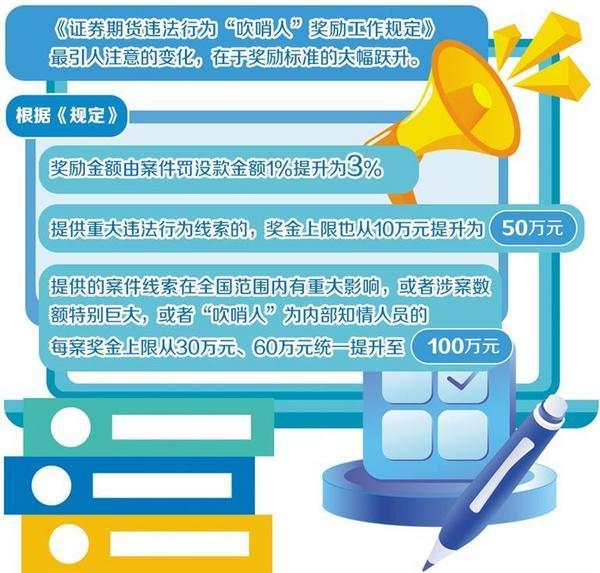
最高100万元 证券期货“吹哨人”奖励大幅提高
Jing Ji Ri Bao· 2026-01-21 23:55
Core Viewpoint - The revised "Whistleblower" reward regulations by the CSRC and Ministry of Finance aim to enhance the reporting system, promote a culture of accountability, and adapt to the requirements of high-quality capital market development and regulatory enforcement [2] Group 1: Changes in Reward Structure - The reward standard has significantly increased, with the reward amount rising from 1% to 3% of the penalties collected from cases [2] - The maximum reward for providing major illegal activity leads has been raised from 100,000 yuan to 500,000 yuan [2] - For cases with significant national impact or involving particularly large amounts, the maximum reward has been unified and increased to 1 million yuan [2][3] Group 2: Inclusion of Serious Cases - The new regulations include serious cases that severely disrupt the securities and futures market order, endanger financial security, or infringe on investors' legal rights [3] - The threshold for rewarding cases has been raised from penalties of 100,000 yuan to 1 million yuan [3] Group 3: Protection Mechanisms for Whistleblowers - The regulations enhance protection mechanisms for whistleblowers, ensuring anonymity and strict management of personal information [4] - Any form of retaliation against whistleblowers, including violence, coercion, or breach of privacy, is prohibited [4] Group 4: Expected Positive Impacts - The dual mechanism of "incentives and protection" is expected to significantly improve the efficiency of regulatory enforcement by enabling whistleblowers to provide high-value information [5] - The regulations signal a strong commitment from regulators to combat illegal activities and protect the rights of small and medium investors, fostering a fair market order [5] Group 5: Future Recommendations - Suggestions for further improvement include establishing a unified, efficient, and confidential reporting platform, enhancing the protection of whistleblower rights, and clarifying standards for malicious reporting [6]

董监高责任约束加强 董责险渐成上市公司“标配”
Jing Ji Ri Bao· 2026-01-21 23:55
董责险正逐渐从上市公司的可选项变为必选项。近日,《中国上市公司董责险市场报告(2026)》(以下简 称《报告》)在北京发布。《报告》显示,截至2025年底,A股市场累计已有1753家上市公司公告披露 购买董事、监事及高级管理人员责任保险,投保渗透率突破三成,董责险正逐渐成为上市公司风险管理 体系中的基础工具。 董监高责任约束加强 董事、监事及高级管理人员责任保险,通常被简称为"董责险",是以公司董事、监事和高级管理人员在 履职过程中可能面临的民事赔偿责任为保障对象的一类责任保险。其核心功能,是在董监高因涉嫌信息 披露违法、决策失当或未尽勤勉义务而遭遇监管调查、投资者诉讼时,为依法应承担的律师费、诉讼费 及民事赔偿金责任提供保险保障。 董责险的走红并非偶然,其发生在资本市场规则体系深刻重塑的关键阶段。随着新证券法和新公司法相 继实施,信息披露责任、董事勤勉义务和连带赔偿责任被系统性强化;代表人诉讼、示范判决等机制逐 步落地,中小投资者的维权能力显著提升。在这样的背景下,董监高的个人责任风险被持续放大,也倒 逼上市公司通过市场化工具为治理风险构建必要的缓冲带。 明亚保险经纪股份有限公司综合业务部副经理潘耀斌在接受 ...
外汇市场保持较强韧性和活力 整体呈现稳健运行趋势
Jing Ji Ri Bao· 2026-01-21 23:55
市场交易量达到42.6万亿美元,企业外汇套期保值比率升至30%,均为历史新高;2025年12月末,我国 外汇储备规模已连续5个月处于3.3万亿美元之上,创2015年12月以来最高……2025年,我国外汇管理亮 点频出,市场供求基本平衡,预期总体平稳,保持较强韧性和活力。 筑牢市场"防波堤" 2025年,我国外汇市场交易量达42.6万亿美元,市场活跃度和参与度显著提升。同时,企业在跨境贸易 投资中主动识别和管理汇率风险的需求上升,企业外汇套期保值比率升至30%。这两项数据,既反映出 市场规模的扩大,也体现了市场成熟度的提升。 随着国际金融市场波动加大,越来越多企业将汇率波动纳入日常财务决策,通过外汇衍生品、本币结算 等多种方式管理汇率风险,企业汇率风险管理意识和能力不断提高。2025年,企业利用外汇衍生品管理 汇率风险的规模超1.9万亿美元,较2020年翻了近1倍;企业外汇套保比率较2020年提高8个百分点。 近年来,国家外汇管理局持续完善企业汇率风险管理服务。国家外汇管理局副局长李斌介绍,一是多种 方式开展汇率风险中性理念宣传,编发《企业汇率风险管理指引》《汇率风险情景与外汇衍生产品运用 案例集》,积极宣传汇 ...
溯源管理全面升级 全链条管理废旧动力电池回收利用
Jing Ji Ri Bao· 2026-01-21 23:50
Core Viewpoint - The introduction of the "Interim Measures for the Recycling and Comprehensive Utilization of Waste Power Batteries from New Energy Vehicles" marks a new phase in the standardized management of waste battery recycling in China, addressing the increasing volume of waste batteries expected to exceed 1 million tons by 2030 [1][2]. Group 1: Regulatory Framework - The new management measures enhance legal constraints and provide a solid guarantee for addressing management bottlenecks in the recycling of waste batteries [2][3]. - The previous regulations from 2018 will be abolished, and a digital identification system for batteries will be established to monitor their lifecycle and ensure compliance [3][4]. Group 2: Industry Standards and Responsibilities - The measures set new requirements for the scope of comprehensive utilization and the conditions for enterprises involved, emphasizing the need for compliance with environmental and safety standards [5][6]. - The government has established a recycling network across 31 provinces and cultivated 148 key enterprises to lead industry development [4][6]. Group 3: Social Participation and Public Awareness - The measures call for collective responsibility from all stakeholders, including consumers, who are urged to understand battery recycling processes and ensure proper disposal [8]. - The initiative aims to integrate policies, technology, and market resources to promote a standardized, efficient, and green transformation of the waste battery recycling industry, supporting sustainable development and carbon neutrality goals [8].
破解危旧楼改造融资困境
Jing Ji Ri Bao· 2026-01-21 23:16
Core Viewpoint - The article discusses the innovative financing solutions for the renovation of old residential buildings in Beijing, particularly focusing on the "personal housing renovation loan" and the "mortgage retention renovation" model, which aim to alleviate the financial burdens on residents while ensuring the security of financial institutions' rights [1][2][3]. Group 1: Financing Challenges and Solutions - The old residential building at No. 28, Sanlihe District, Beijing, built in 1978, faces significant structural issues and requires demolition and reconstruction due to aging and lack of maintenance [1]. - Residents and financial institutions are in a dilemma due to traditional mortgage products not being suitable for old building renovations, leading to difficulties in obtaining new financing while existing loans must be repaid [1]. - The Beijing Financial Regulatory Bureau has introduced a pilot policy for financial support in the renovation of old buildings, creating a dedicated "personal housing renovation loan" product to address residents' financing challenges [2]. Group 2: Innovative Processes and Collaboration - The "mortgage retention renovation" process allows for the renovation of already mortgaged properties, ensuring that the rights of financial institutions are protected through optimized real estate registration processes [2]. - A new "four-in-one" mechanism has been established to streamline the processes of mortgage cancellation, property deregistration, new property registration, and new mortgage registration, effectively eliminating the "vacuum period" of mortgage rights [2][3]. - This innovative approach significantly reduces the financial burden on residents, enabling families previously constrained by mortgage and economic pressures to participate in the renovation, thereby improving living conditions and safety [3]. Group 3: Impact and Future Prospects - The successful demolition and ongoing construction of the No. 28 building serve as a model for similar urban renewal projects in Beijing and across the country, providing replicable experiences for future initiatives [3]. - The collaboration among banks, implementation entities, and real estate registration departments is crucial for ensuring timely financial services and safeguarding financial rights during the renovation process [2][3].
经济日报财经早餐【1月22日星期四】
Jing Ji Ri Bao· 2026-01-21 23:06
Group 1 - The Ministry of Finance announced the full implementation of cross-province reimbursement for fiscal electronic invoices to enhance their social application efficiency [2] - Beijing's GDP reached 52,073.4 billion yuan in 2025, marking a 5.4% increase from the previous year, making it the second city in China to surpass 50 trillion yuan in economic scale [2] - China's self-developed 35,000-ton heavy-duty train completed the world's first automatic formation driving test, potentially revolutionizing the country's freight transport [2] Group 2 - The National Energy Administration reported that by the end of last year, the number of electric vehicle charging facilities in China reached 20.092 million, supporting the charging needs of over 40 million new energy vehicles [1] - The National Film Administration stated that in 2025, the total output value of China's film industry reached 817.259 billion yuan, with a box office multiplier of approximately 1:15.77, ranking among the top globally [4]
外汇市场保持较强韧性和活力
Jing Ji Ri Bao· 2026-01-21 22:29
Group 1: Foreign Exchange Market Overview - In 2025, China's foreign exchange market trading volume reached $42.6 trillion, marking a historical high, with the corporate foreign exchange hedging ratio rising to 30% [1] - The demand for managing exchange rate risks among enterprises has increased, with the scale of using foreign exchange derivatives for risk management exceeding $1.9 trillion, nearly doubling since 2020 [1] - The foreign exchange reserve level has remained above $3.3 trillion for five consecutive months, the highest since December 2015, indicating a stable market supply and demand [1] Group 2: Regulatory and Policy Developments - The State Administration of Foreign Exchange (SAFE) has been enhancing services for corporate exchange rate risk management, including promoting the concept of exchange rate risk neutrality and improving financial institutions' service mechanisms [2] - SAFE has introduced measures to promote high-level institutional opening of capital projects, including direct investment and cross-border financing, to facilitate financial market openness [3] - The integration of domestic and foreign currency fund pools for multinational companies has been expanded nationwide, benefiting over 1,100 multinational companies and 19,000 member enterprises [4][5] Group 3: Future Outlook and Market Stability - The foreign exchange market is expected to maintain stable operations in 2026, with cross-border capital flows remaining orderly and resilient [6] - The external environment is projected to support stable operations, with moderate global economic growth and potential interest rate cuts in major developed economies [6] - The People's Bank of China aims to enhance the resilience of the foreign exchange market and maintain the RMB exchange rate at a reasonable and balanced level [7]
“夺岛关税”暴露美国霸权本性
Jing Ji Ri Bao· 2026-01-21 22:26
Group 1 - The United States announced a 10% tariff on goods imported from Denmark, Norway, Sweden, France, Germany, the UK, the Netherlands, and Finland starting February 1, with a threat to increase it to 25% if an agreement on the "complete and thorough purchase of Greenland" is not reached by June 1 [1] - This action is characterized as an extreme manifestation of unilateralism and power politics, violating international law based on the principles of the United Nations Charter and undermining the current international order [1] - Greenland, as an autonomous territory of the Kingdom of Denmark, has clear legal and historical grounds for its sovereignty, and the U.S. perception of foreign territory as a commodity reflects a colonial mindset [1] Group 2 - European countries have united in condemnation of the U.S. tariff threats, with a joint statement from the eight affected nations expressing that such actions could lead to a dangerous cycle and damage transatlantic relations [2] - French President Macron and Swedish Prime Minister Kristersson have explicitly criticized the U.S. threats as unacceptable and tantamount to extortion, while the Netherlands labeled the behavior as improper [2] - The European Parliament has frozen the approval process of a previously agreed trade deal with the U.S., and several EU countries are considering imposing tariffs on U.S. goods worth €93 billion or restricting U.S. companies' access to the EU market as a countermeasure [2]
高质量推进城市更新 加快房地产转型升级 ——访住房和城乡建设部党组书记、部长倪虹
Jing Ji Ri Bao· 2026-01-21 22:25
"十五五"时期是基本实现社会主义现代化夯实基础、全面发力的关键时期。住房城乡建设领域如何实现 高质量发展?城市更新如何推进?房地产市场如何稳定?带着这些问题,经济日报记者采访了住房和城 乡建设部党组书记、部长倪虹。 记者:您对于"十五五"时期实现住房城乡建设高质量发展有哪些考虑? 倪虹:"十五五"时期,住房城乡建设总体上处在转型发展的关键期,既伴随不少挑战,更面临难得机 遇。习近平总书记高度重视住房城乡建设工作,作出一系列重要指示批示。党的二十届四中全会擘画 了"十五五"我国发展的宏伟蓝图,在去年召开的中央城市工作会议上,党中央作出了城镇化和城市发 展"两个转向"的重大判断,提出了建设现代化人民城市的奋斗目标,这为住房城乡建设工作指明了方 向。 2026年是"十五五"开局之年。我们将高质量推进城市更新。坚持城市内涵式发展,把城市更新作为重要 抓手,统筹落实"一个优化、六大建设"重要任务,统筹构建城市更新体制机制,系统推进好房子、好小 区、好社区、好城区"四好"建设,为人民群众打造高品质生活空间。 将推动房地产高质量发展。牢牢抓住让人民群众安居这个基点,统筹防风险和促转型,统筹惠民生和稳 增长,着力稳定房地产市 ...