
Ke Ji Ri Bao

Search documents
国家卫生健康委:“人工智能+”赋能基层医疗卫生服务
Ke Ji Ri Bao· 2025-11-28 05:33
"县域远程医学影像诊断服务量今年已超过6800万人次。"在27日国家卫生健康委举行的新闻发布会上, 国家卫生健康委基层司司长焦雅辉表示,在"人工智能+"的赋能下,目前80%的县(市、区)初步建成了县 域影像、心电、检验资源共享中心,实现基层检查、区县诊断;远程医疗、互联网医疗、移动巡诊医疗 车等还助力山区、海岛、边远贫困等地方的"空白"得以弥补。 数据显示,全国超过90%的居民能在15分钟内获得就近就便医疗卫生服务,2024年县域内基层医疗卫生 机构诊疗人次占全国诊疗量的63.4%,比上一年提高0.5个百分点,越来越多农村群众看病就医优先选择 基层医疗卫生机构。 焦雅辉表示,在重点专科建设和人工智能的赋能下,一些以往在县级医院比较薄弱的专科,如肿瘤科、 精神科、眼科等,设置率和服务能力均有很大程度提高。 (责任编辑:张紫祎) 为进一步解决农村地区的卫生健康重点和难点问题,2021年起,全国遴选12个县开展基层卫生健康综合 试验区的建设,由县委成立卫生健康工委,一位政府领导统管医疗、医保、医药。"最近我们完成了效 果评价,2024年12个综合试验区基层医疗卫生机构的诊疗量占比达到了69.1%,高于全国平均水 平 ...
【科技日报】《三江源国家公园野生维管植物图鉴》出版
Ke Ji Ri Bao· 2025-11-28 04:31
《三江源国家公园野生维管植物图鉴》中,植物科级分类严格遵循反映植物分子亲缘关系的 APGIV系统排序,属级分类按字母顺序排列,兼顾分类学前沿进展与检索便捷性;形态描述摒弃冗长 的学术术语,转而聚焦花、叶、果等直观识别特征,结合植株整体形态与微观细节的图文对照,构建多 维度鉴定体系;分布信息与生境标注精准锚定三江源国家公园地理单元,细化至典型地貌,让读者在高 原复杂生境中亦可按图索骥;高清图片涵盖全株生态照、花果特写及生境背景,结合引自《中国植物 志》的墨线图与画师李君睿的手绘彩色图片,捕捉同种植物不同物候期的形态变化,使野外鉴定从"专 业难题"变为"自然观察的乐趣"。 记者11月26日获悉,由中国科学院西北高原生物研究所青藏高原植物适应与进化学科组编写的《三 江源国家公园野生维管植物图鉴》,已正式出版发行。 据悉,《三江源国家公园野生维管植物图鉴》的编撰得到三江源国家公园管理局的支持,编纂团队 历时数年,踏遍青海治多、曲麻莱、玛多、杂多四县及可可西里国家级自然保护区,系统梳理了三江源 国家公园全域的野生维管植物。全书收录746种植物,涵盖56科238属。 "长久以来,三江源的植物世界始终蒙着一层神秘面纱。相较 ...


古基因组重建中国最大史前城址社会结构
Ke Ji Ri Bao· 2025-11-28 03:17
Core Insights - The research reveals the origins and social structure of the Shijia culture, indicating a complex early state formation in China, based on a large-scale ancient genomic study published in *Nature* [1][2]. Group 1: Key Discoveries - The study achieved precise tracing of the Shijia culture's population roots, confirming that the main population originated from local Yangshao late-period residents in northern Shaanxi, demonstrating clear genetic continuity [2]. - Genetic components from northern grassland populations and southern coastal agricultural groups were detected, illustrating a dynamic picture of cultural integration and the multi-faceted nature of early Chinese civilization [2]. Group 2: Interaction Patterns - The research clarifies the interaction modes among populations, showing that the Shijia culture had significant genetic exchanges with groups from the Central Plains, northern grasslands, and southern coastal areas, while lacking connections with populations from Eurasian western grasslands and Central Asia [3]. - The findings suggest that the Shijia site served as a regional political and military center, as well as a cultural and trade hub during prehistoric times [3]. Group 3: Social Structure Insights - The study reconstructs the kinship ties and social organization of the early state, revealing a patrilineal hierarchical society with significant social stratification [4]. - The analysis of burial practices indicates a complex social structure, with variations in sacrificial practices reflecting class distinctions within the Shijia culture [4]. - This research marks a shift from material studies to a more precise understanding of human and social dynamics in the context of early Chinese civilization [4].
核工业二〇八大队:扎根祖国北疆 六十载戈壁寻铀
Ke Ji Ri Bao· 2025-11-28 02:30
Core Insights - The article highlights the achievements and contributions of the 208th Brigade in uranium exploration and geological research, emphasizing its role in supporting China's nuclear energy development [1][2][3][4] Group 1: Uranium Exploration Achievements - The 208th Brigade has discovered significant uranium deposits, including one super-large, seven large, and several medium-sized uranium ore deposits since 2000 [1][2] - Key discoveries include the Zaohuohao uranium deposit in the Ordos Basin and the Nalinggou uranium deposit, which supports the "National Uranium No. 1" project [1] - In the Erlian Basin, the Brigade identified multiple large ancient river valley-type sandstone uranium deposits, contributing to the establishment of a major uranium mining base [1][2] Group 2: Engineering and Construction Excellence - The Brigade has successfully completed high-quality engineering projects, including a medical facility construction project with an annual output of 10 billion nitrile gloves [2] - It has also efficiently executed foundation construction for a bank's data center, setting industry standards in Hohhot [2] Group 3: Multi-Mineral Exploration - The 208th Brigade has demonstrated expertise in exploring various minerals, having identified 100 tons of gold resources and several large deposits of other minerals such as graphite and limestone [2] - The Brigade holds 18 exploration rights for gold and multi-metal resources, with its self-operated Tugu Rige gold mine producing 250 kg of gold annually [2] Group 4: Industry Leadership and Equipment - The Brigade possesses advanced drilling equipment and capabilities, with over 80 sets of various drilling rigs and an annual drilling capacity exceeding 800,000 meters [2] - Since 2000, it has completed approximately 4 million meters of drilling tasks independently, establishing itself as a leading exploration unit in China [2] Group 5: Environmental Restoration and Green Practices - The Brigade offers comprehensive solutions for geological environment management and ecological restoration, equipped with over 100 monitoring devices [3] - It has completed significant environmental impact assessments and restoration projects across various regions, setting benchmarks in the field [3] Group 6: Analytical and Testing Capabilities - The Brigade's analysis and testing center is one of the top geological mineral analysis institutions in China, capable of conducting over 2,000 parameter measurements [3] - The center is equipped with more than 300 advanced analytical devices, providing substantial support for uranium mining in Inner Mongolia [3] Group 7: International Expansion - The 208th Brigade actively participates in the Belt and Road Initiative, expanding its overseas resource exploration projects in countries such as Saudi Arabia, Tanzania, and Canada [4]
“煤海蛟龙”:攻克煤巷快速掘进世界难题
Ke Ji Ri Bao· 2025-11-28 01:48
Core Viewpoint - The "Coal Sea Dragon" is a new generation of integrated intelligent rapid excavation system developed by China Coal Technology & Engineering Group Taiyuan Research Institute, achieving parallel operations in excavation, support, and transportation for the first time globally [1] Group 1: Technology and Innovation - The system integrates technologies such as the excavation and support machine and flexible continuous transportation system, overcoming the global challenge of rapid excavation in coal roadways [1] - It introduces an innovative four-in-one excavation model: "drum cutting + advanced drilling + temporary support + permanent support," breaking through the technical bottleneck of full-width advanced drilling [1] - The system has undergone four generations of iterations, with a localization rate of key components reaching 100% [1] Group 2: Performance and Achievements - Under stable surrounding rock conditions, the "Coal Sea Dragon" set a world record with a maximum monthly advance of 3,088 meters [1] - In March 2024, it achieved a breakthrough of over 1,000 meters in monthly advance for the first time under complex surrounding rock conditions [1]
李德仁:扎根地方一线,共筑空天信息产业高地
Ke Ji Ri Bao· 2025-11-28 01:47
Core Insights - The article emphasizes the importance of aligning consulting services with national strategies while addressing local needs, as articulated by Li Deren, an academician and a key figure in promoting Hubei's development [1] Group 1: Establishment and Function of Hubei Research Institute - The Hubei Research Institute was established in 2018 as the first local research institute co-built by the Chinese Academy of Engineering and a provincial government, with Li Deren appointed as the academic committee director [3] - The institute employs a "central-local co-investment" model, where the Chinese Academy of Engineering, Hubei Province, and Wuhan City allocate special funds annually to encourage academicians to address local development issues [3] - A rating mechanism is in place to evaluate the quality and effectiveness of consulting reports, ensuring that they are practical and impactful [3] Group 2: Achievements and Impact - The Hubei Research Institute has implemented 173 consulting projects, resulting in 315 academician recommendations, with several outcomes receiving endorsements from central and provincial leaders [4] - The institute has successfully created high-end academic activity brands like "Jingchu Academician Tour" and has seen over 1 million visits to its technology achievement display and transformation center [4] Group 3: Innovation and Future Directions - Li Deren introduced the concept of "spatiotemporal intelligence," which integrates satellite communication, navigation, remote sensing, drones, and AI to enhance productivity in various sectors [6] - Applications of "spatiotemporal intelligence" include automated management in the power sector and precision agriculture using satellite technology [6] - The team aims to leverage Hubei's strengths to foster the development of commercial space and low-altitude economies, positioning technology as a catalyst for local growth [6] Group 4: Personal Philosophy and Commitment - Despite being retired, Li Deren remains active, emphasizing the importance of contributing to society and finding meaning in service [7] - He advocates for a focus on practical achievements rather than personal accolades, embodying a commitment to writing "papers on the land of the motherland" through tangible projects [7]
含9.6GW光伏!青海近 20GW“沙戈荒”大基地开工!
Ke Ji Ri Bao· 2025-11-28 01:29
Core Insights - The Qinghai Hainan Clean Energy Delivery Base Power Project has commenced construction in Xining, marking a significant development in China's renewable energy sector [1] Investment Overview - The project is led by the State Power Investment Corporation's Huanghe Upstream Hydropower Development Co., Ltd [1] - Total investment for the project is approximately 73 billion yuan [1] - The planned total power generation capacity is 19.44 million kilowatts, which includes 6 million kilowatts from wind power, 9.6 million kilowatts from solar power, 2.64 million kilowatts from coal power, and 120,000 kilowatts of electrochemical energy storage for 4 hours [1] Infrastructure and Capacity - The project features a ±800 kV high-voltage direct current transmission line with a capacity of 8 million kilowatts, designed to deliver electricity directly to Guangdong [1] - This base is noted for having the largest approved renewable energy installed capacity and the highest proportion of green electricity in the "Shagao Desert" area [1]
科技再造,千年古纸迎来新生
Ke Ji Ri Bao· 2025-11-28 01:21
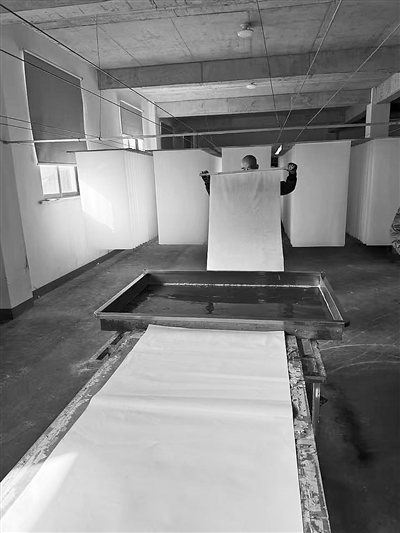
Core Viewpoint - The project "Key Technology Research for the Enhancement of Traditional Chinese Calligraphy and Painting Paper" aims to address the challenges faced by traditional paper-making techniques, including raw material scarcity and complex craftsmanship, by integrating modern technology into the ancient art of paper-making [2][3]. Group 1: Project Background and Objectives - The project was initiated to solve the urgent need for paper in cultural relic restoration, as traditional ancient papers are now considered cultural relics themselves and cannot be used [3]. - The project seeks to develop new types of paper that can replace or even surpass ancient paper, catering to the needs of contemporary artists and promoting the development of the domestic paper industry [3][9]. Group 2: Technological Innovations - The project team utilized advanced technologies such as hyperspectral imaging and infrared electron microscopy to analyze ancient paper materials, leading to the discovery that the raw material for the renowned "Chengxintang Paper" is not the traditionally believed Qingtan bark, but rather the bark of the one-year-old mulberry tree [4][5]. - The team developed a chlorine-free bleaching technology and employed physical methods for pulping to enhance the environmental sustainability of the paper-making process [6][7]. Group 3: Production Process Transformation - The introduction of automated paper-making equipment has significantly improved production efficiency and ensured the uniformity and stability of the paper products, moving away from traditional manual methods [7]. - The project team has also enhanced the durability of the paper by incorporating chemical agents to prevent mold and insects, thereby extending the lifespan of the paper [7][10]. Group 4: Collaboration and Feedback - The project fosters collaboration between scientists and artists, allowing for the translation of artistic needs into specific technical parameters and solutions [9][10]. - New types of paper, including the restored Chengxintang paper, have been sent to institutions like the Palace Museum for trial use, with feedback being used for continuous improvement [9][10]. Group 5: Cultural Heritage and Future Prospects - The project represents a significant step towards the sustainable development and modernization of traditional paper-making techniques, integrating various fields such as technology, engineering, cultural heritage protection, and artistic creation [10]. - The initiative aims to break down barriers between disciplines and encourage more scientists to contribute to the revitalization of traditional culture through technological innovation [10].
最大程度激发消费活力,促进经济循环畅通
Ke Ji Ri Bao· 2025-11-28 01:15
Core Viewpoint - The core idea of the "Implementation Plan for Enhancing the Adaptability of Supply and Demand for Consumer Goods" is to shift production from quantity to quality, addressing resource misallocation and waste, and stimulating consumption through high-quality supply [1] Group 1: Supply and Demand Adaptation - The plan aims to maximize consumption potential and promote smooth economic circulation by enhancing the overall adaptability of supply and demand [1] - The Ministry of Industry and Information Technology will work with relevant departments to implement the plan, increase resource investment, and support policies to expand consumption and stabilize growth [1] Group 2: Quality Supply and Market Growth - China's consumer goods supply has entered a new stage of quality and price, with a total of 230 million varieties of consumer goods, leading in over 100 categories such as home appliances and furniture [2] - The manufacturing capabilities allow rapid responses to technological upgrades and consumer demand changes, resulting in a significant increase in innovative products like smart drones and smart vehicle equipment, with respective value-added growth of 59.9% and 25.1% in the first three quarters of this year [2] - The plan aims to achieve dynamic balance in supply and demand at a higher level within approximately five years, addressing structural mismatches in supply and demand [2] Group 3: Expanding Consumption Space - The plan sets a target to form three trillion-level consumption fields and ten hundred-billion-level consumption hotspots by 2027, focusing on areas such as elderly products, smart connected vehicles, and consumer electronics [2][3] - The implementation of the plan is expected to create greater consumption space, enhancing the resilience and vitality of the domestic consumption market [3] Group 4: Integration of Artificial Intelligence - The plan emphasizes the integration of artificial intelligence (AI) in consumer goods, with AI acting as a catalyst for promoting consumption [4] - By mid-2023, the user base for generative AI products in China reached 515 million, with continuous expansion of application scenarios [4] - Future efforts will focus on product and scenario innovation, leveraging AI and big data to enhance the digital ecosystem across the entire industry chain [5]
今年我国获得ITER合同金额已超1.2亿欧元
Ke Ji Ri Bao· 2025-11-28 01:08
Core Insights - China has successfully secured over 140 cash procurement contracts from the International Thermonuclear Experimental Reactor (ITER) organization, with a contract value exceeding €120 million (approximately 980 million RMB) for 2025 [1] - The ITER program has significantly driven industrial development, with one company nurtured, three companies listed, and over 20 enterprises entering international markets [1] - Nuclear fusion energy is recognized for its abundant resources, safety, efficiency, and environmental friendliness, positioning it as a crucial direction for future energy development [1] Group 1 - China's nuclear fusion sector has achieved notable advancements, with key core technologies making significant breakthroughs and research platforms reaching international standards [2] - The construction of the next-generation "artificial sun," the Compact Fusion Energy Experimental Reactor (BEST), is underway, with plans to complete it by the end of 2027 [2] - Superconducting materials are essential for fusion devices, with low-temperature superconductors already industrialized and high-temperature superconductors entering the engineering phase [2] Group 2 - The integration of nuclear fusion technology innovation with industrial innovation is crucial for ensuring stable and sustainable development in the sector [2] - The event included a roundtable forum and signing ceremonies for various projects, including the ITER magnet power supply phase II and key technology development for terahertz laser pump systems [2]