
Ke Ji Ri Bao

Search documents
方小敏:“了解青藏高原的过去,才能预判地球的未来”
Ke Ji Ri Bao· 2025-12-25 07:05
Core Insights - The article discusses the "Three Polar Interaction" theory proposed by Fang Xiaomin, which emphasizes the interconnectedness of the Tibetan Plateau, North Pole, and South Pole in influencing global climate change [3][4][12]. Group 1: Three Polar Interaction Theory - The "Three Polar Interaction" theory posits that the Tibetan Plateau, North Pole, and South Pole form a dynamic system through atmospheric-oceanic circulation and carbon cycling, impacting the formation of mineral resources and landforms in Asia [3][4]. - The theory suggests that the continuous uplift of the Tibetan Plateau acts as a "super engine" for global climate regulation, affecting the ice caps in the polar regions [3][4]. Group 2: Mechanisms of Influence - The Tibetan Plateau influences the polar regions through two key pathways: the "Dust-Carbon Effect" and the "Chemical Weathering-Carbon Cycle" effect [4][5]. - The "Dust-Carbon Effect" involves the uplift of the Tibetan Plateau leading to increased aridity in Asia, which generates dust that promotes phytoplankton growth in the North Pacific, resulting in a decrease in atmospheric CO2 and global cooling [4]. - The "Chemical Weathering-Carbon Cycle" effect describes how increased rainfall due to the uplift enhances chemical weathering processes, converting CO2 into bicarbonate ions and facilitating long-term carbon storage in the ocean [5]. Group 3: Biodiversity and Evolution - The uplift of the Tibetan Plateau has not only reshaped the natural environment but also driven evolutionary processes, with evidence suggesting that some modern African savanna animals originated from adaptations in the Tibetan Plateau [7][8]. - The Tibetan Plateau serves as a "training camp" for species that later migrated to polar regions, equipping them with survival skills for extreme environments [8]. Group 4: Scientific Research and Applications - The second comprehensive scientific expedition to the Tibetan Plateau has shifted its focus from basic data collection to understanding changes, mechanisms, and strategies for sustainable development [9][10]. - Significant achievements include the publication of 245 high-level papers and the submission of over 110 advisory reports to government bodies, contributing to ecological protection laws and disaster risk management [10][11]. Group 5: Climate Change and Global Impact - The Tibetan Plateau is currently experiencing profound changes characterized by warming and increased humidity, leading to glacier retreat and permafrost degradation, which pose long-term challenges for water resource security [12][13]. - Addressing climate change requires a holistic approach, emphasizing the importance of protecting the Tibetan Plateau as a critical component of global climate stability [13][14].


【科技日报】2025国际十大科技新闻解读
Ke Ji Ri Bao· 2025-12-25 06:58
Group 1: AI Developments - DeepSeek's open-source model DeepSeek-R1 utilizes pure reinforcement learning to enhance model capabilities while reducing reliance on labeled data, showcasing a sustainable AI development path [2] - A new brain-computer interface developed by the University of Texas at Austin can decode thoughts into continuous text in about one hour, significantly improving efficiency and potential applications for patients with speech impairments [3] - AI has been used to design a new serine hydrolase enzyme from scratch, marking a significant advancement in computational biology and the understanding of life’s catalytic mechanisms [4][5] - Lightelligence's photonic accelerator and Lightmatter's photonic processor demonstrate superior performance and lower energy consumption compared to traditional electronic chips, addressing the computational demands of AI [6] Group 2: Medical Innovations - An intelligent robot successfully performed a complete gallbladder removal surgery autonomously, marking a significant step towards integrating AI with surgical practices [8][9] - The advancements in surgical robots indicate a future where human expertise can be extended through machine understanding, enhancing precision and safety in medical procedures [9] Group 3: Space and Environmental Research - The Vera C. Rubin Observatory released its first images, showcasing its capability to observe millions of distant stars and galaxies, marking a new era in cosmic exploration [7] - The detection of gravitational waves by LIGO confirmed Hawking's black hole area theorem, providing substantial evidence for theoretical predictions about black holes [12] - A report indicated that the Earth has reached its first climate tipping point, with significant coral reef die-offs, emphasizing the urgent need for action against climate change [13][14] Group 4: Neuroscience Breakthroughs - A comprehensive cross-species mammalian brain cell development map was published, revealing critical insights into brain cell migration and maturation, which could inform interventions for neurodevelopmental disorders [15][16]
【科技日报】2025国内十大科技新闻解读
Ke Ji Ri Bao· 2025-12-25 06:46
Group 1: DeepSeek AI Model - The Chinese AI company DeepSeek launched its open-source model DeepSeek-R1, which has gained global attention due to its low training costs and high performance in tasks like mathematical reasoning and code generation [2][3] - DeepSeek-R1's core competitiveness lies in its systematic innovation in computational efficiency, demonstrating that top-tier reasoning capabilities can be achieved without massive labeled data, significantly reducing training costs [2][3] - The model's open-source approach breaks technological monopolies, allowing developers worldwide to participate in its ecosystem, which has attracted hundreds of thousands of developers [2] Group 2: Nuclear Fusion and Quantum Computing - China's "artificial sun," the EAST device, achieved a world record by maintaining a plasma temperature of 100 million degrees Celsius for 1000 seconds, marking a significant step towards practical nuclear fusion energy [4] - The superconducting quantum computing prototype "Zuchongzhi 3" was developed, showcasing a computational speed that is a trillion times faster than the current fastest supercomputers, indicating a major advancement in quantum computing capabilities [5][6] Group 3: Advanced Materials and Brain-Computer Interfaces - A research team successfully created large-area two-dimensional metallic materials, marking a significant breakthrough in the field of two-dimensional materials [7] - China initiated its first invasive brain-computer interface clinical trial, allowing participants to control devices through thought, utilizing advanced flexible neural electrodes that minimize brain tissue damage [8][9] Group 4: Lunar Exploration and Plant Biology - The Chang'e 6 mission revealed the evolutionary history of the moon's far side, providing insights into volcanic activity and magnetic fields, which are crucial for understanding lunar geology [11][12] - A research team uncovered the molecular mechanisms behind how a single plant cell can develop into a complete plant, addressing a long-standing scientific question in plant biology [13] Group 5: Technological Innovations in Computing - Researchers developed a high-precision, scalable analog matrix computing chip, achieving digital-level precision in analog computing, which could revolutionize computational tasks in AI and communications [14][15] Group 6: National Strategic Initiatives - The 20th Central Committee of the Communist Party of China emphasized the importance of technological innovation in its strategic planning for the next five years, aiming to enhance China's technological self-reliance and drive new productive forces [16][17] Group 7: Military Advancements - China's first electromagnetic catapult aircraft carrier, Fujian, was commissioned, representing a leap in naval technology by utilizing advanced electromagnetic launch systems, enhancing operational capabilities [18]
“QPU+GPU”异构计算或将重塑AI生态
Ke Ji Ri Bao· 2025-12-25 05:01
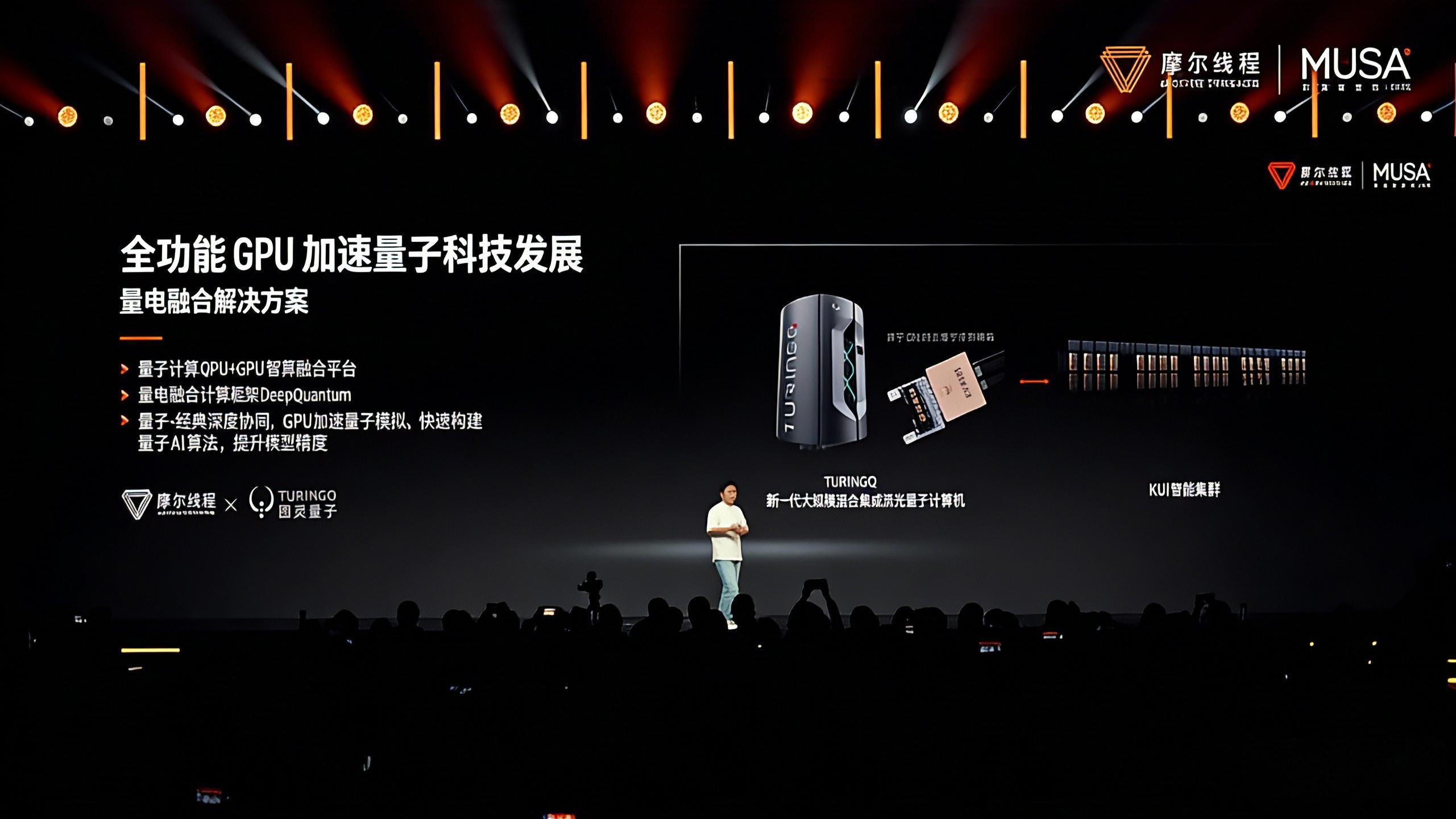
首届MUSA开发者大会上,图灵量子与摩尔线程达成战略合作。图灵量子供图 "QPU+GPU"融合首先面临严峻的通信瓶颈与数据传输延迟挑战,因量子态的相干时间极短,要求两者间的数据交互必须在微秒级完成。这种融合的一大核 心目的是利用GPU的强大算力来辅助QPU进行量子纠错(QEC),提升QPU计算结果的准确性。但这要求GPU必须实时解码错误特征并迅速反馈纠错指 令,这对GPU的实时推理能力提出了极高要求。此外,要真正打通软硬件壁垒,还必须解决异构指令集的统一与编译难题。 "我们将从算法、架构、系统三个维度出发,加速推进量子经典混合核心技术自主化和产业应用本土化,构建一个开放协同且自主可控的新计算生态。"图灵 量子负责人称,"QPU+GPU"异构计算不仅将加速量子计算迈入容错时代,更可能催生新一代AI基础设施标准,推动中国在全球算力竞争中占据先机。 (文章来源:科技日报) 日前,在北京中关村国际创新中心举办的首届MUSA开发者大会上,我国光量子计算企业图灵量子与国产GPU企业摩尔线程达成战略合作,将携手打 造"QPU+GPU"异构计算平台,旨在通过GPU的强大算力加速量子计算模拟,实现量子与经典算力的深度融合,进一 ...
2025算力互联网大会在成都召开
Ke Ji Ri Bao· 2025-12-25 05:00
Core Insights - The 2025 Computing Power Internet Conference was held in Chengdu, focusing on the development of a national computing power internet service platform and the launch of cross-domain verification work [1][2] - The conference highlighted the exponential growth of AI-driven computing power demand globally, emphasizing the need for an integrated computing power ecosystem [2] Group 1: Key Developments - The conference released results for the national computing power internet long-distance high-performance network protocol (RDMA) and initiated a thousand-kilometer cross-domain verification project [1] - A series of results regarding the global computing power status and indicator system were published, along with the launch of key nodes in Sichuan [1] - The conference introduced the first data express line for "Hong Kong, Guangdong, and Computing" [1] Group 2: Strategic Focus Areas - The development of the computing power internet requires emphasis on five key areas: accelerating facility interconnection, strengthening resource sharing, promoting business interoperability, solidifying foundational infrastructure, and enhancing scenario empowerment [1] - The need for a shift from "scale construction" to "efficient service" in computing power resources was highlighted, aiming to create a self-controllable, accessible, green, and secure computing power internet ecosystem [2] Group 3: Standardization and Compliance - The conference announced the results of the 2025 computing power interoperability standard compliance verification, focusing on unified computing power identification and AI cloud operating systems [2] - The China Communications Standards Association and the China Academy of Information and Communications Technology are advancing the construction of a computing power standard system [2]
【科技日报】2025年国内国际十大科技新闻揭晓
Ke Ji Ri Bao· 2025-12-25 04:15
Group 1: Domestic Technological News - The domestic top ten technological news for 2025 includes significant advancements such as the DeepSeek AI model gaining global attention, the "artificial sun" achieving a world record of 100 million degrees for 1000 seconds, and the successful construction of the superconducting quantum computing prototype "Zuchongzhi No. 3" [1][3] - The DeepSeek-R1 model, released by the Chinese AI company DeepSeek, has demonstrated low training costs and high performance in tasks like mathematical reasoning and code generation, marking a significant breakthrough in AI development [4][5] - The "artificial sun" EAST achieved a new world record by maintaining a plasma state at 100 million degrees for 1000 seconds, indicating progress in controlled nuclear fusion research [6][7] - The "Zuchongzhi No. 3" quantum computing prototype has achieved a computing speed that is a billion times faster than the current fastest supercomputer, showcasing its superiority in quantum computing capabilities [8][9] - The first invasive brain-computer interface clinical trial in China has been successfully conducted, allowing participants to control devices through thought after a short training period [11][12] - The Chang'e 6 mission has unveiled the evolutionary history of the moon's far side, providing new insights into lunar geology [13][14] - A breakthrough in understanding how single plant cells can develop into complete plants has been achieved, addressing a long-standing scientific question [15][16] - A high-precision, scalable analog matrix computing chip has been developed, marking a significant advancement in computing technology [17][18] - The Fourth Plenary Session of the 20th Central Committee emphasized the leading role of technological innovation in China's modernization efforts [19][20] - The commissioning of China's first electromagnetic catapult aircraft carrier, Fujian, represents a leap in naval technology and capabilities [21][22] Group 2: International Technological News - The international top ten technological news for 2025 highlights advancements such as the DeepSeek AI model leading an open-source AI paradigm and significant breakthroughs in brain-computer interfaces and quantum computing [23][24] - The development of a new brain-computer interface by the University of Texas can decode thoughts into continuous text, significantly improving the efficiency of brain activity interpretation [26][27] - AI has been utilized to design proteases from scratch, marking a significant step forward in computational biology and enzyme design [28] - Photonic computing chips have demonstrated superior performance and lower energy consumption compared to traditional electronic hardware, addressing the energy efficiency challenges in AI development [29] - The Rubin Observatory has released its first images, showcasing its capability to capture unprecedented details of the universe, marking a new era in astronomical observation [30] - An intelligent robot has successfully performed a gallbladder removal surgery autonomously, indicating a shift towards more advanced surgical robotics [31][32] - A new algorithm has achieved the first verifiable quantum advantage, demonstrating the potential of quantum computing to surpass classical computing limits [34][35] - The detection of gravitational waves has provided strong evidence for Hawking's black hole area theorem, enhancing our understanding of black hole physics [36] - A report has indicated that the Earth has reached its first catastrophic climate tipping point, emphasizing the urgency of addressing climate change [37][38] - A comprehensive cross-species mammalian brain cell development map has been published, providing insights into brain development and potential implications for neurodevelopmental disorders [40][41]
银河系双星团识别与分类标准成功构建
Ke Ji Ri Bao· 2025-12-25 03:27
Core Insights - The research team from the Xinjiang Astronomical Observatory and Shanghai Astronomical Observatory has completed a large-scale systematic study of binary star clusters in the Milky Way, establishing new identification and classification standards for these clusters, which have been published in the international journal "Astronomy and Astrophysics" [1][2] Group 1: Research Findings - The team identified 400 candidate binary star cluster systems, categorizing them into three types: primordial binary clusters, tidal capture/resonance capture systems, and optical pairs [2] - 61% of the candidate binary clusters show high consistency in age and kinematics, supporting the conclusion that they originated from the same giant molecular cloud [2] - 83% of the star cluster pairs exhibit significant tidal interactions, indicating a strong gravitational relationship [2] Group 2: Methodology and Innovation - The research team utilized high-precision astrometric data from the Gaia satellite and established a quantitative standard for spatial and velocity proximity from a statistical perspective [1][2] - The feasibility of the established standard was validated through random simulation samples, showcasing the innovative approach taken in this research [1] Group 3: Implications and Theoretical Support - The study suggests that the "pair formation" of star clusters may be an important pathway for star formation, providing key observational evidence for the formation mechanisms and dynamical evolution of multiple star cluster systems [2] - Approximately 17% of star clusters are currently in binary or multiple star systems, and about 10% may have originated from the same giant molecular cloud, aligning closely with previous theoretical predictions and observational estimates [2]
央企进一步深化原创技术策源地建设
Ke Ji Ri Bao· 2025-12-25 03:27
Group 1 - The central enterprise meeting held on December 22-23 summarized the achievements of state-owned enterprises in 2025 and proposed work ideas for the 15th Five-Year Plan, aiming to enhance core functions and competitiveness for China's modernization [1] - In the first 11 months, central enterprises invested 890.16 billion yuan in R&D, achieving an R&D intensity of 2.62% [1] - By 2025, central enterprises are expected to strengthen independent innovation, with a notable increase in their role within the national innovation system [1] Group 2 - In 2025, central enterprises demonstrated significant innovation outcomes, with 121 landmark achievements from 97 original technology sources [2] - Collaborative innovation expanded, with 23 innovation alliances involving over 100 entities and more than 1,000 high-quality projects [2] - The application of independent technological achievements exceeded 2,300 items, with 134 pilot verification platforms providing specialized services [2] Group 3 - Over the past five years, central enterprises have invested over 5 trillion yuan in R&D, with an annual growth rate of over 20% in emerging industries [3] - The number of technology talents has increased by nearly 50%, contributing to the development of new productive forces [3] Group 4 - For 2026, central enterprises will focus on integrating innovation and transformation, emphasizing both traditional and emerging industries [4] - Key areas of focus include renewable energy, new materials, aerospace, and digital transformation, with an emphasis on intelligent factory development [4] - The meeting highlighted the importance of original innovation and key technology breakthroughs, aiming to produce more landmark achievements [4] Group 5 - There will be an acceleration in the application of major technological achievements, with a push for upgrading collaborative innovation and enhancing pilot verification platforms [5] - The initiative will include expanding the application of technological achievements and improving supply-demand matching in the industrial chain [5]
总规模达到1.1万亿元 我国生物制造进入关键发展期
Ke Ji Ri Bao· 2025-12-25 02:05
Core Viewpoint - Biomanufacturing is recognized as a crucial driver of the fourth industrial revolution, with significant potential for economic growth and innovation in the manufacturing sector [1][3]. Group 1: Industry Development and Achievements - Since the start of the 14th Five-Year Plan, China's biomanufacturing industry has grown to a total scale of 1.1 trillion yuan, with bioproducts accounting for over 70% of global production [2]. - The production value of food and pharmaceutical biomanufacturing segments has each exceeded 400 billion yuan, showcasing a strong competitive advantage in traditional bioproducts like vitamins and antibiotics [2]. - China has established numerous national key laboratories and innovation platforms, contributing to over 20% of global research papers and patent applications in the biomanufacturing field [2]. Group 2: Future Economic Potential - Predictions indicate that by 2050, the biomanufacturing sector could generate an economic value of 30 trillion dollars, representing one-third of global manufacturing [3]. - The Chongqing government plans to implement various measures to accelerate the development of the biomanufacturing industry, including innovation actions and the establishment of verification platforms [3]. Group 3: Technological Challenges and Needs - Despite the current industry scale, there is a significant gap in technological supply, with a need for thousands of mature technologies to support a trillion-yuan industry [4]. - Experts emphasize the necessity of enhancing national strategic technological capabilities to provide a robust foundation for the biomanufacturing sector [4][5]. Group 4: Innovation and AI Integration - The integration of artificial intelligence with biomanufacturing is emerging as a trend, potentially enhancing research efficiency and process optimization [5][6]. - There is a pressing need to upgrade the research paradigm in biomanufacturing to leverage big data and AI, addressing challenges in data quality and model construction [6][7]. Group 5: Strategic Recommendations - The industry is encouraged to focus on original innovation and tackle engineering bottlenecks, fostering collaboration between academia and industry to drive technological advancements [7]. - The Ministry of Industry and Information Technology plans to release a development plan for biomanufacturing, outlining key products and AI applications to support the sector's growth [7].
宫内活体成像技术揭示胚胎小鼠大脑发育进程
Ke Ji Ri Bao· 2025-12-25 01:47
Core Insights - The research published in the journal "Cell" presents a groundbreaking study on the dynamic interactions between inhibitory neurons, vascular networks, and microglia in the embryonic mouse brain using a novel in vivo imaging technique [1][2] Group 1: Research Findings - The study developed a high-stability, multi-angle, long-term in utero imaging technique (IMEE) that allows for comprehensive observation of various indicators such as blood flow and cellular activity in the embryonic brain [1] - Researchers identified the migration patterns of excitatory and inhibitory neurons in the embryonic mouse cortex, revealing that newly formed excitatory neurons migrate radially through multipolar migration, displacement movement, and cell body transport [1] - The findings provide new in vivo evidence for neuronal migration abnormalities in models of neurodevelopmental diseases and elucidate the dynamic behavior of embryonic immune cells in response to environmental stress [1] Group 2: Methodological and Application Value - The established technical system and analytical methods are expected to become important tools for future research on brain development and developmental brain diseases, indicating significant methodological value and broad application prospects [2] - The application of this technology in autism model mice has directly observed abnormal neuronal migration and demonstrated that embryonic microglia can rapidly sense damage and initiate repair [2]