
Zhong Guo Jing Ying Bao

Search documents
摩根大通获中国银行间债市一般主承销商资格
Zhong Guo Jing Ying Bao· 2026-01-08 00:01
Core Viewpoint - JPMorgan Chase has officially received the qualification as a general lead underwriter for non-financial corporate debt financing instruments in China's interbank bond market, marking a significant milestone in its bond business in China [1] Group 1: Company Developments - JPMorgan Chase (China) Co., Ltd. has been actively involved in the Chinese interbank bond market since 2004, starting with bond trading and achieving various qualifications over the years, including market maker in 2008 and settlement agent in 2017 [1] - The recent approval as a general lead underwriter will enhance JPMorgan's ability to serve both domestic and international issuers and investors, leveraging its global resources and local expertise [1] Group 2: Industry Impact - This qualification is expected to contribute to the ongoing high-level opening of China's bond market, promoting the internationalization and inclusiveness of China's capital markets [1] - The move aims to improve the pricing influence and resource allocation efficiency of China's capital market within the global financial system [1]



渣打银行发布《2026年全球市场展望》:超配中国股票、黄金
Zhong Guo Jing Ying Bao· 2026-01-07 14:54
中经记者 郝亚娟 夏欣 上海 北京报道 近日,渣打银行财富方案部发布《2026年全球市场展望》,从宏观层面看,2026年美国经济软着陆的概 率上升,随着全球贸易紧张局势缓和、主要经济体将推进宽松的财政和货币政策,以及人工智能蓬勃发 展,风险资产预期将表现领先。渣打银行建议投资者在基础投资组合中超配股票和黄金,对于中国资产 则重点关注科技、健康护理和通信行业。 在基础配置中,渣打银行建议超配美国、印度和中国股票,新兴市场债以及黄金,同时低配欧洲、英国 和日本股票。渣打银行认为中国在2026年可能推出更果断但针对性刺激措施,尤其是"十五五"规划建议 的发布,重点提出了加快先进技术的投资以提升自主能力和生产力。渣打银行仍然超配中国股票,预期 定向的政策刺激,以及与人工智能主题相关的强劲盈利增长,将为中国经济提供强有力的支持。 关于黄金,渣打银行维持超配黄金,3个月及12个月目标价分别为每盎司4350美元及4800美元。新兴市 场央行持续的需求与有利的宏观环境,有望维持黄金涨势。 (编辑:杨井鑫 审核:朱紫云 校对:张国刚) ...
央行工作会议:强化虚拟货币监管,稳步发展数字人民币
Zhong Guo Jing Ying Bao· 2026-01-07 10:32
Core Insights - The People's Bank of China (PBOC) has outlined seven key areas of focus for 2026, emphasizing the importance of a stable financial environment for economic growth and market stability [2][3]. Group 1: Monetary Policy - The PBOC will continue to implement a moderately loose monetary policy, enhancing both incremental and stock policy effects, and increasing counter-cyclical and cross-cyclical adjustments [2]. - The policy shift from fostering economic recovery to ensuring stable growth and high-quality development reflects a stronger emphasis on financial market stability [3]. Group 2: Financial Regulation - The meeting highlighted the need to strengthen financial management and services, particularly by enhancing regulation of virtual currencies and combating related illegal activities [4]. - The core of strengthening virtual currency regulation is to safeguard financial sovereignty and maintain systemic financial stability, addressing challenges such as anonymity and speculative pricing [5]. Group 3: Digital Currency Development - The PBOC aims to steadily develop the digital yuan, with a new management framework and infrastructure set to launch on January 1, 2026 [6]. - As of November 2025, the digital yuan has processed 3.48 billion transactions worth 16.7 trillion yuan, indicating significant adoption and usage [6]. Group 4: Strategic Implications - The dual focus on regulating virtual currencies and developing the digital yuan represents a comprehensive approach to monetary governance in the digital economy [7]. - The strategy emphasizes a careful balance between innovation and risk management, ensuring that financial technology serves the real economy while maintaining financial security [8].

多项电子烟新政进入征求意见阶段 涉及产能调控、信用管理等问题
Zhong Guo Jing Ying Bao· 2026-01-07 10:28
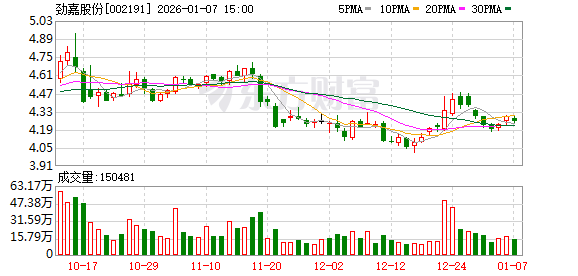
Regulatory Developments - Multiple new policies regarding the electronic cigarette industry are in the public consultation stage, aimed at strengthening credit management and promoting legal and standardized governance of the industry [2] - The State Tobacco Monopoly Administration has released a draft for public consultation on credit management for electronic cigarette production and wholesale enterprises, which includes measures for credit collection, dishonesty recognition, credit rating, information disclosure, dishonesty punishment, and credit repair [3][4] - The draft categorizes dishonesty information into three levels based on severity, with different public disclosure periods, and establishes a credit rating system for enterprises ranging from A to D [3] Industry Impact - The recent regulations are seen as crucial for the healthy growth of the electronic cigarette industry, following a framework established in 2021 that aligns electronic cigarette regulation with traditional tobacco products [3] - The notification issued on December 25, 2025, explicitly prohibits new investment projects that increase production capacity, while allowing for capacity increases only under strict conditions [6] - Companies like Jinjia Co. and Yinghe Co. report stable operations in the electronic cigarette sector, with a focus on overseas markets, indicating that the new policies may have limited immediate impact on their business [6] Market Dynamics - There is a noted trend of consolidation within the industry as some leading companies face capacity shortages, which may lead to acquisitions to expand production capabilities [7] - The competitive landscape is intensifying, with some companies experiencing increased sales but declining revenues, prompting concerns about illegal and non-compliant business practices [7] - The government's recent directive to combat illegal tobacco activities emphasizes the need for stricter enforcement and regulation within the industry [7]


超千家中国企业参展CES 傲鲨消费级外骨骼斩获“创新奖”
Zhong Guo Jing Ying Bao· 2026-01-07 06:50
Group 1 - The International Consumer Electronics Show (CES) will be held in Las Vegas from January 6 to 9, 2026, featuring at least 3,300 exhibitors from 56 countries and regions, with Chinese exhibitors numbering around 1,062, accounting for over 32% of the total [1] - Notably, nearly all Chinese robotics companies are participating, including prominent humanoid robot firms and companies specializing in exoskeletons and industrial manufacturing [1] - The Chinese exoskeleton robot company Aoshah is making its third appearance at CES, showcasing its consumer-grade product VIATRIX, which won a CES Innovation Award [1] Group 2 - Aoshah's VIATRIX features innovative design elements such as a Float360 floating hip joint structure and self-developed automotive-grade motors, which have contributed to its market appeal [3] - The product has received positive feedback from international users, who found it helpful for activities like climbing stairs and running, and noted its aesthetic appeal [3] - Founded in 2018, Aoshah has transitioned from industrial applications of exoskeletons to the consumer market, significantly reducing the price of its products to below 10,000 yuan, making them comparable to smartphone prices [3]

长安汽车辟谣取消年终奖声明称已落实激励计划
Zhong Guo Jing Ying Bao· 2026-01-07 05:24
长安汽车方面还表示,虚假信息的传播已对公司品牌声誉和正常经营秩序造成了严重负面影响。公司将 依法采取必要的法律措施,坚决维护自身的合法权益,并呼吁共同营造清朗的网络环境和公平的市场竞 争秩序。中经记者 陈靖斌 广州报道 【长安汽车澄清"取消年终奖"谣言:坚决捍卫员工权益与品牌声誉】《中国经营报》记者从长安汽车方 面获悉,针对近期网络上关于"长安汽车取消年终奖"的不实谣言,长安汽车不实信息举报中心于1月7日 发表了声明。声明强调,2025年公司整体经营态势稳健,凭借出色的年度经营绩效,长安汽车已根据激 励标准制定并落实了相应的激励计划,切实保障员工的合法权益,并积极推动企业的可持续发展。 ...


CES2026|扫地机器人进化具身智能形态 追觅全产品矩阵亮相CES
Zhong Guo Jing Ying Bao· 2026-01-07 04:59
Core Insights - The annual Consumer Electronics Show (CES) will take place in Las Vegas from January 6 to 9, 2026, where the company will showcase its largest exhibition to date, highlighting its cutting-edge technology developments [1] - The company will unveil its next-generation embodied intelligent robotic vacuum cleaner and globally launch the X60 series, alongside several groundbreaking technological achievements, including the world's first bionic six-legged tracked climbing vacuum cleaner, Cyber X, which addresses the long-standing challenge of autonomous cleaning across floors [1] - The company aims to demonstrate its systematic R&D capabilities driven by continuous innovation, showcasing a comprehensive product and technology matrix [1] Exhibition Details - The company will debut in two core exhibition halls at CES, establishing a flagship ecological exhibition area of over 1,200 square meters at the Las Vegas Convention Center and a high-end smart cleaning experience zone at the Venetian Expo [1] - Visitors will have an immersive experience to understand how cutting-edge technology is reshaping daily cleaning tasks [1] Product Highlights - The Cyber X, which gained significant attention at IFA, will reappear in an upgraded form, featuring industry-leading climbing performance, speed, stability, and safety, with a design that allows compatibility with future main vacuum models [2] - The company will also showcase its complete product matrix, including the Cyber10 Ultra with multi-joint bionic robotic arms for detailed cleaning and item organization, the Aqua10 Ultra Roller combining live water washing and AI smart lifting cover, and the Matrix10 Ultra for intelligent scenario-based cleaning [2]

“牛市旗手”迎开门红 2026“绵长”行情可期并购潮持续
Zhong Guo Jing Ying Bao· 2026-01-07 04:49
2026年1月7日开盘,券商指数(886054.WI)略有下跌。在此之前,5日、6日券商指数分别收涨 1.83%、4.15%。作为新的一年的头两个交易日,券商板块强势迎来"开门红"。 "从这方面可以发现,A股和H股的比价效应开始显现。即,投资者若购买A+H股上市公司,应该兼顾考 虑A/H股溢价率。如果港股低估程度大,则港股会优先吸纳资金量,涨幅也会更大。"许琼娜提示H股内 资上市券商在2025年的表现更能体现板块的价值重估过程,而这轮价值重估中,2025年券商的并购重组 预期已参与定价。 回顾2025年全年,A股市场活跃,"牛市旗手"券商板块的表现曾备受期待。但实际上,Wind数据显示, 券商板块整体跑输,券商指数仅获得4.05%的全年涨幅,远远落后于上证指数、沪深300等。 在2025年A股整体活跃、券商并购加速推进的背景下,为何出现券商板块整体表现的疲弱?如今又为何 出现行情变化?2026年券商还有哪些并购预期?板块有哪些表现机会? 多位业内人士表示,券商属于牛市周期股,跟随此轮慢牛属性,或存在后半程发力、"绵长"上行的趋 势。而2026年券商并购预期还将持续,如跨区并购、区域并购、同一资本系并购的案例还 ...
广汽与华为从“拍桌子”到协同合作 加速迈入智能化
Zhong Guo Jing Ying Bao· 2026-01-07 04:47
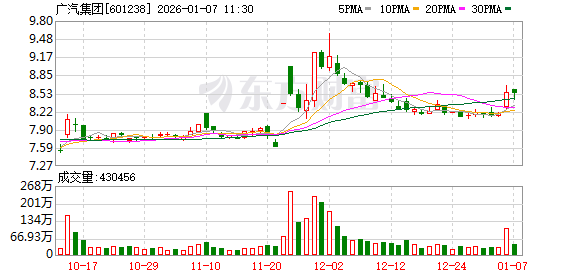
Core Insights - The visit of Huawei's executive Yu Chengdong to GAC Group marks a significant step in their collaboration on smart vehicles, culminating in a comprehensive cooperation framework agreement [2][3] - The agreement signifies a shift from project-level cooperation to a long-term strategic partnership, focusing on the integration of technology and product development in the smart automotive sector [3][5] Group 1: Cooperation Framework - The cooperation framework between GAC Group and Huawei is centered around the co-construction of the HarmonyOS ecosystem, emphasizing joint innovation in AI and other cutting-edge technologies [4][5] - This partnership aims to enhance GAC's smart upgrade and support the international expansion of China's automotive industry [5][6] - Both companies will work on integrating their strengths in electric vehicle manufacturing, operating systems, smart cockpits, and global service systems [4][5] Group 2: Product Development - GAC's new brand, Qijing, is set to play a crucial role in deepening the collaboration, with new models featuring Huawei's advanced driving and smart cockpit systems [7][8] - The first model from Qijing, a stylish shooting brake, is expected to launch in 2026, showcasing a collaborative design process involving significant input from both GAC and Huawei [7][8] - The product development process has been characterized by intense discussions and negotiations, reflecting the high standards both companies aim to achieve [8][9] Group 3: Strategic Alignment - The ongoing collaboration aligns with GAC Group's strategic plan "Smart Travel 2027," which prioritizes smart technology as a core focus [9][10] - The partnership has expanded from hardware to software, covering various aspects of automotive technology, with a consistent emphasis on smart solutions [9][10] - GAC and Huawei's joint initiatives, such as the Huawei cloud vehicle technology, have already been implemented in GAC's models, enhancing the overall smart experience [9]

半年20家!城商行密集增资破解资本“紧箍咒”
Zhong Guo Jing Ying Bao· 2026-01-07 03:33
Core Viewpoint - The recent increase in registered capital among city commercial banks is driven by regulatory pressures, business expansion needs, and risk management requirements, highlighting the urgency for capital replenishment in the sector [2][3][5] Group 1: Regulatory Environment - Regulatory authorities have intensified capital constraints, mandating that small and medium-sized banks maintain a core Tier 1 capital adequacy ratio of no less than 8.5%, with higher standards for systemically important banks [2] - The implementation of the "Commercial Bank Capital Management Measures" has led to more prudent risk asset measurement, further consuming capital space [2] Group 2: Business Expansion Needs - Economic recovery and accelerated credit issuance, particularly in support of local infrastructure and small enterprises, have led to a rapid increase in risk-weighted assets, continuously consuming capital [2] - The marketization of interest rates has compressed interest margins, significantly weakening the internal capital accumulation capacity of banks [2] Group 3: Risk Management Requirements - The adjustment in the real estate market, local government debt risks, and exposure to credit risks in certain industries necessitate a thicker capital buffer to absorb potential losses [2][3] - As of early 2026, 39 out of 123 city commercial banks had risk ratings in the "yellow" or "red" zones, with capital adequacy ratios nearing or below regulatory red lines [3] Group 4: Capital Supplementation Tools - In addition to registered capital changes, perpetual bonds and subordinated debt are also important tools for banks to supplement capital, with nearly 60 banks issuing 71 perpetual bonds totaling 825 billion yuan from January 2025 to January 2026 [4] - However, many city commercial banks face challenges in utilizing these alternative capital supplementation tools due to low credit ratings and high market issuance costs [4] Group 5: Government Involvement - Government-led capital increases are seen as the most feasible and direct solution for capital replenishment, serving as a crucial tool for managing local financial risks and promoting the development of city commercial banks [5]