Zhong Guo Jing Ying Bao

Search documents
山东高速资本局
Zhong Guo Jing Ying Bao· 2025-12-26 19:28
Core Viewpoint - Shandong Hi-Speed Company has been involved in significant capital operations, including impairment of investments and divestiture of assets, which have raised concerns about the sustainability of its investment returns and overall financial health [1][2][10] Investment Operations - The company plans to recognize a 690 million yuan impairment on its long-term equity investment in Dongxing Securities due to a merger proposal by China International Capital Corporation [3][4] - Shandong Hi-Speed has completed the divestiture of its stake in Guangdong Expressway Development Co., Ltd., generating 2.435 billion yuan in cash through an associated transaction [1][6][7] Financial Performance - Investment income from Dongxing Securities has significantly declined, contributing 45.57 million yuan in the first three quarters of 2025, compared to previous years [5][10] - The company's overall investment income has decreased from 17.45 billion yuan in 2022 to 14.03 billion yuan in 2024, with a declining proportion of operating profit [2][10] Historical Context - Shandong Hi-Speed's investment strategy evolved from supporting its core highway operations to establishing a dual strategy of "highway operation + capital investment" around 2016 [8][9] - The company previously achieved peak investment income of 3.29 billion yuan in 2018, which constituted over 50% of its total profit [10] Asset Quality - Guangdong Expressway has been a stable asset, contributing a total of 808 million yuan in investment income from 2020 to the third quarter of 2025, with strong financial metrics [6][7]


人形机器人商用化“拐点时刻”降临 多地卡位万亿级新蓝海
Zhong Guo Jing Ying Bao· 2025-12-26 19:17
作为最具市场前景的未来产业之一,人形机器人备受各地追捧。 中经记者 方超 张家振 上海报道 作为具身智能理想载体的人形机器人,正迎来前所未有的商业化"拐点时刻"。 TrendForce日前发布的趋势预测称,2026年将是人形机器人迈向商用化的关键一年,全球出货量预估年 增逾7倍、突破5万台。"2026年,将是人形机器人正式进入以AI为驱动、以应用为核心的产业新阶段。" 《中国经营报》记者注意到,在迎来产业化、商业化落地关键节点背后,人形机器人作为发展新质生产 力的关键领域,近年来获得了从国家到地方层面的大力支持。"十五五"规划建议明确"前瞻布局未来产 业",其中就包括具身智能。 政策层面全力支持,万亿赛道"一触即发"。上海市、南京市、杭州市、芜湖市等地纷纷出台规划,宣布 打造人形机器人产业高地。12月3日,浙江省"十五五"规划建议对外发布,提出聚焦人形机器人、脑机 接口等领域。杭州市也提出,到2029年,当地人形机器人产业规模达到500亿元,打造一批通用人形、 柔性人形、增强人形等杭研杭产的世界级机器人品牌。 "多地集中布局人形机器人赛道,首要驱动因素来自国家战略对未来产业的明确指引。"一位不愿具名的 行业分 ...

科技·叙事 龙头领衔 科创板半导体并购聚焦补链强链价值协同
Zhong Guo Jing Ying Bao· 2025-12-26 18:56
Core Viewpoint - The semiconductor equipment leader, Zhongwei Company, is planning to acquire a controlling stake in Hangzhou Zhonggui Electronics Technology Co., marking a strategic move towards becoming a platform company in the semiconductor equipment sector within five years [2][4]. Group 1: Acquisition Strategy - Zhongwei Company aims to enhance its core technology portfolio and provide more competitive integrated solutions through this acquisition, which is seen as a significant step towards its goal of becoming a global leader in semiconductor equipment [4][5]. - The acquisition reflects a broader trend among leading semiconductor companies on the Sci-Tech Innovation Board, driven by policy incentives and industry upgrade demands, focusing on "supplementing and strengthening the chain, and value synergy" [2][6]. Group 2: Market Dynamics - Since the release of the "Eight Articles of Sci-Tech Innovation Board," over 150 merger and acquisition transactions have been disclosed, with more than 70% successfully completed, indicating a robust M&A environment in the semiconductor sector [6]. - The semiconductor industry is experiencing a rationalization phase in M&A activities, with an increase in terminated deals not signaling a cooling market but rather a return to rational market behavior [7][8]. Group 3: Industry Trends - The semiconductor sector is witnessing a shift from quantity accumulation to qualitative leaps, with leading companies aiming to transition from domestic to globally competitive players [2][6]. - The concentration of resources and industry maturity is driving a natural trend towards consolidation, as evidenced by the strategic moves of companies like Zhongwei and Huahai Qingke [5][6].



强化硬科技金融支持力度 AIC基金加速落地
Zhong Guo Jing Ying Bao· 2025-12-26 18:55
Core Viewpoint - The recent establishment of equity investment funds initiated by bank-affiliated financial asset investment companies (AIC) is driven by multiple factors, including the expansion of AIC's initiating entities from state-owned banks to national joint-stock banks, and the provision of more quality investment opportunities through pilot expansions [1] Group 1: AIC Fund Establishment and Characteristics - AIC equity investment funds are characterized by large amounts, long cycles, strong professional research capabilities, and high risk tolerance, making them typical "patient capital" focused on early-stage, small, and hard technology investments [1] - The first provincial AIC equity investment fund in Guangdong, with a total scale of 10 billion yuan and an initial scale of 2 billion yuan, focuses on the entire industrial chain of artificial intelligence and robotics [2] - The Nanjing AIC pilot fund, with a scale of 1 billion yuan, participated in a D-round financing for a communication company, showcasing the application of patient capital [2] - The first AIC mother fund in Shenzhen has a scale of 7 billion yuan and targets industries related to the "20+8" industrial cluster, including digital economy and high-end manufacturing [3] Group 2: Expansion of AIC Initiating Entities - As of 2025, the initiating entities of AIC have expanded from the first batch of state-owned banks to include national joint-stock banks, with several banks announcing plans to establish AICs with significant capital contributions [4][5] - The expansion of AIC initiating entities is a policy-level adjustment to adapt to a diversified market, with considerations for capital adequacy and risk tolerance of regional banks [5] Group 3: Regulatory Support and Optimization - The regulatory environment for AIC has been relaxed, allowing for broader investment scopes and increased limits on investment amounts and ratios [6][7] - AICs are now encouraged to engage in equity investments without the primary goal of debt-to-equity swaps, marking a shift in their operational focus [6] - The regulatory framework emphasizes the need for AICs to enhance risk management capabilities and optimize internal management processes [7] Group 4: Strategic Recommendations for AIC - AICs are advised to adopt a "loan-equity linkage" model to mitigate risks associated with high-risk, long-cycle investments, utilizing structured designs to distribute risks [8] - Collaboration between AICs and their parent banks should evolve from merely being a "funding channel" to "ecosystem co-construction," enhancing product innovation and organizational synergy [8]
ST远智造假链全员受罚 监管“处罚曲线”仍在“陡峭上升”
Zhong Guo Jing Ying Bao· 2025-12-26 18:53
Core Viewpoint - The stock price of ST Yuanzhi (002689.SZ) has dropped by 28.5% from November 29 to December 26 due to the announcement of an administrative penalty for financial misconduct involving inflated revenue recognition through forged acceptance certificates [1][2]. Group 1: Financial Misconduct Details - From 2019 to June 2022, ST Yuanzhi inflated its operating revenue by a total of 336 million yuan and inflated its total profit by approximately 93.26 million yuan [2][3]. - The company recognized revenue prematurely for non-ownership elevator products without obtaining necessary inspection reports, leading to inflated revenues of 123 million yuan, 66.22 million yuan, and 138 million yuan for the years 2019, 2020, and 2021, respectively [3][4]. - In the first half of 2022, the company reported a reduction in revenue of 16.11 million yuan and a reduction in profit of 23.45 million yuan [3]. Group 2: Penalties and Regulatory Response - The Liaoning Securities Regulatory Bureau imposed a warning and a fine of 6 million yuan on ST Yuanzhi, while the involved seven key executives were fined a total of 15 million yuan [5][6]. - The penalties reflect a regulatory trend of holding individuals accountable for financial misconduct, emphasizing a "zero tolerance" approach to financial fraud [8][10]. - The penalties for ST Yuanzhi are seen as part of a broader regulatory trend where fines for companies and individuals have significantly increased, with a focus on creating a multi-faceted accountability mechanism [9][10].

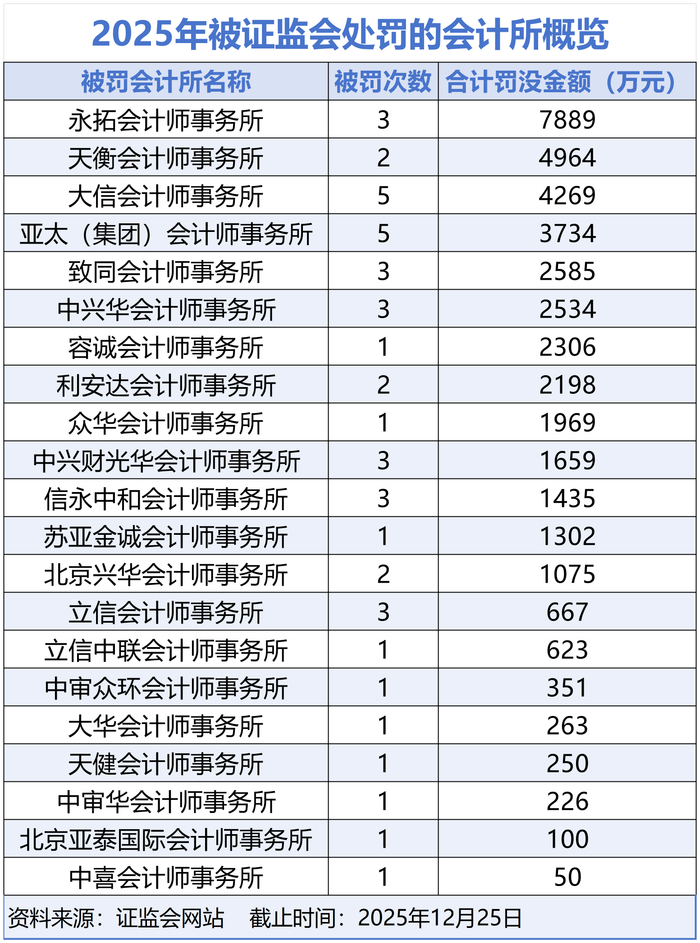
证券审计严监管持续加码 44家次会计所合计罚没4亿元
Zhong Guo Jing Ying Bao· 2025-12-26 18:53
中经记者 孙汝祥 夏欣 北京报道 | 2025年被证监会处罚的会计所概览 | | | | --- | --- | --- | | 被罚会计所名称 | | 被罚次数 合计罚没金额(万元) | | 永拓会计师事务所 | 3 | 7889 | | 天衡会计师事务所 | 2 | 4964 | | 大信会计师事务所 | 5 | 4269 | | 亚太(集团)会计师事务所 | 5 | 3734 | | 致同会计师事务所 | 3 | 2585 | | 中兴华会计师事务所 | 3 | 2534 | | 容诚会计师事务所 | 1 | 2306 | | 利安达会计师事务所 | 2 | 2198 | | 众华会计师事务所 | 1 | 1969 | | 中兴财光华会计师事务所 | 3 | 1659 | | 信永中和会计师事务所 | 3 | 1435 | | 苏亚金诚会计师事务所 | 1 | 1302 | | 北京兴华会计师事务所 | 2 | 1075 | | 立信会计师事务所 | 3 | 667 | | 立信中联会计师事务所 | 1 | 623 | | 中审众环会计师事务所 | 1 | 351 | | 大华会计师事务所 | 1 | ...
四次公开提名独董征集投票权 投保机构从“外围支持”走向“前台参与”
Zhong Guo Jing Ying Bao· 2025-12-26 18:51
Core Viewpoint - The article discusses the increasing role of the Investor Protection Center in nominating independent directors for listed companies, enhancing the voice of small and medium shareholders in corporate governance [1][4][8]. Group 1: Independent Director Nomination - The Investor Protection Center has publicly nominated independent director candidates and collected voting rights for four companies: First Pharmaceutical, Shangfeng Cement, South Network Energy, and Xinbo Co., indicating a shift towards active participation in corporate governance [1][3][8]. - The nomination of Zhang Lizhi as an independent director for South Network Energy was successfully approved, with 9 valid shareholders authorizing the center to exercise voting rights, representing approximately 0.0422% of the total voting shares [3][8]. - The center's approach allows for a more diverse selection of independent directors, enhancing their independence and professionalism, which is crucial for representing the interests of small shareholders [5][6]. Group 2: Enhancing Shareholder Rights - The initiative aims to strengthen the voice of small shareholders, who traditionally have low participation in corporate governance, often resorting to "voting with their feet" [4][6]. - By publicly nominating independent directors and collecting voting rights, the center facilitates small investors in exercising their voting rights, creating a positive example for active participation in corporate governance [4][5]. - The center's actions are seen as a beneficial attempt to address the weak voice of small shareholders and improve the overall effectiveness of investor rights protection [5][6]. Group 3: Full Chain Rights Protection Mechanism - The nomination process contributes to a comprehensive rights protection mechanism, addressing preemptive measures in addition to existing shareholder rights and securities litigation [6][8]. - The center's involvement allows independent directors to participate directly in major corporate decisions, enhancing preventive measures against potential governance issues [6][7]. - The initiative reflects a broader trend of investor protection agencies transitioning from peripheral supporters to active participants in corporate governance structures [6][7]. Group 4: Challenges and Recommendations - Despite the positive developments, the current mechanism faces challenges, including limited case studies and low shareholder participation rates [8][9]. - Experts suggest improving awareness among small shareholders regarding the nomination process and simplifying the authorization procedures to encourage greater participation [9][10]. - There is a need for ongoing efforts to establish a replicable framework across various industries and companies to enhance market recognition and gradually increase the influence of this mechanism [9][10].



地方融资平台转型新模式:城投+产投+上市公司
Zhong Guo Jing Ying Bao· 2025-12-26 18:44
Group 1 - The core viewpoint of the articles emphasizes the "City Investment + Industrial Investment + Listed Companies" model as a new approach for local financing platforms in China, aimed at fostering new productive forces and developing emerging industries over the next five years [1][4] - By 2025, the model is expected to facilitate mergers and acquisitions of listed companies, which will help local investment platforms strengthen their financial base and support local economic transformation [1][4] - Local governments view the acquisition of listed companies as a means to introduce new industries and enhance local industrial chains, thereby attracting more enterprises and boosting GDP, tax revenue, and employment [1][2] Group 2 - The establishment of companies like Moer Thread and Muxi Co., which are referred to as "domestic Nvidia" and "domestic AMD," respectively, marks a significant breakthrough for domestic GPU enterprises in the capital market [1] - Local state-owned assets are increasingly focusing on emerging and future industries, with government support fostering the "City Investment + Industrial Investment + Listed Companies" model [2] - The investment strategies of local financing platforms include direct investments, strategic shareholding, and collaboration across regions to attract listed companies and form industrial clusters [3][4] Group 3 - The "City Investment + Industrial Investment + Listed Companies" model is seen as a practical example for local state-owned enterprises to address debt pressures and traditional business bottlenecks through mergers and acquisitions [3][4] - The approach involves selecting high-potential targets in sectors like new materials and semiconductor integrated circuits, emphasizing the importance of business integration and governance to enhance company value post-acquisition [4] - The model aims to mitigate financial risks while ensuring stable operations for city investment platforms and driving local economic development [4][5] Group 4 - Recent statistics indicate that from July 2023 to July 2025, local state-owned assets participated in the control acquisition of 28 listed companies, with a notable focus on the semiconductor industry [5] - Analysts suggest that local financing platforms should avoid blindly chasing trends and instead align investments with local resources and industry strengths to prevent significant losses [5][6] - The life sciences sector is projected to grow significantly, with estimates suggesting the Chinese life and health industry could reach between 29 trillion to 38 trillion yuan by 2030, highlighting the potential for innovation and investment in this area [6] Group 5 - The modern consulting perspective indicates a shift in fiscal models from land development to a mixed approach combining land revitalization and industrial development, emphasizing the need for city investment platforms to focus on industry-driven strategies [7] - The integration of various resources across government, industry, academia, and finance is crucial for overcoming challenges in the biopharmaceutical sector and achieving strategic transformation from generic to innovative drugs [6][7]
实践探索 党建领航 中国银行打通普惠金融“最后一公里”
Zhong Guo Jing Ying Bao· 2025-12-26 18:38
Core Viewpoint - The Chinese government emphasizes the importance of financial development in achieving modernization, with a focus on inclusive finance as a key component for high-quality economic growth [1] Group 1: Financial Development Strategies - The 14th Five-Year Plan outlines strategic goals for building a strong financial nation, highlighting the development of technology finance, green finance, inclusive finance, pension finance, and digital finance [1] - The implementation plan for high-quality development of inclusive finance was jointly issued by the National Financial Regulatory Administration and the People's Bank of China, emphasizing the integration of party leadership into all aspects of inclusive finance [1] Group 2: Inclusive Finance Achievements - As of September 2023, inclusive loans in China grew by 11.2% year-on-year, with the balance of inclusive micro-loans reaching 36.1 trillion yuan, a 12.2% increase [1] - China Bank reported an inclusive loan balance of 2.71 trillion yuan by September 2025, benefiting nearly 1.8 million small and micro enterprises [2] Group 3: Local Initiatives and Community Engagement - In Shenzhen, the local government and China Bank have established a three-tiered party-building system to enhance financial services for small and micro enterprises, addressing their specific financing needs [3] - The "Xinhua Assistance Seedling" service team from China Bank has tailored financial products like the "Electronic Business Circle Loan" to meet the urgent and frequent funding needs of local businesses [4] Group 4: Organizational Structure and Governance - China Bank is focusing on building a clear and efficient organizational structure led by party leadership to ensure effective policy implementation and high-quality development of inclusive finance [6] - The bank has established various committees and mechanisms to enhance the top-level design and policy framework for inclusive finance, aligning with national strategies [7] Group 5: Risk Management and Sustainability - The bank emphasizes the dual role of party leadership in expanding services while maintaining risk control, ensuring that inclusive finance development is both commercially viable and socially beneficial [11] - China Bank has implemented an intelligent risk control system to proactively identify and manage risks associated with small and micro loans [11] Group 6: Integration of Political and Business Strategies - The practices of China Bank illustrate a pathway for integrating political and organizational advantages into governance effectiveness and business resilience, ensuring alignment with national financial goals [12]

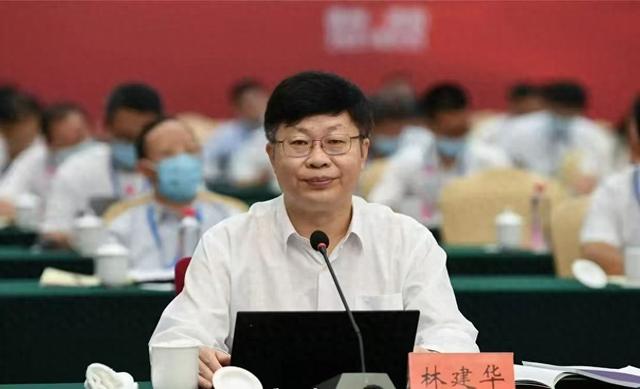
理论纵深 林建华:锚定党建“定盘星” 激活发展原动力
Zhong Guo Jing Ying Bao· 2025-12-26 18:36
Core Viewpoint - The article emphasizes the importance of high-quality party building as a means to lead high-quality development, highlighting the intrinsic connection between the two concepts and their role in achieving China's modernization goals [3][5][9]. Group 1: High-Quality Party Building - High-quality party building is seen as essential for guiding high-quality development, providing direction and ensuring the effectiveness of governance [4][6]. - The relationship between high-quality party building and high-quality development is described as mutually reinforcing, where each enhances the other [5][6]. - The article outlines that high-quality party building involves maintaining the authority of the Party Central Committee and ensuring that party leadership permeates all aspects of economic and social development [6][10]. Group 2: High-Quality Development - High-quality development is defined as development that meets the growing needs of the people, characterized by innovation, coordination, green practices, openness, and shared benefits [7][8]. - The article stresses that high-quality development is not limited to economic growth but encompasses social, cultural, and ecological dimensions [4][7]. - The "14th Five-Year Plan" is highlighted as a critical period for solidifying the foundation for achieving socialist modernization, with a focus on addressing challenges and ensuring sustainable development [8][16]. Group 3: Integration of Party Building and Development - The integration of high-quality party building and high-quality development is framed as a necessary approach to navigate the complexities of modern governance and societal needs [12][13]. - The article discusses the need for a systematic approach to coordinate various aspects of development, emphasizing the role of the Communist Party in balancing interests across different sectors [11][12]. - It is noted that effective party governance can enhance the political environment for economic development, thereby ensuring stability and progress [8][10]. Group 4: Practical Pathways - High-quality party building is positioned as a political guarantee for high-quality development, with a focus on enhancing political leadership and organizational capabilities [9][10]. - The article suggests that the success of high-quality development relies on the party's ability to mobilize resources and coordinate efforts across the nation [9][10]. - The importance of aligning party building efforts with the overarching goals of economic and social development is emphasized, ensuring that all initiatives are interconnected and purposeful [17].