
Zhong Guo Jing Ying Bao

Search documents
北交所上市公司康乐卫士自爆面临流动性压力
Zhong Guo Jing Ying Bao· 2025-12-26 15:44
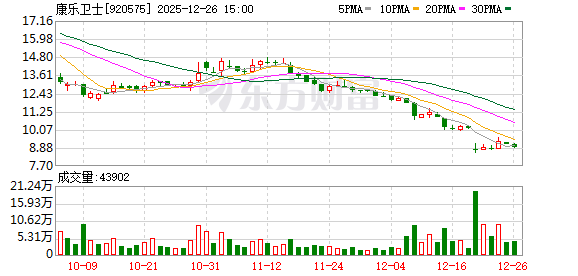
Core Viewpoint - The company Kang Le Wei Zhi is facing significant liquidity pressure due to ongoing R&D investments and delays in financing, leading to multiple court-ordered consumption restrictions and frozen bank accounts [2][3][4]. Financial Situation - As of December 26, 2025, Kang Le Wei Zhi's total market capitalization was 2.512 billion yuan [2]. - The company reported a net loss of 3.57 billion yuan for the year 2024, with a net asset deficit of 1.686 billion yuan [8]. - By the end of 2024, the company's current liabilities exceeded current assets by 7.32 billion yuan [8]. - For the first three quarters of 2025, the company generated revenue of 127.63 million yuan, with a net loss of 2.29 billion yuan [9]. Legal and Operational Challenges - The company and its legal representative, Tao Ran, have been subjected to multiple consumption restriction orders due to failure to fulfill financial obligations, with amounts involved totaling 19.85 million yuan, 6.6 million yuan, and 7.86 million yuan [3][4]. - As of December 18, 2025, 15 bank accounts belonging to the company and its subsidiaries were frozen, representing 41.67% of their total accounts, with a cumulative frozen amount of 346,900 yuan [5]. R&D and Market Position - Kang Le Wei Zhi specializes in HPV vaccines, with ongoing clinical trials for various products, including a nine-valent HPV vaccine and a fifteen-valent HPV vaccine in collaboration with Chengda Biological [6]. - The HPV vaccine market is highly competitive, with several established players and a decline in vaccine prices due to increased supply [7]. - The company has not yet launched any vaccine products, and its revenue primarily comes from the sale of research reagents, which is relatively small [7]. Future Outlook - The company has submitted an application for a Hong Kong stock listing, but there has been no recent progress [6]. - The inclusion of HPV vaccines in the national immunization program starting November 10, 2025, may intensify competition for Kang Le Wei Zhi's products [7].

长城汽车联名老爷车博物馆,暗示将推高端艺术品车型
Zhong Guo Jing Ying Bao· 2025-12-26 14:46
Group 1 - The core message indicates that Great Wall Motors is potentially developing a luxury brand, with a focus on high-end products and cultural value creation in the automotive industry [1][2] - Wei Jianjun, the founder of Great Wall Motors, has expressed ambitions to create a supercar, emphasizing that the project is not just a concept but is being systematically developed to enhance China's automotive global image [2] - The establishment of the "Great Wall Luxury Car Business Group" in January 2025 marks the company's strategic entry into the ultra-luxury market, targeting high-end categories such as supercars and D+ class sedans [3] Group 2 - The collaboration with the Sanhe Classic Car Museum and the exchange of a vintage Packard car highlights Great Wall Motors' commitment to integrating classic automotive aesthetics into its future product offerings [1] - The unveiling of a mysterious vehicle during the company's 35th anniversary celebration suggests that Great Wall Motors is making significant strides in the supercar segment, potentially competing with brands like Ferrari [2] - The new luxury brand aims to set a standard for "Chinese high-end cars," reflecting the company's strategic intent to move towards the top of the automotive industry chain [3]


海南华铁因36.9亿算力合同信披违规被罚800万
Zhong Guo Jing Ying Bao· 2025-12-26 14:24
Core Viewpoint - Hainan Huatie has received an administrative penalty notice from the China Securities Regulatory Commission (CSRC) regarding the disclosure of information related to a 3.69 billion yuan computing power contract, which was terminated due to significant changes in market conditions and lack of procurement orders [1][2]. Group 1 - Hainan Huatie announced the termination of its cooperation with Hangzhou X Company on September 30, citing changes in market environment and supply-demand conditions [1]. - The CSRC initiated an investigation into Hainan Huatie for suspected violations of information disclosure laws, leading to a formal case being opened on October 16 [1]. - The investigation concluded that Hainan Huatie failed to disclose significant contract developments in a timely and complete manner, resulting in penalties [1]. Group 2 - The administrative penalty includes a warning and a fine of 8 million yuan for Hainan Huatie, with the former general manager and other responsible individuals facing fines ranging from 2.6 million to 4 million yuan [2]. - Hainan Huatie stated that its business operations remain normal and that the penalty will not have a significant impact on its production and operations [2]. - The company will continue to monitor the situation and comply with legal disclosure requirements [2].

资管信披新规出台 34万亿银行代销理财生变
Zhong Guo Jing Ying Bao· 2025-12-26 14:23
中经记者 郭建杭 北京报道 冠苕咨询创始人、资深金融监管政策专家周毅钦告诉记者,《信披新规》中对于公募产品的信息披露要 求更细致,信息披露覆盖产品募集、存续、终止整个产品全生命周期;监管约束更严格,提升银行代销 的违规成本;统一了信披标准,这是此次新规将对银行代销理财产生的影响。 周毅钦认为,短期虽然会增加银行一定的合规成本,但长期有助于行业规范化和高质量发展,进一步扩 大银行理财业务规模,提升整体竞争力。 此外,银行理财评级人士对记者指出,《信披新规》主要是对消费者权益保障给出了更详细的指导标 准,其中多项条款主要是加强了产品管理人的责任,但代销银行作为直接面客端也需承担相应的信息披 露责任。 《信披新规》明确,资产管理产品销售时,信息披露义务人应当向投资者披露产品说明书、产品合同、 风险揭示文件及国家金融监督管理总局规定的其他信息。 提升银行理财信任度 12月25日,国家金融监督管理总局发布《银行保险机构资产管理产品信息披露管理办法》(以下简 称"《信披新规》"),立足"同类业务、相同标准",统一明确了资产管理信托产品、理财产品、保险资 管产品信息披露的基本原则、责任义务、共性内容及内部管理要求,对三类产 ...
上海金融监管局等四部门发文:三方面举措打造知识产权金融生态
Zhong Guo Jing Ying Bao· 2025-12-26 14:23
为贯彻落实《国家金融监督管理总局 国家知识产权局 国家版权局关于印发〈知识产权金融生态综合试 点工作方案〉的通知》要求,近日,上海金融监管局、上海市知识产权局、上海市版权局和上海市委金 融办联合印发《上海推进知识产权金融生态综合试点工作的行动方案》(以下简称"《行动方案》")。 《行动方案》聚焦推进上海市知识产权金融生态综合试点工作,力争至2027年年末,上海市基本建成服 务便捷高效、信息共享畅通、体制机制完备的知识产权金融生态综合试验区,推动辖内知识产权金融服 务能力显著提升、覆盖面有效扩大,知识产权质押融资渗透水平逐年提高,质押贷款余额增速高于辖内 科技贷款增速。 中经记者 郝亚娟 夏欣 上海、北京报道 二是优化知识产权金融服务质效。优化知识产权金融产品开发,提升综合服务质效;深化"入园入企"对 接机制,完善伙伴生态圈;用好各项利好政策,强化政策效应传导。 三是完善知识产权金融外部环境。完善配套设施建设,提供"一站式"线上办理服务;强化知识产权价值 评估标准化建设,研究制定规范指引;探索知识产权质押押品处置机制,丰富处置手段;提高知识产权 交易活跃度,提升价值发现;构建立体化风险管控框架,多元化解风险;加 ...
沪指录得“8连阳” 机构看好“跨年—春季”行情
Zhong Guo Jing Ying Bao· 2025-12-26 14:22
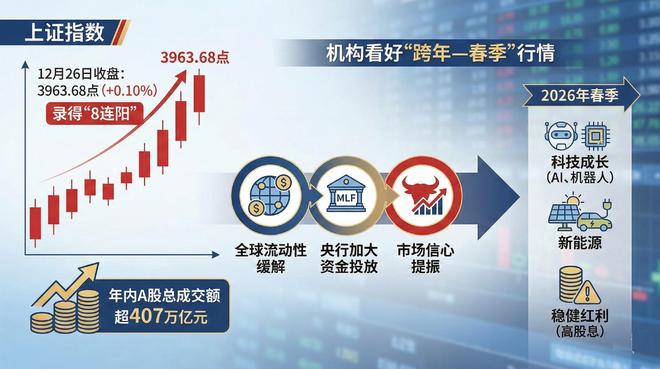
Core Viewpoint - The A-share market is experiencing a sustained upward trend, with the Shanghai Composite Index achieving an 8-day consecutive rise, attributed to multiple favorable factors both domestically and internationally [2][3]. Group 1: Market Performance - As of December 26, the Shanghai Composite Index closed at 3963.68 points, up 0.10%, marking the longest consecutive rise of the year since December 17 [2]. - The total trading volume of the A-share market exceeded 407 trillion yuan, setting a new annual record as of December 23 [3]. Group 2: Monetary Policy and Liquidity - The People's Bank of China (PBOC) announced a 400 billion yuan operation of one-year Medium-term Lending Facility (MLF) to maintain reasonable liquidity in the banking system, resulting in a net injection of 100 billion yuan for December [3]. - The PBOC's actions are aimed at stabilizing the funding environment, with a focus on maintaining a relatively stable and ample liquidity state [3]. Group 3: Seasonal Market Trends - The "cross-year-spring" market phenomenon is characterized by seasonal trends in the A-share market, often occurring from December to February, driven by improved liquidity, favorable policies, and increased risk appetite [4]. - Historical data indicates that significant market movements typically begin in December and are influenced by multiple factors rather than just calendar effects [4]. Group 4: Investment Opportunities - Analysts suggest that the current market environment is conducive to structural opportunities in the technology sector, particularly in AI applications and cyclical sectors like chemicals and non-ferrous metals [7]. - The central economic work conference emphasized innovation and the development of new growth drivers, which may further support investment in technology and related sectors [7]. Group 5: Future Market Outlook - The market is expected to see a rotation among sectors, with technology stocks likely to remain a key investment focus in 2026, alongside sectors such as new energy, consumption, and military [7]. - Investors are advised to pay close attention to industry cycles and market sentiment to optimize asset allocation in the evolving market landscape [7].
“亏损魔咒”难破 智能座舱企业掀起IPO热潮
Zhong Guo Jing Ying Bao· 2025-12-26 14:22
Core Viewpoint - The smart cockpit industry is experiencing a surge in IPO activities, with companies like Cheliantianxia seeking to go public in Hong Kong despite facing significant financial losses [1][2][4]. Group 1: IPO Activities - Cheliantianxia has submitted its prospectus for a Hong Kong IPO, following a trend among smart cockpit companies like Botai Cheliantian, Zebra Zhixing, and others [1][2]. - The smart cockpit sector is becoming a key consideration for consumers when purchasing vehicles, with a projected penetration rate of 75.1% in China's passenger car market by mid-2025 [2]. - Cheliantianxia aims to use approximately 50% of the net proceeds from its IPO for R&D in smart connected vehicle solutions, 23% for enhancing international capabilities, and 17% for increasing production capacity [3]. Group 2: Financial Performance - Cheliantianxia reported net losses of 514 million yuan, 201 million yuan, and 253 million yuan for the years 2022 to 2024, totaling nearly 1 billion yuan in losses over three years [1][5]. - The company's revenue for the same period was approximately 369 million yuan, 2.298 billion yuan, and 2.656 billion yuan, with a significant decline in revenue growth from 523% in 2023 to 15.6% in 2024 [4][5]. - Despite the losses, Cheliantianxia has delivered over 2 million vehicle computing solutions and approximately 2,000 regional controllers, indicating a growing business scale [4][6]. Group 3: Industry Challenges - The smart cockpit industry is characterized by rapid technological iteration and high R&D costs, leading to a "loss expansion" model that suggests an impending industry reshuffle [1][6]. - Many smart cockpit companies, including Botai Cheliantian, are also facing significant losses, with Botai reporting losses exceeding 1.2 billion yuan over the same three-year period [6][7]. - Cheliantianxia's revenue is heavily reliant on its vehicle computing solutions, which accounted for 100% of its revenue from 2022 to 2024, indicating a lack of diversification [7][8]. Group 4: Customer Dependency - Cheliantianxia's revenue is significantly dependent on a few major clients, with the top five customers accounting for over 95% of its revenue during the past years [8][9]. - The company is actively seeking to diversify its customer base and reduce reliance on existing clients by collaborating with new customers, particularly leading automakers [9].
科创板第五套上市标准扩围 支持规模商业化关键期商业火箭企业
Zhong Guo Jing Ying Bao· 2025-12-26 14:22
Core Viewpoint - The release of the "Guidelines" by the Shanghai Stock Exchange supports commercial rocket companies to list on the Sci-Tech Innovation Board under the fifth set of listing standards, enhancing the capital market's inclusivity and adaptability for the commercial aerospace sector [1][2]. Group 1: Guidelines Overview - The "Guidelines" detail four main areas for commercial rocket companies to qualify for the fifth set of listing standards [2]. - The first area emphasizes significant technological advantages, requiring companies to have key core technologies and notable breakthroughs in their business of "independent research, manufacturing, and launch services for commercial rockets" [2][3]. - The second area specifies that companies must achieve a milestone of successfully launching a medium to large reusable rocket payload into orbit before applying [3]. - The third area mandates that companies obtain necessary approvals from relevant national departments during the research and manufacturing process [3]. - The fourth area outlines market space requirements, stating that companies should hold a leading position in the industry and have a clear target market with competitive advantages [3]. Group 2: Industry Implications - The commercial rocket sector is at a critical stage of large-scale commercialization, necessitating support from the capital market due to high technical complexity, significant funding needs, and long R&D cycles [4]. - The "Guidelines" provide an important financing channel for companies in their growth phase, addressing funding bottlenecks during capacity ramp-up and engineering validation [5]. - The capital influx is expected to accelerate technological advancements and enhance collaboration across upstream and downstream sectors, contributing to the development of a robust domestic space transportation capability [5]. - The Shanghai Stock Exchange aims to promote the listing of commercial rocket companies that meet the "Guidelines" standards, thereby supporting the development of technology-driven enterprises and enhancing the competitiveness of the capital market [5].
被传为应对内存短缺进军DRAM制造 华硕已否认!
Zhong Guo Jing Ying Bao· 2025-12-26 14:20
Core Viewpoint - The global memory shortage crisis is prompting downstream brand manufacturers, including ASUS, to consider entering the DRAM manufacturing sector, although ASUS has denied any plans to invest in memory wafer production [1][2]. Group 1: ASUS's Position and Market Response - ASUS plans to deepen cooperation with memory suppliers and adjust product specifications to respond to market supply and demand, rather than investing in memory manufacturing [1]. - The company believes that building a memory factory would take at least two years to become operational, which would not address the current supply issues and carries significant risks due to market uncertainties [1][2]. - Industry analysts suggest that the likelihood of ASUS entering the DRAM manufacturing space is low due to the high capital requirements and the company's focus on its core PC business [2]. Group 2: Market Challenges and Price Implications - The memory market is facing severe challenges, with major manufacturers like Micron and SK Hynix shifting production towards higher-margin AI server markets, leading to a predicted memory shortage lasting until at least the end of 2027 [3]. - The imbalance between supply and demand is driving up memory product prices, which is expected to increase the average selling price of smartphones by 6.9% in 2026 [3]. - The PC industry is experiencing significant disruptions, with IDC reporting that the memory shortage coincides with the end of the Windows 10 lifecycle and the promotion of AI PCs, creating a "super storm" for the sector [3]. Group 3: Price Adjustments by Competitors - HP's CEO indicated that rising memory costs will force the company to raise product prices and introduce lower-spec versions [4]. - Dell plans to increase commercial computer prices by 10% to 30% starting December 17 [4]. - ASUS's co-CEO acknowledged that price increases are a trend in the current market, and the company will adjust its product offerings based on market conditions and consumer demand [4]. Group 4: ASUS's Indirect Involvement in Memory Production - ASUS has previously invested in ASint, which provides it with indirect memory module production capabilities and supply chain resources [5]. - ASint specializes in DRAM modules and flash products, emphasizing high compatibility and stability, and supplies to major brands including ASUS [5].
央企数智化转型样本:中国电信财务公司为何耗时一年“推倒重建”核心系统?
Zhong Guo Jing Ying Bao· 2025-12-26 14:17
Core Insights - Digital transformation is now a critical path for enterprise upgrades, shifting from an optional strategy to a necessity in the digital economy [1] - Many enterprises hesitate to proceed with digital transformation due to high costs and the disconnect between technology upgrades and business needs [1] - China Telecom Financial Company serves as a case study demonstrating the value of digital transformation through its successful core system reconstruction [2] Company Transformation - After a year of hard work, China Telecom Financial Company completed the reconstruction of its core system by the end of September this year [2] - The company aims to align with national requirements for a technology-driven financial system, focusing on principles such as professional service, digital intelligence, and compliance [2] - The transformation includes comprehensive changes in service models, customer service, management, and technological capabilities [2] System Development - The company identified issues with existing market products that did not meet its digital transformation needs, leading to the development of a fully self-controlled, intelligent financial core platform [3] - The new system addresses pain points such as technological dependency, rigid architecture, and insufficient security, integrating resources in software development, cloud, security, and quantum technology [3] Efficiency and Security Improvements - The new core system significantly enhances efficiency, reducing payment processing time from 3-5 minutes to just 10 seconds, achieving a 20-fold increase in efficiency [4] - The system's security has improved, allowing seamless switching between systems and achieving a business continuity capability rated at L6 [4] Business Model Innovation - The new system enables the company to innovate its business model, allowing for flexible combinations of financial products tailored to the needs of group member enterprises [4] - The company is also looking to extend its new system's capabilities to the broader financial company industry, engaging with over 50 financial companies regarding core system upgrades [4] Future AI Applications - The new system will support future AI applications, with plans to complete a "financial private cloud" by the end of 2026, establishing a comprehensive big data system for intelligent operations [5] - The company aims to explore deep applications of AI in financial scenarios, including intelligent risk control and advisory services, to enhance business transformation and productivity [6]
