
Guo Ji Jin Rong Bao

Search documents
资本市场投融资改革“动刀”
Guo Ji Jin Rong Bao· 2025-12-31 07:37
Core Insights - The continuous deepening of capital market investment and financing reforms has been a key focus of the Central Economic Work Conference for two consecutive years, indicating a significant commitment to advancing these reforms in the "14th Five-Year Plan" period [1][2][3] Group 1: Reform Objectives - The reform aims to transition from a "single financing channel" to a "coordinated investment and financing ecosystem," with A-share total market value exceeding 100 trillion yuan and long-term funds holding over 21 trillion yuan in circulating market value [1] - The emphasis on "sustained deepening" signifies a shift towards long-term, stable policy execution and a holistic approach to reform, moving from institutional building to ecosystem cultivation [2][3] Group 2: Key Areas of Focus - The reform will focus on enhancing the inclusivity and adaptability of capital market systems, addressing structural contradictions through coordinated investment and financing [2][4] - Key areas for reform include improving the registration system, enhancing the quality of listed companies, and developing a long-term investment ecosystem to shift the focus from "financing" to "investment" [6][7] Group 3: Investment and Financing Balance - The core of the reform is to address the imbalance in investment and financing structures, moving from indirect financing dominated by banks to a more balanced approach that emphasizes direct financing [4][5] - The goal is to create a virtuous cycle of technological innovation, industrial upgrading, and wealth growth for residents by increasing the proportion of direct financing and reducing reliance on the banking system [5] Group 4: Implementation Strategies - Strategies for implementation include optimizing the entire lifecycle of financing services, enhancing the mechanisms for delisting, information disclosure, and dividend repurchase, and developing regional equity markets [6][7] - Establishing a special mechanism to support key technological breakthroughs and developing private equity secondary markets to broaden exit channels are also critical components of the reform [7]
房地产+地方债,金融如何“拆弹”?| 前瞻2026
Guo Ji Jin Rong Bao· 2025-12-31 07:23
Core Insights - The Chinese government is focusing on addressing deep-seated issues in the economy, particularly in real estate and local government debt, as part of its 2026 economic strategy [1][2] - The central economic work meeting emphasizes the need to stabilize the real estate market and manage local government debt risks in a coordinated manner [2][3] Group 1: Economic Strategy and Risk Management - The 2025 Central Economic Work Conference outlined eight key tasks, with a strong emphasis on risk management in critical areas [1] - The shift in policy focus from "stabilizing growth" to "stabilizing expectations and preventing systemic risks" reflects a strategic commitment to market-oriented and legal approaches to risk resolution [3][4] - The interconnectedness of real estate and local debt issues necessitates simultaneous solutions to prevent worsening conditions [2][3] Group 2: Policy Changes and Local Government Initiatives - The approach to real estate regulation is shifting from demand-side stimulation to supply-side management, focusing on controlling new supply, reducing inventory, and optimizing supply [4][5] - The central government is encouraging local governments to take proactive measures in managing their debts, marking a significant policy shift [4][5] - The need for local governments to improve investment effectiveness is highlighted, as past blind investments have led to unsustainable debt accumulation [4][5] Group 3: Financial Institutions and Market Dynamics - Financial institutions are expected to adopt a layered and categorized management approach to effectively address risks associated with real estate and local debts [7][8] - The challenges faced by financial institutions include mismatched risk-return profiles, limited resources in weaker regions, and profit pressures due to interest rate reductions [8][9] - Innovations in financial tools, such as debt-to-equity swaps and asset securitization, are anticipated to enhance the management of local government debts and stabilize the real estate market [10][11] Group 4: Long-term Implications for Financial Stability - Addressing the risks in real estate and local government debt is crucial for achieving financial stability and is seen as a foundational step towards becoming a "financial power" [11] - The resolution of these risks is expected to enhance the transparency and resilience of the Chinese financial system, making it more immune to external shocks [11][12] - The transition from a scale-driven to an efficiency-driven economic model is essential for achieving sustainable modernization in China [11][12]
房地产+地方债,金融如何“拆弹”?
Guo Ji Jin Rong Bao· 2025-12-31 07:05
Core Insights - The Chinese government is focusing on addressing deep-seated issues in the economy, particularly in real estate and local government debt, as part of its 2026 economic strategy [1][2] - The central economic work meeting emphasizes the need to stabilize the real estate market and manage local government debt risks in a coordinated manner [1][2] Group 1: Economic Strategy - The 2025 Central Economic Work Conference outlined eight key tasks, with a strong emphasis on risk management in critical areas [1] - The shift in policy focus from "stabilizing growth" to "stabilizing expectations and preventing systemic risks" reflects a strategic change in addressing economic challenges [3] Group 2: Real Estate and Local Debt Risks - The interconnection between real estate prices and local government debt is highlighted, indicating that declining property values exacerbate debt issues [2] - Local government debt is primarily linked to infrastructure projects that often lack adequate returns, leading to increased risk of defaults as property values fall [2] Group 3: Policy Changes - The approach to real estate management is shifting from demand-side stimulation to supply-side management, focusing on controlling new supply and reducing inventory [4] - The central government is encouraging local governments to take proactive measures in managing their debts, marking a significant policy shift [4] Group 4: Financial Institutions' Role - Financial institutions are expected to adopt a more nuanced approach to risk management, focusing on categorization and management of risks associated with real estate and local debts [7] - The need for financial institutions to transition from reliance on collateral to assessing cash flow is emphasized, particularly in urban renewal projects [7] Group 5: Long-term Implications - Addressing real estate and local government debt risks is seen as crucial for achieving a "financially strong nation" and realizing "Chinese-style modernization" [11] - The resolution of these risks is expected to enhance the transparency and resilience of the financial system, making it more robust against external shocks [11]
央行四季度货币政策例会释放诸多积极信息
Guo Ji Jin Rong Bao· 2025-12-31 06:18
Group 1 - The core viewpoint of the recent central bank meeting is the commitment to maintain an accommodative monetary policy to support the ongoing economic recovery in China [1][2]. - The meeting emphasized the implementation of a moderately loose monetary policy, utilizing tools such as open market operations and reserve requirement ratio cuts to ensure ample liquidity in the banking system [1]. - The central bank aims to enhance counter-cyclical and cross-cyclical adjustments to align monetary credit growth with economic growth targets, indicating a supportive environment for economic rebound in the upcoming phases [1]. Group 2 - Structural policy tools will continue to be emphasized, with increased financial credit support directed towards key industries and sectors, including technology innovation, manufacturing upgrades, green development, inclusive finance, and pension finance [2]. - The meeting highlighted the importance of balancing interest rate policies with funding efficiency, aiming to improve the market-based interest rate formation mechanism and enhance the effectiveness of monetary policy transmission [2]. - There will be a focus on the synergy between monetary and fiscal policies, leveraging tools like fiscal interest subsidies and risk compensation to better support small and medium-sized enterprises and technological innovation [2].
“迷你”基金转型难清盘难凸显制度短板
Guo Ji Jin Rong Bao· 2025-12-31 06:18
Core Viewpoint - The challenges faced by "mini" funds in convening shareholder meetings highlight shortcomings in the current system, leading to difficulties in fund transformation and liquidation [1][2][3] Group 1: Fund Liquidation and Transformation - As of December 21, 275 public funds have been liquidated this year, with 126 mixed funds, 51 bond funds, and 50 equity funds, accounting for 82.55% of total liquidations [1] - Many funds are struggling to convene shareholder meetings due to issues like "zero registration" and "zero voting," which have resulted in failed attempts to hold meetings [1][2] Group 2: Regulatory and Operational Challenges - The requirement for a shareholder meeting to approve fund transformations or liquidations has become a barrier, as many funds have protective clauses that now hinder necessary actions [2][3] - The inability to successfully convene meetings leads to increased operational costs for fund companies, wasting resources and complicating the management of these funds [3] Group 3: Industry Implications - The current situation serves as a warning for the fund industry, emphasizing the need for innovation and performance improvement to avoid investor disengagement [3] - There is a necessity for a floating fee rate model for all fund products to prevent the excessive issuance of products focused solely on scale rather than innovation and performance [3]
应为上市公司投资私募基金产品立规
Guo Ji Jin Rong Bao· 2025-12-31 06:18
也有必要从制度层面寻找原因。目前制度并未禁止上市公司投资私募基金,因此上市公司购买私募 基金并不奇怪,这也导致相关踩雷消息频繁出现。由于投资失败最终涉及广大中小投资者利益,市场不 能等闲视之,有必要为上市公司投资私募基金立规。 相关报道显示,该私募基金确有违规之嫌。基金原设风控要求:投资同一资产不得超过净资产的 25%;并承诺当净值≤0.8元时,存款、证券保证金、备付金、货币基金及债券逆回购市值合计不低于资 产净值50%;当净值≤0.7元时,管理人需在2个工作日内将非活期存款投资全部变现。基金亏损 81.54%,显然未严格遵守承诺。因此,公司向公安机关报案并向证监会举报,是维护自身权益的正确 举措。 此事也值得反思。在国家队大举买入公募基金的背景下,该公司为何选择信息披露不透明、管理不 规范的私募基金?若购买公募基金ETF,不仅信息透明、安全可靠,今年行情下或能获利,而公司却偏 偏选择了风险更高的私募产品。 同时,私募基金是重要的市场力量,不能一味打压,而应规范其发展。因此,上市公司投资私募基 金的行为不宜一刀切禁止,而应通过规则加以管理。 近日,又一家上市公司因投资私募基金"爆雷"引发关注。今年,该公司以6 ...
推动构建股东大会议案合规保障体系
Guo Ji Jin Rong Bao· 2025-12-31 06:18
Core Viewpoint - The governance proposals presented by Zhenxin Technology at the first extraordinary general meeting were not approved, with over 71.84% of votes against, indicating a potential divergence in governance philosophy between the controlling shareholder, Guoteng Electronics Group, and the board of directors [1] Group 1: Governance Proposals - The three core governance proposals, including the "Rules of Procedure for Shareholders' Meetings," "Rules of Procedure for Board Meetings," and "Implementation Details for Online Voting at Shareholders' Meetings," were rejected [1] - The rejection of the proposals suggests significant opposition from the controlling shareholder, highlighting potential conflicts in governance approaches [1] Group 2: Compliance and Governance Framework - Establishing a compliance assurance system for shareholder meeting proposals requires a comprehensive approach, focusing on legal compliance, procedural integrity, and information disclosure [1] - The drafting of proposals should adhere to principles of legality, clarity of responsibilities, and feasibility, ensuring alignment with laws and regulations [2] - A multi-tiered review mechanism should be established, with the board office or securities department responsible for initial compliance checks, and external professionals involved for complex proposals [2] Group 3: Shareholder Rights and Communication - Companies must ensure timely delivery of complete meeting materials to all shareholders, particularly minority shareholders, to facilitate informed decision-making [2] - During the shareholder meeting, clear explanations of proposals should be provided, and significant disagreements should lead to postponement of votes for further discussion [3] - A comprehensive archive management system for proposals should be implemented, documenting all stages from drafting to approval, serving as a reference for regulatory inquiries and internal reviews [3]
五部门:2026年家电产品每件补贴不超过1500元数码和智能产品每件补贴不超过500元
Guo Ji Jin Rong Bao· 2025-12-31 04:38
Core Viewpoint - The Ministry of Commerce and four other departments have issued a notice regarding the implementation of a subsidy program for the replacement of old home appliances and the purchase of new digital and smart products starting January 1, 2026 [1] Group 1: Subsidy Program Details - The subsidy program will apply to personal consumers purchasing six categories of home appliances: refrigerators, washing machines, televisions, air conditioners, water heaters, and computers, as well as four categories of digital and smart products: mobile phones, tablets, smartwatches (bands), and smart glasses [1] - The subsidy will be 15% of the final sales price after discounts for the eligible products, with a cap of 1,500 yuan for home appliances and 500 yuan for digital and smart products per item [1] - Each individual can receive a subsidy for one item per category, with the price limit for single-item sales set at 6,000 yuan for digital and smart products [1]
韩束被央视曝光“非法添加”!多名消费者要求退货退款
Guo Ji Jin Rong Bao· 2025-12-31 02:53
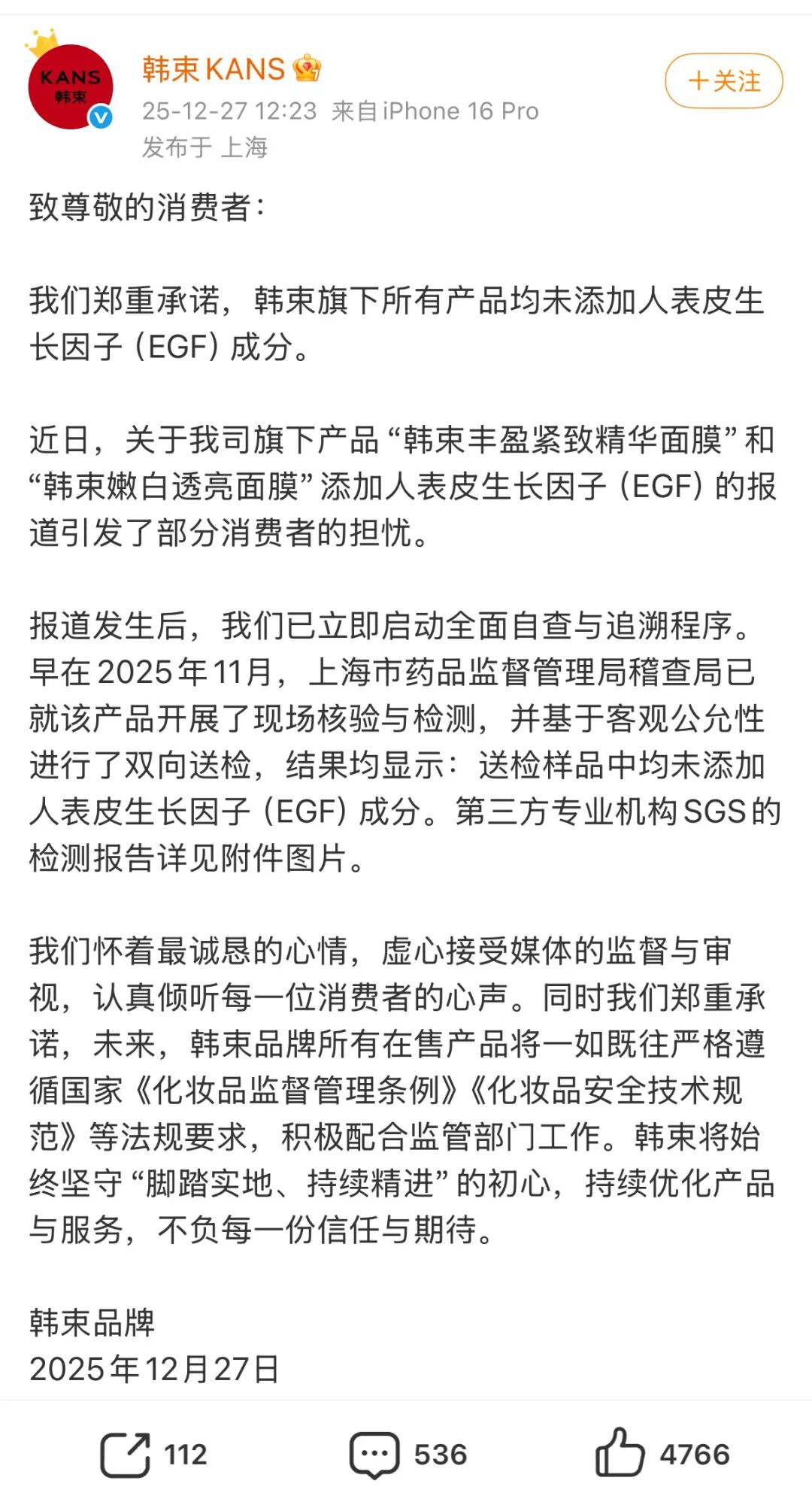
Core Viewpoint - The crisis surrounding Up Beauty Co., Ltd. continues to escalate, with significant stock price fluctuations and allegations of illegal additives in its products, particularly affecting its core brand, Han Shu [1][2][10]. Stock Performance - On December 30, Up Beauty's stock fell by 2.5%, closing at HKD 72.2, marking a total decline of over 15% over two days [1]. - The stock experienced a sharp drop on December 29, reaching a low of HKD 57, a decline of over 33% during the trading session [1]. Product Controversy - Han Shu's products were found to contain epidermal growth factor (EGF), which is not permitted in cosmetics due to safety concerns [2]. - Following the allegations, Han Shu removed the affected products from e-commerce platforms and issued a statement denying the presence of EGF in its products [2][4]. Consumer Reaction - Consumers have expressed distrust and demanded refunds, citing concerns over the safety of the products after the illegal additive allegations [4]. - Previous incidents of illegal additives in Han Shu products have raised further doubts about the brand's integrity [9]. Financial Performance - In the first half of 2025, Han Shu contributed approximately 81.4% of Up Beauty's revenue, amounting to CNY 3.344 billion, a 14.3% increase year-on-year [10]. - The company's online self-operated channel revenue reached CNY 3.421 billion, a 24.6% increase, with its share of total revenue rising from 78.4% to 83.3% [10]. Marketing Strategy - Up Beauty has heavily invested in marketing, particularly through collaborations with influencers and short dramas, leading to a significant increase in revenue [10][11]. - However, this strategy has resulted in rising marketing expenses, with the sales expense ratio increasing from 47.01% in 2022 to 56.88% in the first half of 2025, while R&D spending has decreased [11]. Strategic Shift - The company is shifting its strategic focus towards other brands, aiming for a pre-tax sales target of CNY 4.36 billion for 2026, with specific targets for brands like NEW PAGE and Anminyou [12][13]. - Concerns remain regarding the feasibility of these targets, given the current revenue performance of these brands [13].

花4300万美元收购北美火锅品牌,九毛九押注海外
Guo Ji Jin Rong Bao· 2025-12-31 02:46
Core Viewpoint - The domestic restaurant market is becoming increasingly competitive, prompting Jiumaojiu to focus on overseas expansion by investing in the North American market through a stake acquisition in Big Way Group Inc. [1] Investment Details - Jiumaojiu plans to invest a total of $43 million (approximately 303 million yuan) to increase its stake in Big Way Group Inc., which operates a self-service hot pot brand in North America [1][2] - The investment will be executed in two parts: $15 million for purchasing shares from existing shareholders and $28 million for subscribing to new shares, with all payments made in cash sourced from internal resources and bank loans [2] - Jiumaojiu will hold approximately 49.0% of Class A shares in the target company, corresponding to 10.8% voting rights and 49.0% participation rights, while the target company will not be consolidated into Jiumaojiu's financial statements [2] Strategic Intent - The acquisition is part of a long-term strategy to achieve "resource integration and synergistic efficiency," targeting the North American market as a key area for the globalization of Chinese cuisine [5] - Jiumaojiu aims to leverage the local management team's understanding of market preferences to overcome challenges related to taste adaptation and consumer habits [5] Financial Performance - The target company has shown rapid growth in profitability, with projected pre-tax profits of $259,600 and $1.39 million for 2023 and 2024, respectively, representing over a fourfold increase [6] - In contrast, Jiumaojiu's profitability is declining, with a projected net profit of 55.81 million yuan for 2024, down approximately 88% year-on-year [6][8] Market Challenges - The domestic restaurant market is experiencing significant pressure, with Jiumaojiu's major brands facing declines in customer traffic and same-store sales, leading to an overall revenue drop of over 10% [8] - The company acknowledges the challenges of establishing a presence in the North American market, particularly in appealing to non-Chinese consumers, which presents a high barrier to entry [8]