
Jin Rong Shi Bao

Search documents
创历史新高!超45万亿元!
Jin Rong Shi Bao· 2026-01-14 05:04
Core Viewpoint - In 2025, China's foreign trade demonstrated strong resilience and vitality, achieving a total import and export value of 45.47 trillion yuan, an increase of 3.8% compared to the previous year [1][3]. Group 1: Trade Growth and Characteristics - The total import and export value exceeded 45 trillion yuan, marking a historical high and maintaining China's position as the world's largest goods trading nation [1]. - Trade with over 240 countries and regions was recorded, with exports to countries along the "Belt and Road" reaching 23.6 trillion yuan, a growth of 6.3%, accounting for 51.9% of total trade [1]. - High-tech product exports reached 5.25 trillion yuan, growing by 13.2%, with green products like "new three samples" and wind turbine generators seeing increases of 27.1% and 48.7% respectively [1]. Group 2: Import Dynamics - Imports maintained growth for three consecutive quarters starting from the second quarter, with total imports of 18.48 trillion yuan, a growth of 0.5% [2]. - Key imports included mechanical and electrical products valued at 7.41 trillion yuan, increasing by 5.7%, with electronic components and computer parts growing by 9.7% and 20% respectively [2]. - Consumer goods such as fresh and dried fruits and edible vegetable oils saw import values increase by 5.6% and 16.6% respectively [2]. Group 3: Business Vitality and Market Potential - Over 780,000 enterprises engaged in import and export activities, with private enterprises contributing significantly, achieving a total trade value of 26.04 trillion yuan, a growth of 7.1% [2]. - China's large population and growing middle-income group provide substantial market potential, with domestic economic recovery driving production and consumption demand [4]. - China's complete industrial system and continuous innovation enable it to adapt to international market demands, with equipment manufacturing exports reaching 16.03 trillion yuan, growing by 9.2% [4]. Group 4: Future Outlook and Challenges - Despite a challenging global trade environment, China's foreign trade is expected to remain stable, supported by institutional, market, and industrial advantages [5][6]. - The global trade growth forecast for 2026 has been significantly downgraded to 0.5%, indicating a tough external environment for trade [6]. - China's trade policies and measures are designed to enhance resilience and provide stability for future trade growth [6].
一次与病魔竞速的精准助攻
Jin Rong Shi Bao· 2026-01-14 03:02
Core Insights - The article highlights the significant role of insurance in providing support and financial security during health crises, emphasizing that it is more than just a contract but a source of comfort and dignity in difficult times [1] Group 1: Personal Experience - A case study of a woman from Liaoning, Ms. Li, illustrates the impact of insurance on personal health challenges, as she joined the Taikang Life Health Wealth Planner (HWP) team and purchased comprehensive insurance policies with an annual premium exceeding 200,000 yuan [2] - After a routine health check-up, Ms. Li was diagnosed with breast cancer, which led to a swift initiation of insurance claims, resulting in a total of 60,000 yuan received for critical illness and surgery allowances shortly after her diagnosis [2][3] Group 2: Medical Support Services - The article describes the challenges faced during the treatment journey, including the need for expedited medical services, which were facilitated by Taikang's "Green Channel Service," allowing Ms. Li to receive timely appointments and necessary medical procedures without long waiting times [3] - Financial support was also provided through hospitalization advances, totaling 14,023.84 yuan, with additional insurance payouts covering 64,000 yuan throughout her treatment, alleviating her financial burden significantly [4] Group 3: Emotional and Professional Reflection - Ms. Li's experience led to a deeper appreciation for the warmth and care provided by the insurance process, transforming her perception of the industry from a mere promise to a tangible support system [4] - As both a client and an industry professional, Ms. Li expressed a profound respect and pride for her work in the insurance sector, recognizing the importance of the services offered during critical health challenges [4]
一份写满民生温度的长护答卷
Jin Rong Shi Bao· 2026-01-14 03:02
在浙江嘉兴嘉善县一家医院的病房里,80多岁的章大伯刚从急性胃炎、肺炎的病情中稳定下来,可 行动不便的他,让家人犯了难:怎么安全出院回家?正当一筹莫展之时,他们想起了人保财险浙江嘉兴 嘉善支公司长护险业管中心提醒过,长护险参保人员可预约"善诚护送"服务。"以前出院转运要自己花 钱,现在两次转运下来,160元费用直接减免,体贴入微的政策真是帮到了心坎上!"章大伯的儿子告诉 记者。 据人保财险相关人士介绍,党中央作出"健全基本公共服务体系,提高公共服务水平"决策部署,推 动非急救转运服务纳入长护险保障范围。当地人保财险工作人员深入社区、医院、养老机构,与失能家 庭、医护人员面对面座谈,全面梳理群众在出院转运环节的急难愁盼问题。2024年10月,嘉善县成为浙 江省首个非急救转运惠民机制试点城市。一年下来,这项服务已使用106次,为不少失能患者解决了出 院回家的实际困难。 "多亏了黄医生,她精神好多了,孩子们终于能喘口气奔事业了!"在河北邢台清河县葛仙庄,张阿 姨的老伴摩挲着护理日志上的"红勾",向人保财险的长护险专员道谢。此前,张阿姨突发脑出血后僵卧 在床,儿女们分身乏术无法及时照料,直到村医黄医生定期上门服务,为张 ...

一堂点亮梦想的乡村美术课
Jin Rong Shi Bao· 2026-01-14 03:02
Core Viewpoint - The "Art Returns to the Mountains" public welfare project initiated by China Life Insurance aims to bridge the gap in aesthetic education between urban and rural areas, providing quality art education resources to rural children [1][2]. Group 1: Project Overview - The "Art Returns to the Mountains" project was launched in 2020, focusing on delivering quality aesthetic education resources to rural areas through offline art experiences, art courses, and donations of art supplies [1]. - As of now, the project has reached 188 schools across 159 cities in China, benefiting 45,000 students [1]. Group 2: Educational Activities - The project includes various themed art classes, such as "Space Technology" and "My Hometown," where children engage in creative activities that enhance their understanding of traditional culture and personal expression [2]. - China Life Insurance collaborates with art institutions and renowned teachers to bring quality courses to rural classrooms, ensuring children have access to professional art education [2]. Group 3: Resource Provision - The company has prepared customized art toolkits for rural schools, which include painting supplies and educational materials, alongside donations of children's books and sports equipment [2][3]. - Over the years, the project has consistently provided high-quality aesthetic education resources and support to rural children in various provinces, including Gansu, Hunan, Shandong, and Jiangxi [3]. Group 4: Community Engagement - Volunteers from China Life Insurance actively participate in delivering art toolkits and organizing outdoor activities, fostering a supportive environment for children [3]. - The project has become a long-term partner in rural aesthetic education, with annual expectations from children for the art classes and resources provided [3].

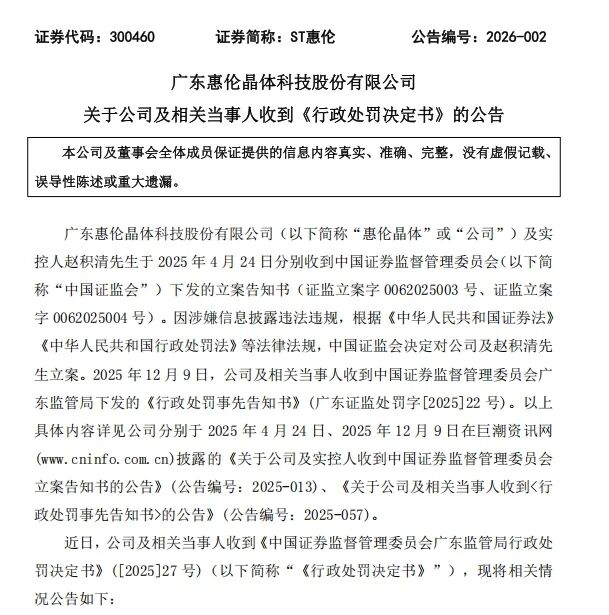
以财务造假掩盖资金占用?监管开出千万级罚单→
Jin Rong Shi Bao· 2026-01-14 02:50
Core Viewpoint - Huineng Crystal Technology Co., Ltd. has been fined a total of 11.4 million yuan due to significant financial misconduct, including fund misappropriation and financial fraud [1][7]. Group 1: Financial Misconduct - The company transferred 28.33 million yuan to related parties under the guise of procurement in 2020, which constituted 5.12% of its net assets, and failed to disclose this in its annual report, leading to a major omission [3][5]. - To cover up the fund misappropriation, Huineng Crystal engaged in financial fraud from 2021 to 2022, inflating revenue by 25.49 million yuan in 2021 and 62.33 million yuan in 2022 [6]. Group 2: Regulatory Actions - The Guangdong Securities Regulatory Bureau imposed a fine of 3 million yuan on Huineng Crystal and penalized its executives, including a 4 million yuan fine on the chairman [7]. - The company acknowledged that the violations identified in the administrative penalty decision were consistent with those in the prior notice, and these violations did not trigger mandatory delisting conditions [7]. Group 3: Company Performance - Huineng Crystal reported a 4.7% year-on-year decline in revenue and a net loss of 76.12 million yuan in the third quarter of 2025, indicating a significant worsening of financial performance [7].

推动农业保险 高质量发展
Jin Rong Shi Bao· 2026-01-14 02:47
Core Viewpoint - The Financial Regulatory Administration has responded to various proposals from the National People's Congress and the Chinese People's Political Consultative Conference, outlining directions for enhancing the quality of agricultural insurance development, including revisions to the Agricultural Insurance Regulations, integration of agricultural data, and the promotion of green agricultural insurance [1][2][3][4][5][6]. Group 1: Agricultural Insurance Regulation Revisions - The Financial Regulatory Administration acknowledges the importance of revising the Agricultural Insurance Regulations to adapt to changing conditions and improve the agricultural insurance system, which has been in place since March 1, 2013, and was revised in 2016 [2]. - The existing legal framework for agricultural insurance is deemed relatively complete and has proven effective in stabilizing farmers' incomes and supporting modern agricultural development [2]. Group 2: Integration of Agricultural Data - The administration is focused on enhancing the technological capabilities of agricultural insurance through the integration of various data sources, including big data, satellite remote sensing, and GPS technology, to improve underwriting and claims processes [3]. - Future efforts will involve collaboration with relevant departments to strengthen the national agricultural insurance information management platform, promoting data sharing and optimizing risk management services [3]. Group 3: Green Agricultural Insurance - The Financial Regulatory Administration is promoting the establishment of a green agricultural insurance service system aimed at supporting sustainable agricultural development and mitigating ecological risks [4]. - Insurance companies are encouraged to collaborate with research institutions to develop risk assessment models based on big data and remote sensing technology, enhancing the precision of risk evaluations [4]. Group 4: Agricultural Employment Insurance - The administration is guiding insurance companies to develop products that address employment risks, including various employer liability insurances, to support flexible employment in the agricultural sector [5][6]. - The focus is on providing better insurance coverage for flexible workers in agriculture, ensuring that insurance products are designed to meet the specific needs of different industries and job types [6].
“确诊即赔”被拒 重疾险“二次限定”条款引争议
Jin Rong Shi Bao· 2026-01-14 02:37
"确诊即赔"是很多重疾险产品宣传时吸引消费者的承诺。然而,不少消费者在真正确诊重大疾病后 却遭遇拒赔,原因往往隐藏在保险合同冗长的免责条款或疾病的"二次限定"条件之中。由于重疾险的高 度专业性,相关争议时有发生。近期,北京市西城区人民法院(以下简称"西城区法院")发布一起典型 案例。 针对此类问题,法官建议多方协同共治。西城区法院金融街人民法庭副庭长苏畅表示,保险公司要 严格合规经营,严格规范销售全流程,全面提升理赔服务质量,发挥风险保障最大效能;保险行业协会 要重视自律管理,牵头更新示范条款,发挥行业自律惩戒职能,激发合规展业内生动力;消费者也要提 高自身法律意识,认真阅读保险条款,从正规渠道购买保险,依法维护自身权益;监管司法更要联动作 为,建立常态化信息共享机制,在多元纠纷调解机制上深入合作,发挥行业治理最强合力。 责任编辑:袁浩 贾某申请理赔后,保险公司以"未出现角膜色素环、未进行肝脏活检"为由拒赔,认为未达到合同约 定的严重程度。贾某提交的病历显示,患儿K-F环呈阴性,但该指标并非衡量病情严重程度的依据;未 进行肝活检,是因为该检查非必需项目。患儿基因检测及肝功能等指标已能明确诊断。贾某遂向法院提 ...
2025年前11个月广东保险业 原保险保费收入同比增长7.03%
Jin Rong Shi Bao· 2026-01-14 02:37
Core Insights - The financial regulatory authority in Guangdong has released key regulatory indicators for the insurance industry, showing significant growth in assets and premium income [1] Group 1: Asset Growth - As of November 2025, the total assets of the insurance industry in the region reached 1.97 trillion yuan, representing an increase of 11.03% from the beginning of the year [1] - Property insurance companies reported assets of 133.95 billion yuan, up by 6.61% year-to-date [1] - Life insurance companies held assets of 1.84 trillion yuan, reflecting a growth of 11.37% since the start of the year [1] Group 2: Premium Income and Claims - In the first eleven months of 2025, the insurance industry achieved original premium income of 535.12 billion yuan, marking a year-on-year increase of 7.03% and ranking second nationally [1] - Claims and benefit payments amounted to 198.91 billion yuan, which is an increase of 8.48% compared to the previous year [1] - The underwriting profit for insurance companies was reported at 7.03 billion yuan [1]
一场跨越万里的救援
Jin Rong Shi Bao· 2026-01-14 02:37
"我摔伤了……想回家。" 日前,一通从瑞士打来的援助电话,打破了中国平安服务网络的日常运转。电话那头,是因疼痛与 无助导致声音微微颤抖的陈女士。一场跨越万里、争分夺秒的守护行动,自此迅速展开。 这场本应充满欢笑的瑞士之旅,在2025年12月4日骤然改变。陈女士因路滑不慎摔倒,致左脚骨 折。剧痛之外,语言障碍与陌生的就医流程,更让身处异国他乡的陈女士倍感焦虑,于是她拨通了一串 并不熟悉的号码——平安24小时全球急难援助热线。 责任编辑:袁浩 从意外发生时的茫然无助,到最终安然归国接受治疗,陈女士的感慨真挚而朴素:"在异国他乡意 外受伤,语言还不通,心里特别着急。没想到仅仅是一个求助电话,平安就派来了专业的守护团队,不 仅关心我的伤势,更如同家人般陪伴全程,令我非常感动。" 此次万里救援是中国平安庞大应急救援网络与专业服务能力的一个缩影。面对全球范围内客户突发 的急难险重事件,中国平安的响应机制总能快速激活。 美国时间2025年5月1日晚,美国黄石国家公园附近发生重大交通事故,造成中国公民5死8伤。中国 平安启动紧急预案,在72小时内完成跨越太平洋的急救协调,协助遇险客户医疗救治与平安返程。2025 年7月30日 ...

2026年险资举牌热度能否延续?
Jin Rong Shi Bao· 2026-01-14 02:37
Core Viewpoint - In 2025, insurance capital's shareholding activities reached a record high of 35 times, driven by regulatory encouragement, the pursuit of higher returns in a low-interest environment, and new accounting standards that help smooth profit fluctuations [1][4]. Group 1: Characteristics of Insurance Capital Shareholding - The number of shareholding activities by insurance capital in 2025 significantly exceeded the average level of recent years, marking the most active year since 2015 [2]. - A total of 14 insurance institutions participated in shareholding activities, including major listed insurance companies, bank-affiliated insurers, and Sino-foreign joint ventures, with Ping An Life being the most active, conducting 12 shareholdings [2]. - Approximately 80% of the shareholding activities were executed through the Hong Kong Stock Connect or continuous purchases in the secondary market, with other methods including agreement transfers and passive shareholding due to mergers [2]. Group 2: Strategic Logic Behind Shareholding - Insurance capital's shareholding activities were not random but followed a clear strategic logic, with a preference for the financial sector, which saw 15 shareholdings involving six banks and two insurance institutions [3]. - Other favored sectors included public utilities, transportation, and environmental protection, indicating a focus on stable, cash-generating industries [3]. - The core demand of insurance capital is for long-term, stable returns, leading to an increased allocation to equity assets as traditional fixed-income returns fail to cover liability costs [3]. Group 3: Factors Driving Shareholding Activities - Regulatory policies have encouraged long-term capital to enter the market, with measures such as increasing the investment limit for insurance companies in equity assets to 50% [4]. - Insurance institutions are responding to downward pressure on interest rates by increasing their allocation to equity assets to enhance long-term investment returns [4]. - New accounting standards impose higher requirements for asset-liability matching, allowing insurance companies to reduce the impact of market value fluctuations on current profits through shareholding [5][6]. Group 4: Future Outlook for Insurance Capital Shareholding - There is optimism that insurance capital will continue to increase equity asset allocations in 2026, with expectations of maintaining high shareholding activity levels [8]. - Analysts suggest that insurance capital's shareholding motivations will focus on stable dividend cash flows and high return on equity (ROE) targets, particularly in sectors aligned with national strategic directions such as high-end manufacturing and technological innovation [8].
