Di Yi Cai Jing Zi Xun

Search documents
苹果被罚款上亿美元
Di Yi Cai Jing Zi Xun· 2025-12-22 08:12
Core Viewpoint - The Italian antitrust authority has imposed a fine of €98.6 million (approximately $115.53 million) on Apple and its two subsidiaries for allegedly abusing their dominant market position in the iOS mobile app distribution sector [1] Group 1 - The fine was issued due to concerns over Apple's market dominance in the iOS mobile application distribution [1] - The total amount of the fine is €98.6 million, which converts to about $115.53 million [1]

收盘丨沪指涨0.69%收复3900点,半导体产业链爆发
Di Yi Cai Jing Zi Xun· 2025-12-22 07:20
Group 1 - The core viewpoint of the news highlights a significant surge in the Hainan Free Trade Port concept stocks, with over 20 stocks hitting the daily limit up, indicating strong market interest and potential investment opportunities in this sector [1] - The semiconductor industry chain has also seen a notable increase, particularly in areas such as CPO, advanced packaging, and silicon wafers, suggesting a robust performance in technology-related stocks [1] - AI-related stocks, including AI smartphones, robotics, and intelligent driving, are actively trading, reflecting growing investor interest in innovative technologies [1] Group 2 - Specific stocks that experienced substantial gains include Shennong Agricultural (up 20.03% to 7.13), Kangzhi Pharmaceutical (up 19.96% to 13.22), and Hainan Mining (up 9.97% to 11.47), showcasing the strong performance of individual companies within the Hainan sector [2][4] - The A-share market showed overall strength, with the Shanghai Composite Index rising by 0.69%, the Shenzhen Component Index by 1.47%, and the ChiNext Index by 2.23%, indicating a positive market sentiment [3] - The total trading volume in the Shanghai and Shenzhen markets reached 1.86 trillion, an increase of 136 billion from the previous trading day, with over 2900 stocks rising, further emphasizing the bullish trend in the market [4] Group 3 - Main capital flows indicate a net inflow into sectors such as electronics, communications, and non-ferrous metals, while there was a net outflow from commercial retail, aerospace, and media sectors, suggesting a shift in investor focus [7] - Notable individual stocks with significant net inflows include Wolong Electric Drive (19.53 billion), Zhongji Xuchuang (13.41 billion), and Industrial Fulian (13.34 billion), indicating strong institutional interest [8] Group 4 - Institutional perspectives suggest that after recent adjustments, a spring rally in the market is anticipated, driven by potential catalysts such as foreign capital position recovery post-Christmas and the upcoming annual report disclosures in January [9] - The liquidity environment is expected to remain loose, with a trend of "deposit migration" likely to continue, providing a favorable backdrop for investors to consider low-entry opportunities for the upcoming year-end market [9] - External factors, including concerns over the AI bubble in the US and the Bank of Japan's interest rate hikes, are influencing short-term A-share volatility, but stabilization in US AI stocks may lead to a positive correlation with global markets [9]


中尾部智驾玩家,陷在“赢者通吃”的焦虑里 | 智驾中场战事
Di Yi Cai Jing Zi Xun· 2025-12-22 07:19
Core Viewpoint - The sudden shutdown of Haomo Zhixing highlights the intense competition and market consolidation in the autonomous driving industry, where leading companies are rapidly advancing while mid-tier players struggle to survive [1][2][3]. Group 1: Company Developments - Haomo Zhixing announced a complete shutdown on November 22, 2025, due to its poor operational status, despite previously being valued at over $1 billion [2]. - The company faced multiple failures, including hardware selection issues, outdated software algorithms, and indecisive management, leading to delays in its urban advanced driving solutions compared to competitors [2]. - Long-term partnerships with major automotive manufacturers have shifted, with Haomo Zhixing losing support from Great Wall Motors, which has turned to other suppliers for its advanced driving solutions [2]. Group 2: Market Dynamics - The autonomous driving industry is experiencing a significant divide, with leading companies like Huawei and Momenta rapidly gaining market share, while mid-tier firms face existential threats [3][5]. - Huawei's autonomous driving system has surpassed 1 million units, with a market share of 27.8% in the NCA segment, indicating strong demand for advanced driving technologies [5]. - The competitive landscape is shifting towards a "winner-takes-all" scenario, where only a few players are expected to survive, as highlighted by predictions from industry leaders [7][10]. Group 3: Strategic Responses - Mid-tier companies are seeking differentiation by exploring new markets and applications, such as autonomous delivery vehicles and international collaborations [4][5]. - There is a trend among mid-tier firms to form strategic partnerships and investments to enhance their competitive positioning, as seen with companies like Aito and their acquisitions [9][10]. - Despite the prevailing narrative of consolidation, some mid-tier executives believe there is still room for diverse survival strategies within the industry, suggesting that the market is not yet fully consolidated [9][10].
互联网平台不得“亏本卖”,香港科技股估值能否受益?
Di Yi Cai Jing Zi Xun· 2025-12-22 07:01
2025.12.22 《规则》还明确:"平台经营者、平台内经营者不得违反《中华人民共和国价格法》第十四条第二项规 定,以排挤竞争对手或者独占市场为目的,以低于成本的价格销售商品或者提供服务,扰乱正常的生产 经营秩序,损害国家利益或者其他经营者合法权益。降价处理鲜活商品、季节性商品、积压商品、临期 商品等商品,或者有正当理由降价提供服务的除外。" 港股100研究中心顾问余丰慧向第一财经记者表示,《规则》的发布,对依赖补贴和低价策略吸引用户 的部分互联网平台公司来说,将促使这些企业重新审视定价策略和商业模式,需要转向更加健康可持续 的发展路径,例如提升服务质量和产品差异化。短期内,部分公司的营收增长可能面临一定压力,但长 期来看有利于行业健康发展。 奶酪基金投资经理潘俊表示,《规则》明确禁止"以低于成本的价格销售商品或者提供服务"等不正当竞 争行为,并要求动态定价、补贴促销等规则公开透明,目的是为了规范平台价格行为、禁止低价倾销、 价格欺诈、强制补贴等,保护消费者和平台内经营者权益,推动平台经济健康发展。 潘俊认为,《规则》将削弱平台"烧钱换市场份额"的能力。美团、京东集团、阿里巴巴今年的外卖大 战,在规则落地后 ...




保时捷将关停所有自建充电站
Di Yi Cai Jing Zi Xun· 2025-12-22 06:41
Core Viewpoint - Porsche China will gradually cease operations of its self-built charging network, which includes approximately 200 charging stations, starting from March 1, 2026 [1] Group 1: Service Changes - The Porsche Enjoy Charging service, which encompasses all self-built high-power DC charging stations, will be discontinued and removed from the Porsche App and WeChat mini-program charging map [1] - Porsche China confirmed that the withdrawal of the Enjoy Charging service facilities will be conducted in an orderly manner beginning March 1, 2026 [1] Group 2: Future Strategy - Following the cessation of its self-built charging network, Porsche will shift its focus towards deep collaboration with leading charging operators in the industry [1]
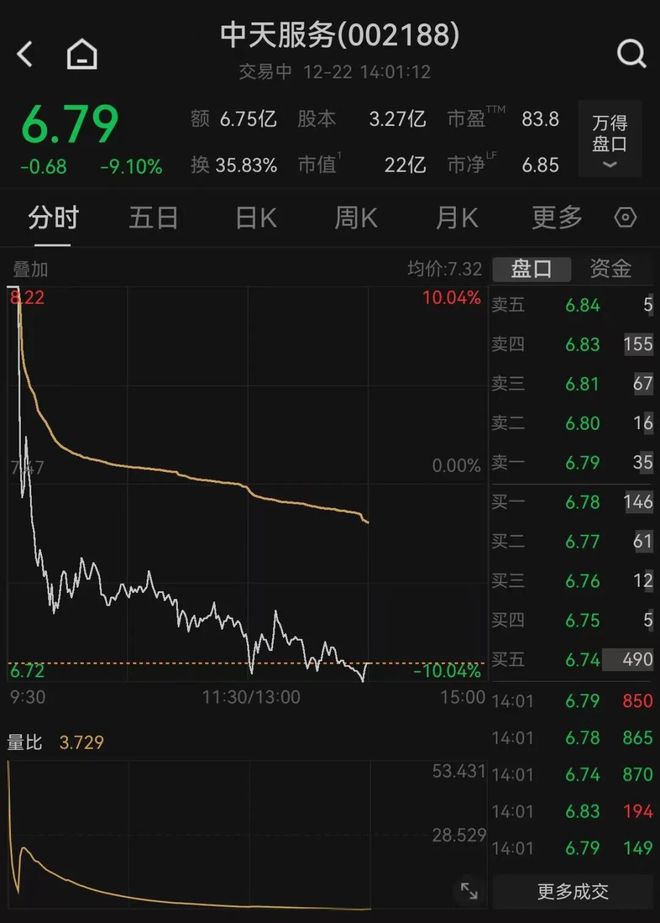
002188,上演“天地板”

Di Yi Cai Jing Zi Xun· 2025-12-22 06:15
Group 1 - The stock of Zhongtian Service experienced a significant drop, hitting the daily limit down, with a decline of 9.1% to 6.79 yuan, and a trading volume of 675 million yuan [1] - Prior to this decline, the stock had seen consecutive limit-up days for three trading sessions [1]
这一概念,大面积涨停
Di Yi Cai Jing Zi Xun· 2025-12-22 05:42
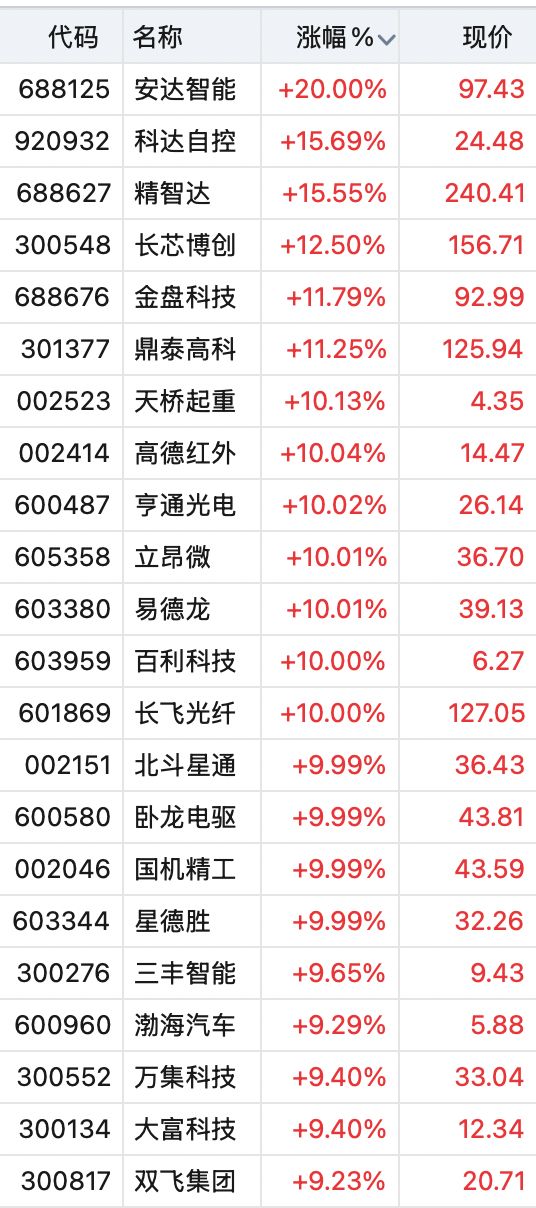
Core Viewpoint - The robotics sector is experiencing a significant surge, with multiple stocks hitting their daily limit up, indicating strong investor interest and market momentum [1]. Group 1: Stock Performance - Andar Intelligent (安达智能) saw a 20% increase, reaching a price of 97.43 [2] - Keda Control (科达自控) rose by 15.69%, with a current price of 24.48 [2] - Jingzhida (精智达) increased by 15.55%, now priced at 240.41 [2] - Other notable performers include Changxin Bochuang (长芯博创) up 12.50% at 156.71, and Jinpan Technology (金盘科技) up 11.79% at 66.76 [2] - A total of over ten stocks in the sector, including Tianqiao Hoisting (天桥起重) and Gaode Infrared (高德红外), also experienced limit up [1]. Group 2: Market Trends - The robotics concept is gaining traction in the market, as evidenced by the widespread price increases across various companies [1]. - The overall positive sentiment in the robotics sector suggests a growing interest from investors, potentially driven by advancements in technology and increased demand for automation solutions [1].


封关第四天海南板块掀起涨停潮:23只个股涨停
Di Yi Cai Jing Zi Xun· 2025-12-22 05:29
Core Viewpoint - The official closure of Hainan Free Trade Port on December 18 marks a significant step in China's commitment to high-level openness and the construction of an open world economy, leading to a surge in market enthusiasm and stock performance in the related sector [1][2]. Group 1: Market Performance - As of December 22, the "Hainan Free Trade Port" sector saw a strong performance, with a notable increase of 9.47%, and 23 stocks within the sector hitting the daily limit [1]. - Following the closure announcement, the sector experienced a decline of 4.15% on December 18, but rebounded with a 4.44% increase on December 19 [1]. Group 2: Policy Impact - The "zero tariff" policy is a key feature of the Hainan Free Trade Port's regulatory framework, aimed at reducing import costs for businesses through phased tariff reductions [1]. - The scope of "zero tariff" goods has expanded significantly from 1,900 tax items to 6,600, increasing the proportion from 21% to 74% [1]. Group 3: Economic Benefits - Since 2020, Hainan Airlines has imported aviation materials worth approximately 350 million yuan, saving over 50 million yuan in tariffs and VAT due to the zero tariff policy [2]. - The total import value of raw materials, vehicles, and self-use production equipment under the zero tariff list reached 29.22 billion yuan, with tax reductions amounting to 5.474 billion yuan [2]. - As of November this year, the processing value exempt from tariffs in Hainan Free Trade Port has reached 11.42 billion yuan, with a total tax reduction of 878 million yuan [2]. Group 4: Strategic Positioning - Hainan Island, as China's second-largest island, is strategically positioned with abundant resources and serves as a vital gateway for trade between East Asia, Southeast Asia, and South Asia, enhancing its role in the global economic cycle [2].
刺激,2025!| 年终特刊,如约而至
Di Yi Cai Jing Zi Xun· 2025-12-22 04:12
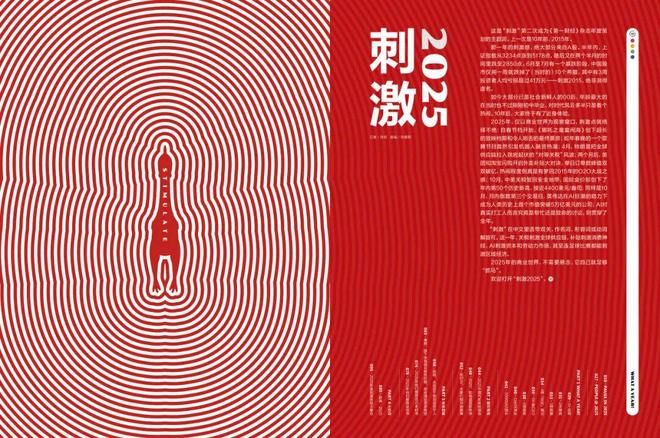
Group 1 - The theme of "stimulation" has returned as a key concept for the annual planning of "First Financial" magazine, marking its second occurrence in ten years, with the last being in 2015 [1] - The stock market experienced significant volatility in 2015, with the Shanghai Composite Index rising from 3,234 points to 5,178 points within six months, followed by a sharp decline to 2,850 points in just two and a half months [1] - The current level of "stimulation" is perceived to be at least ten times higher than it was a decade ago, indicating a substantial shift in the economic landscape [2] Group 2 - In 2025, various stimulating events are expected to unfold in the business world, including record-breaking box office performances and intense competition in the delivery service sector [3] - The year 2025 is anticipated to be a watershed moment for the Chinese automotive industry, with comprehensive updates expected in product quality, marketing strategies, and supply chain operations for new energy vehicles [12] - The impact of AI on the labor market and capital is a central theme for 2025, with discussions on whether it serves as a helper or a threat to workers [3][11] Group 3 - The concept of "stimulation" in Chinese carries dual meanings, representing both positive and negative experiences that exceed previous thresholds [4][5] - The year 2025 is characterized by significant changes in global operational rules, surpassing the experiential limits of a generation [5] - The magazine's annual issue includes insights from experts on investment trends and consumer behavior, highlighting the evolving definitions of a "good life" among Chinese consumers [21][15]
长三角A股市值首超30万亿
Di Yi Cai Jing Zi Xun· 2025-12-22 04:05
Group 1 - The core point of the article highlights the shift in market leadership in Sichuan Province from Wuliangye to the optical module leader Xinyi Sheng, reflecting the broader impact of the AI wave on the electronic and communication industries [2] - The total market capitalization of A-shares increased significantly, with major cities like Shanghai, Beijing, and Shenzhen leading the growth, rising from 48.6 trillion yuan at the beginning of the year to 56.5 trillion yuan by year-end, an increase of nearly 8 trillion yuan [2] - The Yangtze River Delta region's total market capitalization reached 31.51 trillion yuan, accounting for 26.2% of the total A-share market, with cities like Suzhou, Wuxi, and Hangzhou showing notable growth [2] Group 2 - As of December 19, 2025, the total market capitalization of A-shares reached 120.31 trillion yuan, reflecting a year-to-date growth of 22.2% [3] - The top five provinces in terms of market capitalization are Beijing, Guangdong, Shanghai, Zhejiang, and Jiangsu, with a more solidified structure compared to previous years [3][4] - Beijing's market capitalization reached 32.88 trillion yuan, significantly supported by state-owned enterprises and tech companies, while Shenzhen's market capitalization grew to 12.23 trillion yuan, driven by major players in technology and finance [5][13] Group 3 - Fujian Province saw a remarkable market capitalization growth of 51.73%, rising from 3.71 trillion yuan to 5.62 trillion yuan, primarily due to the strong performance of companies like CATL and Zijin Mining [8] - The market capitalization of Jiangsu Province exceeded 30%, reaching 8.65 trillion yuan, with significant contributions from cities like Suzhou and Wuxi in sectors such as semiconductors and digital economy [6][7] - The Yangtze River Delta region's electronic and communication sector saw a market capitalization increase of 1.9 trillion yuan, accounting for nearly 30% of the total growth, with companies like SMIC and Sunwoda contributing significantly [10] Group 4 - The city rankings in terms of market capitalization show stability at the top, with cities like Beijing, Shenzhen, and Shanghai leading, while cities like Hangzhou and Suzhou are emerging as strong contenders [11][14] - Notable growth in the market capitalization of cities such as Hefei, Wuhan, and Shaoxing, which have entered the trillion-yuan market capitalization club, indicates a shift in economic dynamics [14] - Chengdu's market capitalization surpassed 2 trillion yuan, driven by the growth of Xinyi Sheng, which increased from 819 million yuan to 4.316 billion yuan, marking a significant milestone for the city [14]