
Zhong Guo Zhi Liang Xin Wen Wang

Search documents
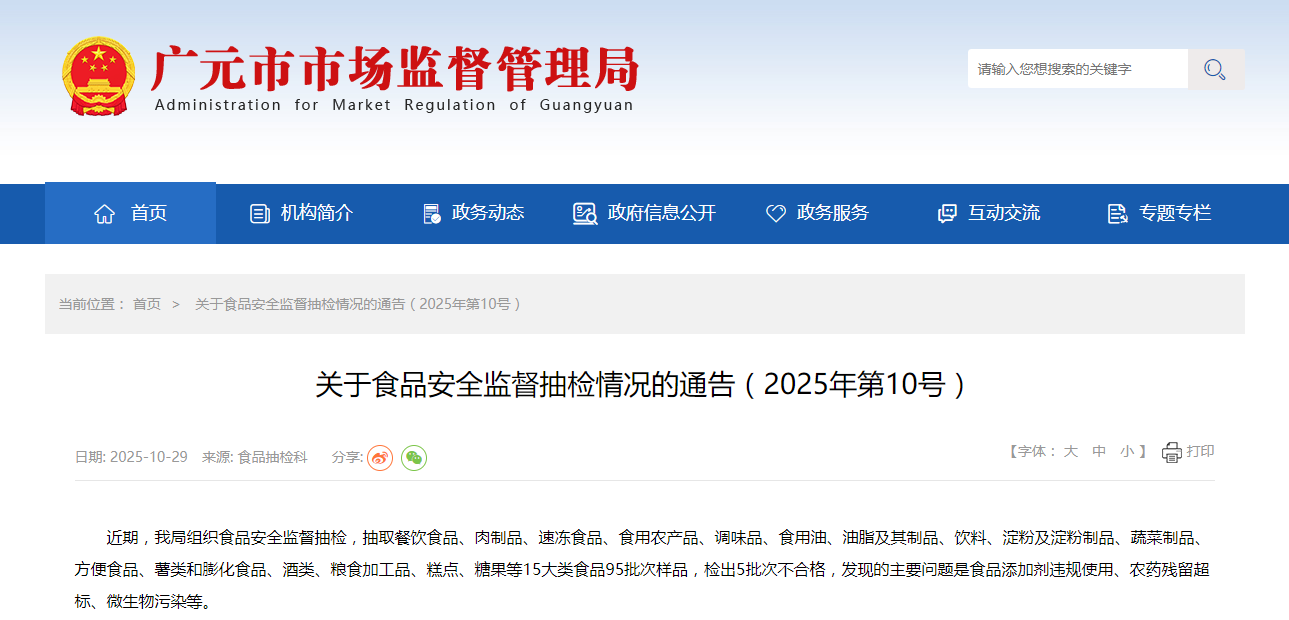
四川省广元市市场监督管理局发布关于食品安全监督抽检情况的通告(2025年第10号)
Zhong Guo Zhi Liang Xin Wen Wang· 2025-11-10 04:41
Summary of Food Safety Supervision Sampling Core Viewpoint The recent food safety supervision sampling conducted by the local authority revealed that out of 95 food samples tested across 15 categories, 5 batches were found to be non-compliant, primarily due to issues related to the illegal use of food additives, pesticide residue exceeding limits, and microbial contamination. The local market supervision departments have been instructed to investigate and address the non-compliant products [2]. Group 1: Non-compliance Details - A total of 95 food samples were collected from various categories including meat products, frozen foods, and beverages [2]. - 5 batches were identified as non-compliant, with major issues including illegal food additives, pesticide residues above permissible levels, and microbial contamination [2]. - The local market supervision departments are tasked with verifying and handling the non-compliant products [2]. Group 2: Consumer Guidance - Consumers are encouraged to report any non-compliant products they encounter in the market by calling the government service hotline at 12345 [2]. - Detailed information regarding the food safety supervision sampling results is available in the attached documents [2].

黑龙江省绥化市市场监管局开展标准化宣传活动
Zhong Guo Zhi Liang Xin Wen Wang· 2025-11-10 04:37
Core Insights - The event organized by the Market Supervision Administration of Suihua City aimed to enhance the standardization level of Heilongjiang Tianyouwei Electronics Co., Ltd, promoting high-quality regional economic development [1][2] - The activities included standardization day promotion, policy interpretation, and hands-on guidance to help employees understand the importance of standards in global sustainable development and international cooperation [1] - The administration provided tailored standardization innovation plans for the company, clarifying goals and directions for their standardization efforts [1] Summary by Sections - **Standardization Promotion**: The event significantly improved employees' understanding of standardization work through various activities, including distributing promotional materials and conducting specialized seminars [2] - **Policy Interpretation**: Detailed explanations of policies related to innovative standard enterprises and "leading" enterprise standards were provided, encouraging the company to actively apply for these initiatives to enhance core competitiveness [1] - **Hands-on Guidance**: The administration offered professional solutions and advice to address challenges faced by the company in the standard formulation process, specifically for the "Coated Cover Plate for Vehicle Display" standard [1]
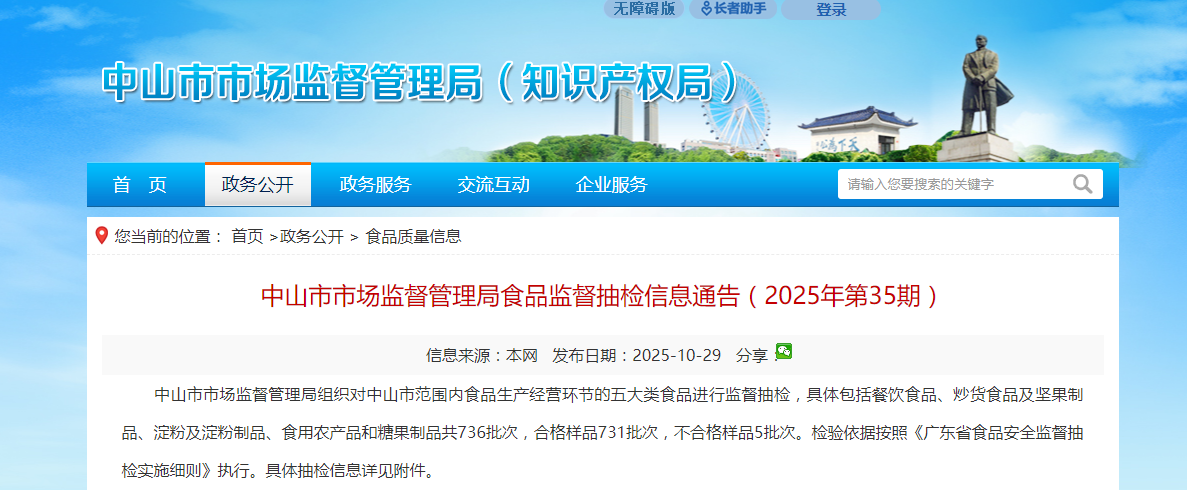
广东省中山市市场监督管理局食品监督抽检信息通告(2025年第35期)
Zhong Guo Zhi Liang Xin Wen Wang· 2025-11-10 04:35
Core Points - The Zhongshan Market Supervision Administration conducted a food safety inspection covering five categories of food, with a total of 736 samples tested, of which 731 were qualified and 5 were unqualified [2]. Group 1: Inspection Results - A total of 736 food samples were collected, including catering food, nut products, starch products, agricultural products, and candy [2]. - Out of the 736 samples, 731 were found to be compliant with safety standards, resulting in a compliance rate of approximately 99.32% [2]. - The inspection was carried out according to the "Implementation Rules for Food Safety Supervision and Sampling Inspection in Guangdong Province" [2]. Group 2: Consumer Engagement - The administration encourages consumers to actively participate in food safety supervision and report any harmful food products or illegal activities by calling the complaint hotline 12345 [2].

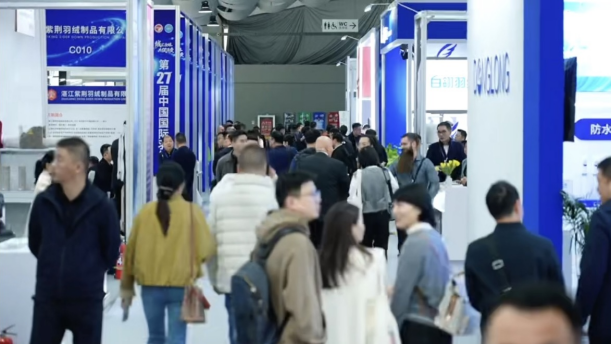
第27届中国国际羽绒博览会圆满闭幕 企业共享丰硕成果
Zhong Guo Zhi Liang Xin Wen Wang· 2025-11-10 03:24
Core Insights - The 27th China International Down Expo successfully concluded, showcasing the vitality of the down industry with a theme of "Gathering Global Down, Promoting Consumption" [1] - The event attracted significant online and offline participation, indicating the expo's broad influence and the industry's robust growth [1] Industry Overview - The expo featured a total exhibition area of 10,000 square meters, gathering various enterprises across the entire down industry chain, including raw materials, clothing, home textiles, equipment, and testing [1][2] - Major domestic brands such as Bosideng, Xuezhongfei, and international companies from Poland and Russia participated, creating a comprehensive platform for global buyers and distributors [2] Quality and Credibility - The China Down Industry Association released the "China Down Industry Quality Improvement White Paper (2025)" during the expo, outlining quality enhancement strategies for the industry [5] - A memorandum of cooperation was signed between the China Down Association and JD Group, allowing certified quality down products to carry the "China Down Association Recommended" label, enhancing consumer trust and brand reputation [5] Sustainability and Product Development - A new standard for quantifying the carbon footprint of down products was launched, guiding companies in their green transformation efforts [7] - Initiatives for developing functional down products, such as waterproof and antibacterial features, were also initiated, promoting higher value-added product development [7] International Collaboration - Representatives from the down industries of the USA, Hungary, Poland, and Russia engaged in discussions, sharing market developments and trends, thus facilitating international cooperation [10] - The "Global Down Traceability System" gained attention, with over 110 companies already connected, enhancing product transparency and buyer confidence [12] Marketing and Sales Innovation - The expo featured a live fashion show by Bosideng, promoting the upcoming 2025 autumn and winter down fashion trends [12] - A new marketing initiative, "Douyin Carnival - China Down Festival," was launched to integrate online and offline sales channels, helping brands achieve sales growth and traffic conversion [16] Future Outlook - The successful hosting of the expo is expected to continue providing value through brand exposure and collaboration opportunities, driving high-quality development in the Chinese down industry [15] - The industry aims to pursue higher quality and sustainable development in collaboration with global partners [15]
澳柯玛推出2026年风冷无霜、立式多系列冷柜新品
Zhong Guo Zhi Liang Xin Wen Wang· 2025-11-10 03:24
Core Insights - The recent launch of new refrigeration products by Aucma at the 2026 Refrigeration Marketing Summit in Qingdao highlights the company's focus on addressing consumer pain points in food preservation and storage [1][7] Product Launch Overview - Aucma introduced five major series of new refrigeration products, including frost-free, variable frequency deep freezing, ultra-low temperature, wide-body large business, and upright freezers [1] - The frost-free variable frequency series, featuring models BC/BD-166WPGXF, BC/BD-206WPGXF, and BC/BD-256WPGXF, targets various household structures, from single apartments to multi-generational families [3][4] Technological Innovations - The frost-free series utilizes advanced technology for even cooling and reduced cleaning burden, while the dual variable frequency design balances energy efficiency and quiet operation [4] - The series supports -40℃ deep freezing technology, which quickly freezes food to minimize cell damage from ice crystal formation [4] Design and Aesthetics - The 2026 upright freezer series, designed for modern kitchens, emphasizes "small size, large capacity, and high aesthetics," with models ranging from 137L to 236L [6] - The WHX and WGX series feature compact designs that occupy only 0.3㎡, allowing for flexible placement in various home settings [6] - The WSPG series incorporates aesthetic elements with a Milan white glass panel, catering to modern luxury and Nordic home styles [6] Consumer-Centric Philosophy - Aucma's product launch reflects its commitment to a user-centered approach, focusing on innovation in refrigeration technology to meet consumer needs [7]


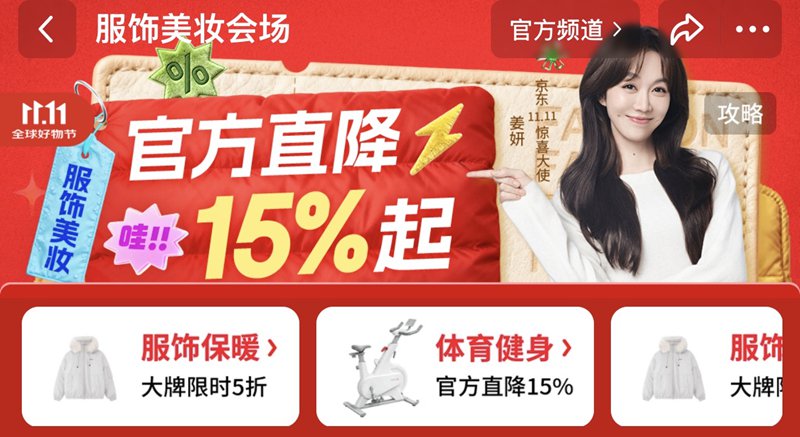
京东11.11海量优惠继续放送 11月9日起服饰美妆官方直降15%起
Zhong Guo Zhi Liang Xin Wen Wang· 2025-11-09 14:20
Core Insights - JD.com is launching a major promotional event for the 11.11 shopping festival, offering significant discounts across various categories including fashion, beauty, and luxury items [1][15] - The event features a "please guest" campaign with participation from numerous brands and celebrities, providing consumers with unique offers and products at very low prices [3] Promotions and Discounts - Discounts start at 15% with additional offers such as beauty coupons and luxury items available at up to 80% off [1] - Specific examples of discounted products include men's and women's winter clothing, with prices like 1799 yuan for a Fila jacket and 499 yuan for a down jacket [3] - Footwear discounts include brands like Belle and Clarks, with prices starting from 499 yuan [5] Product Categories - The event includes a wide range of categories such as children's clothing, lingerie, and skincare products, with notable items like Balabala children's down jackets and SK-II skincare products [7][9] - Fitness and sports equipment are also featured, with items like Yonex badminton rackets priced at 203 yuan and Decathlon bicycles at 1289.9 yuan [11] Accessories and Luxury Items - The promotion highlights luxury accessories including gold jewelry and designer watches, with discounts such as 10% off on certain items [13] - Special offers on high-end products like Montblanc belts and Samsonite bags are also part of the campaign [13] Shopping Experience - Consumers can access the promotions by searching "服饰美妆1111" on the JD.com app, emphasizing the ease of shopping during this peak promotional period [15]

“钛”会造!京东“超级供应链”将千元级材质打入百元市场
Zhong Guo Zhi Liang Xin Wen Wang· 2025-11-09 14:20
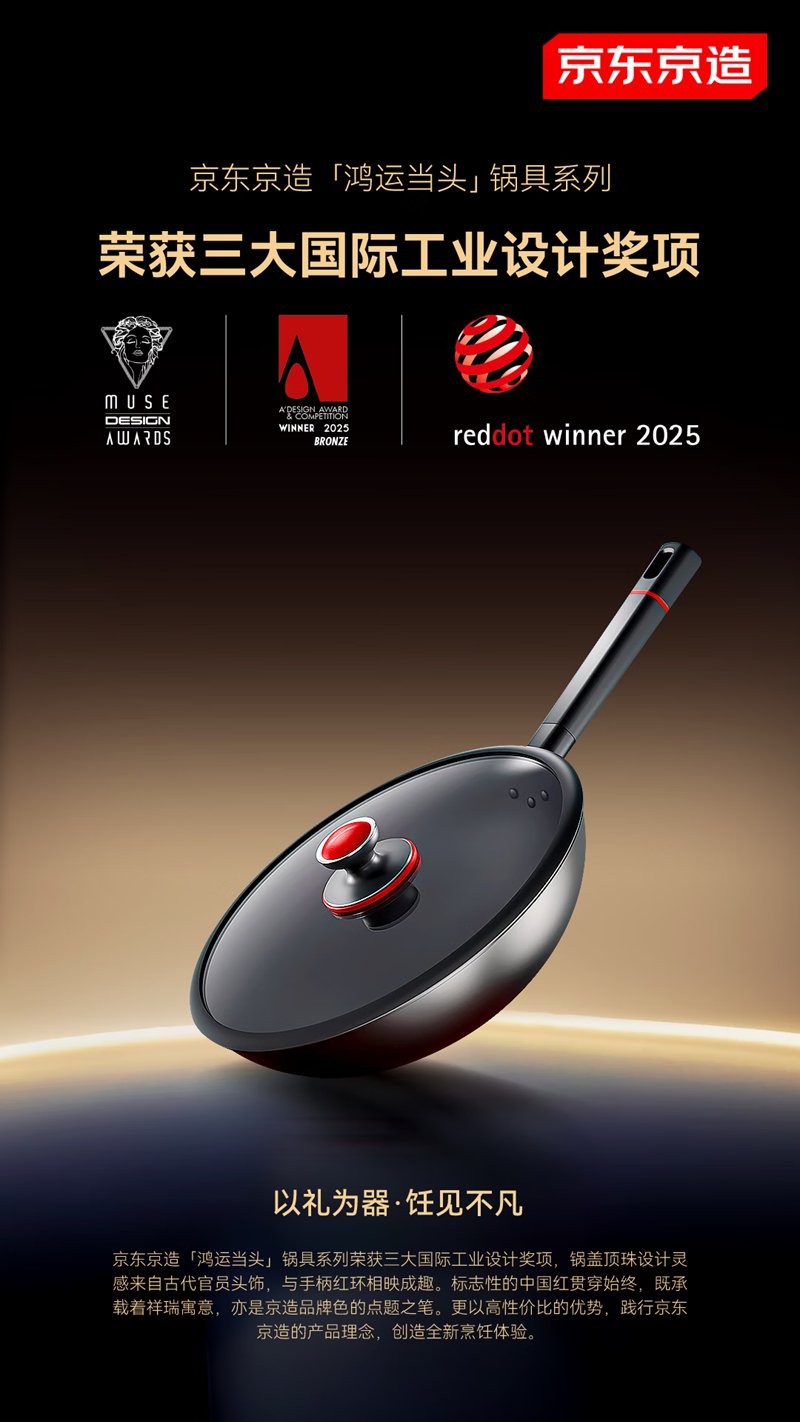
Core Insights - Titanium cookware is gaining popularity due to its health benefits, lightweight, and durability, with a projected compound annual growth rate of 109% from 2023 to 2025 according to JD.com [1] - The shift from niche to mass consumption of titanium cookware is driven by JD.com's "super supply chain" capabilities, facilitating a transformation in China's manufacturing from "mass production" to "flexible intelligent manufacturing" [1] Group 1: Product Innovation - JD.com's "Hongyun Tandou" cookware utilizes plasma titanium melting technology to create a natural physical non-stick layer, eliminating harmful chemical coatings and ensuring a healthy cooking experience [2] - The cookware series has received multiple international design awards, showcasing the integration of traditional Chinese cultural elements with modern industrial design [2] - The titanium health coffee cup emphasizes lightweight design and corrosion resistance, balancing portability, aesthetics, and health [5] Group 2: Supply Chain Transformation - JD.com's "super supply chain" empowers traditional manufacturing by collaborating with over 70% of domestic industrial belts, enhancing product development through data sharing and logistics support [5] - In the Zhejiang Yongkang industrial belt, traditional manufacturing is undergoing significant changes, with advanced technologies reducing defect rates by over 60% compared to manual operations [5] - The flexible supply chain allows for rapid transformation of consumer demands into product development directions, improving efficiency and reducing waste [5] Group 3: Market Dynamics - The transition of titanium cookware from niche to mass market is attributed to improved cost-performance ratios, making previously expensive products more affordable [6] - JD.com's supply chain optimization enhances resource allocation and collaboration efficiency, significantly reducing supply chain risks [6] - JD.com has served over 10 million users, achieving a new product development success rate of over 90%, connecting consumer needs with manufacturing sources [6][7]
海信冰箱城市巡展启动 以创新科技定义“舌尖上的理想家”
Zhong Guo Zhi Liang Xin Wen Wang· 2025-11-09 14:19
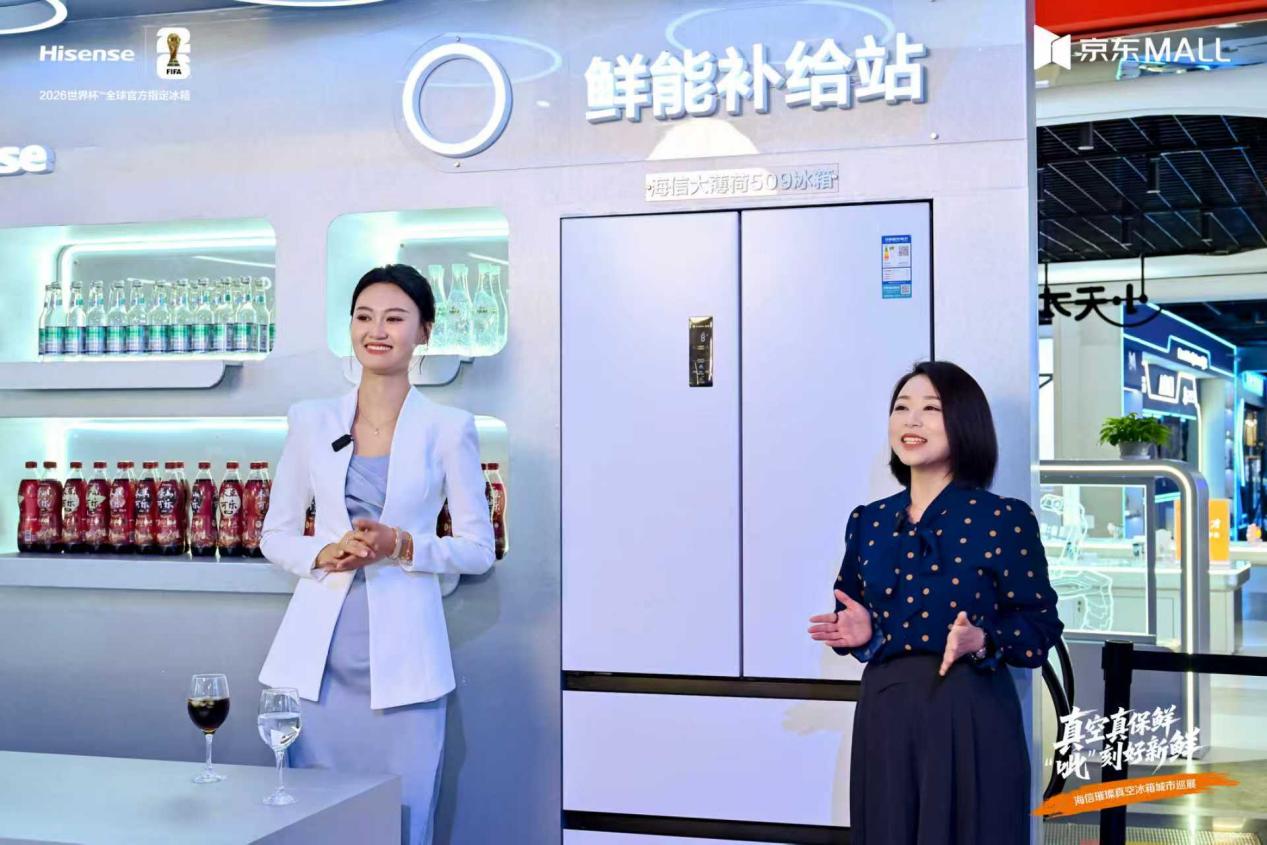
Core Insights - Hisense launched its "Vacuum Fresh Preservation" city tour in Chongqing, showcasing innovative products featuring its vacuum preservation technology and the industry-first "Magnetic Light Curtain Panel" [2][3] - The Hisense Brilliant Vacuum First-Class 650 refrigerator stands out with its aesthetic design and a large capacity of 650 liters, utilizing original vacuum magnetic field preservation technology for molecular-level freshness [2][5] - The Magnetic Light Curtain Panel enhances the refrigerator's interaction and integration with home decor, allowing for the attachment of various items while maintaining a transparent glass appearance [3][5] Product Highlights - The Brilliant Vacuum First-Class 650 refrigerator is noted for its elegant design and significant storage capacity, achieving a high volume-to-width ratio [2] - The Hisense Little Durian 500 refrigerator features a "Vacuum Cube" design to create a sealed space for strong-smelling ingredients, while the Big Mint 509 refrigerator emphasizes large capacity, slim integration, and advanced technology [5] - Hisense's freezer offerings provide professional-grade freezing solutions for families needing substantial storage, complementing the refrigerator lineup for a comprehensive food preservation ecosystem [5] Technological Innovations - The vacuum preservation technology represents Hisense's commitment to achieving ultimate freshness for food at a molecular level [3][5] - The Magnetic Light Curtain Panel addresses the dual needs of aesthetics and functionality, transforming the refrigerator door into a personalized family display area [3]

安全与性能的共舞!解读蒙迪欧的价值回归
Zhong Guo Zhi Liang Xin Wen Wang· 2025-11-09 09:37
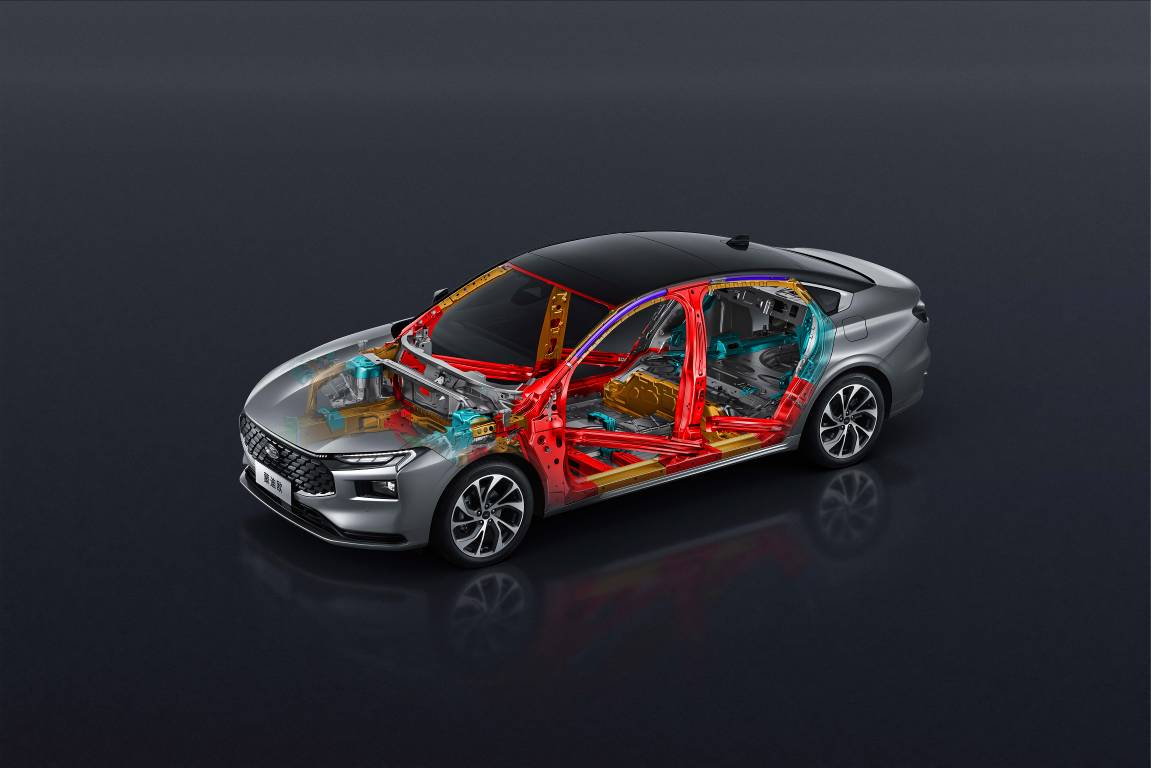
Core Insights - The automotive market is undergoing a revolution towards value return, with consumers prioritizing vehicle performance and reliability over price [1][10] - Changan Ford adheres to the philosophy of "not competing on price but on experience," emphasizing uncompromising quality, safety, and performance [1][10] Group 1: Safety and Structural Integrity - The Mondeo emphasizes safety by utilizing high-strength steel, with 48% of its body made from such materials, including 1700MPa martensitic steel in critical areas [2][4] - The A-pillar features a three-layer composite structure designed to balance energy absorption and protection during collisions, showcasing a deep understanding of safety engineering [4] - The Mondeo has achieved top ratings in the China Insurance Research Institute's collision tests, validating its ability to protect occupants in various scenarios [6] Group 2: Performance and Driving Experience - The Mondeo offers a 2.0T luxury model that accelerates from 0 to 100 km/h in 6 seconds, appealing to driving enthusiasts despite the rise of electric vehicles [7] - The vehicle's compatibility with 92-octane gasoline allows for high performance without incurring excessive fuel costs, aligning with rational consumer choices [9] - The Mondeo's chassis tuning and suspension system provide precise steering feedback and solid cornering support, contributing to its unique driving appeal in a homogenized market [9] Group 3: Market Positioning and Consumer Trends - Changan Ford's commitment to quality, safety, and performance resonates with the evolving demands of consumers who are increasingly discerning about product value [10] - The trend towards rational consumption is expected to grow, with consumers becoming more adept at distinguishing genuine product value from marketing hype [10] - The Mondeo's success reflects a broader positive trend in the automotive industry, indicating a return to fundamental values that align with actual consumer needs [10]
京东外卖11.11首份战报:TOP300品牌订单量较外卖上线首月增长13倍,立冬当日包销爆品开售8小时热卖650万份
Zhong Guo Zhi Liang Xin Wen Wang· 2025-11-07 14:16
Group 1 - JD.com announced its first report on the 11.11 shopping festival, highlighting the participation of over 200,000 quality restaurants and top 100 catering brands in its food delivery service [1] - The campaign "Invite Friends for Takeout, Hot Products at 9.9 Yuan" features a 10 billion Yuan subsidy to support merchant traffic [1] - Since the start of the 11.11 event, the average daily order volume for the top 300 restaurant brands has increased 13 times compared to the first month of the food delivery service launch [1] Group 2 - JD.com introduced an innovative exclusive product sales model, leveraging a differentiated strategy to drive industry growth [1] - On November 7, coinciding with the start of winter, the selected exclusive products sold over 6.5 million units within 8 hours [1]