
Hu Xiu

Search documents
“很多VC/PE已死,只是他们自己还不知道”
Hu Xiu· 2025-10-13 06:25
Core Insights - The "golden era" of private equity is over globally, with a shift towards a more cautious investment environment characterized by a "cash is king" mentality among limited partners (LPs) [1][10][19] Fundraising and Market Dynamics - Fundraising and closures have both declined, leading to increased concentration among top firms while smaller general partners (GPs) are being forced out [2][5] - The global fundraising environment has weakened, with a year-on-year decline of approximately 20%-25% in the first half of 2025 [7][17] - The number of funds closed has sharply decreased, with only 388 funds closing by September 2025, expected to be half of the previous year's total [17][18] Industry Challenges - The private equity industry is experiencing a systemic crisis, with a significant drop in assets under management for the first time since 2005, down 2% to $4.7 trillion as of June 2024 [11][12] - The exit environment is challenging, with only 14 IPO exits totaling $5.2 billion in the first half of 2025, a stark contrast to $37 billion four years prior [7][12] - The industry is witnessing a natural "cleansing" process, with many underperforming funds being quietly eliminated from the market [8][9] Shifts in Investment Strategy - The focus has shifted from "scale above all" to "quality first," emphasizing cash returns over mere asset accumulation [3][22] - LPs are increasingly prioritizing direct exits and cash distributions, leading to a decline in trust towards fund managers who have not delivered returns [7][19] Fund Management and LP Relations - There is a growing sentiment among LPs that many fund managers have become complacent and are more focused on fundraising than on managing investments effectively [20][21] - A significant portion of LPs (88%) plan to refuse additional commitments to existing managers in the next 12 months, reflecting a cautious approach to future investments [21] Market Segmentation - The market is becoming polarized, with private equity facing challenges while venture capital (VC) is experiencing intense competition for high-quality AI-related investments [24]
真实的关税
Hu Xiu· 2025-10-13 06:19
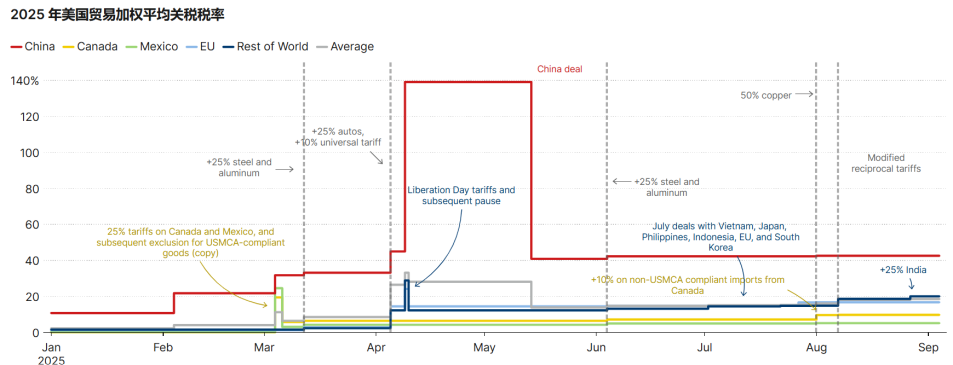
Group 1 - The average import tariff rate in the U.S. for 2024 is approximately 2.5%, but since January, a series of complex tariff regulations have been issued by the White House, including many exemption clauses [1] - The U.S. has the highest average tariff rate of 42.6% on China among its major trading partners [16] - The average tariff rates for Canada and Mexico are 9.8% and 5.2%, respectively, with specific tariffs on certain goods like autos and steel being significantly higher [7][9] Group 2 - Mexico is considering imposing tariffs of up to 50% on over 1,400 products from Asian countries, primarily targeting China [9][10] - The U.S. is tightening scrutiny on the origin of products, which affects how goods assembled in Mexico can be exported to the U.S. without tariffs [12][13] - The trade policies are leading to a trend of increased industrial integration among the U.S., Canada, and Mexico, particularly in the automotive and electronics sectors [15] Group 3 - The average tariff rates for the EU, Japan, South Korea, and the UK are 16.8%, 15.7%, 15.2%, and 13.3%, respectively, indicating a significant disparity compared to tariffs on China [21] - Southeast Asian countries face average tariff levels between 15% and 20%, with Vietnam showing resilience in exports to the U.S. despite tariff pressures [24][26] - The overall weighted average tariff in the U.S. is approximately 18.9%, the highest level since World War II [32] Group 4 - The tariffs imposed by the Trump administration are projected to generate $2.3 trillion in revenue over the next decade but are also expected to reduce U.S. GDP by 0.8% [33] - The housing crisis in the U.S. is exacerbated by tariffs on materials like lumber and steel, which increases construction costs [36][37] - The conflicting nature of trade and housing policies under the Trump administration highlights the complexities of economic management [38]

为什么谷歌搜不到“没有条纹的衬衫”
Hu Xiu· 2025-10-13 06:13
Core Insights - The article discusses the limitations of traditional search engines like Google, which primarily rely on keyword matching without understanding user intent, contrasting this with the capabilities of AI-driven search tools like Websets that aim to comprehend complex queries [2][4][24]. Group 1: Search Engine Limitations - Traditional search engines, such as Google, often fail to grasp the nuances of user queries, leading to irrelevant results [2][4]. - Google provides a plethora of links related to popular content rather than directly answering subjective questions, exemplified by the query about "the most beautiful woman" [13][14]. - The reliance on keyword indexing means that Google excels in factual queries but struggles with complex, multi-faceted tasks [22][24]. Group 2: Websets Capabilities - Websets is designed to handle structured queries and can process complex tasks that traditional search engines cannot, such as finding professionals with specific experiences [4][15]. - It utilizes a deep learning model to create a "semantic fingerprint" of web content, allowing it to match user queries with relevant data more effectively [28][30]. - The tool provides structured outputs, such as candidate lists for specific roles, demonstrating its ability to analyze and filter information based on user-defined criteria [27][30]. Group 3: Data Source Limitations - Websets relies heavily on LinkedIn for sourcing information, which may lead to biases and limitations in its results, particularly for experts not well-represented on that platform [40][41]. - The effectiveness of Websets diminishes in markets like China, where alternative professional networking platforms are more prevalent [41][42]. Group 4: Semantic Search Technology - Websets employs "embedding" technology, which compresses complex information into numerical representations, allowing for nuanced understanding of queries [24][46]. - This method, while effective for grasping overarching themes, may lose specific details during the compression process, highlighting a potential drawback in retrieving precise information [46][48]. Group 5: Market Context and Future Implications - The emergence of AI-driven search tools like Websets indicates a shift in search technology, suggesting a future where search engines may evolve to better understand user intent [50]. - The article emphasizes the importance of recognizing the trade-offs between convenience and the depth of information retrieval in modern search practices [62][63].

孟加拉为啥要买20架歼-10CE?准备干什么?
Hu Xiu· 2025-10-13 06:06
Core Insights - The article highlights that Bangladesh is significantly increasing its military expenditure by committing $2.2 billion to purchase 20 J-10CE fighter jets, despite an annual military budget of only $4 billion, which has raised concerns in India [1] Military Spending - Bangladesh's annual military budget is $4 billion, indicating a substantial allocation of resources towards military enhancement [1] - The decision to spend $2.2 billion on 20 J-10CE fighter jets represents 55% of its total military budget for the year [1] Regional Implications - The purchase of J-10CE jets by Bangladesh is causing alarm in India, suggesting potential shifts in regional military balance and security dynamics [1]
填弹巧发:“稀土威慑”策略的现实和未来
Hu Xiu· 2025-10-13 05:46
Core Viewpoint - China's rare earth export controls are seen as a strategic response to U.S. actions, reflecting a shift towards a more institutionalized deterrence approach, which may complicate future negotiations and economic relations between the two countries [1][4][5]. Group 1: China's Export Control Strategy - The export control is based on a licensing system rather than a ban, serving as a deterrent rather than an immediate retaliatory measure, indicating a cautious approach to escalation [5]. - The timing of the announcement is perceived as a response to U.S. provocations, particularly following Trump's threats of 100% tariffs, suggesting a calculated move to leverage negotiation power [1][2]. - The implementation of these controls may create a long-term structural tension in U.S.-China economic relations, complicating potential compromises [4][6]. Group 2: Market Reactions and Implications - Financial markets reacted to the uncertainty surrounding negotiations, indicating a shift from previous assumptions of stability to a need for re-evaluation of trade factors [2][6]. - The potential for a "derisking" strategy by the U.S. and its allies could diminish the value of China's rare earth resources, as alternative supply chains are being developed [7]. - The market's perception of the effectiveness and credibility of China's deterrent measures will be crucial in determining future trade dynamics [6][7]. Group 3: International Audience and Strategic Considerations - The export controls are not solely aimed at the U.S. but also impact global supply chains, particularly in sectors like semiconductors and automotive industries, raising concerns among other nations [9]. - Managing the international audience's perception is critical; if countries view China's actions as reasonable, cooperation may continue, but if seen as aggressive, it could accelerate supply chain decoupling [9][10]. - The effectiveness of China's strategy will depend on its ability to communicate its intentions clearly and maintain a balance between deterrence and cooperation with other nations [10].

中国AI心脏,为什么选在新疆?
Hu Xiu· 2025-10-13 05:40
Core Viewpoint - The article discusses China's advancements in chip technology and computing power, particularly in Xinjiang, which are seen as a direct challenge to the United States' dominance in the semiconductor industry [1] Group 1 - China is leveraging the computing power of an entire city in Xinjiang to compete with the United States in the semiconductor sector [1] - The article suggests that while the U.S. is focused on restricting China's access to chip technology, China is making significant strides in its own capabilities [1]
从一家超市的开业,看大卖场的终章
Hu Xiu· 2025-10-13 05:33
Core Viewpoint - The retail industry, particularly hypermarkets, is facing significant challenges due to changing consumer behaviors and the rise of e-commerce, leading to a decline in foot traffic and profitability [10][11][13][15]. Group 1: Current State of Hypermarkets - A newly opened hypermarket has seen a bustling opening day with high foot traffic and sales, indicating initial consumer interest [2][4][5]. - Despite the initial success, the long-term sustainability of hypermarkets is questioned, as high sales figures during opening do not guarantee ongoing success [6][10]. - The hypermarket model, once dominant, is now struggling with rising costs and declining customer visits, leading to a wave of closures [13][15]. Group 2: Consumer Behavior Changes - Consumers are increasingly opting for convenience and specialized shopping experiences, favoring online platforms and local stores over traditional hypermarkets [11][14][27]. - The fragmentation of consumer time and preferences has made it difficult for hypermarkets to attract shoppers who prefer quick and easy purchasing options [14][15]. - The shift towards specialized retail formats reflects a broader trend of consumer demand for tailored shopping experiences [27][31]. Group 3: Future of Retail - The future of retail is expected to involve the disassembly of hypermarkets into specialized stores that cater to specific product categories [25][30]. - Retailers must adapt to this trend by developing competitive, focused stores that meet the evolving needs of consumers [29][31][32]. - The transformation of the retail landscape is a gradual process driven by long-term market developments, requiring retailers to embrace change and innovate [30][31].
美国人为什么那么喜欢用人名命名建筑?
Hu Xiu· 2025-10-13 04:35
Group 1 - The article discusses the significance of naming conventions in the United States, particularly the trend of naming places and projects after individuals, reflecting a cultural preference for personalism [2][15][24] - The recent peace agreement between Azerbaijan and Armenia, named the "Trump International Road to Peace and Prosperity" (TRIPP), exemplifies this trend, as it associates a political achievement directly with a personal name [1][25] - Historically, the practice of naming places after individuals in the U.S. can be traced back to colonial times, where land was often named in honor of sponsors or influential figures [3][4][5] Group 2 - The article highlights that the naming of the TRIPP is unusual for a political treaty, as most treaties do not carry the names of individuals, making this case a notable exception [24][25] - The naming reflects a shift in political culture, where personal branding and political achievements are intertwined, particularly under the Trump administration [25][26] - The article also notes that while personal names are commonly used for public facilities and military bases posthumously, Trump's approach marks a departure by linking his name to diplomatic efforts while still in office [25][24]
人均年消费量超20公斤,谁说老外不吃内脏?
Hu Xiu· 2025-10-13 04:03
网上有不少传言,说只有中国人才有吃内脏的习惯,外国人压根不吃内脏,其他国家的内脏都低价卖给 了中国,那问题来了,老外真的不吃内脏吗?背后的真相是什么?为什么中国可以把内脏做出这么多花 样? ...