
Hu Xiu

Search documents
为了一个摄像头,苹果买下一家公司
Hu Xiu· 2025-10-11 11:21
Core Viewpoint - Apple is actively engaging in the AI talent acquisition race, recently targeting the startup Prompt AI, which had previously been in discussions with Elon Musk's companies [2][11]. Group 1: Acquisition Details - Apple is in advanced negotiations to acquire engineers and technology from Prompt AI, a visual AI startup that has also interacted with Musk's xAI and Neuralink [2]. - Prompt AI's leadership informed employees that those not joining Apple would face salary reductions, encouraging them to apply for positions at Apple [2]. - The startup was founded in 2023 in San Francisco and secured $5 million in seed funding, with notable founders including Tete Xiao and Trevor Darrell [4]. Group 2: Technology and Product - Prompt AI's flagship product, Seemour, is an ambient AI system designed for smart security cameras, capable of recognizing family members, pets, and other objects, generating alerts based on their behavior [6][7]. - Seemour can process millions of pixels in under a second, enhancing its ability to identify individuals and animals accurately [7]. - The technology is expected to integrate into Apple's smart home strategy, particularly in developing a smart security camera that aligns with Apple's HomeKit ecosystem [7][8]. Group 3: Strategic Focus - Apple prefers acquiring smaller AI startups to avoid lengthy integration processes associated with larger companies, as seen in past acquisitions like Beats and Intel's modem team [13][14]. - The company aims to enhance its AI capabilities by selectively acquiring mature technologies that fit its product needs, similar to its acquisition of PrimeSense for Face ID technology [14]. - Apple is reportedly considering acquiring Perplexity, a mid-sized AI company, to bolster its AI initiatives, which could lead to significant expansions in its AI and smart home offerings [15][16][18].

2亿人挨饿,印度却成全球米缸?印度怎么做到又穷又饿的?
Hu Xiu· 2025-10-11 11:02
印度是全球米缸?2亿印度人还在挨饿,三哥却成了全球最大的大米出口国,当懂王遇上莫迪,一场由 粮食引发的"国际对狙"已然开始。 ...
AI让我花了1000多块,去了一个根本不存在的景点
Hu Xiu· 2025-10-11 10:56
Core Viewpoint - The article highlights the risks associated with using AI for travel planning, showcasing instances where travelers were misled by AI-generated suggestions, leading to potentially dangerous situations and disappointing experiences [1][2][3][10]. Group 1: AI in Travel Planning - A significant number of travelers, 24%, have used AI for travel planning, with the most common uses being itinerary planning (75%) and destination research (71%) [6]. - User satisfaction with AI travel tools is high, with 79% of users finding them "very" or "somewhat" useful, although there are differences in satisfaction levels between genders [9]. Group 2: Misleading Information and Experiences - Instances of "AI hallucinations" have emerged, where travelers were directed to non-existent locations or provided with incorrect operational information, leading to dangerous situations [2][3][4]. - The phenomenon of misleading travel information is not new, as social media has also contributed to unrealistic expectations through heavily edited photos and marketing tactics [12][26]. Group 3: The Impact of Social Media and Marketing - Social media often presents an idealized version of travel destinations, which can lead to disappointment when the reality does not match the expectations set by curated images [14][28]. - Many tourist spots are marketed with exaggerated claims, leading to a disconnect between the advertised experience and the actual visit [23][26]. Group 4: The Nature of Travel - The article emphasizes that real travel experiences are often imperfect and filled with uncertainties, which can be overshadowed by the pursuit of a "perfect" destination [32][33]. - It suggests that travelers should focus on authentic experiences rather than relying on AI or social media portrayals, which may not reflect reality [31][33].


“价格屠夫”比亚迪,降价也卖不动了?
Hu Xiu· 2025-10-11 10:43
Core Viewpoint - BYD's aggressive price cuts are losing effectiveness as competition intensifies, leading to a decline in sales and potential brand value erosion [3][14][25] Price Strategy - BYD has reduced the price of its Qin model by 10,000 yuan, bringing the starting price to 69,800 yuan, marking the first time a hybrid A-class car is priced below 70,000 yuan [2][5] - The price cuts have not yielded the expected results, with BYD's total sales in September dropping by 5.5% year-on-year to 396,300 units [3][14] - The price war has led to a vicious cycle, compressing profit margins and creating consumer hesitation regarding future price drops [4][25] Market Trends - The market is witnessing a shift towards pure electric vehicles, with sales of pure electric cars reaching 607,000 units in July, a 24.5% year-on-year increase, while plug-in hybrid sales fell by 0.2% [8] - BYD's reliance on plug-in hybrid models is evident, with plug-in hybrid sales in August 2024 being approximately 1.5 times that of pure electric models [9] Competitive Landscape - Competitors like Geely and Changan are also engaging in price wars, with Geely's sales in September reaching 273,000 units, a 35% increase year-on-year [11][19] - Geely's strategy of offering higher specifications at lower prices is undermining BYD's price-cutting efforts, leading to increased competition [20][21] Brand Perception - Frequent price cuts are damaging BYD's brand image, particularly for high-end models like the Han, which saw a 49.38% year-on-year decline in sales in August [22][25] - The cycle of price cuts leading to brand devaluation and declining sales of premium models is becoming evident [25] Technological Focus - As price competition intensifies, the industry is shifting focus towards smart driving technologies, an area where BYD has been relatively conservative [26][27] - Competitors like Huawei are launching advanced driving systems, posing a direct challenge to BYD's market position [29][31] - BYD's strategy of offering basic smart driving features at lower price points may not be sufficient to compete with higher-end offerings from rivals [31]

Sora的“阳谋”:用分钱模式,破解AI版权的死结
Hu Xiu· 2025-10-11 09:58
Core Insights - OpenAI launched its most powerful video generation model, Sora 2.0, which achieved over one million downloads within five days, surpassing the initial speed of ChatGPT [1] - The rapid adoption of Sora 2.0 has reignited long-standing concerns regarding AI copyright issues, particularly as users began generating fan videos using well-known intellectual properties (IPs) [2][3] - In response to the backlash, major Hollywood agencies and companies like Disney are pressuring OpenAI to take responsibility for copyright infringement, leading to a strategic shift in Sora's operational policies [3][4] Legal Context - The controversy surrounding Sora 2.0 stems from the "opt-out" mechanism that allowed the generation of copyrighted content unless explicitly requested to be removed by the copyright holders, which has been criticized for potentially leading to systemic infringement [4][8] - OpenAI's new "opt-in" policy, announced by CEO Sam Altman, aims to establish a revenue-sharing model with copyright holders, marking a significant shift in the relationship between AI companies and IP owners [4][21] - The legal challenges faced by AI companies include the legitimacy of using copyrighted works for training AI models and the risk of generating content that closely resembles existing copyrighted works [9][10][13] Business Model Implications - The new revenue-sharing model proposed by OpenAI seeks to redefine user-generated content as interactive fan creations, providing copyright holders with more control over their IPs and potential revenue streams [18][19] - This model is compared to YouTube's copyright revenue-sharing system, which could incentivize more creative content while offering copyright holders new monetization opportunities [19][22] - However, the implementation of this model faces challenges, including the complexity of tracking and attributing copyright elements in generated content, as well as the need for a clear and fair pricing structure for IP licensing [20][23] Industry Outlook - The shift from litigation to collaboration between AI companies and copyright holders reflects a broader trend in the industry, where the focus is on finding mutually beneficial solutions to copyright disputes [5][21] - The ongoing debate over AI-generated content and copyright distribution highlights the need for updated legal frameworks and standards to address the unique challenges posed by generative AI technologies [22][23] - OpenAI's approach signals a potential transition for the AI industry from unregulated growth to a more structured licensing phase, emphasizing the importance of innovative institutional designs to navigate the complexities of copyright in the AI era [23]

消费类App成功三要素:帮人赚钱、找对象、图一乐
Hu Xiu· 2025-10-11 09:40
Core Insights - A 22-year-old Nigerian entrepreneur, Kelechi Onyeama, transitioned from homelessness to earning $1.5 million annually in under two years through an AI app called Social Wizard, which assists men in flirting and messaging women [3][4][6] - Kelechi developed a theory on the three essential elements for the success of consumer apps: helping people make money, find love, or have fun, which is being validated by numerous entrepreneurs [2][9] Group 1: Success Story of Kelechi Onyeama - Kelechi's journey from being homeless to generating significant income highlights the potential of innovative applications in addressing social anxieties [3][4] - Social Wizard, the AI app, generates personalized messaging suggestions for users, capitalizing on the market of social anxiety among men [4][6] - The app's pricing strategy increased from $6.99 to $9.99 per week without losing users, indicating a strong customer retention and value perception [6] Group 2: Market Insights and Trends - The emergence of AI applications that address unconventional needs, such as cheating in interviews or fortune-telling, reflects a shift in consumer demand for solutions to unspoken problems [9][11][12] - The AI fortune-telling app Moonly reportedly has 8.5 million users and generated $12 million in revenue, showcasing the lucrative potential of this niche market [12] - In South Korea, AI fortune-telling applications generated approximately 4.7 billion KRW (around $3.4 million) in the first half of 2024, indicating a growing trend in digital mysticism [13] Group 3: Changing Business Dynamics - Traditional business barriers are diminishing in the AI era, with speed and agility becoming the new competitive advantages [17][21] - The report from a16z emphasizes that in the fast-evolving AI landscape, the ability to quickly launch products and capture user attention is crucial for success [22] - Successful AI startups are characterized by their innovative marketing strategies, such as transparency in growth metrics and engaging social media campaigns [24] Group 4: Consumer Needs and Market Opportunities - Kelechi's theory suggests that successful applications must provide unprecedented experiences in the realms of making money, finding love, or entertainment [25] - The willingness of users to pay for solutions to their unspoken needs indicates a strong market opportunity for addressing these pain points [25] - Entrepreneurs who dare to tackle taboo subjects, such as social difficulties or cheating, can find substantial market space left by traditional companies [25]

神秘交易员,成功押中诺贝尔和平奖归属
Hu Xiu· 2025-10-11 09:27
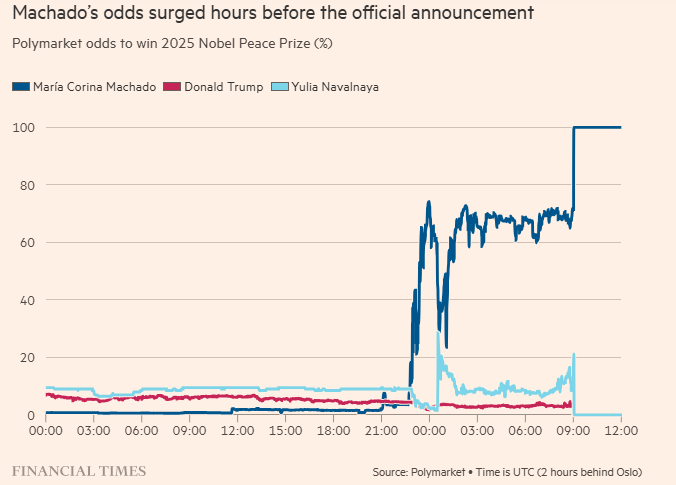
本文来自微信公众号:智通财经 (ID:cailianpress),作者:潇湘,题图来自:视觉中国(马查多) 就在委内瑞拉反对派领袖马查多(Maria Corina Machado)被宣布成为今年诺贝尔和平奖得主的数小时 前,网络预测平台上押注她即将胜出的投注陡然激增。目前,挪威诺贝尔研究所正在调查可能的泄密事 件…… 事实上,在挪威奥斯陆时间周五上午11点宣布获奖结果之前,无论是专家还是媒体,都没有将马查多视 为夺得本届诺贝尔和平奖的热门人选。截至奥斯陆时间周五凌晨0点,马查多在全球最大的预测市场之 一Polymarket上的支持率还仅为约3.7%,而前一天则一度只有不到1%。 然而,她胜出的几率在此后几分钟内就迅速跃升至31.5%,随后又升至73.5%。 据悉,Polymarket平台上一个名为"6741"的新账户,率先在午夜掀起了大量押注马查多胜出的"冷门选 项"。这位身份不明的交易者在这笔押注中赚取了逾5万美元利润。由于其是在成交量稀薄的时段进行买 入操作,使马查多胜出的概率在此后迅速飙升。 其他交易者乘势跟进了"6741"引发的行情,尤其当押注行为在社交媒体引发关注后。Polymarket数据显 示, ...
电视大屏用户的存在感,被低估了?
Hu Xiu· 2025-10-11 09:20
Core Insights - The perception that television is becoming obsolete is challenged by data showing that large screen viewing is nearly equal to mobile viewing, with significant increases in viewing time on platforms like iQIYI and Youku during the recent holiday season [1][2][3] - The Chinese smart screen market is expanding, with nearly 1 billion people covered and a steady annual growth rate, indicating that viewers are not abandoning television but are reallocating their viewing habits between mobile and large screens [1][5][9] Group 1: User Behavior and Demographics - The total number of television viewers in China remains the highest among all viewing populations, with 1.197 billion television viewers compared to 1.108 billion internet users in 2024 [4][5] - Smart TV users are expected to exceed 1 billion by the end of 2025, with OTT users reaching 940 million, reflecting a 25% growth over the past five years [5][8] - The user demographics for large screen viewing include diverse groups such as couples, single young adults, families with children, and older adults, all of whom share a common preference for high-quality long content [12][19][20] Group 2: Content Consumption Trends - Long-form content, particularly dramas, remains the most consumed category on large screens, accounting for 56% of viewing in 2023, with projections for slight increases in subsequent years [23][24] - The viewing habits of different demographics indicate a strong preference for long content, with single young adults watching 1.5 times more on-demand content than live broadcasts [17][19] - The rise of short video content has not diminished the demand for long-form content on large screens, as viewers still prefer the immersive experience that large screens provide [27][29] Group 3: Market Dynamics and Future Outlook - The market for large screens is expected to grow, with stable sales figures and a projected increase in smart TV sales due to government subsidies [8][9] - The integration of short-form content into large screen programming is being explored, with platforms adapting to include micro-dramas and live broadcasts to attract viewers [36][37] - The relationship between long-form content and large screens is symbiotic, as the latter enhances the viewing experience for long dramas, which in turn drives the demand for high-quality content [45][46]

懂王要印250美元钞票,还印自己头像,他意欲何为?
Hu Xiu· 2025-10-11 09:01
懂王又整新活了,想把自己头像印在250美元纸币上,这数字也是真会挑,还把这事儿包装成"突破货币 体系"的大动作。这哪儿是印钱?分明是把国家脸面当自家广告牌,面子挂着经济噱头,里子裹着历史 野心,活脱脱一场多维度的政治表演。 ...