未可知人工智能研究院

Search documents
速递 | DeepSeek突然扔出MODEL1,这到底是V4还是R2?
未可知人工智能研究院· 2026-01-21 04:20
Core Insights - The emergence of DeepSeek's "MODEL1" signals a potential paradigm shift in AI technology, indicating a fundamental architectural overhaul rather than a mere iteration of previous models [2][6][10] - The naming of "MODEL1" suggests a new beginning, akin to Apple's transition from iPhone to iPhone X, which marked a significant redesign and innovation in product strategy [10][11] - The timing of this release coincides with other major AI developments, hinting at DeepSeek's strategy to capture attention and possibly disrupt the market [12] Marketing Strategy - DeepSeek's approach of a "technical leak" serves as a marketing tactic to gauge market reaction and build anticipation without formal announcements [4][5] - The buzz generated around MODEL1 has created a low-cost yet highly effective promotional campaign, surpassing traditional advertising methods [5] Industry Trends - The AI industry is currently focused on first-principles innovation, with major players like OpenAI and Google pushing the boundaries of existing architectures [11] - If MODEL1 represents a true architectural innovation, it could redefine competitive dynamics in the AI space, moving beyond existing frameworks [12] Predictions and Opportunities - MODEL1 is anticipated to be a hybrid model that addresses the limitations of current AI systems, potentially creating new market opportunities rather than competing in existing ones [14][15] - The introduction of MODEL1 could lead to significant advancements in complex decision-making applications, multi-modal integration, and the development of new tools and business models [19][20] Recommendations for Stakeholders - Stakeholders are advised to monitor DeepSeek's official updates and engage with the open-source community to leverage potential opportunities arising from MODEL1 [26][27] - Developers should begin familiarizing themselves with the new architecture to prepare for upcoming changes in the AI landscape [27] - Those interested in AI monetization should consider entering niche markets now, as the official release of MODEL1 may present a competitive advantage [28]

速递 | 2.4万亿估值!Anthropic凭什么成AI圈第二?
未可知人工智能研究院· 2026-01-20 03:02
Core Insights - The article discusses the rapid valuation increase of Anthropic, which recently secured $25 billion in funding, raising its valuation to $350 billion, approximately 2.4 trillion RMB, compared to just over $170 billion four months ago [1][2] - Anthropic's revenue for 2024 is projected to be around $380 million, with expectations to reach $4-5 billion this year and a target of $70 billion by 2028, indicating a growth of approximately 15 times in three years [11][12] Company Overview - Anthropic was founded by Dario Amodei, who previously worked at OpenAI and left due to ideological differences, believing OpenAI was too aggressive and not focused enough on safety [4][6] - The company emphasizes "AI safety first" and has developed a model called "Constitutional AI," which sets ethical guidelines for AI to self-regulate [4][6] Product Capabilities - Anthropic's model, Claude, has shown significant capabilities, particularly in autonomous programming, allowing it to write, test, and debug code independently for extended periods [6][7] - Claude has captured 42% of the programming market share, significantly outperforming OpenAI's ChatGPT, which holds 21% [6][7] Revenue Generation - Anthropic's revenue streams include API calls, expected to generate nearly $4 billion this year with a growth rate exceeding 600%, and subscription services, with customized services for large enterprises being particularly lucrative [12][12] - The company has high-quality clients in regulated industries such as healthcare, finance, and law, which enhances customer retention due to high switching costs [12] Investment Dynamics - The recent funding round has raised questions about whether it represents a "systemic internal circulation" game, as major investors like Microsoft and Nvidia are also customers of Anthropic, creating a cycle of investment and procurement [14][15] - This investment strategy resembles a "high turnover" model in real estate, where funds are cycled back into the investors' services, raising concerns about the sustainability of this model [17] Market Insights - The article highlights the ongoing competition between AI companies, with Anthropic focusing on enterprise markets and safety compliance, while OpenAI prioritizes rapid iteration and consumer engagement [19][20] - The B2B market is identified as a significant revenue opportunity, with enterprise clients potentially generating revenue equivalent to thousands of individual users [19] Conclusion - Anthropic's success is attributed to its differentiated approach in the enterprise market, focusing on safety and compliance, as well as its advanced programming capabilities [20][21] - The article emphasizes the importance of adapting to AI tools for personal and professional growth, suggesting that those who can effectively utilize AI will have a competitive advantage [21]

观察 | AI制药风口真假?撕开四小龙伪装,看懂赚钱逻辑
未可知人工智能研究院· 2026-01-19 10:08
Core Viewpoint - The essence of innovation is solving old problems in new ways, and opportunities often lie in the divergence between tradition and change. The AI pharmaceutical sector is emerging as a potential new frontier, with some companies already generating real orders while others rely on financing through presentations [1][3]. Group 1: Industry Overview - The domestic landscape features four key players in AI pharmaceuticals: JingTai Technology, YS Intelligent, JiTai Technology, and DeepMind [6][8]. - Each of these companies has a distinct approach, making it crucial not to conflate them [7]. - JingTai Technology operates as an "AI + computing power seller," focusing on sectors like energy materials rather than pharmaceuticals, indicating that the commercialization of AI in drug development may not be as straightforward as anticipated [10]. - YS Intelligent is aggressively developing its own drug pipeline, with six drugs currently in clinical stages, but faces a long road to market [11][12]. - JiTai Technology specializes in antibody drug design, which is currently a hot area, allowing it to secure orders more easily [14][15]. - DeepMind takes a more academic approach, focusing on protein structure prediction and molecular generation, holding core algorithms that could significantly impact the field [16][17]. Group 2: Industry Discrepancies - There is a notable divide between the tech and pharmaceutical sectors, with many in traditional medicine skeptical of AI's role in drug development, viewing it as merely enhancing compound screening efficiency without addressing core clinical and regulatory challenges [20]. - This skepticism from traditional pharmaceutical professionals may present an opportunity for investors, as it allows new players time to validate their models [21]. - Major pharmaceutical companies like Pfizer and Roche are quietly forming partnerships with AI firms, indicating a strategic interest in reducing R&D costs and timelines [22]. Group 3: Investment Logic - Key investment criteria include the presence of a drug pipeline entering clinical trials, securing real orders from major pharmaceutical companies, and monitoring cash burn rates [26][28][32]. - Future trends in the sector may include platformization, vertical specialization, and a wave of mergers and acquisitions as companies seek to consolidate resources [30]. Group 4: Core Challenges - The speed of cash burn is a critical factor for survival in the AI pharmaceutical space, with many companies facing financial strain during early clinical phases [32][34]. - The market is increasingly unwilling to invest in mere concepts; companies must demonstrate commercial viability [35]. - The sector requires a long-term perspective, as short-term fluctuations are expected, but long-term certainty is increasing [36].

速递 | ChatGPT加广告啦:AI收割时代的开始
未可知人工智能研究院· 2026-01-18 04:02
Core Viewpoint - The introduction of ads in ChatGPT signifies OpenAI's response to commercial pressures and marks a shift in the AI industry from idealism to realism, similar to the evolution of the internet where advertising became prevalent [19]. Advertising Format - OpenAI is testing a form of conversational native advertising, where brands may be mentioned in responses with a "sponsored" label, making it less intrusive than traditional ads [4][5]. Financial Pressures - OpenAI reported a loss of over $5 billion last year, with expectations of increased losses this year. The $13 billion investment from Microsoft comes with a performance agreement, necessitating OpenAI to demonstrate its commercial viability [8]. Market Competition - The competitive landscape is intensifying, particularly with Google's Gemini integrating AI into its search capabilities. OpenAI's need to monetize through ads is driven by the risk of losing market share if it does not adapt [8]. User Base and Monetization Strategy - OpenAI is shifting its monetization strategy from a subscription-only model to a dual approach of subscriptions and ads, aiming to capture a larger user base willing to engage with ads for free [9]. Domestic AI Trends - Domestic AI companies in China, backed by major firms with existing advertising businesses, are expected to adopt advertising strategies similar to OpenAI, potentially in more elaborate ways [11][12]. Impact on AI Objectivity - The introduction of ads may alter the standard of "optimal" answers provided by AI, as paid placements could influence the recommendations given to users, leading to a more personalized but potentially biased experience [14]. Information Echo Chambers - The integration of ads could reinforce existing information silos, as AI systems may increasingly cater to user preferences shaped by advertising interests, limiting exposure to diverse viewpoints [16]. Practical Tips for Users - Users are advised to recognize ad content in AI responses, consider paying for ad-free versions for more objective information, and verify information across multiple AI platforms to avoid bias [18]. Future Considerations - The balance between company sustainability and user experience is crucial. A healthy model would involve clear ad labeling in free versions and a clean, reasonably priced paid version, ensuring user trust and retention [19].

速递 | OpenAI官方报告泄露:DeepSeek一周年,他们慌了
未可知人工智能研究院· 2026-01-17 01:56
Group 1 - The core viewpoint of the article is that the competition in AI technology is fundamentally a battle of efficiency and deployment capabilities, with OpenAI's recent report indicating a shift in the landscape between the US and China in AI development [1][2][3]. - OpenAI's report, intended for policymakers and investors, reveals a candid acknowledgment of China's advancements in AI deployment and cost-effectiveness, contrasting with the US's lead in model capabilities [6][7]. - The report highlights significant data points, such as the usage of Chinese open-source models on the OpenRouter platform increasing from about 1% to nearly 30% within a year, indicating a strong preference among developers for Chinese AI solutions [7][8]. Group 2 - The report emphasizes that Chinese AI companies are integrating large models into government workflows, suggesting that the Chinese government views AI companies as essential infrastructure [8][9]. - OpenAI expresses concern about China's limitations in computing power, indicating that while China has made strides, it still faces challenges in training larger models due to insufficient computational resources [12][13]. - The report outlines China's strengths in AI, including deployment capabilities supported by a complete industrial chain, cost control with training costs for DeepSeek-R1 being under $6 million compared to over $100 million for GPT-4, and an aggressive open-source ecosystem [17][18][19]. Group 3 - The report identifies weaknesses in China's AI landscape, such as the ceiling on computing power, the depth of application, and the lag in scientific research capabilities compared to the US [19][20]. - OpenAI poses three critical questions that will determine the future of AI competition between the US and China: whether US models can maintain practical utility, if China can produce sufficient computing power, and if China can effectively scale AI deployment across industries [21][22][24]. - The article concludes that the AI competition has reached a critical juncture, with both countries now operating on the same playing field, and the outcome will depend on various factors including deployment efficiency and algorithmic innovation [26].
观察 | 美团藏不住了!AI杀招曝光,碾压Claude?
未可知人工智能研究院· 2026-01-16 13:34
Core Viewpoint - Meituan's recent update of its LongCat model has positioned the company as a significant player in the AI sector, showcasing its capabilities beyond just food delivery services [2][24]. Group 1: LongCat Model Strengths - The LongCat-Flash-Thinking-2601 model utilizes a "Heavy Thinking Mode," allowing it to process multiple solutions simultaneously, outperforming Claude in tool utilization for complex tasks [6][19]. - The model achieved impressive scores: 82.8 in programming, full marks in mathematical reasoning, and 88.2 in tool utilization, indicating its top-tier performance in the open-source model landscape [6][19]. Group 2: Technological Foundation - Meituan has integrated AI deeply into its operations, with 52% of new code generated by AI and over 90% of engineers using AI coding tools [10]. - The company has developed over 3,000 production-level applications on its NoCode platform, demonstrating its commitment to leveraging AI across various business functions [10][11]. Group 3: Investment Strategy - Meituan has invested over $100 million in AI companies, including a significant stake in Zhipu AI, which recently went public with a market valuation of over 50 billion HKD [15][16]. - The company is actively investing in robotics, with a focus on reducing delivery costs through autonomous vehicles and drones, indicating a strategic approach to future logistics [16][17]. Group 4: Strategic Collaborations - Meituan has formed strategic partnerships to develop delivery robots and drones, achieving over 500,000 orders in fully autonomous delivery in Shenzhen, validating its business model [17][18]. Group 5: Competitive Advantages - The LongCat model is open-source, providing a cost-effective alternative to proprietary models, which is particularly beneficial for small and medium enterprises [20]. - Meituan focuses on B2B applications, emphasizing practical tools that enhance operational efficiency rather than consumer-facing chatbots [20]. Group 6: Future Outlook - The competition in AI models has shifted towards practical application and engineering capabilities, where Meituan's real-world experience gives it a competitive edge [21]. - The investment in embodied intelligence positions Meituan favorably for future growth in robotics, a sector expected to expand significantly in the coming years [21].


速递 | 携程垄断被查,不是结束是开始:AI智能体正在颠覆所有平台
未可知人工智能研究院· 2026-01-15 12:01
Group 1 - Ctrip's recent issues stem from accumulated technical debt and monopolistic practices, indicating a critical point in its operational stability [2][3] - The timing of the antitrust investigation against Ctrip suggests that platform companies often face scrutiny when they begin to decline, as they resort to practices like increased commissions and bundled sales [3][5] - Ctrip's perceived threat from AI technology has led to its aggressive revenue strategies, which have now backfired [3][5] Group 2 - Alibaba's Tongyi conference marked a significant shift as AI begins to take over decision-making processes, allowing consumers to rely on AI assistants for tasks like hotel bookings [5][6] - The competition will evolve into a battle between consumer AI agents and platform AI sales, fundamentally changing the landscape of commercial interactions [6][7] - Predictions indicate that a significant portion of advertising budgets will shift towards AI-driven strategies, reflecting a broader trend in the industry [7] Group 3 - The concept of GEO (Generative Engine Optimization) is introduced as a new method for brands to optimize their visibility for AI recommendations, contrasting with traditional SEO practices [9][10] - Companies that adapt to creating AI-friendly content will see improved recommendations from AI systems, highlighting the importance of quality and structured information [10] - The current market still presents opportunities for brands to leverage AI for traffic generation, similar to past trends with short videos and live streaming [10] Group 4 - The impact of AI on ordinary consumers is significant, as AI can help individuals save money by comparing prices and monitoring historical data, reducing reliance on platforms like Ctrip [14][15] - As AI takes over consumer decision-making, platforms that profit from monopolistic practices will face challenges, leading to a market shift towards more competitive and service-oriented businesses [15] - Consumers are encouraged to adopt AI tools for decision-making to escape the grasp of traditional platforms [15] Group 5 - The investigation into Ctrip may signal the beginning of a broader trend where platforms relying on monopolistic practices will be challenged by AI advancements over the next three to five years [16][17] - This situation represents a pivotal transition from a platform-dominated era to one characterized by AI agents, fundamentally altering the competitive landscape [17]

观察 | 苹果谷歌突然“联姻”,科技圈天变了?
未可知人工智能研究院· 2026-01-14 03:02
Core Viewpoint - The collaboration between Apple and Google signifies a strategic shift in the tech industry, where Apple aims to enhance its AI capabilities by leveraging Google's advanced technology, while Google seeks to gain access to Apple's vast user base and data [2][21]. Group 1: Key Facts - Apple and Google announced a partnership where Apple's next-generation AI model will be built on Google's Gemini, specifically the Gemini 2.5 Pro version, which has 1.2 trillion parameters, surpassing GPT-4 [5][6]. - Apple will pay Google an annual licensing fee of $1 billion, translating to over $270,000 daily, to utilize Google's AI model [6]. - The agreement is for multiple years, indicating a long-term reliance on Google's technology while Apple maintains control over user data [7]. Group 2: Underlying Logic - Apple's strategy is to quickly catch up in the AI race after falling behind competitors like Microsoft and Google, opting to purchase the best technology rather than developing it in-house [9][10]. - Google, on the other hand, is using this partnership to gain a foothold in the mobile ecosystem, as integrating Gemini into Siri allows Google to access data from over a billion iPhone users, which is more valuable than the licensing fee [10]. Group 3: Market Dynamics - The biggest losers in this partnership are OpenAI and Microsoft, as Apple shifts from using OpenAI's ChatGPT to Google's Gemini, potentially sidelining OpenAI in Apple's ecosystem [12][13]. - This collaboration may solidify the market position of Apple and Google, making it difficult for new entrants like Musk's xAI to compete effectively [13]. Group 4: Beneficiaries - AI chip manufacturers, such as NVIDIA and TSMC, are likely to benefit from increased demand for AI processing capabilities as both Apple and Google expand their AI applications [14]. - Ordinary users may experience improved AI functionalities in Siri, leading to enhanced user experiences and potentially reshaping consumption habits and work methods [20]. Group 5: Future Implications - The partnership model observed between Apple and Google may inspire similar collaborations among domestic tech giants in China, where competitive pressures could lead to strategic alliances for technological and market advantages [19][21].



速递 | DeepSeek又发论文了,这可能是V4核心预告,普通人的3个机会来了?
未可知人工智能研究院· 2026-01-14 03:02
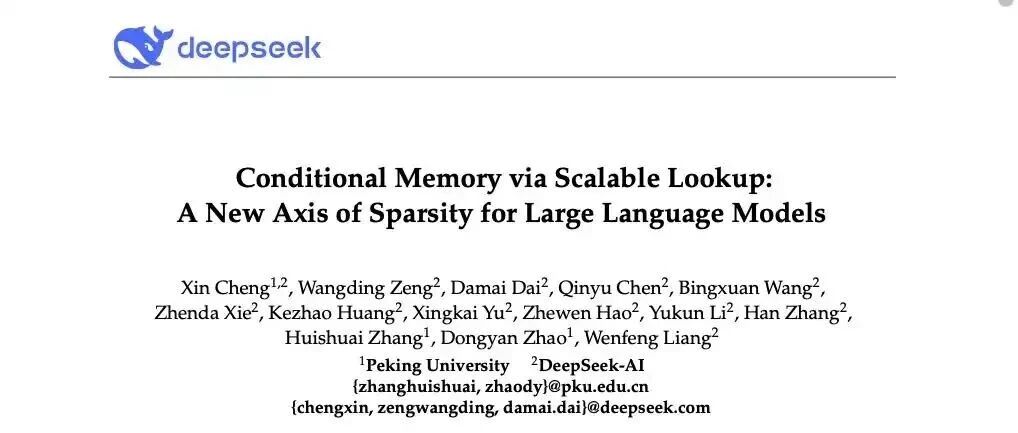
Core Insights - DeepSeek has introduced a new module called Engram, which addresses a significant limitation of the Transformer architecture by enabling direct memory retrieval, thus improving efficiency in knowledge retrieval and reasoning tasks [9][10][12]. Group 1: Core Problem - The Transformer architecture mixes tasks that should be retrieved with those that require computation, leading to inefficiencies [14][20]. - DeepSeek's Engram module acts as a "quick reference manual," allowing AI to retrieve fixed knowledge instantly rather than computing it through multiple neural network layers [21][22]. Group 2: Key Discoveries - A critical finding from DeepSeek's research is that a balance between memory and computation enhances performance, as demonstrated by a U-shaped curve in their experiments [30][32]. - The introduction of the Engram module not only improves knowledge retrieval but also enhances reasoning capabilities by freeing up neural network resources for complex tasks [36]. Group 3: Industry Impacts - The AI industry is entering a "dual-axis era" with the introduction of conditional memory, which may require companies that invested heavily in MoE architectures to redesign their systems [38][39]. - The hardware ecosystem will change as Engram's deterministic retrieval allows for pre-fetching and overlapping computations, potentially reducing costs for startups while impacting GPU manufacturers negatively [40][44]. - Engram significantly improves long-context capabilities, enhancing performance in tasks involving lengthy documents, which is crucial for industries like legal and medical [46][48]. Group 4: Opportunities for Individuals - There is a surge in demand for knowledge-intensive applications, particularly in fields like healthcare and law, where Engram's efficient retrieval can drastically reduce costs and improve response times [51][52]. - Opportunities exist in providing multilingual and specialized services, leveraging Engram's ability to compress semantic tokens and reduce barriers for small language applications [54][55]. - The long-context application market is expanding, with significant potential in contract review, medical diagnosis, and legal consulting, where Engram's capabilities can address previous limitations [56][59].
观察 | 韩服登顶“非人生物”:14小时连轴转,马斯克要终结电竞时代?
未可知人工智能研究院· 2026-01-13 03:02
Core Viewpoint - The emergence of an AI player in the Korean server of League of Legends, known as "택배기사" (Deliveryman), raises significant questions about the future of gaming, the potential for AI to replace human players, and the restructuring of a $300 billion industry [4][26]. Group 1: AI Performance and Characteristics - The AI account achieved a remarkable 92% win rate, with a 100% win rate in the jungle position, raising suspicions about its nature [2][3]. - The account played 56 games over 51 hours, winning 52 and losing only 4, with a consistent playtime schedule [8][9]. - Three anomalies suggest the account may be AI: its precise operation with minimal variance, a linear learning curve from the first game, and extreme differentiation in win rates across positions [21][23][24]. Group 2: Technical Challenges and Implications - The complexity of League of Legends makes it significantly more challenging for AI compared to games like Go, as it involves real-time, multi-player dynamics with incomplete information [14][18]. - The AI's development may involve advanced techniques that could revolutionize the AI industry, as suggested by Musk's statements about using computer vision for gameplay [19][33]. - The potential for AI to dominate esports could lead to a paradigm shift in the industry, similar to the impact of smartphones on traditional mobile phones [26][31]. Group 3: Impact on Players and Industry - For ordinary players, AI could serve as an advanced training tool, but it may also diminish the motivation to compete if AI becomes the norm in ranked play [27]. - Professional players face existential threats, as AI could surpass human capabilities, leading to a future where human champions may no longer exist [28][31]. - The esports industry may not be destroyed by AI; instead, it could create new opportunities, particularly in areas like AI training tools and esports data analysis [29][34]. Group 4: Future Opportunities - Players and content creators are encouraged to start producing AI-related content, as this market is expected to grow rapidly in the near future [34]. - Industry professionals should focus on AI training tools and data analytics, anticipating increased demand in the coming years [35]. - Spectators are advised to appreciate the current era of human competition, as the landscape may change dramatically in the near future [36].