未可知人工智能研究院

Search documents
观察| 你曾引以为傲的工作,正在成为历史
未可知人工智能研究院· 2025-12-15 10:02
Core Viewpoint - The article discusses a significant shift in the job market and societal structure due to the rise of AI, leading to a reversal of economic hierarchies where manual labor becomes more valuable than knowledge work [14][25][49]. Group 1: Job Market Changes - Millions of white-collar workers are entering the job market as AI tools replace many knowledge-based jobs, while manual labor jobs are becoming scarce and highly valued [14][25]. - The demand for skilled tradespeople, such as electricians and welders, is at an all-time high, with companies offering salaries of 20,000 to 30,000 yuan per month, which exceeds the pay of many mid-level positions in tech companies [25]. - The employment rate for vocational school graduates (96.5%) has surpassed that of bachelor's degree holders (88.1%) for two consecutive years, indicating a shift in job market dynamics [25]. Group 2: Societal Implications - The traditional perception of "white-collar" jobs as superior is being challenged, as blue-collar jobs may offer more economic security and stability in the future [27][28]. - The societal structure built around the idea that intellectual work is more valuable than manual work is being disrupted, leading to potential identity crises for those who have defined themselves by their professional titles [29][30]. - The article draws parallels to historical events, such as the Black Death, which drastically changed labor dynamics and power structures, suggesting that a similar transformation is occurring today due to AI [20][24]. Group 3: Psychological Impact - The rapid changes in job value and societal status may lead to significant psychological adjustments for individuals who have long identified with their professional roles [29][32]. - There is a potential for a new social order where success is redefined, and traditional markers of achievement, such as job titles, may lose their significance [40][43]. - The article emphasizes the need for flexibility and the ability to redefine success in the face of these changes, as the old systems of value may no longer apply [48].


沙龙| 未可知 x VividLifes: 绘出我心,AI助力女性情感表达
未可知人工智能研究院· 2025-12-13 10:03
▲ 戳蓝 色字关注我们! 近日,由 女性公益社群 VividLifes 发起的 "HerRoom: AIGC视觉行动计划" 迎来重要分享环节,特邀未可知人工智能研究院AIGC创作专家、高级 授课讲师 吴小楠 ,围绕 "AI工具如何辅助女性情感表达" 展开主题分享。此次合作源于对艺术领域中性别失衡现象的持续关注,旨在借助AIGC技术降 低创作门槛,为女性构建一个能够自由表达的安全创作空间。 吴小楠老师结合自身经历, 分享了AIGC技术如何成为情感表达与心灵慰藉的贴心助手 ,助她走出人生至暗时刻,深深触动了参与学员。在她看来, AI工具不只是技术手段,更像是一位耐心的创作伙伴, 能把感性的情绪转化为具象的画面,达成自我对话与情感表达 。 此外,她还介绍了提示词四步撰写法在绘图场景中的运用,并指出, 阅读专业摄影书籍,掌握构图、光影、色调等专业词汇 ,有助于进一步把控作品 细节,提升品质呈现。 | | 人物 | 龄&人种 | 女性 | 男性 | 女孩 男孩 | 美少女 | 美少男 | | | 眉毛 間青& 睫毛 | 液眉 | 没有眉毛 | 刻眉 間 | 平眉 品 美瞳 | | | --- | --- | --- | ...

观察| 专注力: 在AI的注意力战场如何自救
未可知人工智能研究院· 2025-12-12 10:03
Core Insights - The average attention span of humans in 2025 is projected to be 8 seconds, which is one second less than that of a goldfish and a 40% decrease from 12 seconds in 2000 [2] - The article discusses the systematic depletion of attention in the digital age, where distractions from notifications and multitasking hinder productivity [2][3] - It emphasizes that focus is a limited resource, akin to a muscle that can be exhausted, and highlights the importance of single-tasking for optimal performance [3][4] Group 1: Attention and Focus - Attention is being systematically harvested in the digital age, leading to a decline in cognitive performance [2][3] - Studies show that switching tasks can temporarily lower IQ by 10 points, equivalent to a night of lost sleep, and it takes 20 minutes to regain focus after a distraction [3][4] - The brain's "executive control network" can become overloaded, leading to a cycle of anxiety and decreased focus [4] Group 2: Strategies for Enhancing Focus - Top performers utilize "single-threaded" work sessions, focusing on core objectives without multitasking [5] - Techniques include creating "no-interruption blocks" of 90 minutes, gradually increasing task difficulty, and batching low-value tasks [5][6] - Physical isolation of distractions, such as locking away phones, and setting digital protocols can help maintain focus [6][7] Group 3: Environmental and Biological Factors - A clean workspace correlates with longer attention spans, as clutter can distract and hinder cognitive function [8] - Understanding biological rhythms can enhance productivity; for instance, scheduling creative tasks during peak brain activity times [9][10] - Implementing a 90/20 work cycle can align with the brain's natural focus periods, promoting better concentration [10] Group 4: Building Automatic Focus - Developing systems to replace willpower with automatic behaviors can enhance focus [12][13] - Identity anchoring, solidifying focus routines, and maintaining feedback loops can help establish a habit of sustained attention [14][15] - When these strategies become second nature, individuals can navigate the information overload of the digital age more effectively [16] Group 5: The Value of Focus in the AI Era - In an age where AI can perform many tasks, human deep thinking and focus remain irreplaceable skills [17] - Those who excel in utilizing AI tools are not just proficient users but are capable of deep, focused thought that leads to innovative solutions [17][18] - The article concludes that focus can be trained and improved, likening it to a muscle that can be developed over time [19][20]

观察| 铜: 下一个财富密码
未可知人工智能研究院· 2025-12-11 10:01
Core Viewpoint - The article emphasizes that copper is an undervalued investment opportunity, poised for significant growth due to its essential role in the electrification and AI revolution, contrasting it with gold, which is driven more by emotional and speculative factors [1][4][40]. Group 1: Demand Drivers - The demand for copper is expected to surge due to the increasing energy needs of AI data centers, electric vehicles, and renewable energy sources, with projections indicating global copper consumption will rise from 33 million tons in 2024 to 41 million tons by 2030, reflecting a compound annual growth rate of 3.4% [23][24]. - AI models require substantial energy, with a single training session consuming about 12,000 MWh, equivalent to the daily electricity consumption of a medium-sized city, leading to a projected increase in global data center electricity consumption from 415 TWh in 2024 to 945 TWh by 2030 [7][9]. - Electric vehicles consume four times more copper than traditional vehicles, with an estimated additional demand of 200,000 to 300,000 tons of copper by 2030 due to the anticipated 55.7% penetration rate of electric vehicles [17][19]. Group 2: Supply Constraints - The average grade of copper ore has declined from 0.95% in the early 2000s to 0.60% in 2024, meaning more ore must be mined to extract the same amount of copper, effectively doubling the workload and costs [25][28]. - The development of new copper mines is increasingly challenging, with an average exploration to production timeline of 20-30 years, and many potential projects remain in the planning stages [27][28]. - The global copper concentrate supply is expected to face a shortfall, with a projected deficit of 1.2 million tons by 2040, which is 30% of total demand, indicating a significant supply-demand imbalance [37][38]. Group 3: Investment Opportunities - Investing in copper is seen as a more stable and necessary choice compared to gold, as copper's price is driven by fundamental demand rather than speculative trends, making it suitable for long-term investment [40][42]. - The current copper price of approximately $11,000 per ton is still below historical highs, suggesting significant upside potential as supply constraints become more pronounced [43][44]. - Various investment avenues are available for copper, including mining stocks, ETFs, and futures, allowing investors of different risk tolerances to participate in the copper market [46][47]. Group 4: Strategic Recommendations - Investors are advised to focus on upstream copper mining companies with integrated operations, as they are likely to benefit directly from rising copper prices [49][50]. - Attention should also be given to downstream sectors that utilize copper, such as data centers and electric vehicle manufacturers, which are expected to experience high growth due to increased copper demand [52]. - For risk-averse investors, copper ETFs provide a diversified investment option, while more experienced investors may consider futures and options to enhance capital efficiency [53][54].

观察| AI不是泡沫,而是野火
未可知人工智能研究院· 2025-12-10 03:02
Core Viewpoint - The article argues that the current AI landscape should not be viewed as a bubble but rather as a transformative force akin to a wildfire that clears out the old to make way for new growth, emphasizing the concept of "creative destruction" [1][4][30]. Group 1: The Nature of AI Wildfire - The AI sector is currently facing an overabundance of low-value applications and models, which are likened to "flammable materials" that will be eliminated in the ongoing transformation [2][6]. - Wildfires in ecology serve as purifiers and catalysts, returning nutrients to the soil and creating space for new growth, paralleling the necessary cleansing of the AI ecosystem [4][18]. Group 2: Different Players in the AI Ecosystem - Three types of players are identified in the AI ecosystem: - "Flammable materials" which are doomed to fail due to lack of real demand and differentiation [6][7]. - "Fire-resistant giants" like Nvidia and Amazon, which possess strong revenue streams and technological advantages, ensuring their survival and growth [9]. - "Budding entities" that emerge from the ashes, such as startups founded by knowledgeable individuals, which can leverage lower costs and resources post-transformation [10][12]. Group 3: Historical Context of Technological Fires - The history of technological innovation is marked by significant "wildfires" that, while destructive, ultimately laid the groundwork for future advancements [13][14]. - The 2000 internet bubble led to a massive investment in fiber optics, which, despite initial overcapacity, became foundational for the digital age [15][16]. - The 2008 financial crisis allowed companies like Apple and Amazon to thrive, utilizing the infrastructure and resources left behind by the previous crisis [17][18]. Group 4: Future of AI and Energy - The current AI "wildfire" is more intense than previous ones, with significant investments in computational infrastructure projected to exceed $480 billion by 2025 [19][22]. - The real challenge lies in energy supply, as AI data centers consume vast amounts of electricity, necessitating investments in sustainable energy infrastructure to support future growth [20][22]. Group 5: Lessons from the Sequoia Tree - The resilience of the sequoia tree serves as a metaphor for the strength needed in the AI sector, emphasizing the importance of building robust foundations to withstand challenges [23][26]. - The article warns against uncontrolled wildfires, which can lead to catastrophic outcomes, highlighting the need for periodic adjustments to prevent larger crises [25][27]. - The distinction between speculative bubbles and beneficial wildfires is made, with the latter fostering innovation and growth in the long term [28][30].

解读:特朗普突批H200入华,抽成25%背后的大棋局
未可知人工智能研究院· 2025-12-09 10:01
Core Viewpoint - The article discusses the recent shift in U.S. technology policy regarding the export of AI chips to China, highlighting the implications of this decision for both American companies and the global AI chip industry. It emphasizes the complex interplay of business interests, national security, and the evolving landscape of China's domestic chip industry. Group 1: Policy Shift and Its Implications - On December 8, 2025, President Trump announced the approval for NVIDIA to export H200 AI chips to China, with the U.S. government taking a 25% cut from each sale, marking a significant policy reversal from previous export bans [1][2] - The decision followed a closed-door meeting between NVIDIA CEO Jensen Huang and U.S. government officials, where Huang sought to restore chip exports to mitigate NVIDIA's declining sales in China, which had resulted in a write-down of approximately $5.5 billion [4][5] - The U.S. government aims to balance maintaining its chip market position while ensuring technological superiority and extracting financial benefits from the deal [5][6] Group 2: Economic Analysis of the Deal - Industry estimates suggest NVIDIA could export between $2 billion to $5 billion worth of chips quarterly to China, meaning the U.S. government could earn $500 million per quarter, totaling $2 billion annually without any investment in R&D or manufacturing [6][7] - This arrangement is characterized as "rent-seeking," where the U.S. government collects a "protection fee" from NVIDIA, which still finds the deal beneficial compared to the zero revenue it faced under the export ban [7][8] Group 3: China's Response and Market Dynamics - Despite the U.S. expectations, the Chinese market's response to the H200 chips has been more cautious than anticipated, with concerns over reliability and cost-effectiveness [29][30] - Factors influencing China's reluctance include a broken trust in U.S. supply chains, the high cost of H200 due to the 25% fee, and the potential security risks associated with U.S. technology [31][33][34] - The Chinese government is actively promoting domestic chip development, which further limits the market for imported chips [36] Group 4: The Rise of China's AI Chip Industry - Reports predict that by 2026, Huawei will capture 50% of the Chinese AI chip market, while NVIDIA's share could plummet from 39% to just 8% [13][15] - The growth of domestic chip manufacturers like Huawei, Cambricon, and Baidu is accelerating, with significant advancements in AI chip technology and production capacity [16][18][19] - The rapid development of China's AI chip industry is seen as a response to U.S. export restrictions, with the potential to reshape the global semiconductor landscape [19][24] Group 5: Long-term Consequences and Strategic Miscalculations - The U.S. government's strategy of using national security as a pretext for economic gain may backfire, accelerating China's technological independence and reducing global reliance on U.S. technology [20][40] - The contrasting approaches of the Trump and Biden administrations highlight a fundamental tension in U.S. policy towards China, with implications for international trust in U.S. technology [22][40] - Ultimately, the article suggests that true victory lies in fostering domestic innovation rather than relying on outdated technology imports, emphasizing the long-term nature of technological competition [44]


企业培训| 未可知 x 交通银行: AI 如何改写信用卡行业竞争规则?
未可知人工智能研究院· 2025-12-08 03:03
Core Insights - The article emphasizes that AI has transitioned from being an enhancement in the financial industry to a core competitive advantage, particularly in the credit card business [2][22]. - The competition among banks is now centered around who can effectively convert ineffective time into valuable outcomes through technology [5]. Risk Control - AI is revolutionizing risk management in credit card operations, shifting from reactive measures to proactive predictions in milliseconds [6]. - By integrating various data sources and utilizing advanced algorithms, AI risk management systems have moved from fixed thresholds to dynamic real-time controls [6]. - The "Dragon Shield" system of China Construction Bank exemplifies this shift, enabling real-time fraud risk verification and significantly reducing bad debt rates by 15.2% [8]. Marketing - AI has transformed credit card marketing from a broad approach to a highly targeted strategy, allowing for personalized user engagement [9]. - The Industrial and Commercial Bank of China has developed an AI-driven installment marketing system that effectively matches user needs with appropriate offers, enhancing business volume while minimizing unnecessary outreach [11]. - China Merchants Bank has elevated AI marketing to a core capability, utilizing real-time user behavior data to deliver timely and relevant product promotions [15]. Service and Compliance - The integration of AI in customer service is enhancing user experience, with China Merchants Bank's AI customer service achieving a 98% intent recognition accuracy [16]. - AI is also playing a crucial role in consumer protection by enabling proactive compliance measures, such as real-time monitoring of marketing materials to prevent regulatory violations [20]. Future Outlook - AI is set to drive a comprehensive evolution in credit card operations, enhancing risk management, marketing precision, and customer service while ensuring compliance [21]. - The ongoing advancements in technologies like multi-modal systems and federated learning are expected to accelerate the shift towards smarter, more compliant credit card services [24].

观察| 100万亿Tokens的:AI正在发生你看不见的巨变
未可知人工智能研究院· 2025-12-07 03:02
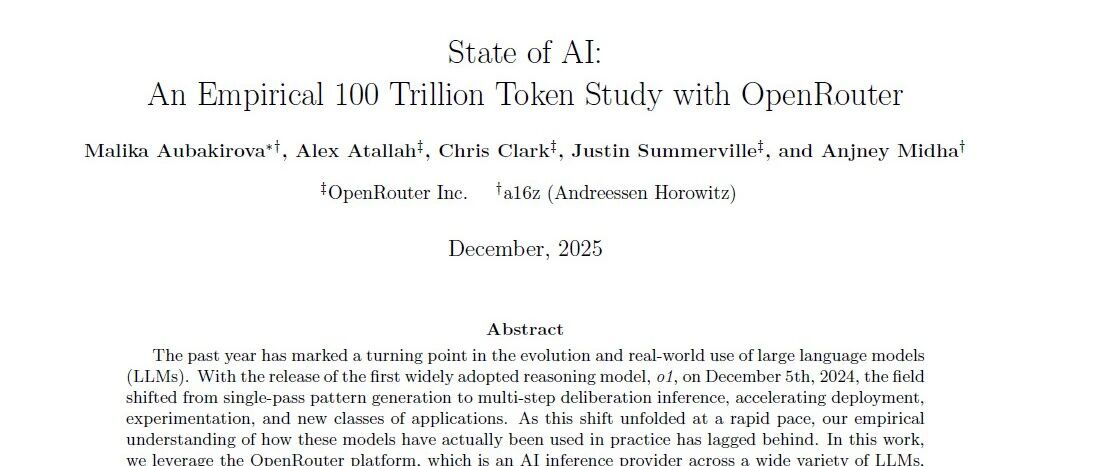
Core Insights - The report reveals that AI is undergoing a significant revolution, characterized by a shift from traditional models to reasoning models that can think and plan in multiple steps [3][11][12]. Group 1: OpenRouter and Its Importance - OpenRouter is likened to "Meituan" in the AI world, connecting over 500 million developers to more than 300 AI models, making its data highly credible [5][6]. - OpenRouter's daily token processing volume has surpassed 1 trillion, indicating a rapid growth from approximately 100 trillion tokens annually from early 2024 to mid-2025, marking a tenfold increase [8][6]. Group 2: Reasoning Revolution - The report identifies a "reasoning revolution," where AI models evolve from simple response machines to complex reasoning machines capable of multi-step thinking [11][12]. - The launch of OpenAI's o1 reasoning model (codename Strawberry) is a pivotal event, as it incorporates internal reasoning processes that enhance its problem-solving capabilities [18][19]. - Users are increasingly engaging in complex tasks, leading to longer prompts and more dialogue rounds, indicating a shift towards training AI for intricate tasks [20][21][23]. Group 3: Agentic AI - Agentic AI represents a transformation where AI can autonomously plan, execute, and verify tasks, moving from passive response to active engagement [27][30]. - The report highlights that agentic reasoning is the fastest-growing behavior on OpenRouter, indicating a shift in user expectations from simple answers to task completion [34][35]. Group 4: Rise of Open Source Models - Open source models, particularly from Chinese teams like DeepSeek R1 and Kimi K2, are rapidly gaining market share, challenging the dominance of closed-source models [44][47]. - DeepSeek R1 offers significant cost advantages, with a cost of $0.003 per 1K tokens compared to $0.03 for GPT-4, making it attractive for developers [52]. Group 5: Real-World AI Usage - The primary applications driving token usage are creative writing and programming, with AI becoming indispensable for developers [71][72]. - Users are not merely relying on AI for content generation but are engaging in co-creation, indicating a shift in the role of AI from a tool to a creative partner [77][78]. Group 6: Model Personality - Users' choices of AI models are influenced by the "personality" of the models, which affects user retention and engagement [88][95]. - The report suggests that models with unique personalities can outperform those with higher benchmark scores in terms of user loyalty [96][100]. Group 7: Implications for the Chinese AI Industry - The success of Chinese models like DeepSeek R1 and Kimi K2 in the global market indicates that they have competitive capabilities [109]. - The report emphasizes the importance of focusing on reasoning and agentic capabilities as key technological directions for the Chinese AI industry [115].
政务培训| 未可知 x 湖州税务: AI在税收科研领域的运用与实战
未可知人工智能研究院· 2025-12-06 03:03
Core Viewpoint - The training session organized by the Huzhou Taxation Bureau aimed to enhance the efficiency and innovation capabilities of tax research through the application of artificial intelligence tools, receiving positive feedback from participants [1][4]. Group 1: Training Overview - The training featured a lecture by Zhang Ziming, Vice President of the Unseen AI Research Institute, focusing on the application of AI in tax research [1][3]. - Zhang Ziming has a strong academic background and practical experience in AI, having contributed to national guidelines and authored several popular books on AI [3]. - The training covered various AI technologies, including text generation, audio synthesis, image creation, and video generation, and their practical applications in tax research [3]. Group 2: Practical Applications - AI tools can efficiently complete tasks such as policy analysis, data analysis, and research design, exemplified by the automatic generation of timelines for tax policy changes and quick aggregation of industry tax burden rates [3]. - A practical case study on "risk of false invoicing in the textile industry" demonstrated how to design risk control models using invoice field indicators [3]. - Participants experienced the DeepSeek tool, which showcased AI's ability to shorten research cycles and reduce labor costs [3]. Group 3: Future Directions - The Unseen AI Research Institute aims to continue its collaboration with tax departments to promote the integration of AI in tax modernization [4]. - The training not only improved the AI application skills of tax personnel but also opened new pathways for intelligent tax research in Huzhou [4]. - The institute plans to provide ongoing insights and support for various industries to embrace the AI revolution [4].

观察| 国际大牌,为何集体撤离中国?
未可知人工智能研究院· 2025-12-05 03:02
Core Viewpoint - The article discusses the significant retreat of foreign consumer brands from the Chinese market, attributing it to the transformative impact of AI on the global consumption landscape, rather than a decline in China's consumer market potential [3][7]. Group 1: Truth Behind Foreign Withdrawal - The withdrawal of foreign brands is not indicative of a peak in China's consumer market but rather a result of AI disrupting the traditional advantages held by Western brands [3]. - Historically, developed countries leveraged brand, technology, and management to dominate the consumption industry, while developing countries relied on cheap labor. AI has reversed this dynamic, allowing Chinese companies to leverage algorithms to outperform foreign brands [4][7]. Group 2: AI Reshaping Global Industries - The essence of foreign brands' retreat is a global shift in industrial advantages driven by AI, with developed countries focusing on "re-industrialization" while China emphasizes "consumption intelligence" [7]. - AI and robotics have made production costs in the U.S. lower than in China by 15%, a trend now seen in the consumer sector, where local brands are using AI to enhance efficiency and reduce costs [9][11]. Group 3: Local Brands' Competitive Edge - Local brands are leveraging AI to achieve a level of operational efficiency that significantly outpaces foreign competitors, with examples like Luckin Coffee's inventory turnover rate being 1.8 times that of Starbucks [14]. - The innovation process for local brands is data-driven, allowing them to adapt quickly to consumer preferences, unlike foreign brands that struggle with lengthy decision-making processes [15][18]. Group 4: Warnings from the Retreat - The collective withdrawal of foreign brands serves as a warning that no advantage is permanent in the AI-driven market; brands must continuously innovate to remain competitive [18][20]. - The competition is shifting from a simple dichotomy of "Chinese factories vs. Western brands" to a more complex battle of who can utilize AI and data more effectively [21].