是说芯语

Search documents
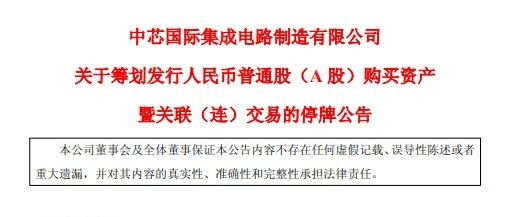
中芯国际宣布收购!
是说芯语· 2025-08-29 11:12
Group 1 - The company is planning to issue RMB ordinary shares (A shares) to acquire minority equity in its subsidiary, SMIC North Integrated Circuit Manufacturing (Beijing) Co., Ltd. [3][5] - The transaction is expected not to constitute a major asset restructuring or a restructuring listing, but it is classified as a related party transaction [3][4] - The company's stock will be suspended from trading starting September 1, 2025, for a period not exceeding 10 trading days [2][4] Group 2 - The target asset for the transaction is 49% equity held by the counterpart in SMIC North, which has a registered capital of USD 480 million [5][6] - The preliminary identified counterparties for the transaction include several investment entities, such as the National Integrated Circuit Industry Investment Fund Co., Ltd. and Beijing Economic Development Investment Management Co., Ltd. [6] - The company intends to purchase the minority stake through the issuance of RMB ordinary shares (A shares) [7]


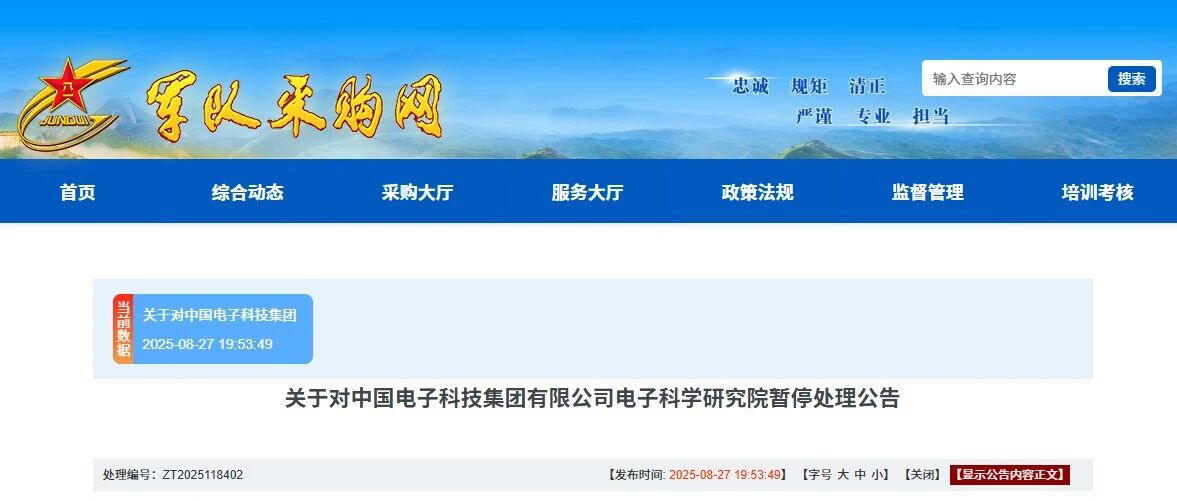
两家中国电科下属单位同日因军队采购违规被处理
是说芯语· 2025-08-29 03:52
Core Viewpoint - Recent announcements in the military procurement supervision sector indicate that two research units under China Electronics Technology Group Corporation (CETC) have been suspended from participating in military procurement activities due to violations of trust [1][3][5]. Group 1: Violations and Consequences - The China Electronics Technology Group Corporation's Electronic Science Research Institute was found to have engaged in violations during a military procurement activity identified as "2022-VQ01-W1080," leading to a suspension of its procurement qualifications [3]. - The China Electronics Technology Group Corporation's Network Communication Research Institute (54th Research Institute) was similarly implicated in violations during the procurement project "2021-JQ02-W1257," resulting in a suspension of its procurement qualifications as well [5]. - Both institutes will have their procurement qualifications suspended starting from August 27, 2025, and their respective legal representatives will also face restrictions on participating in military procurement activities [1][5]. Group 2: Regulatory Actions - The military's Supply Bureau has implemented measures to cut off the chain of interests related to the violations by suspending the legal representatives of the involved institutes from managing or controlling other enterprises that participate in military procurement [3][5]. - The actions taken by the military procurement management departments reflect strict adherence to regulations governing military suppliers, emphasizing the importance of compliance in procurement processes [3][5].

芯原收购芯来,今天开始停牌!
是说芯语· 2025-08-28 23:03
Core Viewpoint - The article discusses the planned acquisition of ChipRising Semiconductor Technology (Shanghai) Co., Ltd. by ChipOrigin Microelectronics (Shanghai) Co., Ltd. through a combination of share issuance and cash payment, highlighting the strategic importance of this move in the RISC-V architecture field [1][4]. Group 1: Transaction Details - ChipOrigin is planning to acquire ChipRising using a combination of shares and cash, with additional fundraising to support the transaction [1][4]. - The specific transaction amount and equity payment ratio have not been disclosed yet, but ChipOrigin has a history of successful cash transactions exceeding tens of millions in recent years [4]. - The transaction is subject to audit, board, and shareholder approval, as well as regulatory approval, indicating some uncertainty [4]. Group 2: Strategic Importance - This acquisition is seen as a key move for ChipOrigin in the RISC-V architecture sector, potentially creating synergies with its existing GPU and NPU product lines [4][7]. - ChipRising, established in 2018, is a leading player in the RISC-V field, offering a complete product line including 32-bit and 64-bit CPU IPs, and has served over 300 domestic and international clients [6][9]. - ChipOrigin ranks first in China and seventh globally in semiconductor IP revenue, with a diverse portfolio of IP types, indicating a strong foundation for the acquisition [6][9]. Group 3: Market Outlook - The acquisition is expected to enhance technological collaboration, particularly in creating a heterogeneous computing platform that combines general computing and specialized acceleration [7]. - The RISC-V architecture is projected to be a critical technology path for overcoming heterogeneous computing challenges, with the AI SoC market based on RISC-V expected to exceed $42 billion by 2030, growing at a compound annual growth rate of 49.2% [7][9].


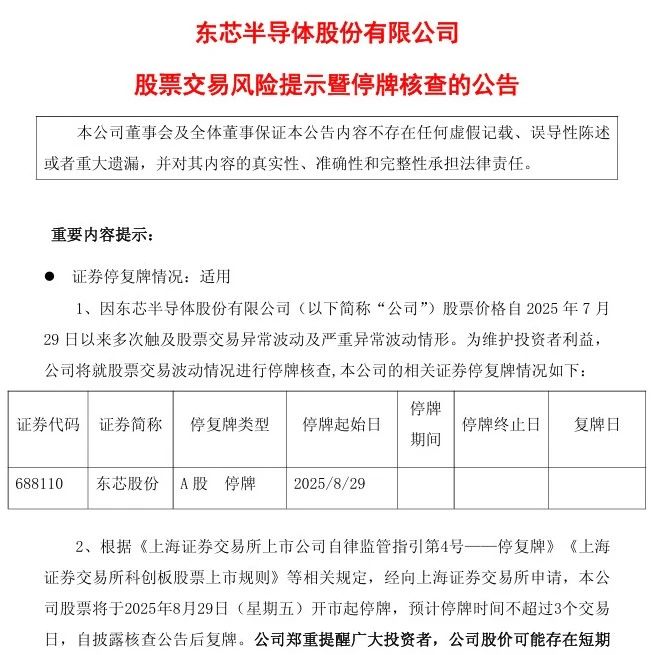
突发!著名国产存储芯片公司停牌核查!
是说芯语· 2025-08-28 23:03
Core Viewpoint - Dongxin Co., Ltd. (688110.SH), a leading domestic storage chip design company, announced a temporary suspension of its stock trading due to significant price fluctuations, aiming to protect investor interests [1][3]. Group 1: Stock Trading Suspension - The stock trading suspension is a response to Dongxin's stock price volatility, which has repeatedly triggered regulatory thresholds for abnormal trading [3][6]. - On August 28, Dongxin's stock closed at 118.00 yuan, with a single-day increase of 16.43% and a trading volume of 5.317 billion yuan, leading to a total market capitalization of 52.185 billion yuan [3]. Group 2: Company Overview - Established in 2014 and headquartered in Shanghai, Dongxin is one of the few companies in mainland China that offers a complete solution for NAND Flash, NOR Flash, and DRAM storage chips [5]. - The company's products are widely used in various sectors, including network communication, surveillance, consumer electronics, and industrial applications [5]. - In 2024, Dongxin achieved a revenue of 641 million yuan, reflecting a year-on-year growth of 20.80%, indicating a consistent upward trend in the recovering storage chip industry [5]. Group 3: Research and Development - Dongxin has significantly increased its R&D investment, with R&D expenses reaching 213 million yuan in 2024, accounting for 33.27% of its revenue [5]. - The company is focusing on certifying automotive-grade storage products and industrializing its 1xnm flash products, with several of its products already certified to AEC-Q100 automotive standards [5]. Group 4: Market Context - The storage chip industry has shown a remarkable recovery since 2024, with the global market size increasing by 81% year-on-year [6]. - Dongxin's stock price fluctuations reflect both the industry's changing dynamics and the market's enthusiasm for domestic substitution concepts [6].

刚刚!芯原微电子收购芯来,停牌!
是说芯语· 2025-08-28 13:32
Core Viewpoint - The article discusses the planned acquisition of Chip Origin Microelectronics (芯原股份) by purchasing equity in Chip Lai Zhi Rong Semiconductor Technology (芯来智融) through a combination of issuing shares and cash payments, which is expected to enhance Chip Origin's position in the RISC-V architecture sector and create synergies with its existing IP product lines [1][4]. Group 1: Transaction Details - Chip Origin is planning to acquire Chip Lai Zhi Rong using a combination of share issuance and cash payments, while also raising matching funds [1][4]. - The specific transaction amount and equity payment ratio have not yet been disclosed, but Chip Origin has a history of completing multiple cash transactions exceeding tens of millions in recent years [4]. - The transaction is subject to audit evaluation, board and shareholder approval, and regulatory approval, indicating some level of uncertainty [4]. Group 2: Strategic Importance - The acquisition is seen as a key move for Chip Origin in the RISC-V architecture field, potentially complementing its existing GPU and NPU product lines [4][7]. - Chip Lai Zhi Rong, established in 2018, is a leading player in the RISC-V sector, focusing on RISC-V CPU IP and platform solutions, with a complete product line serving over 300 domestic and international clients [6][9]. - Chip Origin has a strong presence in the semiconductor IP field, ranking seventh globally and first in China for IP revenue, with a diverse range of IP offerings [6][9]. Group 3: Market Outlook - The acquisition is expected to create multiple technological synergies, enhancing Chip Origin's capabilities in AI computing and automotive electronics [7][9]. - The RISC-V architecture is projected to be a critical technology path for overcoming heterogeneous computing bottlenecks, with the AI SoC market based on RISC-V expected to exceed $42 billion by 2030, growing at a compound annual growth rate of 49.2% [7][9].

翱捷科技半年报的10个评论
是说芯语· 2025-08-28 09:32
Core Viewpoint - The article discusses the performance and future prospects of Aojie Technology, highlighting that the company's performance is expected to improve gradually from the second half of this year, with profitability anticipated by next year [3]. Group 1: Business Performance - The core business segment, cellular baseband chips, has shown outstanding performance, with revenue contribution exceeding 85%. Sales volume increased by over 50%, revenue grew by over 30%, and gross profit rose by over 60% compared to the same period last year [5]. - In the Cat.1 bis sector, the company has achieved nearly 50% market share, with 4G Cat.1 main chip shipments increasing by over 50% year-on-year. The second quarter's shipments grew by over 40% compared to the first quarter, indicating a sustained high growth trend [5]. - The 4G Cat.4 main chip shipments increased by approximately 35% year-on-year, with the company expanding into more automotive applications [6]. - The 5G Redcap sector has seen successful progress with the ASR1903 series, which has passed certifications from major operators and has over 30 products in testing or commercial release [6]. - The first 4G octa-core smartphone chip has been successfully commercialized, with significant market feedback and a projected substantial increase in shipments for 2025 [8]. Group 2: Future Developments - The second-generation 4G octa-core smartphone chip is in the tape-out phase, utilizing a 6nm process and featuring a large NPU, with mass production expected in the first half of next year [8]. - The first 6nm 5G octa-core smartphone chip is in the late R&D stage, with expectations for tape-out in the second half of this year and customer onboarding in the second half of next year [9]. - The company is developing three new projects, including high-performance WiFi6 chips and Redcap chips for automotive applications [10]. Group 3: Custom Chip Business - The decline in revenue from the custom chip business in the first half of the year is attributed to a previous focus on smartphone chips. However, the company has received numerous projects since late last year, including those related to AI and cloud computing [11]. - The custom chip business is expected to generate significant revenue next year, with estimates suggesting tens of millions in revenue due to new client projects [11].


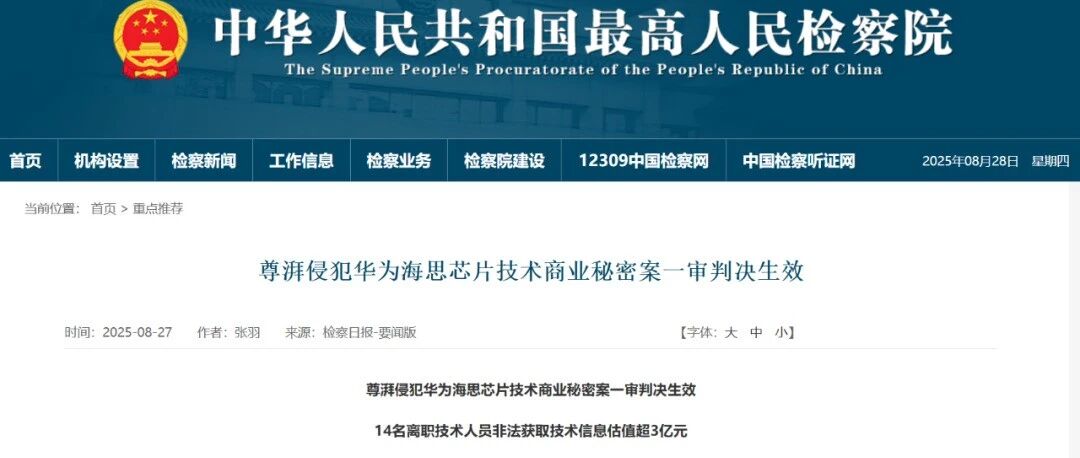
尊湃窃密华为海思芯片技术,一审判决生效!
是说芯语· 2025-08-28 07:34
Core Viewpoint - The article discusses the legal case involving the theft of Huawei's HiSilicon chip technology by the company Zunpai, highlighting the severe consequences for the perpetrators and the impact on Huawei's business and technology development [1][6]. Group 1: Case Overview - The Supreme People's Procuratorate announced that the case of Zunpai infringing on Huawei's HiSilicon chip technology trade secrets was judged on July 28, with 14 defendants not appealing within the ten-day period, making the ruling effective [1]. - The illegal acquisition of technology information was valued at 317 million yuan [1]. - The Shanghai Third Intermediate People's Court sentenced the defendants for trade secret infringement, with Zhang Kun receiving a six-year prison term and a fine of 3 million yuan [1][6]. Group 2: Technology Theft Details - Huawei initiated its Wi-Fi chip development project in 2011, with HiSilicon responsible for implementation, achieving significant technological breakthroughs while maintaining strict confidentiality [2]. - After leaving Huawei, Zhang Kun and several former employees founded Zunpai, using high salaries and equity incentives to recruit current and former Huawei staff, who illegally obtained over 40 core technology pieces from Huawei [2][5]. - Techniques for stealing technology included screenshotting, copying, and using personal devices to transfer sensitive information [5]. Group 3: Consequences and Impact - Zunpai's rapid success in developing a Wi-Fi 6 chip within two years raised questions about the legitimacy of their claims, especially given the extensive R&D efforts typically required [3][5]. - Huawei incurred significant losses, including 900 million yuan in R&D expenses for Wi-Fi 6/7 technologies and a 15% reduction in its patent pool due to technology leaks, equating to over 10 million USD in annual losses [6]. - The case revealed that 90% of the technology points overlapped with Huawei's, setting a precedent for future similar cases [7].
刚刚,沐曦回应问询!
是说芯语· 2025-08-28 04:59
Core Viewpoint - The article discusses the recent response from Muxi Co., Ltd. regarding the inquiry letter for its initial public offering and listing on the Sci-Tech Innovation Board, focusing on its product offerings, market competition, and financial performance. Product and Market Competition - Muxi's products are categorized into training and inference integrated series (GPU boards, GPU servers), intelligent computing inference series (GPU boards), IP licensing, and others, with significant revenue fluctuations across different product types [1][3] - The company has delivered nine intelligent computing clusters, catering to various customer needs, including integrated servers and workstations [1] - The global GPU market is dominated by Nvidia and AMD, with domestic competitors including Huawei HiSilicon, Suiruan Technology, and Kunlun Core, which focus on specialized computing architecture [1] - Muxi's competitive position against international and domestic leaders is not sufficiently detailed in the prospectus [1] Financial Performance and Product Structure - Muxi's revenue from the training and inference integrated series has significantly increased, with the revenue share rising from 30.09% in 2023 to 97.87% in Q1 2025, while the intelligent computing inference series has dropped from 100% to 1.25% during the same period [12][14] - The main revenue sources are the Xiyun C500 series products, which have gained substantial market recognition due to their performance and alignment with industry needs [15][16] - The company has focused its resources on flagship products, which is a common strategy among industry peers like Nvidia, where flagship products dominate revenue streams [18] Product Development and Market Trends - Muxi was established in 2020 with a clear focus on AI training and inference chips, aligning with the growing market demand for such products [10][14] - The company has successfully launched the Xiyun C500 series, which competes with Nvidia's A100 in performance, and has been well-received in various industry applications [15][16] - The GPU chip development cycle is long and capital-intensive, making the concentration on flagship products a strategic choice for Muxi [17] Competitive Landscape and Challenges - The domestic GPU market faces challenges such as competition from international giants, high customer service standards, and a relatively weak software ecosystem [22][23][24] - Muxi's products are positioned to meet the increasing demand for high-performance GPUs in AI applications, particularly in the context of geopolitical tensions and the push for domestic alternatives [15][26] - The company has established partnerships with various sectors, enhancing its market presence and brand recognition [27][28]


上海芯片龙头出手并购!
是说芯语· 2025-08-27 10:44
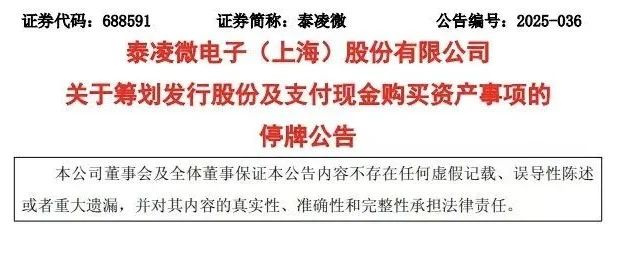
Core Viewpoint - The acquisition of Shanghai Panqi Microelectronics by Tailin Microelectronics is a strategic move to enhance product lines and market presence in the IoT chip sector, aiming for a comprehensive portfolio in both 2.4GHz and Sub-1G frequency bands [11][12][13]. Group 1: Company Overview - Tailin Microelectronics is a leading player in the low-power wireless IoT chip market, with a global market share of 12% in low-power Bluetooth chips, ranking third globally and first domestically [5]. - Shanghai Panqi Microelectronics, established in 2010, specializes in IoT chip design with over 130 patents, focusing on low-power wide-area network technologies [8]. Group 2: Strategic Rationale for Acquisition - The acquisition allows Tailin Microelectronics to expand its product offerings from 2.4GHz to Sub-1G frequency bands, enhancing its capabilities in outdoor IoT applications [11]. - Tailin Microelectronics' strengths in digital circuits and overseas market channels can address Panqi Microelectronics' weaknesses, facilitating rapid market penetration and revenue growth [11][12]. - The merger is positioned to capitalize on the growing demand for low-power wide-area networks, particularly in industrial IoT applications, with predictions of significant market growth by 2030 [13]. Group 3: Market Context and Trends - The semiconductor industry is experiencing a wave of mergers and acquisitions, with over 23 events and a total transaction value of approximately 400 billion yuan in the first half of 2025 [11]. - Government policies are increasingly supportive of the semiconductor sector, encouraging mergers that enhance supply chain resilience and competitiveness [12]. - The acquisition is expected to accelerate the domestic replacement process in the IoT chip sector, leveraging Panqi Microelectronics' unique technologies to increase market share [13].

又一批半导体产业链新公司成立
是说芯语· 2025-08-27 06:29
Core Viewpoint - The establishment of multiple new companies in the semiconductor industry chain indicates a significant trend of regional expansion among leading enterprises, with a focus on key areas such as chip design, manufacturing equipment, materials, and packaging testing [1] Group 1: New Company Establishments - A total of 11 new semiconductor companies have been established, with a concentration in Shanghai (4), Jiangsu (3), and Zhejiang (2), while emerging regions like Hainan and Inner Mongolia are becoming new hubs for technology deployment [1] - Hainan Unisoc Technology Co., Ltd. focuses on integrated circuit design, data processing services, and cloud computing equipment sales, potentially aligning with the cross-border data flow policies of the free trade port [3] - Shanghai SIDA Integrated Circuit Co., Ltd. aims to enhance its capabilities in power semiconductor design and sales, particularly targeting the automotive electronics industry in the Yangtze River Delta [4] - Cambricon (Hohhot) Information Technology Co., Ltd. is dedicated to integrated circuit chip design and manufacturing, supporting AI chip trials and localization in Northern China [5] - Beijing Weifang Technology Co., Ltd. is involved in 5G communication and integrated circuit chip manufacturing, particularly in satellite mobile communication terminals and smart drones [6] - Haimuxing Laser Intelligent Equipment (Foshan) Co., Ltd. applies laser technology to semiconductor device manufacturing, contributing to the local semiconductor industry cluster [7][8] Group 2: Industry Chain Segmentation - Shanghai Huichunxin Semiconductor Materials Co., Ltd. focuses on the research and sales of electronic materials, potentially involving the localization of critical materials like photoresists and target materials [10] - Huzhou Sucas Semiconductor Technology Co., Ltd. continues its parent company's expertise in semiconductor cleaning equipment, while Suzhou Guanghuan Zhi Semiconductor Equipment Co., Ltd. is involved in semiconductor device manufacturing [12] - Basic Semiconductor (Hangzhou) Co., Ltd. specializes in silicon carbide discrete devices and integrated circuit chips, catering to high-voltage applications in electric vehicles and energy storage [13] Group 3: Investment Characteristics - 80% of the new companies are wholly owned by listed companies or industry leaders, indicating a trend of vertical integration to strengthen control over the industry chain [16] - Investment in automotive-grade chips, silicon carbide devices, and semiconductor laser equipment accounts for over 60% of the new establishments, closely linked to the explosive growth of end markets like electric vehicles and energy storage [16] - The establishment of companies in non-traditional semiconductor bases like Hohhot and Hainan suggests a shift towards regions with lower costs and better policies, accelerating the formation of a national industry chain network [16]