是说芯语

Search documents
高盛再次上调寒武纪目标价至2104元…
是说芯语· 2025-09-01 00:44
高盛最新的报告,核心就2点: (1)2025年营收指引符合预期; (2)上调目标价至 人民币2104元… 具体营收和净利润预测上, GS将25-27年营收上调至65.6亿、139.6亿、299.5亿 ,净利润上调了34%、 21%、19%至 20.22亿、36.8亿和77亿。 以下文章来源于橙子不糊涂 ,作者橙子 橙子不糊涂 . 88年,集成电路背景,主要写科技,偶尔聊聊宏观和新鲜事儿。 同时GS上调了2025/2026年国内云服务厂商资本支出预期,分别上调23%/17%,预计2026年资本支出同 比增长 13%。 … 高盛的上调有个特点,营收基本没上调,净利润咔咔上调,大概意思也是净利润率超出了预期。 但实际上, 相比净利润率,很明显营收才是核心和关键,营收以及在国内的份额决定了寒武纪的市场 地位、技术能力以及商业能力的位次能否坐稳前两名,这个至关重要 。至于净利润,那就是顺理成章 的结果而已。 对于高盛上调到观点: 2026营收预估保守,之后还要上调。 AI芯片的爆发,尤其是 推理卡 的爆发,将成为今明两年最具现象级的产业爆发方向,相关的投资机会 也会越来越多被关注。刚好之后沐曦预估IPO时间点也非常好, ...


上海半导体公司,“卖身”2.95亿!
是说芯语· 2025-08-31 23:33
Core Viewpoint - Biyi Microelectronics has signed an agreement to acquire 100% of Shanghai Xingan Semiconductor for 295 million yuan, marking a significant step in enhancing its semiconductor industry chain layout [1][9]. Company Overview - Biyi Microelectronics, established in 2014, specializes in high-performance analog and mixed-signal integrated circuits, focusing on power management, motor drive, and battery management technologies [4]. - The company provides comprehensive chip solutions and system integration services across various sectors, including energy and power, home appliances, industrial control, and smart IoT [4]. Acquisition Details - The acquisition of Xingan Semiconductor will allow Biyi Micro to integrate Xingan's unique technology in current sensors and signal chain chips, filling a strategic gap in Biyi Micro's sensing technology [6][8]. - Xingan Semiconductor has developed the SC783 series of integrated current sensor modules, which feature ultra-low wire resistance and high precision, successfully applied in high-end scenarios like photovoltaic inverters and charging stations [6]. Strategic Synergy - The combination of Biyi Micro's existing product lines in power management and Xingan's current detection and motion sensing technologies will create a rare complete smart control system product matrix in the industry [8]. - This synergy is expected to enhance Biyi Micro's competitiveness in high-end markets such as industrial automation and new energy vehicles, positioning it as one of the few domestic suppliers offering integrated solutions for current sensors, magnetic encoders, and core chips [8]. Market and Growth Potential - Biyi Micro anticipates a revenue of 688 million yuan in 2024, reflecting an 18.98% year-on-year growth, indicating confidence in the long-term development of the semiconductor industry [9]. - The acquisition is seen as a strategic move to capitalize on the growing demand for high-precision sensing and power control in sectors like new energy and industrial automation, helping Biyi Micro secure a technological advantage in the domestic market [9].

华虹正式披露华力微注入预案
是说芯语· 2025-08-31 23:33
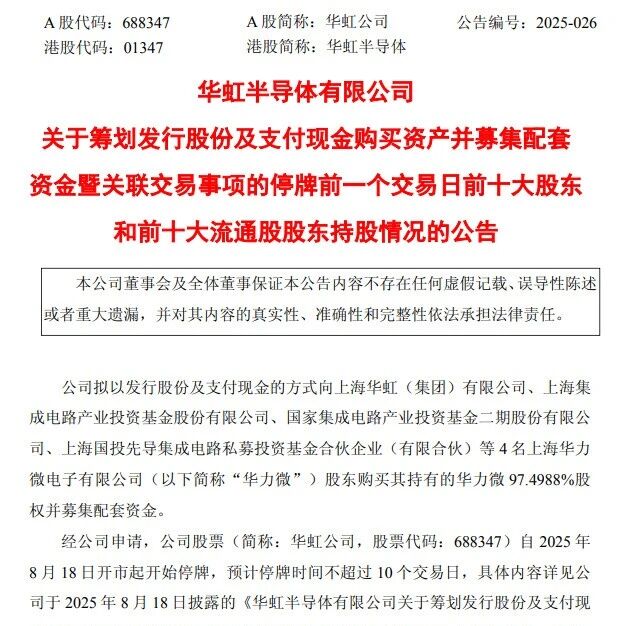
2025年8月31日,国内特色工艺晶圆代工龙头华虹半导体有限公司(股票代码:688347.SH/01347.HK) 正式发布《发行股份及支付现金购买资产并募集配套资金暨关联交易预案》,宣布拟通过发行股份及支 付现金相结合的方式,收购控股股东华虹集团等4名交易对方持有的上海华力微电子有限公司(简称"华 力微")97.4988%股权,并计划向不超过35名特定对象发行股票募集配套资金。 交易完成后,华虹半导体现有0.35μm-40nm工艺与华力微55-28nm产线形成完美衔接,使公司在成熟制 程领域的工艺覆盖更加完整。产能方面,华虹五厂3.8万片/月的12英寸产能注入,将有效缓解华虹当前 108.3%的产能利用率压力,规模效应有望进一步优化单位生产成本。根据华虹集团此前承诺,整合后 65/55nm非易失性存储器业务将由华虹半导体承接,逻辑与射频业务则保留在华力微平台,这种专业化 分工将提升资源配置效率。 作为全球领先的特色工艺晶圆代工企业,华虹半导体2024年实现营收143.88亿元,在中国大陆纯晶圆代 工企业中排名第二,其工艺覆盖0.35微米至40纳米节点,产品广泛应用于新能源汽车、工业控制、物联 网等战略领域。 ...
上海百亿级半导体项目宣告破产!
是说芯语· 2025-08-31 03:00
2025年8月28日,上海市浦东新区人民法院的一纸裁定,为曾经风光无限的上海梧升半导体集团有限公司画上了句号。这家注册资本高达100亿元的半导体 企业,最终以归集财产1100元、负债590余万元的尴尬局面,草草终结了破产清算程序。从2021年高调宣布投资不低于180亿元打造半导体全产业链,到 2025年资产不足以支付破产费用,仅仅过去了四年。 梧升半导体成立于2021年3月,正值国内半导体投资热潮之际。在成立初期,公司及其母公司梧升电子科技集团曾备受瞩目,在2021年上海全球投资促进 大会上高调宣布,梧升半导体项目将落户上海浦东,计划总投资额不低于180亿元,并雄心勃勃地提出要在五年内完成晶圆制造、封装测试及研发设计等 全产业链建设。 事实上,梧升半导体及其关联公司从成立起就显露出明显的资金不足问题。以南京梧升半导体项目为例,虽然注册资本一度增至32.85亿元,但最终因资 金不到位而被迫终止,南京经开区工作人员证实:"梧升后续没有到资,包括人员配置都没有到,在多次沟通后我们就发函给了梧升,要求终止合同"。 梧升半导体的管理层问题是导致公司迅速衰败的关键因素之一。公司法定代表人及实际控制人张嘉梁的背景与半导体行 ...
厉害了!6G,我国取得新突破!
是说芯语· 2025-08-30 23:50
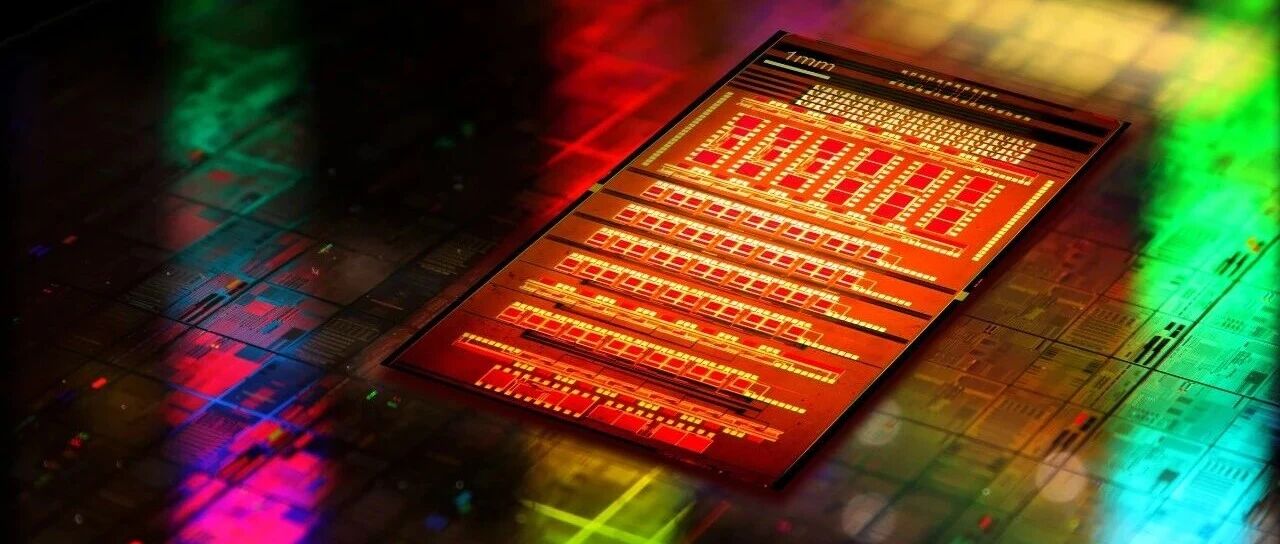
Core Viewpoint - Chinese scientists have successfully developed an ultra-wideband optoelectronic integrated system, achieving high-speed wireless communication across all frequency bands, which is expected to support the future of more reliable 6G wireless communication [1][2]. Group 1: Technological Advancements - The joint research team from Peking University and City University of Hong Kong has spent four years developing this ultra-wideband optoelectronic integrated system, capable of high-speed transmission across a frequency range from 0.5GHz to 115GHz, showcasing international leadership in full-band compatibility [2]. - The system features flexible tunability, allowing dynamic switching to secure frequency bands in response to interference, thereby enhancing communication reliability and spectrum utilization efficiency [2]. Group 2: Analogies and Implications - The technology is likened to building a wide highway for electronic signals, where multiple lanes (frequency bands) are available for vehicles (signals) to choose from, allowing for faster and more efficient travel without congestion [2]. - The integration of AI algorithms into this new system is expected to create a more flexible and intelligent AI wireless network, capable of real-time data transmission and precise environmental sensing, while automatically avoiding interference signals for safer and smoother network communication [5].

台积电“清洗”高毛利、高大陆比重本土设备商
是说芯语· 2025-08-30 23:50
Core Viewpoint - TSMC's decision to exclude Chinese equipment from its 2nm production line has raised concerns in the market, affecting not only mainland semiconductor equipment but also the Taiwanese semiconductor industry [1] Group 1: Supply Chain Management - TSMC is conducting an early review of its supply chain, targeting both "big alliance" and "small alliance" members, including many local Taiwanese equipment and material suppliers [3] - Some suppliers marked for review have unique patented technologies and strong profitability, with many maintaining gross margins over 30%, and some exceeding 60%, which is higher than TSMC's current 58% gross margin [3] - Suppliers heavily reliant on the mainland market will be excluded starting in 2026, leading to order cuts for several companies [3][4] Group 2: Impact on Taiwanese Suppliers - The tightening of supply chain management by TSMC is not only about "de-China" but also affects Taiwanese suppliers, with stricter audits requiring disclosure of gross margins and revenue exposure to mainland China [4] - Taiwanese suppliers are increasingly receiving orders from mainland China, which often have higher margins and larger scales compared to TSMC orders [4] - Many suppliers prefer to serve mainland clients over TSMC due to lower profit margins and the requirement for two years of free trials for TSMC orders [4] Group 3: Government and Industry Response - The Taiwanese government has strengthened its semiconductor strategy, promoting digital transformation and encouraging the formation of holding companies [5] - TSMC has set procurement goals to increase local sourcing, aiming for 65.5% indirect material procurement and 45% component procurement from Taiwan by 2025 [5] - However, TSMC's stricter audits may undermine these local support efforts and conflict with government policies aimed at semiconductor equipment and component self-sufficiency [5] Group 4: Global Semiconductor Equipment Landscape - Global demand for semiconductor equipment is primarily focused on front-end equipment, dominated by manufacturers from the US, Europe, and Japan, while Taiwanese suppliers are limited to back-end tools [6] - TSMC emphasizes that its procurement prices are based on market supply and demand dynamics, and it will continue to collaborate with local suppliers to enhance technology and quality [6] - The projected value of Taiwan's electronic equipment industry is expected to reach NT$600 billion by 2028, with semiconductor equipment accounting for NT$250 billion [6]

科创板即将迎来“光刻胶第一股”!!
是说芯语· 2025-08-30 10:02
Core Viewpoint - Hengkun New Materials faces challenges in its IPO process, primarily due to concerns over technology intellectual property disputes and the appropriateness of its revenue recognition methods [3][4]. Group 1: IPO Challenges - Hengkun New Materials was the first company to face a "suspension of review" in 2025 during the Shanghai Stock Exchange's listing committee meeting, raising questions about its compliance and technical capabilities [3]. - The listing committee questioned the company's technological independence and required further clarification on potential ownership disputes regarding core technologies [3]. - Concerns were also raised about the revenue recognition method used for its introduced business, prompting the company to justify its compliance with accounting standards [3]. Group 2: Response to Regulatory Concerns - In response to the regulatory scrutiny, Hengkun New Materials provided detailed evidence and logical explanations to address the concerns, ultimately gaining approval [4]. - The company emphasized that all core technologies are derived from independent research and development, having obtained 78 patent authorizations, including 45 invention patents [4]. - To alleviate concerns about ownership disputes, Hengkun New Materials clarified that there are no unresolved technical disputes with upstream and downstream partners and has established a comprehensive intellectual property protection system [4]. Group 3: Company Background and Development - Established in 2004 and headquartered in Xiamen, Hengkun New Materials is one of the few companies in China capable of developing and mass-producing key materials for 12-inch integrated circuit wafer manufacturing [6]. - The company transitioned from its initial focus on optical film devices to the semiconductor materials sector in 2014, seizing opportunities for domestic production [6]. - By the end of 2024, Hengkun New Materials had obtained 89 patent authorizations and was recognized as a key materials engineering research center in Fujian Province [6].
最新消息:阿里巴巴三步走战略替代英伟达的,追加寒武纪GPU至15万片
是说芯语· 2025-08-30 07:46
Core Viewpoint - Alibaba is developing a new generation of AI chips focused on multifunctional inference scenarios, aiming to fill the market gap left by NVIDIA's H20 exit [1][3]. Chip Development and Specifications - The new chip utilizes domestic 14nm or more advanced processes, supported by local foundries like Yangtze Memory Technologies, integrating high-density computing units and large-capacity memory with an expected LPDDR5X bandwidth exceeding 1TB/s, targeting a single-card computing power of 300-400 TOPS (INT8), comparable to H20's approximately 300 TOPS [1][3]. - Compared to NVIDIA's H20, Alibaba's chip offers full-scene compatibility, supporting FP8/FP16 mixed precision computing and seamless integration with the CUDA ecosystem, reducing migration costs by over 70% [3]. - Alibaba has urgently increased its order for the Cambricon Siyuan 370 chip to 150,000 units, which is based on a 7nm process and utilizes Chiplet technology, integrating 39 billion transistors and achieving a measured computing power of 300 TOPS (INT8) with a 40% improvement in energy efficiency [5]. Market Strategy and Production Capacity - The Cambricon Siyuan 370 chip is expected to cover 60% of Alibaba Cloud's inference demand by Q2 2025 and supports multi-card interconnection via PCIe 5.0, facilitating user growth for Tongyi Qianwen [5]. - Alibaba collaborates with Yangtze Memory Technologies to develop AI chips focusing on overcoming storage bottlenecks, achieving a storage density of 20GB/mm² and read/write speeds of 7000MB/s, a 40% improvement over the previous generation, expanding local storage capacity to 128GB [5][6]. - To ensure mass production, Alibaba employs a dual-foundry backup strategy, with SMIC's 14nm production line handling basic chip production, achieving a stable yield of over 95% and a monthly capacity of 50,000 units [6]. Future Roadmap - Alibaba's three-step strategy includes: - Short-term (2025-2026): Focus on 7nm/14nm inference chips to quickly capture market share through ecosystem compatibility [10]. - Mid-term (2027-2028): Launch 4nm training chips targeting a computing power of 1 EFLOPS, competing with NVIDIA's H100 [10]. - Long-term (post-2030): Explore disruptive technologies like photonic computing and integrated storage-computing solutions, with the first commercial photonic AI chip already released, promising a speed increase of 1000 times and a 90% reduction in power consumption compared to GPUs [10]. - Alibaba's path to domestic computing power is characterized as a dual battle of technological breakthroughs and ecosystem reconstruction, aiming to disrupt NVIDIA's monopoly through a "compatibility-replacement-surpassing" strategy [10][11].


超13亿!大基金挂牌转让EDA公司
是说芯语· 2025-08-30 01:11
Core Viewpoint - The transfer of 38.7357% equity in Shenzhen Hongxin Weina Technology Co., Ltd. by the National Integrated Circuit Industry Investment Fund is a strategic move reflecting the ongoing exit actions of the first phase of the national big fund, which is entering its investment recovery period [1][2]. Group 1: Equity Transfer Details - The equity transfer price is set at approximately 1.32 billion yuan, with a total valuation of Hongxin Weina estimated at around 3.4 billion yuan [1]. - The transfer requires a one-time payment, indicating a preference for financially robust investors, potentially including large integrated circuit companies or listed firms [1]. - The National Integrated Circuit Industry Investment Fund and Shenzhen Guiding Fund each contributed 496 million yuan to acquire the same percentage of equity in 2024 [1]. Group 2: Company Background and Financials - Shenzhen Hongxin Weina, established in 2018, focuses on the development of a full-process EDA toolchain for digital chips, supporting major semiconductor manufacturers [3]. - The company reported total assets of approximately 6.32 billion yuan and total liabilities of about 2.37 billion yuan as of March 31, 2025, with owner’s equity at around 3.95 billion yuan [3]. - In 2024, the company faced a net profit loss of approximately 179.34 million yuan, with total revenue reported at about 157.82 million yuan [3]. Group 3: Industry Context and Implications - The EDA sector is crucial for chip design and has been dominated by international giants, with domestic market penetration below 10% [4]. - The equity transfer is expected to bring both financial and resource support to Hongxin Weina, accelerating technological advancements and market expansion [4]. - The current valuation of the integrated circuit industry is historically high, with an average P/E ratio of 197, reflecting optimism regarding the domestic substitution process [4].
美商务部:不再豁免在华外资晶圆厂
是说芯语· 2025-08-30 00:11
Core Viewpoint - The U.S. Department of Commerce has announced the revocation of exemptions for Samsung and SK Hynix regarding the use of U.S. technology in their Chinese operations, which may impact their production capabilities in the largest semiconductor market globally [1][2]. Group 1: Regulatory Changes - The revocation of exemptions is part of a broader effort to modify the "Verified End User" (VEU) rules, which restricts China's ability to manufacture chips and threatens Beijing's access to certain technologies [4]. - The exemptions trace back to 2023, when the Biden administration allowed Korean chip manufacturers to procure necessary equipment to maintain and expand their operations in China [5]. - The U.S. Department of Commerce has stated that it does not intend to issue permits for companies to "expand capacity or upgrade technology" in their manufacturing plants in China [7]. Group 2: Impact on Companies - A significant portion of the memory chip production capacity for Samsung and SK Hynix relies on China, with components produced by these companies being used in smartphones and consumer electronics assembled in China [9]. - The decision follows a meeting between former President Trump and South Korean President Yoon Suk-yeol, where they discussed a recent agreement that set tariffs on Korean goods at 15%, avoiding a potential increase to 25% [9]. Group 3: Responses and Future Actions - SK Hynix and Samsung have not immediately responded to requests for comments regarding the announcement [6]. - The U.S. Department of Commerce's Deputy Secretary, Jeffrey Kessler, emphasized that the decision is a significant step towards closing export control loopholes that disadvantage U.S. companies [8]. - The Korean Ministry of Trade, Industry and Energy has stated that it will work to minimize disruptions to Korean enterprises and has been in close communication with the U.S. Department of Commerce regarding potential adjustments to the VEU system [10][11].