私募排排网

Search documents
私募股票策略2025年度10强出炉!幻方居第4!远信、喜世润、北京禧悦分别夺魁!
私募排排网· 2026-01-21 07:00
Core Viewpoint - In 2025, major stock markets including A-shares, Hong Kong stocks, and US stocks experienced significant fluctuations but ultimately recorded impressive cumulative gains, with the Shanghai Composite Index rising over 18% and the ChiNext Index increasing by over 49% [3][4]. Group 1: Market Performance - The Shanghai Composite Index increased by 18.41%, while the Shenzhen Component Index rose by 29.87% and the ChiNext Index surged by 49.57% [4]. - Hong Kong's Hang Seng Index and Hang Seng Tech Index saw gains of 27.77% and 23.45%, respectively [4]. - In the US, the Dow Jones Industrial Average increased by 12.97%, and the Nasdaq rose by 20.36% [4]. Group 2: Private Equity Performance - Private equity stock strategies achieved an average return of approximately 29.20% in 2025, comparable to the Shenzhen Component Index [4]. - A total of 373 private equity firms had at least three stock strategy products with performance data available for 2025 [5]. Group 3: Top Private Equity Firms by Size - Among firms with over 100 billion in assets, the top performers included Yuanxin Investment, Lingjun Investment, and Fusheng Asset, with average returns exceeding a certain threshold [6][8]. - In the 50-100 billion category, Xishirun Investment and Shengqi Asset led the rankings [10][12]. - For the 20-50 billion category, Beijing Xiyue Private Equity and Qiantu Investment topped the list [13][16]. - In the 10-20 billion category, Shanghai Hengsui Asset and Fuyuan Capital were the top firms [17][19]. - For firms below 5 billion, Longhui Xiang Investment and Moku Asset were the leading performers [25][27]. Group 4: Investment Strategies and Focus Areas - Yuanxin Investment focuses on long-term value investment based on deep fundamental research, particularly in emerging sectors like technology and new energy [8]. - Fusheng Asset plans to continue focusing on "new consumption" and is also exploring traditional industries and AI technology applications [9]. - Xishirun Investment emphasizes a research-based approach to value investing, adapting to global market changes [12][16].

黄金突破4800美元:避险逻辑共振下的“系统性定价重估” | 市场观察
私募排排网· 2026-01-21 04:00
Core Viewpoint - The article discusses the recent surge in gold prices, which have surpassed $4800 per ounce, driven by geopolitical tensions, a weakening dollar, and strong demand from central banks and institutions [4][6][8]. Group 1: Geopolitical Risks and Market Reactions - The immediate trigger for the gold price increase is the escalation of global geopolitical tensions, particularly concerning U.S. trade policies and military actions, which have heightened market uncertainty and increased demand for safe-haven assets like gold [7]. Group 2: Currency and Monetary Policy Dynamics - The U.S. dollar index has significantly declined, reaching approximately 98.77, which typically inversely affects gold prices. The market anticipates continued dovish policies from the Federal Reserve, reducing the attractiveness of holding cash and dollar-denominated assets [9]. Group 3: Central Bank and Institutional Demand - Unlike previous market trends driven by speculative funds, the current gold price increase is largely supported by long-term allocation from central banks, which are diversifying their reserves away from dollar assets. This trend is expected to continue amid rising geopolitical and financial instability [11]. - Data from the World Gold Council indicates that global gold ETF inflows are at historically high levels, reflecting sustained demand from institutions and long-term investors [11][12]. Group 4: Technical Analysis and Market Sentiment - Technically, gold prices have broken through key resistance levels of $4400, $4500, and $4600, reinforcing a bullish trend. This positive feedback loop has attracted trend-following funds, further amplifying the market momentum [14]. - The article suggests that if global political and financial uncertainties persist, gold will maintain its position as a core asset for hedging systemic risks, evolving from a mere defensive tool to a strategic asset in portfolios [14].

AI为热门选项,策略多元化成主流!鸣石、蒙玺、世纪前沿等12家量化私募2026年观点研判
私募排排网· 2026-01-21 04:00
Core Insights - The year 2025 is characterized as a significant year for quantitative private equity, with a favorable market environment for quantitative trading, providing ample Alpha space due to active trading and increased volatility [2] - The release of the DeepSeek-R1 model has sparked a competitive race in the "AI + Quant" sector, leading top quantitative private equity firms to engage in an arms race for AI models and talent [2] Group 1: Industry Trends in 2025 - The quantitative private equity industry is entering a high-quality, ecological competition phase, with improved excess returns and a steady growth in scale, benefiting from a more liquid market [6][8] - Key trends identified include "long-term victory," "scale leap," and "strategy iteration," with firms focusing on enhancing strategy adaptability and diversifying sources of returns to strengthen Alpha acquisition capabilities [8][9] - The industry is shifting from a focus on scale to ecological competition, emphasizing the importance of a comprehensive system that integrates research, production, risk control, and operations [9][10] Group 2: Performance and Strategy Capacity - Many firms have reported significant growth in management scale, with some exceeding 100 billion yuan, while emphasizing that their strategy capacity has not yet reached its limit [17][19] - The management scale of firms like 半鞅 has increased from 10-20 billion to 50-100 billion, indicating a positive feedback loop between scale growth and performance [20] - Firms are focusing on maintaining a balance between scale expansion and performance, with a strong emphasis on risk management and strategy adaptability [21][22] Group 3: AI Integration in Quantitative Investment - The application of AI in quantitative investment is becoming increasingly prevalent, with firms integrating AI across various stages of the investment process, from data cleaning to strategy execution [25][26] - Companies like 鸣石基金 have embedded AI deeply into their research processes, enhancing their ability to process large datasets and optimize strategies [26][27] - The focus is on using AI as a tool to enhance existing frameworks rather than replacing traditional investment logic, with an emphasis on human-machine collaboration [29][30] Group 4: Challenges Ahead for 2026 - The primary challenges facing the quantitative private equity industry in 2026 include strategy homogenization and the sustainability of excess returns, as market efficiency increases and strategies become more similar [34][35] - Firms are advised to diversify their strategies and invest in technology and talent to maintain competitive advantages, while also focusing on risk management and investor relations [35][36] - The industry is expected to transition from rapid growth to a focus on high-quality development, with an emphasis on unique strategies and effective risk control [36][37] Group 5: Future Outlook for 2026 - The industry is anticipated to continue focusing on strategy iteration and AI empowerment, with a growing importance placed on strategy diversity and combination management as core competitive advantages [42][43] - Investors are encouraged to assess their risk tolerance and investment goals before allocating to quantitative products, emphasizing the importance of long-term performance and risk management [43][44] - The trend towards multi-strategy and multi-asset approaches is expected to gain traction, as firms seek to provide more tailored solutions to meet diverse investor needs [44][46]
新晋百亿私募,国内知名纯AI量化管理人,一图看懂倍漾量化!
私募排排网· 2026-01-20 12:30
Core Viewpoint - Beiyang Quantitative, established in 2020, is an innovative quantitative manager driven by artificial intelligence technology, achieving a management scale exceeding 10 billion yuan by January 2026, making it the first pure quantitative private equity manager in Jiangsu Province [3][8]. Group 1: Company Overview - Beiyang Quantitative is positioned as an AI-native technology company, employing a full-process AI investment research model, with notable technical strength in artificial intelligence within China [3][9]. - The company was founded by Dr. Feng Ji, who is the executive director of the Nanjing International Artificial Intelligence Research Institute, and the team includes ACM/ICPC medalists and experts in artificial intelligence [3][9]. - As of January 2026, Beiyang Quantitative has built a competitive supercomputing center with a computing power exceeding 150 PFlops and a storage capacity of over 50 PB [12][14]. Group 2: Investment Philosophy and Strategies - The core philosophy of Beiyang Quantitative is "Building the Future of Investment with AI," focusing on transforming financial investment paradigms through advanced technology [3][9]. - The company employs short-cycle quantitative strategies with a turnover rate exceeding 200 times, capturing short-term alpha while maintaining a focus on market volatility [13]. - The investment strategies include: - **Index Enhancement Strategy**: Targets the CSI 1000 index, aiming for excess returns through a combination of active and passive investment approaches [18]. - **Quantitative Stock Selection Strategy**: Focuses on achieving higher absolute returns without tracking specific broad-based indices, allowing for greater flexibility in portfolio construction [20]. - **Market Neutral Strategy**: Utilizes mathematical models to identify pricing inefficiencies while minimizing risk through a balanced long and short position [21]. Group 3: Performance and Recognition - Beiyang Quantitative's products have consistently outperformed benchmarks, with several funds achieving returns above ***% since their inception [3][19]. - The company has received multiple industry honors, including the "Three-Year Outstanding Private Equity Company Award" in the neutral strategy category at the 2025 Golden Bull Awards [27].
私募“女将”业绩十强出炉!浩坤昇发李佳佳、把脉私募许琼娜、博普何瑞琳领衔!
私募排排网· 2026-01-20 10:42
Core Viewpoint - The rise of female fund managers in the private equity sector reflects a significant evolution in investment strategies, talent structures, and decision-making cultures, showcasing their ability to identify overlooked certainties in the market [3][4]. Group 1: Female Fund Managers Overview - As of the end of 2025, there are 197 female private fund managers with performance records on the platform, with the majority (117) from subjective private equity, 38 from quantitative private equity, and 41 from mixed strategies [5]. - Among these, 93 female fund managers are from firms with assets under 500 million, while 40 are from firms with over 2 billion, including 11 from top-tier firms (over 5 billion) [5]. Group 2: Notable Female Fund Managers - Liu Xiaofang from Guangdong Dehui Investment, with 18 years of experience, focuses on deep value investment and emphasizes the importance of fundamental analysis [7]. - Liu Xiaofang's managed products achieved an average return rate of ***% by 2025, ranking her among the top female fund managers [8]. - Li Pei from Banxia Investment is recognized as a pioneer in macro hedging, with her two macro strategy products showing explosive performance in 2025, achieving returns of ***% [9]. Group 3: Performance Rankings - The top ten female fund managers for 2025 have an average return rate exceeding 22%, with the threshold for inclusion being over ***% [10]. - The top three female fund managers for 2025 are Li Jiajia (Haokun Shengfa Asset), He Ruilin (Bopu Technology), and Liu Xiaofang (Guangdong Dehui Investment), with returns of ***% [10][11]. Group 4: Three-Year Performance Rankings - For the three-year performance ending in 2025, the average return rate is 49.95%, with the top three female fund managers being Xu Qionna (Bama Private Equity), He Ruilin (Bopu Technology), and Yang Ping (Shenzhen Shanzhe Private Equity) [14][15]. - Xu Qionna emphasizes a cycle + value investment strategy, achieving an average return of ***% over three years [15]. Group 5: Market Outlook - Liu Xiaofang maintains a cautiously optimistic view for 2026, identifying numerous undervalued sectors and stocks with significant structural opportunities [9]. - Li Jiajia highlights four core sectors for investment opportunities in 2026, including technology breakthroughs, consumption upgrades, cyclical reversals, and policy changes [12][13].

2025年主观私募十强揭晓!远信、盛麒、禧悦等摘冠!复胜、国源信达、龙辉祥等居前!
私募排排网· 2026-01-20 07:00
Core Viewpoint - The article discusses the significant performance of various private equity firms in the A-share market during 2025, highlighting the influence of "hard technology" sectors such as AI, humanoid robots, computing power, non-ferrous metals, and commercial aerospace on market indices like the ChiNext Index and the Sci-Tech 50 Index, which saw substantial gains [3]. Group 1: Market Performance - The A-share market indices showed impressive growth in 2025, with the ChiNext Index rising by 49.57% and the Sci-Tech 50 Index also performing well [4]. - The average return for subjective private equity products reached 35.14%, significantly outperforming the CSI 300 Index [4]. - Notably, 49 private equity firms doubled their annual returns, and 193 firms achieved returns exceeding 50% [4]. Group 2: Private Equity Firms Performance - Among private equity firms with over 10 billion in assets, the top performers included Yuanxin Investment and Fusheng Asset, with the latter achieving a remarkable fundraising success early in the year [6][15]. - The newly established Guoyuan Xinda also made the list, indicating a strong outlook for 2026, with expectations of continued growth in stocks and gold [16]. - In the 50-100 billion category, Shengqi Asset topped the list, followed by Xishirun Investment, both focusing on stock strategies [17][22]. Group 3: Emerging Private Equity Firms - In the 20-50 billion category, Beijing Xiyue Private Equity and Qiantou Investment were the top two firms, both employing stock strategies [23][28]. - For firms in the 10-20 billion range, Fuyuan Capital led with impressive returns, emphasizing a focus on resource stocks and technology for 2026 [29][33]. - In the 5-10 billion category, Qiaogeli Capital and Shanghai Yixin ranked first and second, respectively, with a strong emphasis on stock strategies [34][38]. Group 4: Small Private Equity Firms - Among firms with less than 5 billion in assets, Longhuixiang Investment achieved the highest returns, showcasing the potential for smaller firms in the market [39][44].
中证1000指增如何把握Beta与Alpha? | 资产配置启示录
私募排排网· 2026-01-20 03:41
Group 1 - The core viewpoint of the article emphasizes the growing interest in the CSI 1000 Index Enhanced products, which aim to share Beta returns while striving for excess Alpha, particularly in a recovering market since 2025 [3] - The CSI 1000 Index features a small and mid-cap style, covering companies ranked approximately 801 to 1800 in A-share market capitalization, with a significant representation from high-growth sectors such as electronics, electrical equipment, pharmaceuticals, and computers [4] - The CSI 1000 Index typically exhibits higher elasticity and greater volatility compared to broader indices like the CSI 300 and CSI 500, making it more suitable for investors with a certain risk tolerance seeking potential excess returns through accepting short-term fluctuations [4] Group 2 - Since 2021, the Chinese government has introduced various policies to support the high-quality development of "specialized, refined, and innovative" small and medium-sized enterprises, with cumulative fiscal subsidies exceeding 10 billion by 2025 [7] - The combination of industrial upgrades and policy dividends provides a clear growth logic for the CSI 1000 Index in the medium to long term, particularly as high-tech enterprises constitute a significant portion of its constituent stocks [7] - The performance of private equity CSI 1000 Index Enhanced strategies has shown a clear "Beta + Alpha" advantage, with a strategy index return exceeding 36% over the past year, compared to less than 16% for the CSI 1000 Index [7] Group 3 - When selecting CSI 1000 Index Enhanced products, traditional metrics like return rate and volatility are important, but two new indicators are introduced: non-regular investment annualized return and regular investment annualized return [10] - Non-regular annualized return reflects the product's ability to generate returns from a single entry point, while regular annualized return measures the stability of performance over time with fixed frequency investments [12][13] - Products that perform well on both metrics are rare and indicate a more sustainable and evenly distributed source of Alpha, making them suitable for both one-time allocations and long-term regular investments [14] Group 4 - The article highlights the compounding effect of index enhancement, noting that in volatile market conditions, consistent outperformance against a benchmark can lead to significant excess returns over time [18] - The strategy of index enhancement focuses on closely tracking the benchmark while allocating more to quality stocks and less to underperforming ones, aiming to accumulate excess returns [19] - Long-term holding is suggested as the optimal approach for index enhancement, as short-term evaluations may not accurately reflect the strategy's true capabilities [19]

私募CTA收益榜出炉!京盈智投位列2025年榜首!持赢近半年领跑!华澄短中长业绩均居前3
私募排排网· 2026-01-20 03:41
Core Viewpoint - The article discusses the increasing prominence of CTA (Commodity Trading Advisor) strategies in the context of global supply chain restructuring, geopolitical conflicts, and energy transitions, highlighting their ability to generate absolute returns in volatile markets [6][11]. Group 1: CTA Strategy Overview - CTA strategies do not rely on overall market uptrends and can seek profit opportunities through long or short positions in futures and options, making them attractive during periods of high market uncertainty [6][11]. - In 2025, commodities are expected to experience significant price movements, particularly in precious metals and agricultural products, providing trend-following opportunities for CTA strategies [6][11]. Group 2: Performance Metrics - As of December 31, 2025, the average annual returns for subjective and quantitative CTA products were 34.55% and 20.21%, respectively, with subjective CTA ranking third overall [6][11]. - The top-performing CTAs for the second half of 2025 included companies like Holding Win Private Fund, Jingying Zhito, and Huacheng Private Fund, with the average return for the top 10 CTAs being notably high [8][12]. Group 3: Performance Rankings - In the second half of 2025, the top 10 private funds had an average return of ***%, with a significant number of funds managing under 5 billion [8][12]. - For the entire year of 2025, Jingying Zhito achieved the highest average return among CTAs, followed by Huacheng Private Fund and Jiaxin Rongcheng [12][13]. Group 4: Long-term Performance - Over the past three years, Xurian Investment led the rankings, with a notable average return, while Huacheng Private Fund consistently ranked among the top three [20][21]. - In the last five years, Huacheng Private Fund has been a top performer, achieving high average returns and demonstrating a strong operational strategy [28][29].
Barra风控+限制个股权重+高成分股占比!敦和量化,打造“攻守兼备”的指增利器!
私募排排网· 2026-01-19 12:00
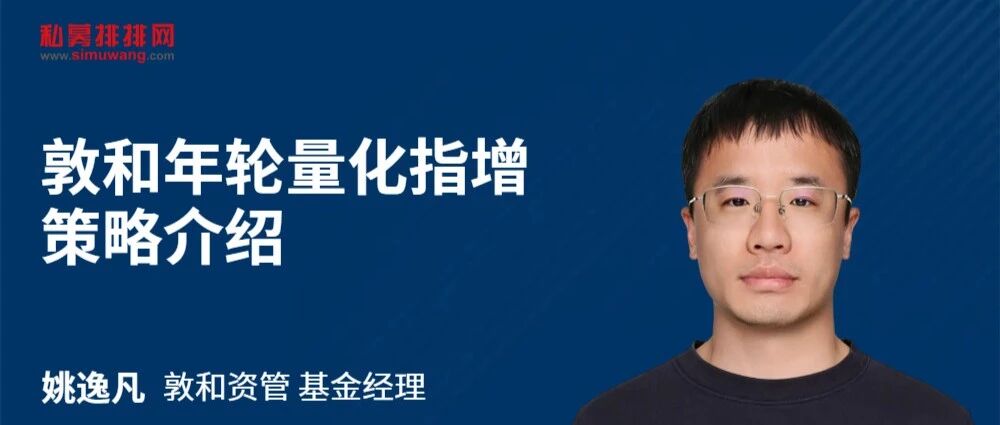
Core Viewpoint - The article emphasizes the increasing structural differentiation in the market, highlighting the phenomenon where "indices rise but profits do not." It presents Dunhe Asset Management's investment philosophy of "asset rotation based on safety margins" as a solution to enhance excess returns in a challenging investment environment [1]. Group 1: Company Overview - Dunhe Asset Management, established in 2011, has consistently adhered to its investment philosophy and has received multiple industry awards, including the Golden Bull Award and the Golden Yangtze Award [1]. - In 2022, Dunhe Asset Management proactively entered the quantitative investment sector by establishing the Dunhe Quantitative Anxin Division, which comprises seven specialized teams and nearly 30 professionals with extensive quantitative experience [1]. Group 2: Performance Metrics - As of December 2025, the Dunhe Year Wheel Quantitative Index Enhancement Series products have shown impressive performance, with the "Dunhe Year Wheel CSI 1000 Index Enhancement No. 1 A-Class" achieving a full-year return of ***% and excess geometric returns exceeding ***%, with a maximum drawdown of ***%, significantly lower than the CSI 1000 index drawdown [2]. - The "Dunhe Year Wheel CSI 2000 Index Enhancement No. 1 A-Class" also reported a full-year return of ***% since its inception on April 16, 2025, with similar metrics of excess returns and drawdown [3][4]. Group 3: Investment Strategy - The Dunhe Year Wheel Quantitative Index Enhancement Strategy is designed as a balanced enhancement tool covering various indices, aiming to provide both offensive and defensive capabilities [8]. - The strategy employs a three-pronged framework of "factor-model-risk control," integrating human and machine-driven factor discovery, traditional machine learning, and advanced deep learning models to enhance predictive capabilities while mitigating strategy crowding [8][9][10]. Group 4: Team Composition - The investment research team for the Year Wheel series consists of seven core members with backgrounds in mathematics, physics, computer science, and artificial intelligence, combining strong academic foundations with practical experience [7]. - The investment manager, Yao Yifan, has over ten years of quantitative research experience across various prestigious institutions, contributing to the strategy's robust professional foundation [7]. Group 5: Future Outlook - As market structural opportunities become increasingly difficult to capture and competition in quantitative strategies intensifies, the article suggests that building a truly balanced and stable investment portfolio will be crucial for future success [11].
股票策略基金经理十强揭晓!但斌领衔百亿!茂源郭学文、复胜陆航、大岩黄铂、橡木楼建平强势上榜!
私募排排网· 2026-01-19 10:00
Core Insights - The article emphasizes the importance of long-term performance over short-term rankings in investment, particularly focusing on the last three years as a critical evaluation period for fund managers [3] - It provides a detailed analysis of the performance of private equity fund managers across different asset sizes, highlighting their average returns and years of experience [4][6][8] Group 1: Performance of Billion-Level Fund Managers - Among the billion-level fund managers, Dan Bin from Dongfang Hongwan leads with an impressive average return of ***% over the past three years, followed by Guo Xuewen from Maoyuan Quantitative and Lu Hang from Fusheng Asset [4][6] - The average return for billion-level fund managers in the last three years is 72.07%, with an average experience of 18.5 years [4][6] Group 2: Performance of 50-100 Million Fund Managers - In the 50-100 million category, Huang Bo from Dayan Capital ranks first with an average return of ***%, followed by He Ruilin from Bopu Technology and Shi En from Yunqi Quantitative [9][11] - The average return for this group over the past three years is 62.24%, with an average experience of approximately 17.4 years [9][11] Group 3: Performance of 20-50 Million Fund Managers - He Yuqing from Yidian Najin ranks first in the 20-50 million category with an average return of ***%, followed by Huang Litu from Qiantou Investment and Lou Jianping from Xiangmu Asset [14][16] - The average return for this group is 69.30%, with an average experience of about 20.7 years [14][16] Group 4: Performance of 10-20 Million Fund Managers - Wei Xiaokang from Shanghai Lingjiu leads the 10-20 million category with an average return of ***%, followed by Liu Xianglong from Fuyuan Capital and Zeng Weijiang from Beijing Zhenke Private Equity [19][21] - The average return for this group is 89.91%, with an average experience of approximately 18.2 years [19][21] Group 5: Performance of 5-10 Million Fund Managers - Wu Tianzeng from Zhongying Investment ranks first in the 5-10 million category with an average return of ***%, followed by Du Yanjie from Shanghai Yixin Private Equity and Han Yongfeng from Jiu (Hainan) Private Equity [22][24] - The average return for this group is 72.48%, with an average experience of about 21.7 years [22][24] Group 6: Performance of 0-5 Million Fund Managers - Yao Yong from Qinxin Fund tops the 0-5 million category with an average return of ***%, followed by Yang Zhongguang from Longhui Xiang Investment and Chu Fan from Mojia Asset [25][27] - The average return for this group is 69.31%, with an average experience of approximately 20.9 years [25][27]