
digihuman(835670)

Search documents
数字人民币App上线新服务!这些行为都能挣钱了!
Jin Rong Shi Bao· 2026-01-08 08:56
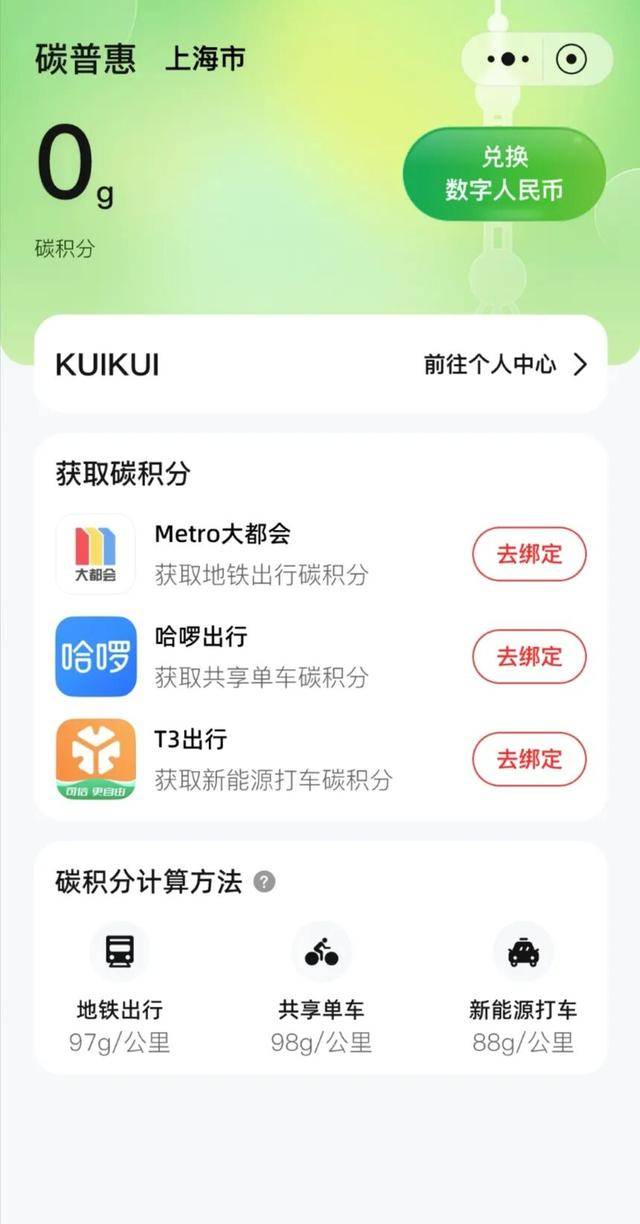
Core Viewpoint - The digital RMB "Carbon Inclusive" service aims to incentivize low-carbon behaviors by allowing users to convert their green actions into carbon credits that can be exchanged for digital currency, promoting public participation in energy conservation and emission reduction efforts [1][9]. Group 1: Carbon Inclusive Service Overview - The "Carbon Inclusive" mini-program has been launched in Shanghai, enabling users to accumulate carbon credits for their low-carbon activities, such as using public transport or shared bikes [1][2]. - Users can link their accounts from platforms like Metro, Hello Bike, and T3 to automatically record their low-carbon behaviors and accumulate corresponding carbon credits [2][5]. Group 2: Carbon Credit Accumulation - The carbon reduction metrics for different services are as follows: Metro calculates carbon reduction at 97g/km, Hello Bike at 98g/km, and T3 for new energy vehicles at 88g/km [5]. - The system automatically converts the distance traveled into carbon credits, encouraging users to engage in more sustainable commuting options [5]. Group 3: User Engagement Process - The process to unlock the "green red envelope" and convert carbon credits into digital RMB involves four simple steps: accessing the mini-program, activating the feature, linking to partner platforms, and redeeming credits for digital currency [6]. - Users must upgrade to a real-name digital RMB wallet to successfully redeem their carbon credits for currency [6]. Group 4: Future Developments - The "Carbon Inclusive" service is expected to evolve with more diverse applications and cities, enhancing the attractiveness and practicality of low-carbon incentives [9]. - The digital RMB management center plans to collaborate with operational entities to introduce additional low-carbon scenarios and expand the service network across multiple cities [9].


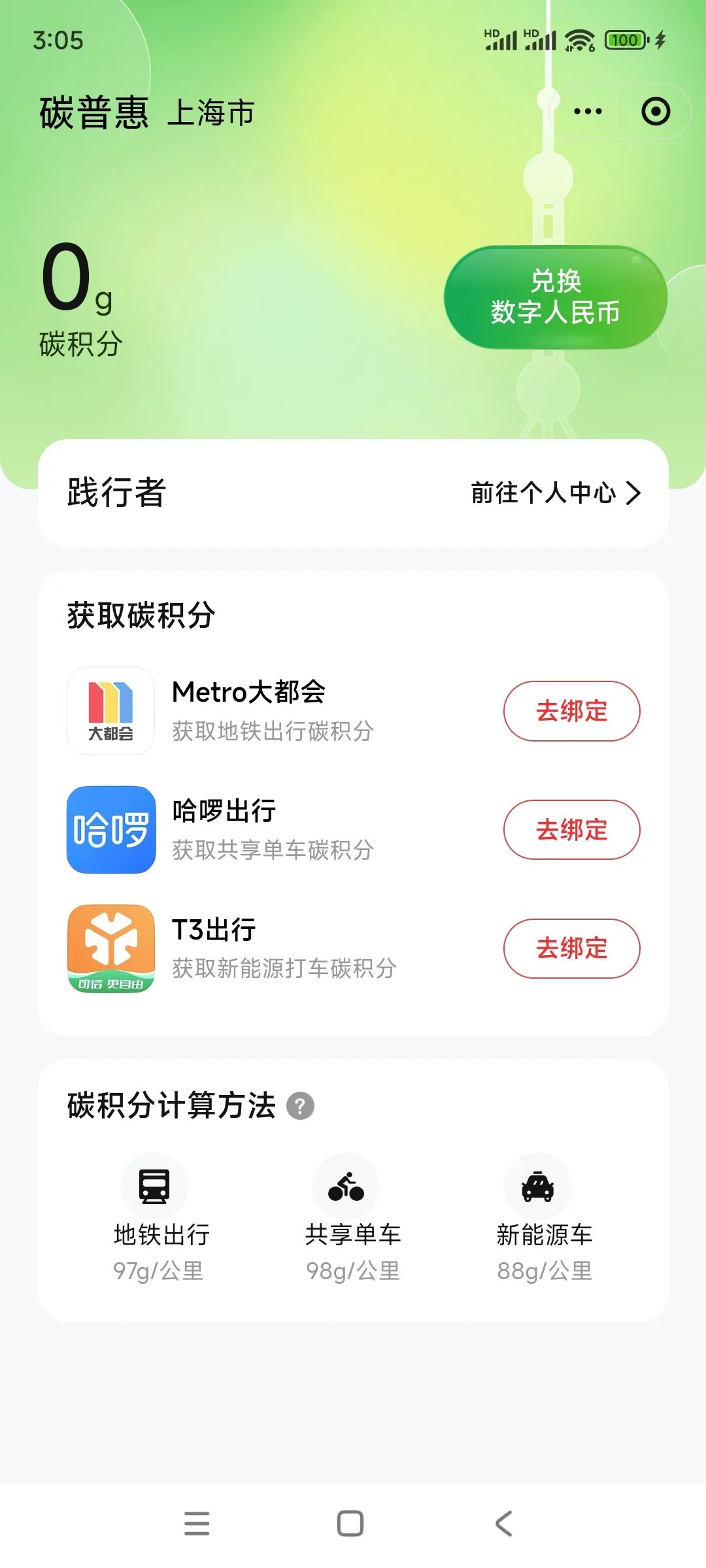
数字人民币App上线“碳普惠”服务 “碳积分”兑换“真金白银”
Sou Hu Cai Jing· 2026-01-08 08:50
Core Viewpoint - The digital renminbi management center has launched a "Carbon Inclusive" mini-program within the digital renminbi app to promote low-carbon behaviors among the public, initially available in Shanghai [1] Group 1: Digital Renminbi Initiatives - The "Carbon Inclusive" service encourages users to engage in low-carbon activities, with carbon credits automatically accumulated in a "Carbon Inclusive" account for everyday green actions such as riding shared bikes or using public transport [1] - Users can exchange their accumulated carbon credits for actual digital renminbi, creating a tangible incentive for environmentally friendly behavior [1] Group 2: Partnerships and Expansion - The initial partners for the "Carbon Inclusive" mini-program include Metro (Shanghai Metro), Hello Chuxing, and T3 Chuxing, indicating a collaboration with major transportation platforms [1] - The digital renminbi management center plans to collaborate with business operators to continuously introduce more low-carbon scenarios and expand the service to multiple cities, aiming to build a collaborative carbon inclusive service network [1]
直播电商新规落地 私域、数字人主播纳入监管
Sou Hu Cai Jing· 2026-01-08 08:48
Core Viewpoint - The newly released "Live E-commerce Supervision Management Measures" aims to enhance supervision and management of live e-commerce, protect the legal rights of consumers and operators, and promote healthy development in the industry, effective from February 1, 2026 [1]. Group 1: Responsibilities and Regulations - The measures clarify the legal responsibilities of four key entities: platform operators, live room operators, live marketing personnel, and service agencies, forming a closed-loop regulatory framework [2]. - Platforms are assigned a crucial role, with responsibilities including qualification verification, credit evaluation, and complaint mechanisms, thereby establishing a comprehensive responsibility system [2]. - The regulation includes private domain live streaming under legal supervision, addressing the challenges of monitoring this area due to its hidden nature [2]. Group 2: Blacklist System and Compliance - A blacklist system is established, requiring platforms to list operators and personnel who severely violate laws, with provisions for appeals and re-evaluation [3]. - The measures prohibit individuals on the blacklist from circumventing penalties by changing accounts and encourage information sharing between platforms for joint punitive actions [3]. - Clear behavioral boundaries are set for operators and marketing personnel, including prohibitions on providing illegal goods or services and false advertising [3]. Group 3: Artificial Intelligence and New Risks - The measures proactively include AI-generated content in regulatory oversight, mandating clear identification of digital personas used in live e-commerce to prevent misuse of technology as a shield for illegal activities [4][6]. - A case involving AI-generated advertisements misleading consumers highlights the necessity for such regulations [6]. Group 4: Collaborative Governance - The measures emphasize the need for a cross-departmental and cross-platform collaborative governance mechanism to address the complexities of live e-commerce [7]. - The regulation aims to enhance cooperation between market supervision and internet information departments, focusing on issues like false advertising and deceptive practices targeting vulnerable groups [7]. - Major platforms are already taking action against violations, with initiatives to combat fraudulent activities and ensure compliance [7]. Group 5: Industry Impact - Experts believe the measures will significantly promote industry standards, eliminate non-compliant entities, and guide the sector from chaotic growth to a focus on quality, fostering long-term healthy development in live e-commerce [8].

日常绿色低碳行为可兑换数字人民币!快来看看怎么操作
2 1 Shi Ji Jing Ji Bao Dao· 2026-01-08 08:04
Core Insights - The digital RMB is expanding its application in "green finance" by launching a "Carbon Inclusive" mini-program in the digital RMB app, initially available in Shanghai [1] - Users can accumulate carbon credits for their low-carbon activities, which can be exchanged for digital RMB, incentivizing environmentally friendly behavior [1][6] - The program integrates with major platforms like Metro, Hello Chuxing, and T3 Chuxing to automatically track users' low-carbon actions and credit their accounts [1] Group 1: Digital RMB and Carbon Inclusive Program - The digital RMB management center is coordinating with business operators to create innovative applications in the carbon inclusive sector [1] - The "Carbon Inclusive" service allows users to convert their carbon credits from activities such as public transport and bike-sharing into digital RMB [1][6] - The program aims to encourage public participation in low-carbon behaviors by quantifying their actions into carbon credits [1] Group 2: User Engagement and Functionality - To activate the "Carbon Inclusive" service, users must open the digital RMB app, navigate to the service page, and bind their accounts with participating platforms [3] - Carbon credits can be exchanged for digital RMB, with a conversion rate of 1 digital RMB for every 1250 grams of carbon credits [10] - Users must upgrade to a real-name digital RMB wallet to successfully redeem their carbon credits for digital currency [10]
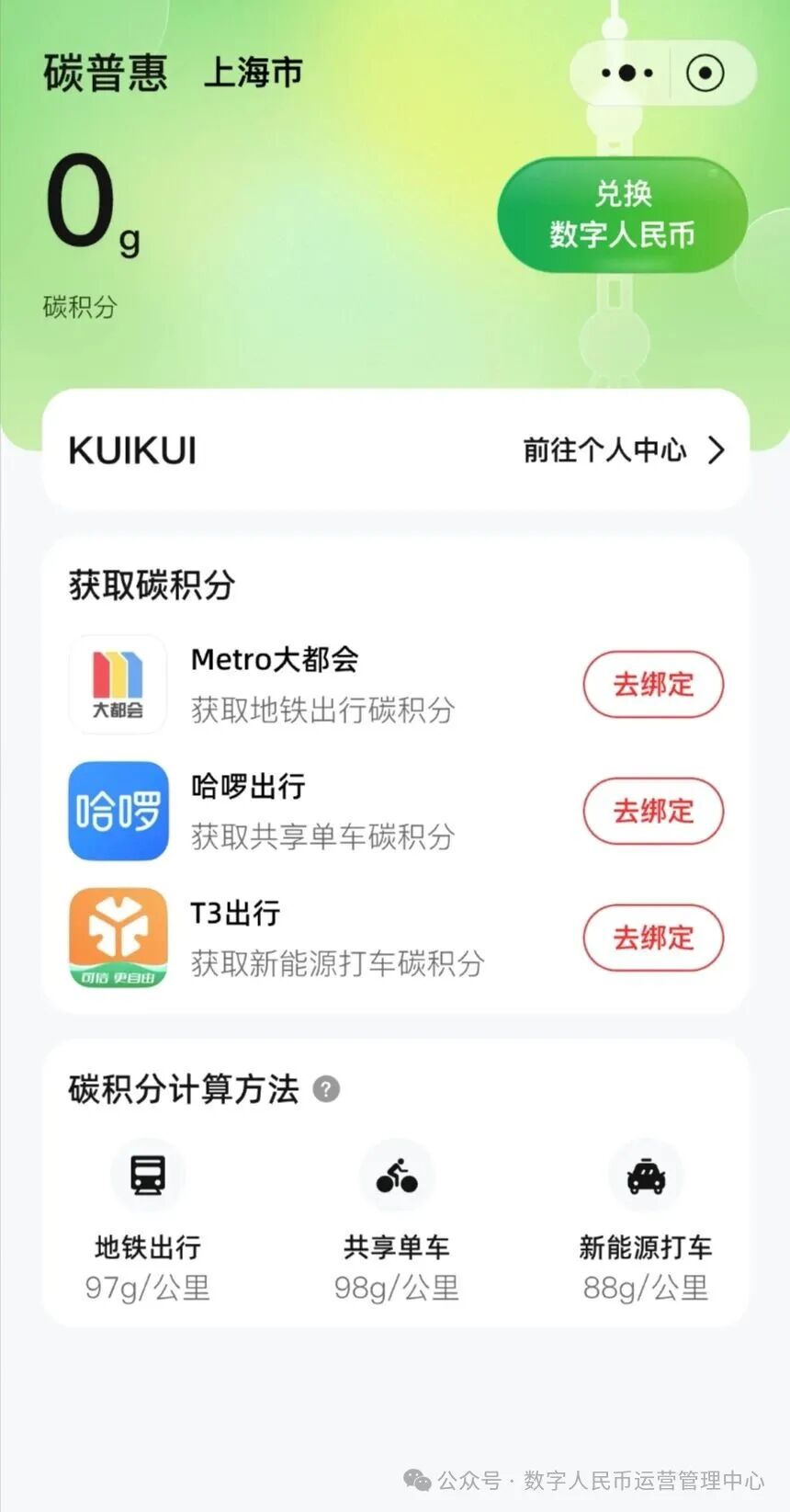
积分换钱!每有1250(g)碳积分可兑换0.01元数字人民币!
Zhong Guo Jing Ying Bao· 2026-01-08 07:46
Core Viewpoint - The Digital Renminbi Operations Management Center has launched a "Carbon Inclusive" mini-program within the Digital Renminbi App to promote the use of digital currency in green finance, initially available in Shanghai [1]. Group 1: Digital Currency and Green Finance - The initiative aims to enhance the application of digital renminbi in the carbon finance sector by creating innovative scenarios for carbon inclusivity [1]. - Users who activate the service will have carbon credits from their daily low-carbon activities automatically collected in a "Carbon Inclusive" account [1]. - Each 1250 grams of carbon credits can be exchanged for 0.01 yuan of digital renminbi, incentivizing users to engage in environmentally friendly behaviors [1].
坐地铁公交能换钱!数字人民币App上线“碳普惠”服务
Bei Jing Shang Bao· 2026-01-08 07:12
Core Viewpoint - The digital RMB is expanding its application in "green finance" by launching a "Carbon Inclusive" mini-program, initially available in Shanghai, to encourage low-carbon behaviors among the public [1] Group 1: Digital RMB and Carbon Inclusive Service - The digital RMB operation management center is coordinating with business operators to create innovative applications in the carbon inclusive sector [1] - Users can accumulate carbon credits for their daily low-carbon activities, which can be exchanged for digital RMB [1] - The "Carbon Inclusive" service aims to motivate the public to engage in environmentally friendly actions, such as using public transport or shared bikes, which will be quantified into carbon credits [1] Group 2: Implementation and User Engagement - The "Carbon Inclusive" mini-program is integrated with three major platforms: Metro, Hello Chuxing, and T3 Chuxing, allowing automatic tracking of low-carbon behaviors [1] - To activate the service, users must open the digital RMB App, access the service page, and complete the binding process with the relevant platforms [2] - Carbon credits can be exchanged for digital RMB, but users must first open a digital RMB wallet and upgrade to a real-name wallet for successful transactions [2]
重大利好 | “数字人民币”重大调整对普通人很有意义
Sou Hu Cai Jing· 2026-01-08 07:06
大朋友小朋友们,2026年到来,一个超级酷炫的"好朋友"也正式登场——我们国家的"数字人民币"升级啦! | | | 一起来看看它们的 "身份大揭秘"吧: 微信和支付宝,就像你漂亮又具备多种功能的小钱包。你可以用微信和支付宝绑定银行卡,然后进行支付。但微信和支付宝本身不是钱,只是帮你保管和 拿出钱的工具。 数字人民币,它可了不起啦!数字人民币本身就是国家造出来的"钱",和你手里摸得到的硬币、纸币本质上是一样的,只是它生活在手机里,是"数字形 态"的钱。 而买东西用数字人民币支付,就像是直接把"电子硬币"从你的手机里"嗖"一下传到了商家的手机里,不需要经过"钱包",这样支付更快,更直接! 不仅能拥有利息收入,以后可能还会在更重要的地方大显身手,而且它超级安全——由国家精心守护,就像有了钢铁铠甲一样。 以前,"数字人民币"像你放在手机里的"电子硬币",现在,"数字人民币"变成会下金蛋的"电子储蓄罐"了! 这意味着,你在持有数字人民币的同时,也能拥有利息收入,能享受管理财富的乐趣了,是不是听起来就很有意思? 你可能会问:"我一直都可以用手机买东西呀,用数字人民币和用微信、支付宝不一样吗?它们和有什么区别呢?" 除此之 ...
数字人民币App上线“碳普惠”服务 首批接入三大低碳场景
Xin Hua Cai Jing· 2026-01-08 06:38
Core Viewpoint - The People's Bank of China is enhancing the application of digital RMB in green finance by launching a "Carbon Inclusive" mini-program, initially available in Shanghai, to encourage low-carbon behaviors among the public [1][3]. Group 1: Digital RMB "Carbon Inclusive" Service - The "Carbon Inclusive" service allows users to accumulate carbon credits for their daily low-carbon activities, which can be converted into digital RMB [2][3]. - The first platforms integrated with the "Carbon Inclusive" mini-program include Metro Shanghai, Hello Chuxing, and T3 Chuxing [1]. Group 2: Future Developments - The digital RMB operation management center plans to collaborate with business operators to introduce more low-carbon scenarios and expand the service to multiple cities, creating a collaborative carbon-inclusive service network [4].
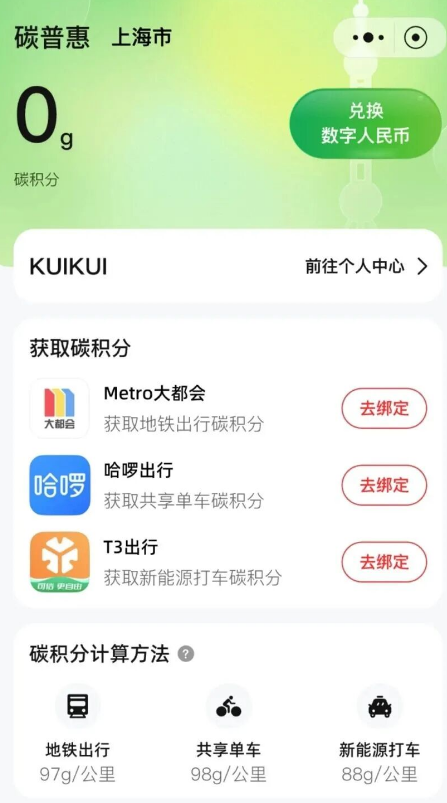
数字人民币App上线“碳普惠”服务
Sou Hu Cai Jing· 2026-01-08 06:36
Core Viewpoint - The digital RMB "Carbon Inclusive" service aims to encourage public participation in low-carbon behaviors by allowing users to earn carbon credits for environmentally friendly actions, which can be exchanged for digital RMB [1][2]. Group 1: Service Overview - The "Carbon Inclusive" service is designed to reward users for engaging in low-carbon activities such as using public transportation and participating in recycling [2][12]. - Users can accumulate carbon credits through their daily green actions, which are automatically recorded in the "Carbon Inclusive" account within the digital RMB app [6][14]. Group 2: Initial Implementation - The first three low-carbon scenarios integrated into the "Carbon Inclusive" program include Metro (Shanghai subway), Hello Bike, and T3 Mobility [3]. - Users must log into the "Carbon Inclusive" mini-program and link their accounts from the aforementioned platforms to automatically track their low-carbon behaviors [6]. Group 3: Activation Process - To activate the service, users need to open the digital RMB app, navigate to the service page, find the "Carbon Inclusive" mini-program, and complete the scene binding [9]. - After activation, users' low-carbon travel behaviors will be automatically recorded, and carbon credits will be accumulated in their accounts [9][14]. Group 4: Redemption Mechanism - Carbon credits can be exchanged for digital RMB, with a conversion rate of 1 digital RMB for every 1250 grams of carbon credits [21]. - Users must have a digital RMB wallet and upgrade it to a real-name wallet before redeeming their carbon credits for digital RMB [21].
数字人民币2.0版2026年上线,六大行钱包余额正式计息
Sou Hu Cai Jing· 2026-01-08 04:40
Group 1 - The core upgrade of digital RMB to version 2.0 will take effect from January 1, 2026, allowing major state-owned banks to pay interest on digital RMB wallet balances at the same rate as demand deposits [1] - The upgrade is based on a recent action plan by the People's Bank of China, which states that digital RMB in commercial bank wallets will be treated as bank liabilities, marking a shift from cash-type to deposit currency-type [1] - The liquidity of digital RMB in the banking system is expected to significantly increase with this transition to a deposit currency, encouraging banks to offer more financial services related to digital RMB [1][2] Group 2 - As of November 2025, the digital RMB pilot program has expanded to 26 regions across 17 provinces, processing a total of 3.48 billion transactions amounting to 16.7 trillion yuan [2] - The number of personal wallets opened through the digital RMB app reached 230 million, while corporate wallets totaled 18.84 million [2] - In the cross-border payment sector, the mBridge initiative has processed 4,868 transactions with a total value of approximately 477.8 billion yuan, with digital RMB accounting for about 96% of the transaction volume [2]