
HKEX(00388)

Search documents
市场成交回落,港交所震荡走低逼近400港元
第一财经· 2025-12-03 07:16
Core Viewpoint - The Hong Kong Stock Exchange (HKEX) has experienced a decline in stock price due to reduced trading volume, with a significant drop from 460 HKD to 406.6 HKD, reflecting a nearly 12% decrease since October 9 [2][4]. Trading Volume as a Key Variable - Short-term stock price movements of HKEX are closely linked to the trading volume in the spot market, which has been low recently, impacting the exchange's revenue [3][4]. - The average daily trading volume has fallen below 2000 billion HKD, significantly affecting HKEX's income and contributing to the stock price decline [5][6]. IPO Market Dynamics - The IPO market remains stable, with no significant slowdown in listing fee income; however, there is a lack of high-profile companies seeking to raise funds in Hong Kong, leading to decreased investor enthusiasm [6][9]. - In 2025, HKEX achieved a record high in revenue of 77.75 billion HKD, with a 45% year-on-year increase, and a net profit of 49 billion HKD, up 56% [8]. Future Outlook - The IPO market is expected to maintain its activity, with a robust pipeline of applications; however, the growth rate may stabilize [9][10]. - Factors that could improve HKEX's outlook include potential increases in market trading volume, sustained interest in the IPO market, and continued net inflows from mainland investors [10].


市场成交回落,港交所震荡走低逼近400港元|公司观察
Di Yi Cai Jing· 2025-12-03 05:53
年底调整后明年有望重拾升势。 李泽铭说,新股挂牌数量比较平稳,交易所上市费收入暂未放缓,不过近日缺乏知名大型企业赴港融 资,部分挂牌公司市场认知度低,投资者申购热情降温,市场担忧本轮新股热潮或已接近尾声,今年以 来大盘反弹及政策利好驱动的上升基本到位,港交所正处于调整阶段,在这个过程中逐步筑底。 IPO节奏维持 根据港交所披露,2025年三季度,该公司实现营业收入77.75亿港元,连续第三个季度创历季新高,同 比上升45%;股东应占净利润49亿港元,同比增长56%。现货市场方面,第三季平均每日成交金额2864 亿港元,较去年同期翻倍;9月日均成交首次突破3000亿港元,达3167亿港元,创单月纪录;首三季日 均成交2564亿港元,亦创同期历史高位,同比上升126%。 新股市场保持活跃,2025年首三季香港融资额居全球新股市场榜首,前三季度共有69家公司新上市,总 融资额达1883亿港元,是2024年前三季度的三倍多;截至9月30日,正在处理的上市申请达297宗。 12月3日,香港交易所(00388.HK)下跌0.88%,中午报收406.6港元,盘中一度触及405.6港元的近两个 月调整新低,相比10月9日46 ...
科技股上市潮加持下,内港两地市场筹资总额占比超全球三成,港股IPO有望全球夺冠
Hua Xia Shi Bao· 2025-12-03 04:38
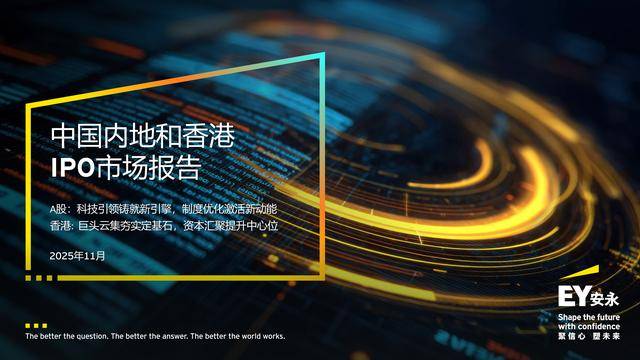
Group 1 - The core viewpoint of the article highlights that the Hong Kong IPO market is expected to maintain its leading position globally, driven by the surge of technology companies from mainland China going public [2][3]. - In 2025, the IPO activities in mainland China and Hong Kong accounted for 16% and 33% of the global total in terms of number and fundraising amount, respectively, with Hong Kong's fundraising amount reaching $36 billion, making it the top exchange globally [2][3]. - The report indicates that the A-share market has shifted from quantity-driven growth to a focus on high-quality development, emphasizing technological innovation and institutional inclusiveness [2][3]. Group 2 - The report notes that the A-share IPO market has transitioned to prioritize quality over quantity, with the number of IPOs remaining stable while fundraising amounts have increased, placing Chinese companies in five of the top ten global IPOs [3][4]. - The active sectors for IPOs include strategic emerging industries such as artificial intelligence, robotics, semiconductors, new energy, and biomedicine, indicating a more mature development stage for the A-share market [4][6]. - The Hong Kong IPO market is expected to remain robust, with a structural deepening characteristic, driven by the A+H model and the return of Chinese concept stocks [4][6]. Group 3 - The report highlights a significant decrease in the first-day IPO failure rate in Hong Kong, dropping to 24%, the lowest in five years, while the average return rate for new listings reached 253%, a five-year high [5][6]. - The introduction of new IPO pricing and allocation regulations in Hong Kong has led to a marked improvement in the profitability of new listings, with only 6 out of 36 new stocks experiencing a failure to list [5][6]. - The influx of international capital into the Hong Kong market has shifted the investor structure from being predominantly foreign to a dual-driven model of domestic and foreign investment [6][7]. Group 4 - The report indicates that the positive effects of mainland companies going public in Hong Kong are diminishing, with the number of mainland enterprises and their fundraising amounts constituting 88.5% and 83.5% of the total, respectively [7][8]. - The phenomenon of A-share companies announcing plans to list in Hong Kong has led to a decrease in stock prices for some firms, indicating a potential over-saturation of such announcements [7][8]. - The report emphasizes the need for companies to embrace technology and build a governance system that aligns with future trends to enhance their competitiveness in the IPO market [8][9].

科技驱动A股动能,港交所融资额居全球交易所榜首
Sou Hu Cai Jing· 2025-12-03 02:54
Group 1 - The core viewpoint of the article highlights the positive trends in the A-share and Hong Kong IPO markets, with a significant emphasis on technology-driven listings and a strong recovery in Hong Kong's IPO activities [2][3][4]. - In 2025, the A-share IPO market experienced moderate growth, with the average fundraising amount increasing by over 50% to 1 billion yuan, driven by large IPOs [3][4]. - The Hong Kong IPO market saw a robust recovery, with total fundraising exceeding 200 billion HKD, marking the second-highest level in five years, largely due to large IPOs from mainland companies [4][5]. Group 2 - The report indicates that the A-share market has shifted from a focus on quantity to a quality-driven approach, with technology innovation becoming a core characteristic of new listings [3][6]. - The Hong Kong market is characterized by a dual engine of new consumption and hard technology, with policies like the "Special Technology Line" facilitating faster listings for high-potential tech companies [6][7]. - The ongoing mutual opening of capital markets between mainland China and Hong Kong is expected to deepen cooperation and enhance market efficiency, with a focus on strategic emerging industries such as AI, robotics, and renewable energy [7][8].
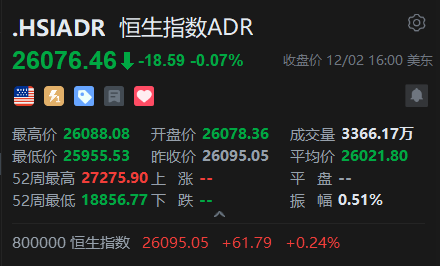
智通ADR统计 | 12月3日
智通财经网· 2025-12-02 22:39
Market Overview - The Hang Seng Index (HSI) closed at 26,076.46, down by 18.59 points or 0.07% on March 10 [1] - The index reached a high of 26,088.08 and a low of 25,955.53 during the trading session, with a trading volume of 33.66 million [1] Blue-Chip Stocks Performance - HSBC Holdings closed at HKD 112.111, up by 1% compared to the previous close [2] - Tencent Holdings closed at HKD 616.297, down by 0.11% compared to the previous close [2] Individual Stock Movements - Tencent Holdings: Latest price HKD 617.000, down by HKD 2.500 or 0.40% [3] - Alibaba Group: Latest price HKD 157.000, up by HKD 2.100 or 1.36% [3] - China Construction Bank: Latest price HKD 8.160, up by HKD 0.010 or 0.12% [3] - HSBC Holdings: Latest price HKD 111.000, up by HKD 0.500 or 0.45% [3] - Xiaomi Group: Latest price HKD 40.700, up by HKD 0.400 or 0.99% [3] - AIA Group: Latest price HKD 80.800, up by HKD 0.300 or 0.37% [3] - NetEase: Latest price HKD 224.400, up by HKD 2.000 or 0.90% [3] - BYD Company: Latest price HKD 100.100, up by HKD 2.150 or 2.19% [3] - Ctrip Group: Latest price HKD 543.000, down by HKD 1.000 or 0.18% [3] - JD Group: Latest price HKD 116.000, down by HKD 1.100 or 0.94% [3]





香港交易所(00388) - 截至2025年11月30日止月份之股份发行人的证券变动月报表
2025-12-02 08:31
股份發行人及根據《上市規則》第十九B章上市的香港預託證券發行人的證券變動月報表 | 截至月份: | 2025年11月30日 | 狀態: 新提交 | | --- | --- | --- | | 致:香港交易及結算所有限公司 | | | | 公司名稱: | 香港交易及結算所有限公司 | | | 呈交日期: | 2025年12月2日 | | | I. 法定/註冊股本變動 | 不適用 | | | 備註: | | | | 香港交易所並無法定股本,及其股本並無股份面值。 | | | FF301 第 1 頁 共 10 頁 v 1.1.1 FF301 II. 已發行股份及/或庫存股份變動 | 1. 股份分類 | 普通股 | | 股份類別 | 不適用 | | 於香港聯交所上市 (註1) | 是 | | | --- | --- | --- | --- | --- | --- | --- | --- | --- | | 證券代號 (如上市) | 00388 | | 說明 | 股份 | | | | | | 多櫃檯證券代號 | 80388 | RMB 說明 | | 股份 | | | | | | | | 已發行股份(不包括庫存股份)數目 ...
12月1日深港通非银(983053)指数跌0.35%,成份股海德股份(000567)领跌
Sou Hu Cai Jing· 2025-12-01 12:02
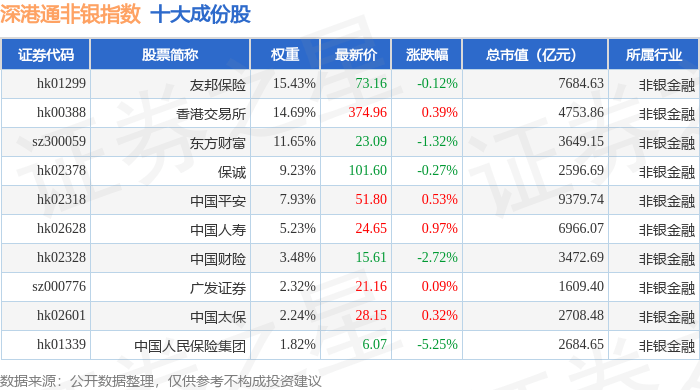
Core Viewpoint - The Shenzhen-Hong Kong Stock Connect Non-Bank Index (983053) closed at 7020.28 points on December 1, experiencing a decline of 0.35% with a trading volume of 20.159 billion yuan and a turnover rate of 0.54% [1] Group 1: Index Performance - On the same day, 34 constituent stocks rose, with Changjiang Securities leading with a 2.27% increase, while 20 stocks fell, with Haide Shares leading the decline at 9.97% [1] - The top ten constituent stocks of the Shenzhen-Hong Kong Stock Connect Non-Bank Index are detailed, with AIA Group holding the highest weight at 15.43% and a latest price of 73.16 yuan, despite a slight decrease of 0.12% [1] Group 2: Market Capitalization - The total market capitalization of the top ten stocks ranges from 1.609 billion yuan for Guangfa Securities to 7,684.63 billion yuan for AIA Group, indicating significant variations in company sizes within the index [1] Group 3: Capital Flow - The net outflow of main funds from the index's constituent stocks totaled 1.288 billion yuan, while retail investors saw a net inflow of 1.046 billion yuan, indicating differing investor behaviors [1] - Detailed capital flow data shows that Bohai Leasing had a net inflow of 36.79 million yuan from main funds, while Changjiang Securities experienced a net outflow of 13.50 million yuan [2]




金融行业周报(2025、11、30):保险开门红展望积极,坚持银行板块配置策略-20251130
Western Securities· 2025-11-30 12:49
Core Conclusions - The financial industry experienced a weekly increase of +0.68% in the non-bank financial index, underperforming the CSI 300 index by 0.96 percentage points [1] - The banking sector saw a decline of -0.59%, lagging behind the CSI 300 index by 2.23 percentage points, with state-owned banks, joint-stock banks, city commercial banks, and rural commercial banks showing varied performance [1][9] Insurance Sector Insights - The insurance sector's index rose by +0.20%, underperforming the CSI 300 index by 1.44 percentage points, driven by strong demand for dividend insurance products that align with residents' needs for stable returns and value appreciation [2][12] - Major insurance companies are focusing on dividend insurance as a strategic core, with product offerings expanding significantly ahead of the 2026 "opening red" period [2][12] - The growth of new single premiums is expected to be strong in 2026, supported by improved net present value margins (NBVM) and a favorable regulatory environment for dividend insurance [2][17] Brokerage Sector Insights - The brokerage sector index increased by +0.74%, underperforming the CSI 300 index by 0.90 percentage points, with recent developments in refinancing for two brokerages indicating a cautious approach to capital raising [2][18] - The current environment presents a mismatch between profitability and valuation in the brokerage sector, suggesting potential for valuation recovery [2][19] - Recommendations include strong mid-to-large brokerages with low valuations and those involved in mergers or restructuring [2][19] Banking Sector Insights - The banking sector's index decreased by -0.59%, underperforming the CSI 300 index by 2.23 percentage points, with a focus on high dividend strategies remaining viable [3][20] - The average dividend yield for banks is approximately 4.1%, which is attractive compared to other sectors, particularly in the context of a stable earnings outlook [3][21] - Recommendations include state-owned banks and resilient city commercial banks, with specific attention to banks with strong fundamentals and low volatility [3][22]



非银金融行业周报:多只券商股被调入重要指数,关注被动资金流入、调整公告日-20251130
Shenwan Hongyuan Securities· 2025-11-30 10:45
Investment Rating - The report maintains a positive outlook on the non-bank financial sector, particularly highlighting the potential benefits for brokerage firms and insurance companies in the upcoming year [3][4]. Core Insights - The report emphasizes the expected inflow of passive funds into newly included stocks in major indices, which could enhance liquidity and market performance for these stocks [4]. - It identifies key trends for 2026, including a shift in insurance companies' focus towards asset-liability matching and the stabilization of core business indicators due to new regulatory standards [4]. - The report recommends specific brokerage firms such as Dongfang Securities, GF Securities, Huatai Securities, and China Galaxy, as well as insurance companies like China Life and Ping An, based on their competitive positioning and growth potential [4]. Summary by Sections Market Performance - The Shanghai Composite Index closed at 4,526.66 with a weekly increase of 1.64%, while the non-bank index rose to 1,932.15, reflecting a 0.68% increase [7]. - The brokerage sector index reported a 0.74% increase, and the insurance sector index saw a 0.20% rise [7]. Brokerage Sector Insights - Notable stocks in the brokerage sector included Guosheng Securities and Xinyi Securities, which saw increases of 3.68% and 3.36%, respectively [9]. - The average daily trading volume for the Shanghai and Shenzhen markets was 17,370.85 billion, a decrease of 6.87% week-on-week, but a year-to-date increase of 61.11% [20]. Insurance Sector Insights - The insurance sector is expected to experience a systematic revaluation in 2026, driven by long-term interest rate increases and continued investment from insurance funds into the stock market [4]. - The report highlights the performance of major insurance companies, with A-shares like China Life and Ping An showing modest increases [9]. Key Data Points - As of November 28, 2025, the average daily trading volume was 19,147.38 billion, and the margin trading balance was 24,720.45 billion, reflecting a year-on-year increase of 32.6% [51][20]. - The report notes that the total market value of private equity funds reached 22.05 trillion, marking a historical high [21].


大湾区交易所科技大会聚焦“迈向人工智能+时代”
Zhong Guo Zheng Quan Bao· 2025-11-28 20:25
Group 1 - The 2025 Greater Bay Area Exchange Technology Conference was held on November 28-29, focusing on "Entering the Era of Artificial Intelligence+" and featured the release of 8 technological achievements [1][2] - The Shenzhen Stock Exchange (SZSE) aims to enhance risk prevention, strengthen regulation, and promote high-quality development during the 14th Five-Year Plan period, with a focus on six key areas to support the construction of a world-class exchange [1] - Key initiatives include building intelligent computing infrastructure, implementing cloud applications, integrating AI into core business areas, improving AI application architecture, enhancing intelligent innovation research, and strengthening AI governance [1] Group 2 - The year 2025 is referred to as the "Year of AI Agents," marking a shift in AI technology from passive response to proactive execution, deeply embedding into workflows to automate complex tasks [2] - The conference highlighted 8 technological achievements, with 2 from SZSE and 6 from industry institutions, including a project on intelligent monitoring of abnormal trading behaviors that has been implemented in the exchange's internal production environment [2] - SZSE, in collaboration with Huawei, developed an industry regulation model that addresses issues of timeliness, accuracy, and completeness in regulatory Q&A, which is currently available for trial on the industry cloud [2]