
CHINA OVERSEAS(00688)

Search documents
中海23.7补仓深圳龙华
Cai Jing Wang· 2025-07-07 09:32
Core Insights - The successful land auction in Longhua District, Shenzhen, reflects intense competition among developers for high-quality land, driven by a low inventory cycle of only 7.6 months as of June [1][3] - The A802-0309 plot, which was previously designated for commercial use, was converted to residential use, highlighting a trend towards enhancing residential quality in Shenzhen's real estate market [2][3] Land Auction Details - The A802-0309 plot was sold for 2.37 billion yuan, with a floor price of approximately 38,975 yuan per square meter, representing a premium of 40.74% over the starting price [1] - The plot covers an area of 21,820.58 square meters, with a total construction area of 61,090 square meters, including residential, commercial, and childcare facilities [1] Market Trends - The recent land auction results indicate a shift towards lower density, high-quality residential developments, aligning with government policies aimed at improving living standards [2][3] - In the first half of 2025, new home transactions in Shenzhen reached 30,245 units, a year-on-year increase of 75.1%, with residential sales specifically rising by 44.9% [2] Regional Performance - Longhua, along with Bao'an and Longgang, ranks as a top area for new residential supply and sales, with notable projects achieving high sales rates [2][3] - The average new home price in the Longhua area was approximately 63,848 yuan per square meter as of June, indicating strong market demand [3]

经过百余轮竞价 中海23.7亿摘得深圳龙华区一宗宅地
news flash· 2025-07-07 09:18
经过百余轮竞价 中海23.7亿摘得深圳龙华区一宗宅地 智通财经7月7日电,深圳今日出让一宗位于龙华区民治街道的住宅用地,该地块土地出让面积21820.58 平方米,规划建筑面积61090平方米,起拍价16.84亿元,起始楼面价27566元/平方米。在与招商、中 海、华润、越秀、深铁等房企经过108轮竞价后,该地块最终被中海以23.7亿元的价格摘得,成交楼面 价38795元/平方米,溢价率40.74%。(智通财经记者 王海春) ...
深圳龙华区宅地溢价40.74%成交
news flash· 2025-07-07 09:16
Core Viewpoint - A residential land parcel in Longhua District, Shenzhen, was sold at a premium of 40.74%, indicating strong demand in the local real estate market [1] Group 1: Land Transaction Details - The land parcel is located in Minzhi Street, Longhua District, with a total area of 21,820.58 square meters and a planned construction area of 61,090 square meters [1] - The starting price for the land was set at 1.684 billion yuan, with a starting floor price of 27,566 yuan per square meter [1] - After receiving bids from six real estate companies and undergoing 108 rounds of bidding, the land was ultimately acquired by China Overseas Shenzhen Real Estate Development Co., Ltd. for a total price of 2.37 billion yuan, resulting in a final floor price of 38,795 yuan per square meter [1]
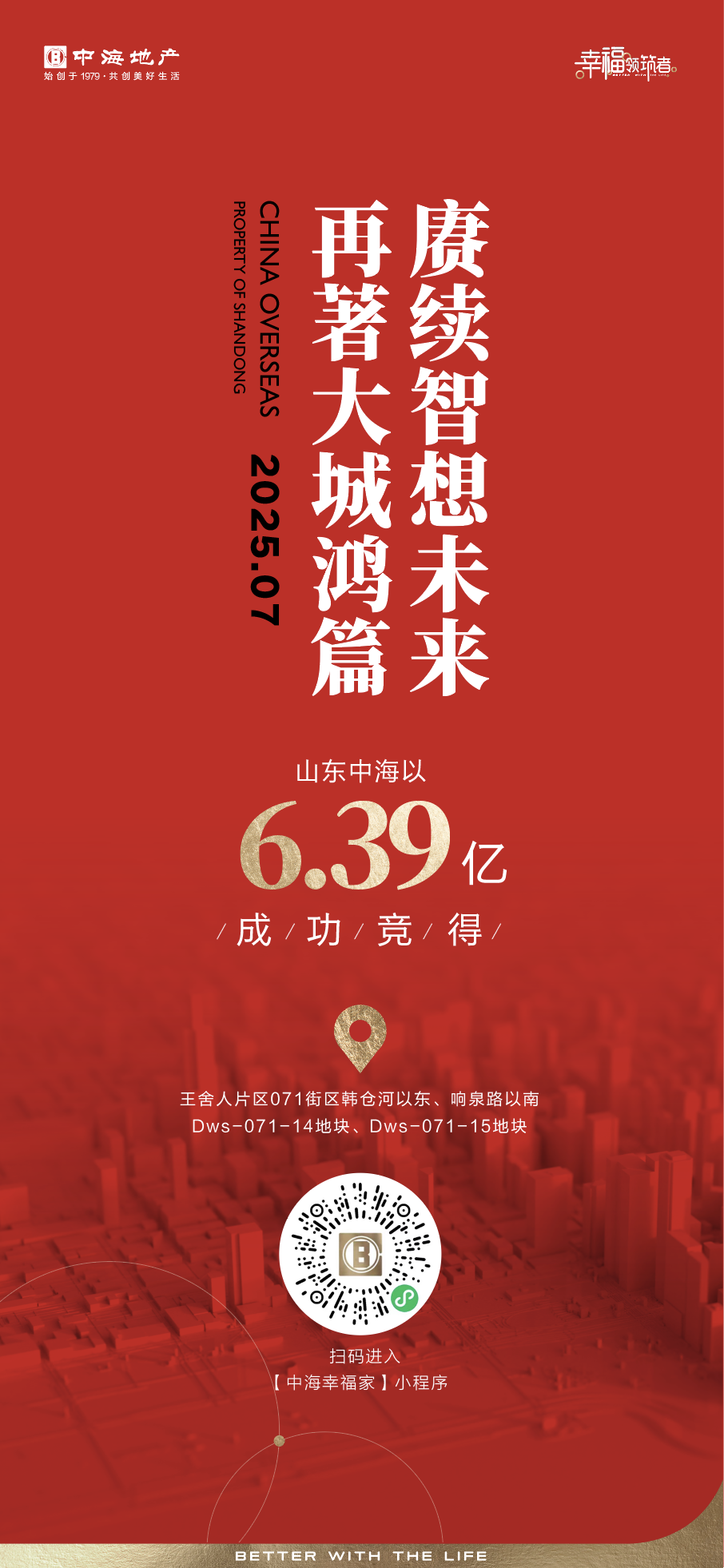
比双十一手速都快,中海4个月斩获3块土地后今日又摘济钢地块
Qi Lu Wan Bao· 2025-07-07 02:50
Group 1 - China Overseas Land & Investment (COLI) has aggressively acquired land in Shandong, securing four significant plots in just four months, indicating a strong commitment to the region [6] - The recent acquisitions include prime locations in Jinan and Qingdao, with a focus on both high-end and affordable housing markets, showcasing COLI's strategy to maintain a diverse portfolio [6] - The company achieved the highest sales revenue and sales area in Shandong for the first half of the year, reflecting its strong brand power and product quality [7][8] Group 2 - The recent land acquisition at Jinan's Jinan Steel site is strategically located in the eastern part of the city, which is expected to attract a significant population due to its proximity to employment centers [12] - The Jinan Steel area is characterized by low-density development, which is anticipated to enhance property value retention and comfort for residents [12] - Infrastructure developments, including the new metro line and parks, are already in place, providing a solid foundation for future residential projects [12]

楼市早餐荟 | 广东明确小产权房不予登记;郑州上调住房公积金月缴存额上限;中国海外发展6月销售额297.13亿元
Bei Jing Shang Bao· 2025-07-07 01:35
Group 1: Real Estate Regulations - Guangdong Province has issued guidelines prohibiting the registration of "small property rights houses" and illegal land use, ensuring that the rights of citizens are protected [1] - The guidelines emphasize that any illegal construction or land use cannot be legitimized through registration, maintaining strict adherence to land use regulations [1] Group 2: Housing Fund Adjustments - Zhengzhou has announced an increase in the monthly housing fund contribution limits for 2025, with a maximum contribution base of 27,520 yuan and a maximum monthly contribution of 6,604 yuan [2] - The minimum contribution base is set at 2,100 yuan, with a minimum monthly contribution of 210 yuan [2] - Similarly, Henan Province has aligned its housing fund contribution limits with Zhengzhou, establishing the same maximum and minimum contribution bases and amounts for 2025 [3] Group 3: Real Estate Sales Performance - China Overseas Development reported a contract property sales amount of approximately 29.713 billion yuan in June, reflecting a year-on-year decline of 36.3%, with a sales area of about 1.3718 million square meters, down 6.7% year-on-year [4] - Country Garden disclosed a contract sales amount of approximately 2.81 billion yuan in June, with a sales area of about 350,000 square meters [5]

地产及物管行业周报:住建部要求多管齐下稳定预期,更大力度推动房地产止跌回稳-20250706
Shenwan Hongyuan Securities· 2025-07-06 10:43
Investment Rating - The report maintains a "Positive" rating for the real estate and property management sectors [5] Core Insights - The report indicates that the real estate market is still in a destocking trend, with new housing market conditions remaining challenging despite some policy support aimed at stabilizing expectations and promoting recovery [4][32] - The report highlights the importance of strong product capability and inventory management in identifying quality real estate companies for investment [5] Summary by Sections Industry Data - New housing transaction volume in 34 key cities decreased by 0.3% week-on-week, with first and second-tier cities seeing a 2% increase while third and fourth-tier cities experienced a 38% decline [6] - In July, the cumulative transaction volume for new homes in 34 cities dropped by 25% year-on-year, with first and second-tier cities also down by 25% [9][10] - The inventory of new homes in 15 cities decreased by 1% week-on-week, with a current available area of 88.85 million square meters [23] Policy and News Tracking - The Ministry of Housing and Urban-Rural Development emphasized the need for multi-faceted approaches to stabilize expectations and promote recovery in the real estate market [32][33] - Local policies include the expansion of housing provident fund loans in Nanjing and new policies in Hainan and Guangzhou to facilitate housing loans [32][33] Company Dynamics - Vanke has applied for a loan of up to 6.249 billion yuan from Shenzhen Metro Group, marking the sixth loan transaction this year [5] - Poly Developments reported sales of 29 billion yuan, down 31% year-on-year, while China Overseas Development reported 29.7 billion yuan, down 36% [5] - The report recommends focusing on quality real estate companies with strong product capabilities and inventory management, including companies like China Overseas Development and Poly Developments [5]






房地产行业研究:半年数据收官:土拍向左,销售向右
SINOLINK SECURITIES· 2025-07-06 09:48
Investment Rating - The report suggests a cautious approach towards the real estate sector, recommending selective investments in companies with strong fundamentals and potential policy benefits [7]. Core Insights - The A-share real estate sector saw a slight increase of +0.3% while the Hong Kong real estate sector rose by +1.7% during the week of June 28 to July 4, 2025 [3][18]. - The land market's premium rate has decreased, with a total of 762,000 square meters of residential land sold across 300 cities, reflecting a week-on-week decline of 35% and a year-on-year decline of 15% [3][29]. - The first half of 2025 showed a significant improvement in land market performance, with a total supply of 21,930 million square meters and a total transaction of 17,390 million square meters, indicating a narrowing decline compared to previous years [5][14]. Summary by Sections Market Overview - The report highlights that the sales volume of commercial housing in 47 cities reached 514,000 square meters, with a week-on-week decrease of 3% and a year-on-year decrease of 8% [4][34]. - The average new home price in May showed a slight decrease of 0.2% month-on-month and a year-on-year decrease of 4.1%, indicating a gradual stabilization in the market [4]. Land Market - The average transaction price for residential land in the first half of 2025 across 300 cities was 4,953 yuan per square meter, with significant year-on-year increases across different city tiers [5][14]. - The top five companies in terms of land acquisition amount included Poly Developments, Greentown China, China Overseas Development, Jianfa Real Estate, and Binjiang Group, with acquisition amounts of 41.4 billion, 40.1 billion, 39.3 billion, 34.1 billion, and 31.3 billion yuan respectively [29][33]. Sales Performance - The total sales amount for the top 100 real estate companies in the first half of 2025 was 1,782 billion yuan, reflecting a year-on-year decline of 11.4% [6][16]. - The report notes a divergence where the decline in sales is greater than the decline in investment, indicating a challenging sales environment for real estate companies [6][16]. Investment Recommendations - The report recommends investing in real estate stocks during market dips, particularly focusing on developers with strong operations in core first and second-tier cities [7]. - Suggested companies include Jianfa International Group, China Overseas Development, and Binjiang Group for developers, and Beike for real estate intermediaries [7].


上半年千亿房企仅剩4家,政策支持力度有望持续加码,7月楼市或延续弱复苏走势
Hua Xia Shi Bao· 2025-07-05 03:09
Group 1 - The core viewpoint of the articles indicates that the real estate market is experiencing fluctuations and adjustments, with a need for further policy support to stabilize the market [1][6][7] - In the first half of the year, the total sales of the top 100 real estate companies reached 18,364.1 billion yuan, a year-on-year decrease of 11.8%, with only four companies exceeding 100 billion yuan in sales [2][4] - The land acquisition strategy is shifting towards core cities such as Beijing, Shanghai, and Chengdu, with the average premium rate for land transactions increasing to 9.2% [4][5] Group 2 - Major cities like Beijing, Shanghai, and Guangzhou have shown significant growth in new residential sales, with Guangzhou experiencing a 16% year-on-year increase [3][6] - The government is expected to continue implementing policies to stabilize the market, including measures to enhance housing demand and improve supply [6][7] - The trend of "good cities + good houses" is emerging, indicating structural opportunities in the market, with a focus on product innovation to meet changing consumer preferences [7][8]
企业月报 | 单月销售、投资环比增长,新城实现民企境外债“破冰”(2025年6月)
克而瑞地产研究· 2025-07-05 02:26
1、 合约销售: 百强房企6月业绩环比增长14.7% 2、 企业拿地:典型房企投资规模回升,头部房企投资持续领跑 3、 企业融资: 单月总量再创年内新高,新城实现民企境外债"破冰" 4、 组织动态: 招商蛇口裁撤5大区域,中海地产城市总再换防 核心内容 ◎ 文 / 克而瑞研究中心 0 1 合约销售 百强房企6月业绩环比增长1 4 . 7% 核心观点: 1、 2025年6月, TOP100房企实现单月销售操盘金额3389.6亿元, 环比增长14.7% 。上半年累计实现销售 操盘金额16526.8亿元。 2、 从百强房企规模门槛来看,2025年6月TOP30房企 销售操盘金额门槛同比增长1.2%至119.8亿元。其他 各梯队房企的销售操盘金额门槛则略有降低。具体分梯队来看,2025年上半年百强房企各梯队销售规模变 动分化。其中, TOP21-30梯队房企 的累计销售规模同比基本持平。 而TOP10、TOP11-20和TOP51-100 梯队房企 销售规模则同比降低。 3、 从企业表现来看,2025年6月近六成百强房企单月业绩环比增长,其中28家企业单月业绩环比增幅大于 30%。 如中海地产、华润置地、招商蛇口、中 ...

2025年或许就只剩7家千亿房企了
Guan Cha Zhe Wang· 2025-07-05 02:22
Core Viewpoint - The number of billion-dollar real estate companies in China is sharply declining, with only a few remaining amidst a cooling new housing market [1][2]. Group 1: Sales Performance of Real Estate Companies - In the first half of 2025, only three companies—Poly Developments, Greentown China, and China Overseas—achieved sales exceeding 100 billion yuan, with sales figures of 133.61 billion yuan, 122.11 billion yuan, and 114.12 billion yuan respectively [1]. - The overall sales performance indicates that by the end of 2025, it is estimated that only seven companies may reach the billion-dollar sales mark [2]. Group 2: New Housing Market Trends - The new housing market is experiencing a downturn, with a 2.9% year-on-year decrease in the sales area of newly built commercial housing from January to May 2025, and a 3.8% decline in sales revenue [3]. - The sales of pre-sold properties fell by 10.0%, while the sales of existing homes increased by 13.2% during the same period, indicating a preference for existing homes over new constructions [3]. Group 3: Market Segmentation and Pricing - The demand for homes in the 90-120 square meter range remains dominant, but there is an increasing interest in larger units (120-140 square meters and 180-220 square meters), reflecting a shift towards both first-time buyers and those seeking improved living conditions [6]. - In major cities, such as Shanghai, high-end projects are seeing strong demand, with some properties selling out quickly, while peripheral areas face significant challenges with low buyer interest [5]. Group 4: Land Market Dynamics - The residential land market is showing signs of recovery, with a nearly 30% year-on-year increase in land transfer fees across 300 cities, and an average premium rate of 10.2% [7]. - Core cities like Beijing, Shanghai, and Hangzhou are experiencing high demand for quality land parcels, with significant premium rates achieved during land auctions [8][9].