
CNOOC(00883)

Search documents
【真灼机构观点】美国股市经历剧烈调整 港股通周二净流入98亿港元
Sou Hu Cai Jing· 2025-11-05 04:42
Group 1 - The U.S. stock market experienced significant adjustments on November 4-5, with technology stocks leading the decline, and the Nasdaq dropping over 2% [2] - AI stock valuations are seen as a core risk, with Palantir's price-to-earnings ratio reaching 700 times, far exceeding historical levels [2] - The Federal Reserve's changing stance and persistent inflation above target for over four and a half years are putting pressure on technology companies that heavily rely on low-interest financing [2] Group 2 - Market analysts warn of a potential correction of 10% to 20%, reflecting growing investor concerns that technology stock valuations may not be self-justifying, with over 300 S&P 500 constituents declining [2] - In the Hong Kong stock market, net inflows through the Stock Connect on Tuesday reached HKD 9.8 billion, with China National Offshore Oil Corporation (00883.HK) seeing the highest net inflow of HKD 1.05 billion, followed by Xiaomi Group (01810.HK) [2] - Conversely, Alibaba (09988.HK) recorded the largest net outflow of HKD 868 million, followed by Sunny Optical Technology (02382.HK) [2]





铁矿石:三季度四大矿山产销平稳
Wu Kuang Qi Huo· 2025-11-05 01:48
Report Summary 1. Investment Rating There is no information about the industry investment rating in the provided content. 2. Core Viewpoints - In Q3 2025, the production and sales of the four major iron ore mines were generally stable. Vale's production and sales increased year - on - year and quarter - on - quarter, Rio Tinto remained basically flat, FMG declined quarter - on - quarter due to the first quarter of the new fiscal year, and BHP decreased both year - on - year and quarter - on - quarter [1]. - The total iron ore production/processing volume of the four major mines in Q3 was 299.5 million tons, basically flat quarter - on - quarter and up 1.63% year - on - year. In terms of sales, the total sales volume was 291 million tons, up 0.52% quarter - on - quarter and 1.86% year - on - year [1]. - For the first three quarters of 2025, the total production of the four major mines increased by about 10 million tons year - on - year, with FMG showing a significant increase. The total sales volume decreased by about 500,000 tons year - on - year, mainly due to Rio Tinto's reduced shipments [1]. - Overall, the four major mines were stable in the first three quarters. Rio Tinto may face some pressure to boost shipments in Q4. It is expected that the annual shipment volume of the four major mines will increase by 3.5 - 6 million tons year - on - year, with relatively limited overall growth [1]. 3. Summary by Company Rio Tinto - In Q3 2025, production in the Pilbara region remained high at about 84.1 million tons (100% equity), with year - on - year and quarter - on - quarter stability. Shipments were 84.3 million tons, basically flat year - on - year and up about 5.51% quarter - on - quarter, reaching the second - highest Q3 record since 2019 [6]. - The Gudai - Darri mine achieved its highest quarterly production, with an annualized production capacity of 51 million tons. The IOC mine in Canada produced about 2.348 million tons in Q3, up 11% year - on - year but down 6% quarter - on - quarter [9]. - Since July, Rio Tinto has been shipping adjusted PB fines. It maintains its 2025 shipment guidance of 323 - 338 million tons, but considering the early - year losses, the annual shipment is expected to be at the lower end of the guidance range [9]. BHP - In Q3 2025 (Q1 of FY2026), BHP's WAIO production was 62.01 million tons (equity basis), down about 2% year - on - year and 9% quarter - on - quarter; 70.25 million tons on a 100% equity basis, down about 2% year - on - year. Planned maintenance affected short - term production, but the Samarco project's output increased significantly [12]. - Sales were basically flat, with a slight year - on - year decline of about 1%. The sales of lump ore increased by 5% year - on - year. BHP maintains its FY2025 production guidance of 258 - 269 million tons (284 - 296 million tons on a 100% equity basis) [12]. FMG - In Q3 2025 (Q1 of FY2026), FMG's iron ore shipments were 49.7 million tons (including 2.1 million tons from the Iron Bridge project), up about 4% year - on - year, setting a record for the same period. Due to seasonal maintenance, shipments decreased by about 10% quarter - on - quarter. Ore processing volume was 50.8 million tons, up about 6% year - on - year [16]. - The proportion of Super Special Fines and Blend Fines is about 78%. FMG maintains its FY2026 shipment guidance of 195 - 205 million tons, with the Iron Bridge project contributing about 10 - 12 million tons [16]. Vale - In Q3 2025, Vale's iron ore production reached 94.4 million tons, up 3.8% year - on - year and 12.9% quarter - on - quarter, the highest for the same period since 2018. Sales were 86 million tons, up 5.1% year - on - year and 11.2% quarter - on - quarter [18][23]. - Inventory increased by about 4.5 million tons in Q3, mainly due to more in - transit concentrate products in China. The pellet production in Q3 was 7.997 million tons, down 22.8% year - on - year [23]. - Assuming Q4 production is the same as the previous year, Vale's annual production is expected to be slightly higher than the mid - point of the guidance range of 325 - 335 million tons [24].


资金复盘 | 北水逆势抢筹港股超98亿港元!小米、中海油获加仓
Xin Lang Cai Jing· 2025-11-05 01:44
Market Performance - The Hong Kong stock market indices experienced a decline, with the Hang Seng Index falling by 0.79%, the Hang Seng Tech Index down by 1.76%, and the National Enterprises Index decreasing by 0.92% [1] - Gold stocks saw significant drops, with Tongguan Gold and Lingbao Gold falling over 6%, Zijin Mining and Chifeng Jilong Gold down over 5%, Zhaojin Mining down over 4%, and Zijin Gold International down over 2% [1] Capital Flow - Southbound funds recorded a net purchase of Hong Kong stocks amounting to 9.832 billion HKD, with the Shanghai-Hong Kong Stock Connect contributing 5.202 billion HKD and the Shenzhen-Hong Kong Stock Connect contributing 4.630 billion HKD [1] - China National Offshore Oil Corporation, Xiaomi Group-W, and China Mobile received net purchases of 1.046 billion HKD, 1.002 billion HKD, and 753 million HKD respectively [2] - Alibaba-W, Sunny Optical Technology, and SMIC faced net sales of 868 million HKD, 325 million HKD, and 234 million HKD respectively [2] Regulatory Changes - Starting from August 19, 2024, the Shanghai and Shenzhen Stock Exchanges will adjust the information disclosure mechanism for the Shanghai-Shenzhen-Hong Kong Stock Connect, which will include daily disclosures of total trading amounts and active securities [3]

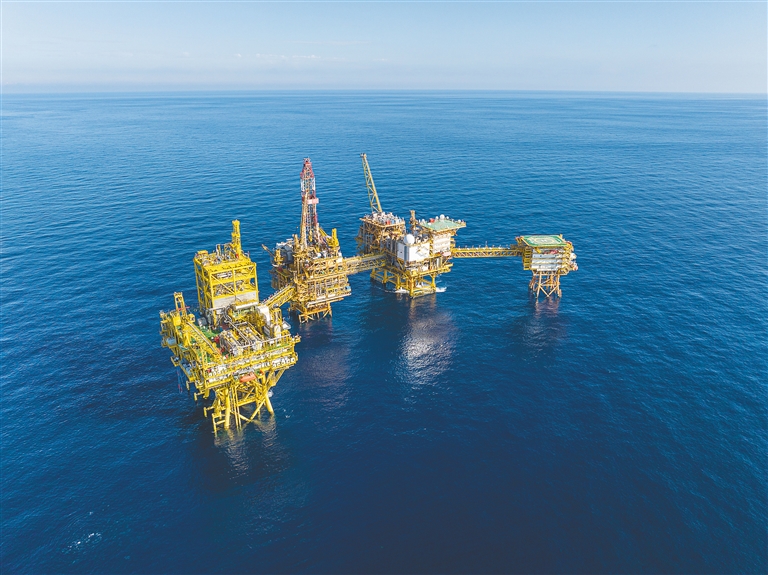
年产气量超45亿立方米“深海一号”系我国产量最大的海上气田
Hai Nan Ri Bao· 2025-11-05 01:43
Core Insights - "Deep Sea No. 1" is China's largest offshore gas field, with an annual production capacity exceeding 4.5 billion cubic meters [5][8] - The project has achieved a daily gas production of up to 15 million cubic meters, marking a significant milestone in deep-sea oil and gas development in China [6][8] Production Capacity - The "Deep Sea No. 1" gas field has a total of 23 underwater gas wells that are now operational, contributing to its status as the largest offshore gas field in China [5][6] - The gas produced is transported to various regions, including Hainan Free Trade Port and the Guangdong-Hong Kong-Macao Greater Bay Area, benefiting numerous households and industries [5][8] Technical Achievements - The project faced extreme geological conditions, with the highest formation temperature reaching 138 degrees Celsius and maximum pressure exceeding 69 MPa, presenting significant technical challenges [6][9] - "Deep Sea No. 1" has become the deepest and most challenging deep-water gas field developed independently in China, showcasing advanced technology and engineering capabilities [6][9] Innovative Development Model - The project utilized a pioneering development model combining underwater production systems, shallow water jacket platforms, and deep-water semi-submersible platforms, which is a first in the industry [7] - The infrastructure includes a vast network of underwater pipelines and platforms, spanning over 170 kilometers and operating at depths exceeding 1,500 meters [7][8] Future Prospects - The successful implementation of "Deep Sea No. 1" is expected to enhance the development of other complex deep-water oil and gas reserves, contributing to China's energy supply and supporting the transition to a greener energy structure [7][9]
智通港股通持股解析|11月5日





智通财经网· 2025-11-05 00:33
Core Insights - The top three companies by Hong Kong Stock Connect holding ratios are China Telecom (71.17%), COSCO Shipping Energy (70.06%), and GCL-Poly Energy (69.25%) [1][2] - The largest increases in holdings over the last five trading days were seen in the Tracker Fund of Hong Kong (+56.53 billion), Hang Seng China Enterprises (+19.83 billion), and Meituan-W (+17.13 billion) [1][2] - The largest decreases in holdings were recorded for Tencent Holdings (-18.04 billion), ZTE Corporation (-6.76 billion), and Innovent Biologics (-6.70 billion) [1][3] Group 1: Hong Kong Stock Connect Holding Ratios - China Telecom (00728) has a holding ratio of 71.17% with 9.878 billion shares [2] - COSCO Shipping Energy (01138) has a holding ratio of 70.06% with 908 million shares [2] - GCL-Poly Energy (01330) has a holding ratio of 69.25% with 280 million shares [2] Group 2: Recent Increases in Holdings - Tracker Fund of Hong Kong (02800) saw an increase of +56.53 billion in holdings, with a change of +21.71 million shares [2] - Hang Seng China Enterprises (02828) increased by +19.83 billion, with a change of +2.12 million shares [2] - Meituan-W (03690) increased by +17.13 billion, with a change of +1.71 million shares [2] Group 3: Recent Decreases in Holdings - Tencent Holdings (00700) experienced a decrease of -18.04 billion, with a change of -2.86 million shares [3] - ZTE Corporation (00763) saw a decrease of -6.76 billion, with a change of -2.09 million shares [3] - Innovent Biologics (01801) decreased by -6.70 billion, with a change of -0.77 million shares [3]
中国海油(600938)2025年三季报点评:成本同比优化 圭亚那YELLOWTAIL项目投产
Ge Long Hui· 2025-11-04 20:47
Core Viewpoint - China National Offshore Oil Corporation (CNOOC) reported a decline in revenue and net profit for the first three quarters of 2025, with a slight recovery in Q3, driven by increased production and successful project launches [1][2]. Financial Performance - For the first three quarters of 2025, CNOOC achieved revenue of 312.5 billion yuan, a year-on-year decrease of 4.15%, and a net profit attributable to shareholders of 101.97 billion yuan, down 12.59% year-on-year [1]. - In Q3 2025, the company reported revenue of 104.9 billion yuan, with a year-on-year increase of 5.68% and a quarter-on-quarter increase of 4.11%. The net profit for Q3 was 32.44 billion yuan, reflecting a year-on-year decrease of 12.10% and a quarter-on-quarter decrease of 1.59% [1]. Sales and Production - In Q3 2025, CNOOC's oil and gas sales revenue was 83.74 billion yuan, down 3.0% year-on-year, with liquid petroleum sales revenue at 69.95 billion yuan, down 5.6%, while natural gas sales revenue increased by 13.0% to 13.78 billion yuan [1]. - The average realized price for liquid petroleum in Q3 was 66.62 USD per barrel, a decrease of 12.8% year-on-year, while the realized price for natural gas was 7.80 USD per thousand cubic feet, an increase of 0.6% year-on-year [1]. - CNOOC's total oil and gas production in Q3 was 193.7 million barrels of oil equivalent, up 7.9% year-on-year, with liquid petroleum production at 149.0 million barrels of oil equivalent, up 7.1%, and natural gas production at 261.3 billion cubic feet, up 11.0% [1]. Exploration and Project Development - In Q3 2025, CNOOC successfully evaluated four oil and gas structures, with significant results from the Kenli 10-6 structure and the Lingshui 17-2 integrated rolling reserve increase [2]. - Four projects were launched in Q3, including the Kenli 10-2 oilfield group development project, Dongfang 1-1 gas field 13-3 area development project, Guyana Yellowtail project, and Wenchang 16-2 oilfield development project, with peak daily production of 19,400, 5,500, 250,000, and 11,200 barrels of oil equivalent, respectively [2]. Cost Management and Shareholder Returns - CNOOC's main cost per barrel of oil equivalent was 27.35 USD, optimized by 0.79 USD per barrel compared to the first three quarters of 2024, enhancing the company's competitiveness [2]. - The company has committed to a dividend payout ratio of no less than 45% for the years 2025-2027, an increase of 5 percentage points compared to the previous three years, indicating potential for improved shareholder returns in the long term [2]. Investment Outlook - Based on current oil price trends and production growth, CNOOC is expected to achieve net profits attributable to shareholders of 138.2 billion yuan, 143.6 billion yuan, and 146.9 billion yuan for 2025-2027, with a corresponding price-to-earnings ratio of 9 [3]. - A relative valuation method suggests a target price of 36.24 yuan for 2026, based on a 12 times price-to-earnings ratio [3].
南向资金与上市公司回购给力 港股仍有上行空间
Zhong Guo Zheng Quan Bao· 2025-11-04 20:17
Core Insights - Southbound capital has significantly increased its holdings in the Hong Kong stock market, marking it as the largest source of incremental funds this year, with a cumulative net inflow exceeding 1.27 trillion HKD, a historical high [1][4] - The Hong Kong stock market has performed well this year, with the Hang Seng Index and Hang Seng Tech Index rising over 29% and 30% respectively as of November 4 [1][6] - Despite recent market fluctuations, analysts believe that the Hong Kong market is primarily driven by liquidity, with potential for substantial upward movement in the medium to long term [1][7] Southbound Capital Inflows - As of November 4, 2023, southbound capital has recorded a cumulative net inflow of 12,753.21 billion HKD this year, more than double the amount from the same period in 2024, with a single-day record inflow of 358.76 billion HKD on August 15 [1][4] - In 198 trading days this year, there were net inflow days on 166 occasions, accounting for over 80% [1] - Monthly net inflows have consistently exceeded 110 billion HKD in several months, including January through April, July, August, and September [1] Holdings and Sector Preferences - As of November 3, 2023, southbound capital held 5,525.19 billion shares, an increase of 867.34 billion shares since the beginning of 2025, with a market value of 6.29 trillion HKD, up 2.71 trillion HKD [2] - The financial, information technology, and consumer discretionary sectors have the highest holdings, valued at 15,135.25 billion HKD, 13,086.04 billion HKD, and 8,918.34 billion HKD respectively [2] - Major stock holdings include Tencent Holdings over 650 billion HKD, Alibaba-W over 360 billion HKD, and several banks and energy companies exceeding 200 billion HKD [2] Recent Buying Trends - The most significant increases in holdings this year have been in China Construction Bank, Bank of China, and other major banks, with increases of 68.96 billion shares, 52.02 billion shares, and 50.27 billion shares respectively [3] - In the past month, the financial, energy, and communication services sectors saw the highest net buying amounts, with 255.73 billion HKD, 112.20 billion HKD, and 95.67 billion HKD respectively [4] Company Buybacks - As of November 3, 2023, Hong Kong-listed companies have repurchased over 1,460 billion HKD worth of shares, with 239 companies participating in buybacks this year [5] - Tencent Holdings leads in buyback scale with 609.65 billion HKD, followed by HSBC and AIA with 302.57 billion HKD and 176.93 billion HKD respectively [5] - The buyback trend is particularly strong in the technology and financial sectors, with notable increases in consumer companies as well [5] Market Performance and Outlook - The Hong Kong stock market has shown strong performance this year, with all industry sectors experiencing gains, particularly materials, healthcare, and information technology [6] - The Hang Seng Index's rolling P/E ratio has increased from 8.96 to 11.89, indicating a potential for valuation recovery [6] - Analysts suggest that the market may continue to experience fluctuations in the short term but has significant upward potential in the medium to long term due to favorable liquidity conditions and ongoing capital inflows [7]


港股通11月4日成交活跃股名单
Zheng Quan Shi Bao Wang· 2025-11-04 16:24
Core Insights - The Hang Seng Index fell by 0.79% on November 4, with southbound trading totaling HKD 1000.97 billion, including HKD 549.64 billion in buying and HKD 451.32 billion in selling, resulting in a net inflow of HKD 98.32 billion [1] Trading Activity - The most actively traded stock by southbound funds was Alibaba-W, with a total trading amount of HKD 74.27 billion, followed by SMIC and Xiaomi Group-W with HKD 42.55 billion and HKD 36.09 billion respectively [1] - In terms of net buying, China National Offshore Oil Corporation (CNOOC) led with a net inflow of HKD 10.46 billion, while Xiaomi Group-W and China Mobile had net inflows of HKD 10.02 billion and HKD 7.53 billion respectively [1] - The stocks with the highest net selling were Alibaba-W, with a net outflow of HKD 8.68 billion, followed by Sunny Optical Technology and SMIC with net outflows of HKD 3.25 billion and HKD 2.34 billion respectively [1] Continuous Net Buying/Selling - Among the stocks, CNOOC and Xiaomi Group-W were notable for continuous net buying, with Xiaomi Group-W having a total net inflow of HKD 29.15 billion over five days, and CNOOC with HKD 26.49 billion over four days [2] - Conversely, SMIC, Alibaba-W, and Tencent Holdings experienced continuous net selling, with total net outflows of HKD 23.26 billion, HKD 21.89 billion, and HKD 21.63 billion respectively [2]
港股通净买入98.32亿港元
Zheng Quan Shi Bao Wang· 2025-11-04 16:21
Market Overview - On November 4, the Hang Seng Index fell by 0.79%, closing at 25,952.40 points, while southbound funds through the Stock Connect recorded a net purchase of HKD 9.832 billion [1] Trading Activity - The total trading volume for the Stock Connect on November 4 was HKD 100.097 billion, with a net purchase of HKD 9.832 billion. Specifically, the Shanghai Stock Connect had a trading volume of HKD 61.300 billion and a net purchase of HKD 5.202 billion, while the Shenzhen Stock Connect had a trading volume of HKD 38.796 billion and a net purchase of HKD 4.631 billion [1] Active Stocks - In the Shanghai Stock Connect, Alibaba-W had the highest trading volume at HKD 44.666 billion, followed by SMIC and Xiaomi Group-W with trading volumes of HKD 26.778 billion and HKD 22.200 billion, respectively. In terms of net buying, Xiaomi Group-W led with a net purchase of HKD 0.908 billion, despite its closing price dropping by 2.91%. Conversely, Alibaba-W experienced the highest net selling at HKD 0.586 billion, with a closing price decline of 2.57% [1] Shenzhen Stock Connect Highlights - In the Shenzhen Stock Connect, Alibaba-W also topped the trading volume with HKD 29.600 billion, followed by Tencent Holdings and SMIC with trading volumes of HKD 17.460 billion and HKD 15.760 billion, respectively. Tencent Holdings saw the highest net purchase of HKD 0.379 billion, with a slight closing price increase of 0.16%. The stock with the highest net selling was Sunny Optical Technology, which had a net selling amount of HKD 0.325 billion, closing down by 4.59% [2]
智通港股通活跃成交|11月4日
智通财经网· 2025-11-04 11:01
Core Insights - On November 4, 2025, Alibaba-W (09988), SMIC (00981), and Xiaomi Group-W (01810) were the top three companies by trading volume in the Southbound Stock Connect, with trading amounts of 4.466 billion, 2.678 billion, and 2.220 billion respectively [1] - In the Southbound Stock Connect for the Shenzhen-Hong Kong Stock Connect, Alibaba-W (09988), Tencent Holdings (00700), and SMIC (00981) also ranked as the top three, with trading amounts of 2.960 billion, 1.746 billion, and 1.576 billion respectively [1] Southbound Stock Connect (Shanghai-Hong Kong) - Top active companies by trading amount: - Alibaba-W (09988): 4.466 billion, net buy of -0.586 billion - SMIC (00981): 2.678 billion, net buy of -72.6415 million - Xiaomi Group-W (01810): 2.220 billion, net buy of 0.908 billion - Tencent Holdings (00700): 1.756 billion, net buy of -0.551 billion - CNOOC (00883): 1.577 billion, net buy of 0.710 billion - Hua Hong Semiconductor (01347): 1.397 billion, net buy of 0.163 billion - Meituan-W (03690): 1.300 billion, net buy of -0.113 billion - China Mobile (00941): 1.034 billion, net buy of 0.633 billion - Pop Mart (09992): 1.028 billion, net buy of 0.119 billion - Jingtao Holdings (02228): 0.985 billion, net buy of -29.1001 million [2] Southbound Stock Connect (Shenzhen-Hong Kong) - Top active companies by trading amount: - Alibaba-W (09988): 2.960 billion, net buy of -0.282 billion - Tencent Holdings (00700): 1.746 billion, net buy of 0.379 billion - SMIC (00981): 1.576 billion, net buy of -0.161 billion - Xiaomi Group-W (01810): 1.389 billion, net buy of 9.35231 million - CNOOC (00883): 0.910 billion, net buy of 0.336 billion - Hua Hong Semiconductor (01347): 0.883 billion, net buy of 0.166 billion - Meituan-W (03690): 0.730 billion, net buy of 0.204 billion - Sunny Optical Technology (02382): 0.573 billion, net buy of -0.325 billion - China Mobile (00941): 0.563 billion, net buy of 0.120 billion - Pop Mart (09992): 0.534 billion, net buy of 0.0078456 billion [2]