SMIC(00981)

Search documents
恒生科技重回20日线!多因素共振,港股科技资产迎补涨
Mei Ri Jing Ji Xin Wen· 2026-01-23 01:43
Group 1 - The Hang Seng Tech Index has returned above the 20-day moving average, indicating a short-term bullish trend, with notable stock movements from major companies like Baidu, Alibaba, Bilibili, Kuaishou, SMIC, Hua Hong Semiconductor, and Li Auto [1] - Since October of last year, Hong Kong tech assets have been under pressure due to structural industry differences, negative impacts from delivery subsidies, and year-end liquidity constraints. However, these factors are expected to improve by 2026, driven by AI industry growth, a cycle of overseas interest rate cuts, foreign capital inflows, and the return of southbound funds, suggesting a potential rebound for undervalued Hong Kong tech stocks [1] - Year-to-date, southbound funds have seen a cumulative net inflow of nearly 68 billion HKD into the Hong Kong stock market. Looking ahead to 2026, domestic AI models like DeepSeek are expected to launch around the Chinese New Year, while major domestic companies are increasing capital expenditures to enhance overall model capabilities [1] Group 2 - The National Securities Hong Kong Stock Connect Technology Index includes biotech leaders such as BeiGene, Innovent Biologics, and WuXi Biologics, currently trading at a rolling P/E ratio of only 27 times, which is below the 50th percentile of the past decade, indicating significant mean reversion potential [2]


智通港股通资金流向统计(T+2)|1月23日
智通财经网· 2026-01-22 23:36
Core Insights - Tencent Holdings (00700), Meituan-W (03690), and Xiaomi Group-W (01810) ranked as the top three in net inflow of southbound funds, with net inflows of 660 million, 574 million, and 395 million respectively [1] - China Mobile (00941), SMIC (00981), and Innovent Biologics (01801) led in net outflows, with net outflows of -831 million, -723 million, and -216 million respectively [1] Net Inflow Summary - Tencent Holdings (00700): Net inflow of 660 million, representing a 4.51% increase, closing at 601.000 with a decrease of 1.48% [2] - Meituan-W (03690): Net inflow of 574 million, with a 12.93% increase, closing at 97.350 with a decrease of 1.17% [2] - Xiaomi Group-W (01810): Net inflow of 395 million, showing a 4.91% increase, closing at 35.480 with a decrease of 2.74% [2] - Other notable inflows include Pop Mart (09992) with 350 million and a 5.95% increase, and China Life (02628) with 232 million and a 7.71% increase [2] Net Outflow Summary - China Mobile (00941): Net outflow of -831 million, a -34.50% decrease, closing at 79.300 with no change [2] - SMIC (00981): Net outflow of -723 million, a -14.66% decrease, closing at 74.500 with a decrease of 3.25% [2] - Innovent Biologics (01801): Net outflow of -216 million, a -28.25% decrease, closing at 83.200 with a decrease of 2.52% [2] - Other significant outflows include Zijin Mining (02899) with -204 million and a -8.43% decrease, and China National Aviation (00753) with -116 million and a -26.75% decrease [2] Net Inflow Ratio Summary - Southern Hong Kong Technology (03442): Net inflow ratio of 88.29% with a net inflow of 3.8171 million, closing at 9.040 with a decrease of 1.36% [3] - Haipru (09989): Net inflow ratio of 61.65% with a net inflow of 801.6 thousand, closing at 5.230 with an increase of 0.19% [3] - Fudan Zhangjiang (01349): Net inflow ratio of 60.38% with a net inflow of 2.1035 million, closing at 3.020 with a decrease of 0.33% [3] Net Outflow Ratio Summary - China Longgong (03339): Net outflow ratio of -54.88% with a net outflow of -12.6831 million, closing at 3.140 with an increase of 0.64% [3] - Miniso (09896): Net outflow ratio of -52.86% with a net outflow of -89.0301 million, closing at 38.140 with an increase of 0.26% [3] - Sichuan Chengyu Expressway (00107): Net outflow ratio of -51.05% with a net outflow of -5.9294 million, closing at 5.120 with an increase of 0.39% [3]





“旭易”东升 基金重仓股变迁 折射中国资本市场深刻变化
Shang Hai Zheng Quan Bao· 2026-01-22 18:42
Group 1 - The A-share market experienced fluctuations at relatively high levels in Q4 2025, with a slight decrease in overall equity positions of public funds compared to Q3 2025 [1][2] - The average equity positions for stock and mixed funds were 89.06% and 81.05%, respectively, showing a minor decline from the previous quarter [2] - Major holdings in public funds included leading light module companies, with Zhongji Xuchuang and Xinyi Sheng surpassing Ningde Times and Tencent Holdings to become the top two heavyweights [1][4] Group 2 - Several actively managed equity funds significantly increased their positions, with notable examples including Bosera Huixing and GF Chengxiang, which raised their equity positions by 12.31 and 10.3 percentage points, respectively [2] - Fund managers expressed optimism about the A-share market for 2026, citing potential dual benefits from domestic and international liquidity [3][9] - The focus on technology sectors continued, with managers identifying investment opportunities in storage chips, solid-state batteries, and humanoid robots [7][10] Group 3 - The top 50 heavyweights in public funds were primarily concentrated in information technology, consumer goods, and investment sectors, with 18 stocks in the information technology sector [4][6] - AI-related stocks gained prominence, with Zhongji Xuchuang, Xinyi Sheng, and Hanwujing entering the top seven heavyweights due to the AI boom [4][6] - The number of innovative drug companies in the top 50 heavyweights decreased from eight to five by the end of Q4 2025, indicating a shift in investment focus [5] Group 4 - Fund managers anticipate that the AI investment theme will continue to be a primary focus, with expectations for rapid growth in AI applications in the coming years [9][10] - The investment strategy is shifting towards AI applications, including smart driving, edge AI, and humanoid robots, as the industry matures [9][10] - The overall sentiment among fund managers is that the AI-driven technology market will remain a significant area of investment for the next several years [9][10]




国产显示芯片独角兽云英谷再闯港交所,台积电是最大供应商
Guan Cha Zhe Wang· 2026-01-22 14:10
Core Viewpoint - Yunyinggu Technology Co., Ltd. is seeking to list on the Hong Kong Stock Exchange after a tumultuous journey, including attempts to list on the A-share market and a near acquisition by another company. The firm specializes in semiconductor design, particularly display driver chips for AMOLED and Micro-OLED technologies [1][2]. Company Overview - Established in 2012 and headquartered in Shenzhen, China, Yunyinggu focuses on the design and sale of display driver chips. The company has raised over 1.3 billion RMB through multiple funding rounds, with notable investors including BOE Technology Group and Qualcomm China [1]. - As of August 2024, the company's valuation reached approximately 8.33 billion RMB [1]. Product Portfolio - The company primarily offers two product categories: AMOLED display driver chips for smartphones and Micro-OLED display driver/backplane for AR/VR devices [1]. - In 2024, Yunyinggu ranked as the fifth largest supplier of AMOLED display driver chips globally, with a market share of about 5.7%, and the largest in mainland China with a 12.4% market share [2]. Financial Performance - Revenue for the years 2022, 2023, and 2024 was reported at 551.29 million RMB, 720.40 million RMB (30.7% YoY growth), and 891.30 million RMB (23.8% YoY growth), respectively, with a compound annual growth rate of 27.1% from 2022 to 2024 [4]. - The company reported net losses of 124 million RMB, 232 million RMB, and 309 million RMB for the respective years, totaling approximately 722 million RMB in cumulative losses [4]. Pricing and Margins - The average selling price of AMOLED display driver chips has decreased significantly from 25.7 RMB in 2022 to 15.9 RMB in 2024, reflecting a nearly 40% decline [5]. - The gross margin for AMOLED chips plummeted to 0.3% in 2024, with a negative gross margin of -1.4% in 2023 due to falling prices and inventory devaluation [5][6]. Market Strategy - To maintain market share amid fierce competition, the company adopted a pricing strategy that involved lowering the average selling price of its products [7]. - The shift from direct sales to a dealer-based sales model has increased the proportion of revenue from dealers from 4.8% in 2022 to 73.7% in 2024, aimed at improving cash flow management [8][9]. Supply Chain and Production - As a fabless company, Yunyinggu relies heavily on third-party foundries, with TSMC being a key partner. The procurement from TSMC accounted for a significant portion of total purchases [10]. - The company is gradually shifting towards domestic foundries like SMIC to mitigate supply chain risks amid geopolitical tensions [10]. Investment Outlook - Despite having a strong customer base and market presence, the company faces challenges in profitability and cash flow, necessitating funds from the secondary market to alleviate financial pressures and continue R&D investments [10].




智通港股解盘 | 格陵兰岛事件告一段落市场喘口气 商业航天再度催化
Zhi Tong Cai Jing· 2026-01-22 12:35
Market Overview - The Greenland incident has concluded, leading to a rebound in the US stock market, with the S&P 500 index experiencing a notable recovery [1] - Trump announced a framework for future agreements regarding Greenland and the Arctic during his speech at the World Economic Forum, which alleviated market concerns [1] - The North Atlantic Treaty Organization (NATO) discussed a compromise where Denmark would transfer small parcels of land in Greenland to the US for military base construction [1] Commercial Aerospace - SpaceX, led by Elon Musk, is actively pursuing an IPO plan aimed for completion by July this year [3] - Blue Origin, owned by Jeff Bezos, announced the launch of TeraWave, a satellite internet service, with plans to deploy over 5,000 satellites by the end of 2027 [3] - Companies like Junda Co. are focusing on space photovoltaic battery products and commercial aerospace investments, leading to significant stock price increases [3] Automotive Industry - The German government is set to restart its electric vehicle subsidy policy, with plans to allocate €3 billion by 2029 to support low-income families in purchasing zero-emission vehicles [4] - Companies like Minth Group are positioned as key suppliers for European electric vehicle platforms and are expanding their operations in robotics and semiconductor supply chains [4] Real Estate and Construction - Hong Kong's real estate market is showing signs of recovery, with a revised forecast predicting an 8% increase in residential property prices by 2026 [6] - The Ministry of Housing and Urban-Rural Development in China has released guidelines to enhance housing quality, promoting the use of green building materials [6] Semiconductor Industry - Semiconductor companies like SMIC are benefiting from the domestic demand surge, with a reported revenue of ¥49.51 billion for the first three quarters of 2025, reflecting an 18.22% year-on-year increase [9] - The company has achieved a net profit of ¥3.818 billion, a 41.09% increase year-on-year, driven by rising demand for AI computing and domestic substitution [9][12] - SMIC's production capacity utilization rate reached 95.8%, with a significant increase in average selling prices due to a shift in product mix [10][11]

兴业证券基金四季报拆解:加仓有色与金融 减持电子与医药
Zhi Tong Cai Jing· 2026-01-22 11:57
Core Viewpoint - As of January 22, 2026, the disclosure rate of active equity funds' quarterly reports reached 100%, with a slight decrease in overall positions but remaining at historically high levels [2][3] Fund Positioning - Active equity funds' positions decreased by 0.83 percentage points to 86.6%, still the second highest level after Q3 2025, with ordinary stock, mixed equity, and flexible allocation funds decreasing by 0.5, 0.8, and 0.9 percentage points respectively [3] - The ChiNext board saw an increase in positions by 1.2 percentage points to 25.0%, while the Sci-Tech Innovation board decreased by 0.9 percentage points to 16.6%, and the main board decreased by 0.3 percentage points to 58.2% [3] Sector Allocation - The sectors with the highest increases in positions were non-ferrous metals (+2.3 percentage points), communication (+1.9 percentage points), and non-bank financials (+0.9 percentage points), with non-ferrous metals increasing for four consecutive quarters and communication for three [3] - The sectors with the largest decreases were electronics (-1.7 percentage points), pharmaceuticals and biology (-1.5 percentage points), and media (-1.2 percentage points) [3] Sub-sector Insights - In the secondary industry, the sectors with the highest increases were communication equipment (+1.9 percentage points), industrial metals (+1.2 percentage points), and insurance (+0.9 percentage points), while the largest decreases were in consumer electronics (-1.9 percentage points), batteries (-1.3 percentage points), and chemical pharmaceuticals (-1.0 percentage points) [3] Stock Performance - The stocks with the highest increases in positions included Zhongji Xuchuang, Xinyi Technology, Dongshan Precision, China Ping An, and Zijin Mining, while the stocks with the largest decreases included Industrial Fulian, Yiwei Lithium Energy, CATL, Luxshare Precision, and Focus Media [3] Hong Kong Market Overview - In the Hong Kong market, the active equity positions decreased by 3.1 percentage points to 16.0%, with increases in financials, materials, and energy sectors, while decreases were seen in non-essential consumer, information technology, and healthcare sectors [3] - The most increased stocks were China Ping An H, CNOOC H, and China Life H, while the most decreased stocks were Alibaba, Tencent Holdings, and SMIC [3]




宏观对话行业-科技叙事还能走多远
2026-01-22 02:43
Summary of Key Points from Conference Call Records Industry Overview - **Macro Industry**: The discussion centers around the technology sector, particularly the impact of AI on the macroeconomic landscape in the U.S. and China, as well as investment opportunities in various sub-sectors like commercial aerospace and humanoid robotics [1][3][17][19]. Core Insights and Arguments AI and Economic Growth - AI capital expenditures are projected to drive U.S. economic growth, with major tech companies expected to spend approximately $350 billion to $360 billion by 2025, accounting for about 1% of GDP and growing at a rate of 60%-70% [1][3]. - The contribution of AI to macroeconomic growth is estimated to be around 0.6%-0.7% [1][3]. - By 2026, capital expenditures from the top five U.S. tech companies are expected to reach $500 billion to $510 billion, indicating sustained investment-driven growth, albeit at a potentially slower pace [3][5]. AI's Impact on Various Industries - AI technology is having a comprehensive impact on the semiconductor industry, leading to price increases in mature processes and the rise of domestic computing power [1][12][14]. - The storage sector is also benefiting from AI, with new technologies driving demand for NAND and DRAM [11][12]. - In the commercial aerospace sector, investment opportunities are concentrated in rocket assembly, core aerospace engines, and satellite payloads, with companies like BoLite and Zhenlei Technology highlighted as key players [1][17]. Concerns and Risks - There are growing concerns about a potential bubble in the AI sector, particularly as discussions around the transition from short-term to long-term economic benefits intensify [6][9][13]. - The stability of macroeconomic policies is crucial to ensure a smooth transition and to mitigate risks associated with the AI narrative [5][6]. China's Technological Landscape - China has surpassed Japan in R&D spending, becoming the second-largest globally, and leads in PCT patent applications, indicating significant advancements in technology [8][7]. - However, the impact of these advancements on labor productivity remains limited, primarily reflecting in capital markets rather than the real economy [7][8]. Additional Important Insights - The humanoid robotics industry is transitioning from component manufacturing to key assembly stages, with companies in Tesla's supply chain, such as Sanhua and Topband, being noteworthy [2][20][21]. - Investment opportunities in the commercial aviation sector are expected to rise due to increased domestic production capabilities, particularly in engine manufacturing [18]. - AI applications in retail are opening new growth avenues, with companies leveraging AI tools to enhance operational efficiency and consumer engagement [25]. - The development of AI glasses is anticipated to grow significantly, with a projected increase in global shipments and sales exceeding 50% over the next five years [26]. Conclusion - The overall sentiment is cautiously optimistic regarding the future of AI and its integration into various industries, with a focus on the importance of stable macroeconomic policies and the potential for significant technological advancements to drive productivity and economic growth [15][16].


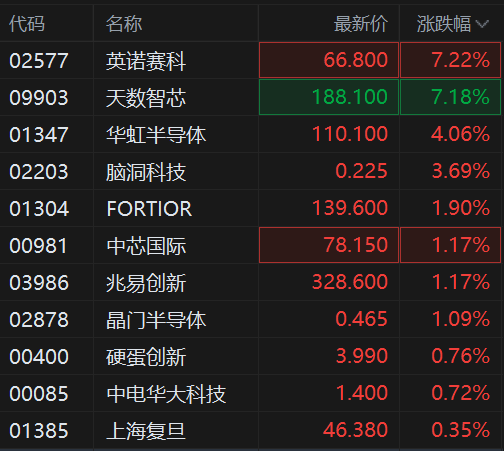
半导体股拉升 英诺赛科涨超7% 华虹半导体、兆易创新齐创新高
Ge Long Hui· 2026-01-22 02:12
Group 1 - Semiconductor stocks in Hong Kong experienced a significant rise, with InnoCare leading with over 7% increase and Hua Hong Semiconductor rising over 8%, reaching a historical high [1] - KeyBanc data indicates that Intel and AMD have nearly sold out their server CPU capacity for the entire year of 2026 due to large-scale cloud service providers purchasing aggressively [1] - Both Intel and AMD plan to increase server CPU prices by 10-15% to address extreme supply-demand imbalance and ensure stable future supply [1] Group 2 - Analysts predict that the market demand for server chips will grow at an annual rate of 30% to 40% by 2026 [1] - Guosen Securities' latest report highlights that the semiconductor sector is performing better than expected, with price increases across multiple segments and the upcoming release of AI glasses [1] - The report continues to recommend cyclical recovery semiconductor companies such as Naxin Micro and foundry firms like SMIC and Hua Hong Semiconductor [1]

港股半导体股拉升 英诺赛科涨超7% 华虹半导体、兆易创新齐创新高
Jin Rong Jie· 2026-01-22 02:11
Group 1 - Semiconductor stocks in Hong Kong experienced a significant rise at the beginning of trading, with InnoCare increasing by over 7% [1] - Hua Hong Semiconductor surged by over 8%, reaching a new historical high [1] - Newly listed stock Zhaoyi Innovation also hit a new high during the trading session [1] Group 2 - Both SMIC and Jingmen Semiconductor saw their stock prices increase by over 1% [1]
港股异动丨半导体股拉升 英诺赛科涨超7% 华虹半导体、兆易创新齐创新高
Ge Long Hui A P P· 2026-01-22 01:54
Group 1 - Semiconductor stocks in Hong Kong experienced a surge, with InnoCare leading with a rise of over 7%, and Hua Hong Semiconductor increasing by over 4%, reaching a historical high [1] - KeyBanc data indicates that due to significant purchases by large-scale cloud service providers, Intel and AMD's server CPU capacity for the entire year of 2026 is nearly sold out [1] - To address the extreme supply-demand imbalance and ensure stable future supply, both companies plan to increase server CPU prices by 10-15% [1] - Analysts predict that the market demand for server chips will grow at an annual rate of 30% to 40% by 2026 [1] Group 2 - Guosen Securities' latest report highlights that the semiconductor sector is experiencing better-than-expected conditions, with price increases across multiple segments and the imminent release of AI glasses [1] - The report continues to recommend cyclical recovery stocks such as Naxin Micro and foundry companies like SMIC and Hua Hong Semiconductor [1]