SMIC(00981)

Search documents
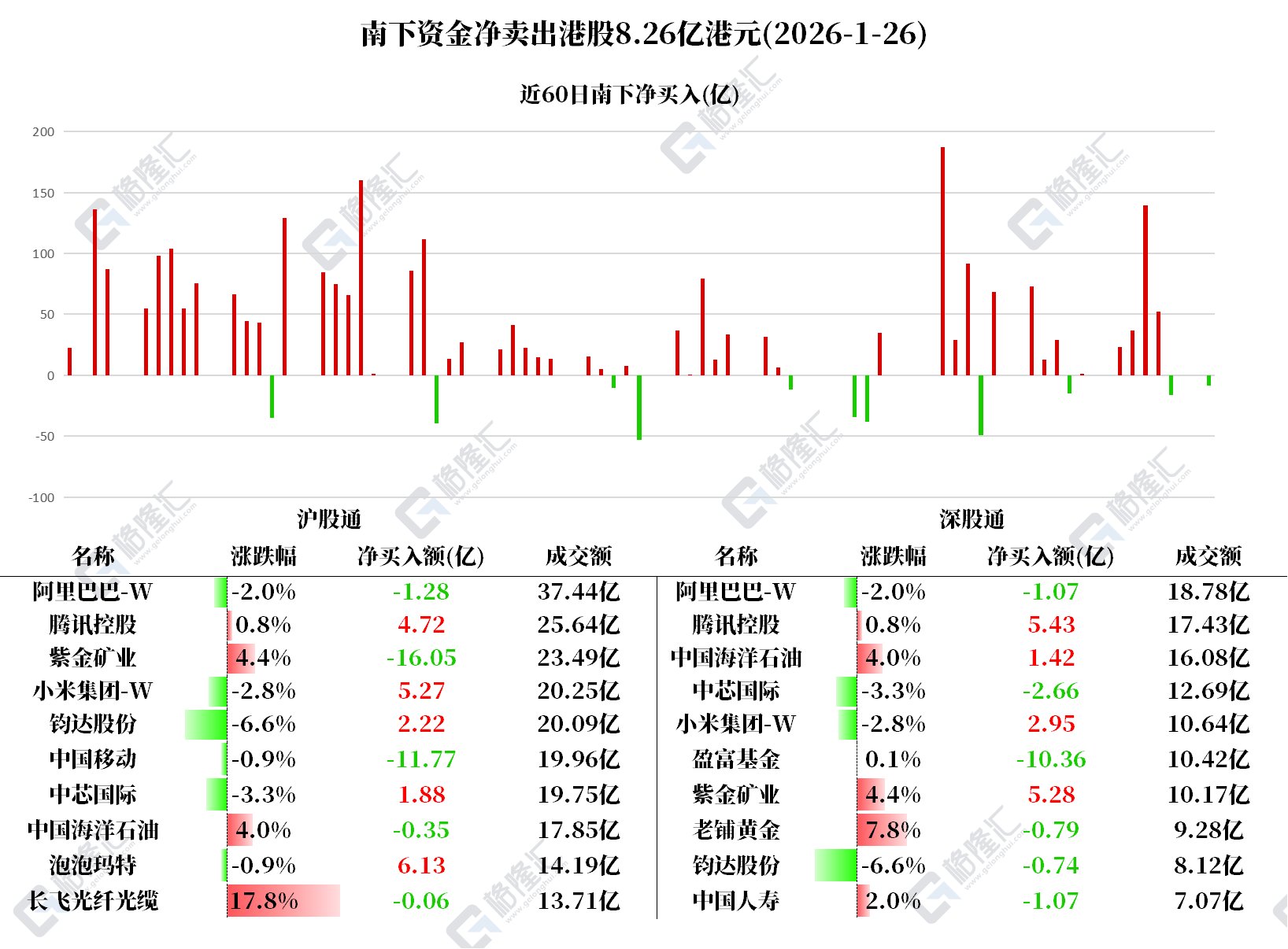
图解丨南下资金连续第二日净卖出港股,加仓腾讯、小米,持续出中国移动
Ge Long Hui A P P· 2026-01-26 09:52
Group 1 - Southbound funds recorded a net sell of HKD 826 million in Hong Kong stocks for the second consecutive day [1] - Notable net purchases included Tencent Holdings at HKD 1.015 billion, Xiaomi Group at HKD 822 million, and Pop Mart at HKD 613 million [1] - Significant net sales were observed in China Mobile at HKD 1.177 billion, Zijin Mining at HKD 1.077 billion, and Alibaba at HKD 235 million [1] Group 2 - Southbound funds have consistently net bought Xiaomi for 7 days, totaling HKD 3.89621 billion [1] - Continuous net buying for China National Offshore Oil Corporation (CNOOC) for 4 days, amounting to HKD 1.09627 billion [1] - Pop Mart has seen net buying for 3 consecutive days, totaling HKD 1.73397 billion [1] - China Mobile has faced net selling for 16 days, accumulating to HKD 12.89303 billion [1]



中国半导体设备:光刻机进口强劲,预示一线市场扩张加速-China Semi Equipment_ Strong litho imports point to accelerating expansion in tier-1 markets
2026-01-26 02:50
Summary of Conference Call on China's Semiconductor Production Equipment (SPE) Imports Industry Overview - **Industry**: Semiconductor Production Equipment (SPE) - **Key Focus**: China's SPE imports, particularly lithography equipment, and their implications for capacity expansion in tier-1 cities Key Points SPE Import Trends - China's SPE imports rebounded significantly in December 2025, increasing by **95% MoM** but down **9% YoY** from the previous year's high base due to geopolitical uncertainties [1] - Total SPE imports for Q4 2025 were **US$9.3 billion**, a **1% decrease** from the previous quarter, while annual imports for 2025 reached **US$34.7 billion**, marking a **3% increase** YoY [1] Lithography Equipment Insights - Lithography imports surged to **US$2.3 billion** in December 2025, representing a **59% increase YoY** and **222% increase MoM**, accounting for **55%** of total SPE imports [2][1] - The average cost per unit of lithography equipment imported was **US$75 million** for Shanghai, **US$95 million** for Beijing, and **US$46 million** for Guangdong, indicating strong demand in these regions [3] Regional Performance - The Netherlands emerged as the top exporter of SPE to China in December 2025, while imports from Japan continued to decline, down **38% YoY** [2] - Major cities like Shanghai, Beijing, and Guangdong showed robust lithography import values, suggesting accelerated capacity expansion by local fabs such as SMIC and Hua Hong [3] Capital Expenditure (Capex) Outlook - Evidence suggests solid capex demand in tier-1 cities, supported by local government plans to invest in the semiconductor and AI industries [3] - Expectations for China's WFE spending in 2026 could exceed previous estimates, with projected growth of **10% YoY** driven by advanced logic and memory capacity expansion projects [4] Investment Recommendations - Top investment picks include **NAURA** (rated Buy) and **ACMR Shanghai** [4] Risks and Opportunities - **Downside Risks**: Include potential worsening macroeconomic conditions, intensified geopolitical tensions, and slower-than-expected R&D progress [52] - **Upside Risks**: Include faster-than-expected recovery in end-demand and potential technological breakthroughs by China's WFE vendors [53] Government Initiatives - The 15th Five-Year Plans from major provinces emphasize commitments to enhancing semiconductor capabilities and AI development, which may positively impact WFE demand in the long term [51] Additional Insights - The strong performance of lithography imports indicates a shift in spending patterns, with lithography now accounting for a significantly higher percentage of total WFE spending than the historical norm of **20-25%** [2] - The average selling price (ASP) of lithography units reflects the high value and demand for advanced semiconductor manufacturing capabilities in China [3] This summary encapsulates the key insights and trends from the conference call regarding China's semiconductor production equipment imports and the broader implications for the industry.

港股半导体概念走低
Jin Rong Jie· 2026-01-26 02:20
本文源自:金融界AI电报 港股半导体概念走低,天数智芯跌超5%,英诺赛科跌超4%,中芯国际、兆易创新跌超3%,上海复旦、 华虹半导体跌超2%。 ...

南向资金上周净流入235.2亿港元,阿里巴巴、小米集团、泡泡玛特、中芯国际净流入金额居前
Mei Ri Jing Ji Xin Wen· 2026-01-26 01:43
Group 1 - The core viewpoint of the article highlights that southbound capital inflow into the Hong Kong market reached 23.52 billion HKD last week, showing an increase compared to the previous week [1] - Year-to-date, the net inflow of southbound capital into Hong Kong has totaled 59.3 billion HKD, which represents 4.56% of the total net inflow for the entire previous year [1] - Key stocks that saw significant net inflows from southbound capital last week include Alibaba-W (3.349 billion HKD), Xiaomi Group-W (2.583 billion HKD), Pop Mart (1.691 billion HKD), and SMIC (1.683 billion HKD), indicating a strong focus on internet platforms and technology leaders [1] Group 2 - The article suggests monitoring technology-related ETFs in the Hong Kong market, specifically the Hang Seng Internet ETF (513330.SH) and the Hong Kong Stock Connect Technology ETF (159101.SZ) [1] - The Hang Seng Internet ETF (513330.SH) focuses on internet giants and includes companies not covered by the Stock Connect, such as Baidu Group-S, JD Group-S, and NetEase-S [1] - The Hong Kong Stock Connect Technology ETF (159101.SZ) targets hard technology, soft applications, smart driving, and CXO concepts, with constituent stocks including SMIC, Alibaba, Xiaomi, Li Auto, and Innovent Biologics, all of which are eligible for Stock Connect and not subject to QDII foreign exchange limits [1]

行业周报:台积电计划新建4座先进封装设施,CPU、存储、封测涨价
KAIYUAN SECURITIES· 2026-01-25 07:45
Investment Rating - The industry investment rating is "Overweight" (maintained) [2] Core Insights - The electronic industry index experienced a weekly change of +1.58%, with semiconductors rising by 2.7% and consumer electronics declining by 1.4% [4] - TSMC plans to build four advanced packaging facilities to enhance backend capacity, driven by strong demand for AI [6] - The AI hardware market is expected to see a surge in product launches, including OpenAI's AI audio headphones with projected shipments of 40-50 million units in the first year [5] Market Review - The semiconductor sector is witnessing a significant increase in demand, with TSMC's 3nm capacity fully booked until 2027 due to AI demand [6] - Major storage companies are entering a price increase cycle as they face unprecedented chip shortages, with Micron indicating that its HBM orders for 2026 are already filled [5] - The import value of key semiconductor equipment in China reached 15.5 billion yuan in December 2025, marking a 244% month-on-month increase [6] Industry Developments - AI infrastructure is rapidly developing, with domestic GPU manufacturers accelerating their self-sufficiency processes [5] - Companies like SK Hynix and Kioxia have reported that their chip and flash memory production capacities for 2026 are already sold out, exacerbating NAND supply pressures [5] - The Nasdaq index saw a slight decline of 0.06% this week, while notable gains were observed in companies like SanDisk (+14.56%) and AMD (+12.01%) [4]



行业周报:台积电计划新建4座先进封装设施,CPU、存储、封测涨价-20260125
KAIYUAN SECURITIES· 2026-01-25 05:41
Investment Rating - The industry investment rating is "Overweight" (maintained) [2] Core Insights - The electronic industry index experienced a weekly change of +1.58%, with semiconductors rising by 2.7% and consumer electronics declining by 1.4% [4] - TSMC plans to build four advanced packaging facilities to enhance backend capacity, driven by strong demand for AI and advanced 3nm processes [6] - Major storage companies are entering a price increase cycle due to unprecedented chip shortages, with Micron and SK Hynix reporting full order books for 2026 [5] Market Review - The semiconductor sector showed a weekly increase of 2.7%, while the consumer electronics sector saw a decline of 1.4% [4] - Notable stock performances included SanDisk up 14.56%, AMD up 12.01%, and Micron up 10.17% [4] Industry Updates - AI hardware is expected to see a surge in releases, with OpenAI planning to launch AI audio headphones with projected shipments of 40-50 million units in the first year [5] - The demand for AI infrastructure is increasing, with domestic GPU manufacturers accelerating their development processes [5] - TSMC's advanced 3nm production capacity is fully booked until 2027, indicating strong market demand [6] Beneficiary Stocks - Beneficiary stocks include Huahong Semiconductor, Zhongwei Company, Jingce Electronics, and several others [6]


【数智周报】中芯国际等巨头集体提价;风投资金涌入Anthropic,新一轮融资250亿美元;DeepMind CEO:中国头部AI企业只比前沿水平落后六个月,但中国AI基础创新仍存短板
Sou Hu Cai Jing· 2026-01-25 00:26
Group 1 - Huang Renxun discussed the AI bubble, stating that the bubble is due to unprecedented investment scale aimed at building AI infrastructure, with total investment expected to reach trillions of dollars [2] - Microsoft CEO Satya Nadella warned that if AI development relies solely on capital without real productivity improvements, a bubble may form, emphasizing the need for a focus on actual demand and application [3] - DeepMind CEO Demis Hassabis and Anthropic founder Dario Amodei debated the timeline for AGI, with predictions ranging from two years to the late 2030s, highlighting the potential impact on the labor market [4] Group 2 - DeepMind's Hassabis noted that Chinese AI companies are only about six months behind the frontier level, showcasing impressive catch-up capabilities, although he believes they have yet to prove their ability to innovate beyond the frontier [5] - Tencent's Tang Daosheng emphasized that AI development should not be limited to AGI but should focus on diverse model adaptations for different scenarios [6] - Baichuan Intelligent's Wang Xiaochuan responded to concerns about AI in healthcare, arguing that limiting AI use could hinder medical advancements [7] Group 3 - Alibaba is reportedly planning to spin off its chip company T-Head for independent listing [8] - Moore Threads forecasted a revenue of 1.45 to 1.52 billion yuan for 2025, with a year-on-year growth of 230.70% to 246.67% [9] - Major Chinese foundries, including SMIC, are raising prices by 5% to 20% due to a reduction in global 8-inch foundry capacity [10] Group 4 - DeepSeek plans to launch its flagship AI model DeepSeek V4 in February, featuring a new architecture aimed at enhancing coding capabilities [11] - Alibaba Cloud's PolarDB has released new products, including an AI data lake solution designed for integrated data management [12] - DingTalk has launched an "AI travel" feature in collaboration with Gaode and Alipay, allowing enterprise users to access travel services without upfront costs [13][14] Group 5 - Baichuan Intelligent released the M3 Plus medical model, introducing "evidence anchoring" technology to ensure AI-generated medical advice is backed by professional evidence [15] - Donghua Software announced a 300 million yuan investment to establish a wholly-owned subsidiary focused on AI and big data [16] - Alibaba Health's AI product "Hydrogen Ion" has completed internal testing and aims to assist doctors with low hallucination rates and high evidence-based capabilities [17] Group 6 - Baidu launched the official version of its Wenxin model 5.0, featuring 2.4 trillion parameters and supporting multiple information formats [18] - The 2025 Hurun AI 50 list ranked Cambricon and Moore Threads at the top, with significant representation from chip companies [19] - MiniMax introduced an AI-native workspace, enhancing local environment applications and expert agents [20] Group 7 - Moonshot AI's valuation increased by 500 million dollars to 4.8 billion dollars following its latest funding round [43] - OpenAI is reportedly negotiating a new round of financing with a Middle Eastern sovereign wealth fund, potentially raising 50 billion dollars [32] - Anthropic is raising at least 1 billion dollars in its latest funding round, with annual revenue expected to exceed 9 billion dollars by 2025 [42]

兴证策略:2025年四季度主动权益基金管理规模小幅下降 四季度存量基金的赎回压力仍然较大
Sou Hu Cai Jing· 2026-01-23 12:38
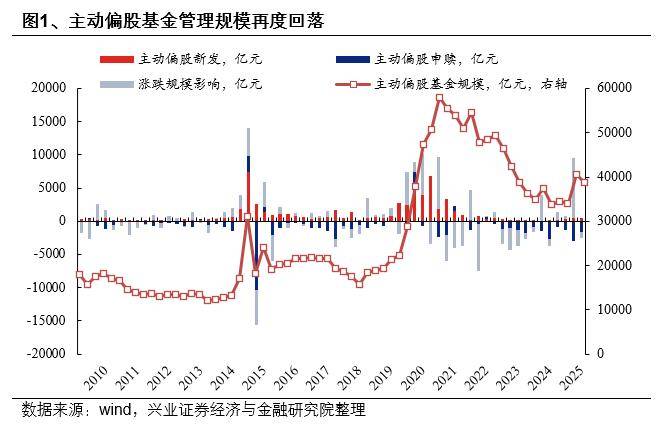
Group 1 - The active equity fund management scale decreased slightly in Q4 2025, primarily due to significant redemption pressure from existing funds, resulting in a net redemption of 165.6 billion yuan [1] - The total management scale of three types of active equity funds (ordinary stock, mixed equity, and flexible allocation) decreased by 189.8 billion yuan, with new active equity fund issuance at 56.2 billion yuan [1] - The active equity fund's position in Q4 2025 decreased by 0.83 percentage points to 86.62%, remaining at the second-highest level in history [2] Group 2 - In terms of sector allocation, the proportion of the ChiNext board increased by 1.24 percentage points to 24.98%, while the main board and Sci-Tech Innovation board saw declines [5][8] - The allocation to the main board decreased by 0.30 percentage points to 58.21%, indicating a further increase in underweight [8] - Active equity funds increased their positions in cyclical and financial real estate sectors while reducing exposure to technology growth and pharmaceuticals [11] Group 3 - The active equity funds increased their allocation in the non-ferrous metals, communication, and non-bank financial sectors, with increases of 2.26 percentage points, 1.85 percentage points, and 0.87 percentage points respectively [13] - The funds reduced their positions in electronics, pharmaceuticals, media, power equipment, and computers, with reductions of 1.72 percentage points, 1.54 percentage points, and 1.16 percentage points respectively [13] - Excluding thematic/sector funds, the active equity funds still increased their positions in non-ferrous metals, communication, and non-bank financial sectors [14] Group 4 - The allocation to the TMT sector slightly decreased in Q4 2025, with the configuration coefficient at 1.48, indicating room for further improvement [29] - Within the TMT sector, active equity funds increased their holdings in communication equipment and components while reducing positions in consumer electronics and semiconductors [32] - The dividend sector's allocation stabilized and increased, with the low-volatility dividend index rising by 1.7 percentage points to 4.3% [37] Group 5 - The top five stocks in active equity funds in Q4 2025 included Zhongji Xuchuang, Xinyi Sheng, Dongshan Precision, China Ping An, and Zijin Mining, with respective increases in holding ratios [43] - The top ten holdings accounted for 4.83%, 4.01%, and 3.97% of the total market value of the funds [46] - The concentration of individual stocks in active equity funds increased slightly, while the concentration of industries showed a mixed trend [49] Group 6 - The Hong Kong stock allocation of active equity funds decreased to 15.98%, down from 19.09%, with a total holding value of 302.9 billion yuan [51] - The funds increased their positions in the healthcare, materials, and energy sectors while reducing exposure to consumer discretionary and information technology sectors [54] - Tencent maintained its position as the largest holding in Hong Kong stocks, with a market value of 57.3 billion yuan [56]



智通港股通活跃成交|1月23日





智通财经网· 2026-01-23 11:01
Group 1 - On January 23, 2026, Alibaba-W (09988), Pop Mart (09992), and Tencent Holdings (00700) ranked as the top three companies by trading volume in the Southbound Stock Connect, with transaction amounts of 4.748 billion, 2.660 billion, and 2.614 billion respectively [1] - In the Southbound Stock Connect for the Shenzhen-Hong Kong Stock Connect, Alibaba-W (09988), Tencent Holdings (00700), and Pop Mart (09992) also held the top three positions, with transaction amounts of 3.322 billion, 1.798 billion, and 1.370 billion respectively [1] Group 2 - In the Southbound Stock Connect, the top active trading companies included Alibaba-W (09988) with a net buy amount of -0.595 billion, Pop Mart (09992) with a net buy amount of +0.480 billion, and Tencent Holdings (00700) with a net buy amount of +0.396 billion [2] - In the Shenzhen-Hong Kong Stock Connect, Alibaba-W (09988) had a net buy amount of -0.895 billion, Tencent Holdings (00700) had a net buy amount of -0.156 billion, while Pop Mart (09992) recorded a net buy amount of +0.268 billion [2]
【广发金工】从长线重仓股看2025Q4基金权益配置变化
广发金融工程研究· 2026-01-23 09:20
Group 1 - The core viewpoint of the article is the analysis of long-term heavy holdings by funds, identifying key stocks that are consistently held over multiple reporting periods, such as Ningde Times, Tencent Holdings, Zijin Mining, Kweichow Moutai, and Midea Group [4][5] Group 2 - In the long-term heavy holdings change, stocks like Xiaomi Group and Poly Developments have a high termination ratio in Q4 2025, while stocks like Baillie Tianheng and Zijin Mining have a low termination ratio [2][6] Group 3 - Industry-wise, the media, food and beverage, and electric equipment sectors show relatively low termination ratios for long-term holdings, indicating a positive outlook from fund managers for these sectors [3][9]