
SMIC(00981)

Search documents
港股通1月8日成交活跃股名单




Zheng Quan Shi Bao Wang· 2026-01-08 15:07
Market Overview - On January 8, the Hang Seng Index fell by 1.17%, with southbound capital totaling HKD 117.906 billion, comprising HKD 56.503 billion in buying and HKD 61.403 billion in selling, resulting in a net sell of HKD 4.901 billion [1] Southbound Trading Activity - The southbound trading through Stock Connect (Shenzhen) had a total turnover of HKD 47.015 billion, with buying at HKD 23.041 billion and selling at HKD 23.974 billion, leading to a net sell of HKD 0.933 billion [1] - The southbound trading through Stock Connect (Shanghai) recorded a total turnover of HKD 70.891 billion, with buying at HKD 33.461 billion and selling at HKD 37.429 billion, resulting in a net sell of HKD 3.968 billion [1] Active Stocks - Alibaba-W had the highest trading volume among southbound stocks, with a total turnover of HKD 94.86 billion, followed by the Tracker Fund of Hong Kong and SMIC, with turnovers of HKD 65.30 billion and HKD 55.70 billion respectively [1] - The top net buying stocks included Xiaomi Group-W with a net buy of HKD 10.72 billion, Tencent Holdings with HKD 8.64 billion, and SMIC with HKD 5.63 billion [1] - The stock with the highest net sell was the Tracker Fund of Hong Kong, with a net sell of HKD 62.84 billion, followed by Hang Seng China Enterprises and Southern Hang Seng Technology with net sells of HKD 28.78 billion and HKD 12.88 billion respectively [1] Continuous Net Buying and Selling - Xiaomi Group-W, Tencent Holdings, and SMIC were among the eight stocks that appeared on both the Shenzhen and Shanghai Stock Connect active lists, with Xiaomi Group-W having a total turnover of HKD 41.07 billion and a net buy of HKD 10.72 billion, while Tencent Holdings had a turnover of HKD 45.90 billion and a net buy of HKD 8.64 billion [2] - Over a continuous period, Xiaomi Group-W, Alibaba-W, and Goldwind Technology saw net buying for more than three days, with Xiaomi Group-W leading with a total net buy of HKD 46.84 billion [2] - Conversely, China Mobile and Hua Hong Semiconductor experienced continuous net selling, with net sells of HKD 31.39 billion and HKD 6.88 billion respectively [2]
行业投资策略:AI算力自主可控的全景蓝图与投资机遇
KAIYUAN SECURITIES· 2026-01-08 14:22
Group 1 - The semiconductor industry is expected to experience significant growth, with the domestic semiconductor index outperforming the CSI 300 index, showing a cumulative increase of 54.51% as of October 28, 2025, driven by factors such as national subsidies, AI computing demand, and domestic substitution [16][21]. - The AI chip market in China is projected to grow from 142.54 billion yuan in 2024 to 1,336.79 billion yuan by 2029, with a compound annual growth rate (CAGR) of 53.7% from 2025 to 2029, indicating a critical development opportunity for domestic AI chip manufacturers [42][44]. - The global GPU market is expected to grow from $77.39 billion in 2024 to $472.45 billion by 2030, with a CAGR of 35.19%, reflecting strong demand for AI computing [37][40]. Group 2 - The domestic AI chip industry is categorized into three stages: the first stage focuses on the self-sufficiency of computing, storage, and power chips; the second stage emphasizes the self-sufficiency of chip manufacturing processes; and the third stage targets the self-sufficiency of foundational hard technologies such as equipment materials and EDA [5][6]. - The demand for AI computing chips is driven by the rapid growth of generative AI applications, with NVIDIA's data center revenue increasing by 69% year-on-year to $44.1 billion in the first quarter of fiscal 2026, highlighting the accelerating demand for AI computing power [37][44]. - The semiconductor equipment sector is experiencing a significant increase in domestic production capacity, with the domestic semiconductor equipment localization rate expected to rise rapidly, particularly in dry etching and thin film deposition processes [6][15]. Group 3 - The report indicates that the advanced packaging technology, such as CoWoS, is expected to play a crucial role in the evolution of AI computing power, with domestic companies making significant advancements in this area [7][11]. - The semiconductor industry is witnessing a recovery in profitability, with the average gross margin and net profit margin for the semiconductor sector showing improvements in the first half of 2025 [36][34]. - The report highlights the importance of advanced wafer manufacturing as the physical foundation for AI chips, with a long-term demand for advanced foundry services expected to drive growth in this segment [7][11].


创元科技:江苏苏净是上海微电子、中芯国际、海力士的合格供应商
Zheng Quan Ri Bao Zhi Sheng· 2026-01-08 13:38
Core Viewpoint - Chuangyuan Technology's subsidiary, Jiangsu Sujing, is a comprehensive supplier in the clean and environmental protection sector, providing products and services for the semiconductor industry [1] Group 1: Company Overview - Jiangsu Sujing is recognized as a qualified supplier for major companies such as Shanghai Microelectronics, SMIC, and SK Hynix [1] - The current business scale of Jiangsu Sujing is relatively small, having a minor impact on the overall revenue of Chuangyuan Technology [1] Group 2: Future Plans - Jiangsu Sujing plans to increase its R&D investment to accelerate technological breakthroughs and the transformation of scientific achievements [1] - The company aims to further explore industry demands and business potential to enhance productivity and promote high-quality development [1]


近850亿资本涌入,中芯、华虹、晶合密集动作
3 6 Ke· 2026-01-08 12:09
Group 1 - The core point of the article highlights significant movements in the semiconductor industry, particularly acquisitions and investments by major players like SMIC, Huahong Semiconductor, and Jinghe Integrated [1][2][3] - SMIC announced plans to acquire 49% of the shares of its subsidiary, SMIC North, for 40.6 billion yuan, aiming to fully own the company and consolidate its operations [1][4][5] - Huahong Semiconductor plans to acquire 97.4988% of Huahong Micro for 8.268 billion yuan, enhancing its control over the company and addressing competition within its group [2][6][7] - Jinghe Integrated has initiated a new project with a total investment of 35.5 billion yuan, focusing on expanding its production capacity and technological capabilities in the semiconductor sector [2][8] Group 2 - SMIC North, established in 2013, has become a key production base for SMIC, with a monthly capacity of 70,000 wafers and advanced technology covering 40nm and 28nm processes [4][5] - The financial performance of SMIC North is strong, with projected revenues of 11.575 billion yuan and 12.98 billion yuan for 2023 and 2024, respectively, indicating significant profit contributions to SMIC [5] - Huahong Micro's core asset is a fully automated 12-inch wafer production line with a monthly capacity of 38,000 wafers, which will enhance Huahong Semiconductor's market position post-acquisition [7] - Jinghe Integrated's new project will add a 55,000 wafers/month production line, focusing on 40nm and 28nm processes, catering to various applications including AI and smart devices [8][9] Group 3 - The global wafer foundry market is expected to grow, with projections indicating an 18.3% increase in the semiconductor market size by 2026, reaching $880 billion [10] - The demand for mature process nodes (22-28nm) is anticipated to shift, with China's share in the global market expected to rise significantly by 2030 [10] - Major foundries, including SMIC and Huahong Semiconductor, are operating at high capacity utilization rates, indicating strong demand and potential for revenue growth [11][12] - Recent trends show a price increase in wafer foundry services, with SMIC and other companies raising prices by approximately 10% for certain processes, reflecting the industry's tightening supply and demand dynamics [12]

图解丨南下资金逆势净买入小米、腾讯和中芯国际
Ge Long Hui· 2026-01-08 11:56
Group 1 - The net outflow of southbound funds from Hong Kong stocks today amounted to HKD 4.9 billion, with notable net purchases in Xiaomi Group (HKD 1.072 billion), Tencent Holdings (HKD 0.863 billion), SMIC (HKD 0.563 billion), Alibaba (HKD 0.35 billion), and Goldwind Technology (HKD 0.13 billion) [1] - The net sales included significant amounts in the Tracker Fund of Hong Kong (HKD 6.284 billion), Hang Seng China Enterprises (HKD 2.878 billion), Southern Hang Seng Technology (HKD 1.288 billion), China Mobile (HKD 0.732 billion), Hua Hong Semiconductor (HKD 0.413 billion), Meituan (HKD 0.227 billion), and Kuaishou (HKD 0.122 billion) [1] - Southbound funds have recorded six consecutive days of net purchases in Xiaomi, totaling HKD 4.6844 billion, and five consecutive days of net purchases in Alibaba, totaling HKD 2.46627 billion; conversely, there have been four consecutive days of net sales in China Mobile, totaling HKD 3.13893 billion [1] Group 2 - In the Shanghai Stock Connect, Alibaba saw a decline of 2.3% with a net purchase of HKD 0.311 billion, while Tencent experienced a drop of 1.3% with a net outflow of HKD 4.631 billion [4] - SMIC had a slight increase of 0.3% with a net purchase of HKD 0.34 billion, and Xiaomi Group saw a decrease of 0.4% with a net purchase of HKD 0.578 billion [4] - Goldwind Technology increased by 2.7% with a net purchase of HKD 0.13 billion, while China Mobile decreased by 0.6% with a net outflow of HKD 0.732 billion [4]

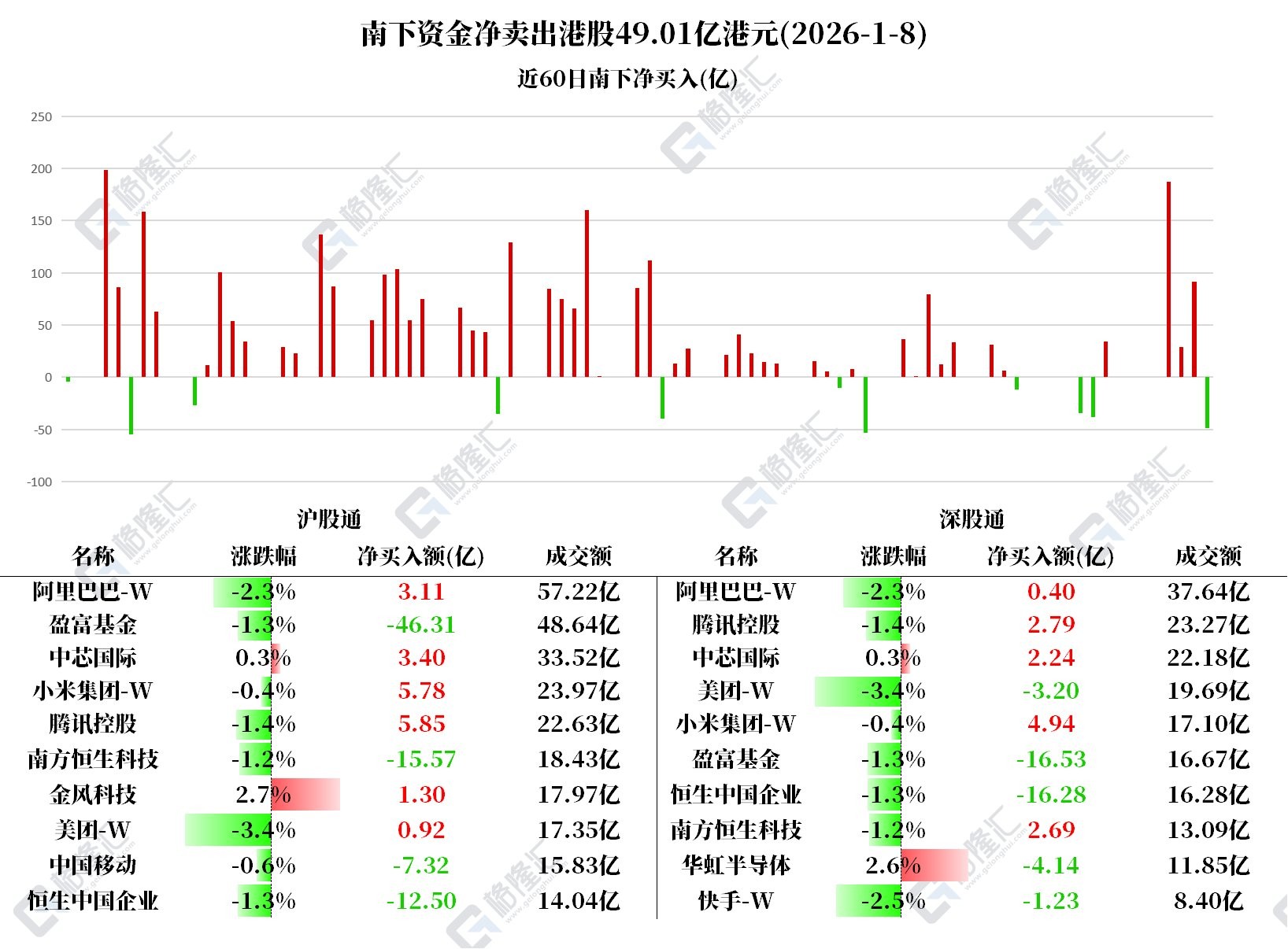
图解丨北水加仓小米超10亿港元,连续4日卖出中国移动
Ge Long Hui· 2026-01-08 11:47
Group 1: Investment Trends - Net purchases included Xiaomi Group at 1.072 billion, Tencent Holdings at 863 million, SMIC at 563 million, Alibaba at 350 million, and Goldwind Technology at 130 million [1] - Net sales included the Tracker Fund at 6.284 billion, Hang Seng China Enterprises at 2.878 billion, Southern Hang Seng Technology at 1.288 billion, China Mobile at 732 million, and Hua Hong Semiconductor at 413 million [1] - Southbound funds have recorded six consecutive days of net purchases for Xiaomi, totaling 4.6844 billion HKD, and five consecutive days for Alibaba, totaling 2.46627 billion HKD [1] Group 2: Stock Performance - Alibaba-W saw a decline of 2.3% with a net purchase of 311 million and a transaction volume of 5.722 billion [4] - Tencent Holdings experienced a drop of 1.4% with a net purchase of 585 million and a transaction volume of 2.263 billion [4] - Goldwind Technology increased by 2.7% with a net purchase of 130 million and a transaction volume of 1.797 billion [4] Group 3: Company Insights - Tencent Holdings is viewed positively for its monetization capabilities among moderate to heavy users, despite short-term competition concerns in the music sector [5] - SMIC's acquisition of 49% of the shares in SMIC North is expected to positively impact both short-term and long-term shareholder value, with a projected increase in net profit of over 120 million USD by 2026 [5] - Alibaba's recent communication indicates significant progress in its Taobao Flash Sale initiative, with a clear strategy for market share growth and increased investment [5] Group 4: Analyst Ratings - Daiwa has upgraded Goldwind Technology's rating to "Outperform" with a target price raised to 17 HKD [6]


智通港股通活跃成交|1月8日
智通财经网· 2026-01-08 11:03
Core Insights - On January 8, 2026, Alibaba-W (09988), the Tracker Fund of Hong Kong (02800), and SMIC (00981) were the top three stocks by trading volume in the Southbound Stock Connect, with trading amounts of 57.22 billion, 48.64 billion, and 33.52 billion respectively [1] - In the Shenzhen-Hong Kong Stock Connect, Alibaba-W (09988), Tencent Holdings (00700), and SMIC (00981) also ranked as the top three stocks, with trading amounts of 37.64 billion, 23.27 billion, and 22.18 billion respectively [1] Southbound Stock Connect Trading Activity - **Top Active Companies in Southbound Stock Connect**: - Alibaba-W (09988): Trading amount of 57.22 billion, net inflow of +3.11 billion [2] - Tracker Fund of Hong Kong (02800): Trading amount of 48.64 billion, net outflow of -46.31 billion [2] - SMIC (00981): Trading amount of 33.52 billion, net inflow of +3.40 billion [2] - Xiaomi Group-W (01810): Trading amount of 23.97 billion, net inflow of +5.78 billion [2] - Tencent Holdings (00700): Trading amount of 22.63 billion, net inflow of +5.85 billion [2] Shenzhen-Hong Kong Stock Connect Trading Activity - **Top Active Companies in Shenzhen-Hong Kong Stock Connect**: - Alibaba-W (09988): Trading amount of 37.64 billion, net inflow of +398.60 million [2] - Tencent Holdings (00700): Trading amount of 23.27 billion, net inflow of +2.79 billion [2] - SMIC (00981): Trading amount of 22.18 billion, net inflow of +2.24 billion [2] - Meituan-W (03690): Trading amount of 19.69 billion, net outflow of -3.20 billion [2] - Xiaomi Group-W (01810): Trading amount of 17.10 billion, net inflow of +4.94 billion [2]

北水动向|北水成交净卖出49.01亿 北水再度抛售港股ETF 全天净卖出盈富基金(02800)近63亿港元
智通财经网· 2026-01-08 10:01
Group 1 - The Hong Kong stock market experienced a net sell-off of 49.01 billion HKD from northbound capital on January 8, with the Shanghai-Hong Kong Stock Connect contributing a net sell of 39.68 billion HKD and the Shenzhen-Hong Kong Stock Connect a net sell of 9.33 billion HKD [1] - The stocks with the highest net buy from northbound capital included Xiaomi Group-W (01810), Tencent (00700), and SMIC (00981) [1] - The stocks with the highest net sell included the Tracker Fund of Hong Kong (02800), Hang Seng China Enterprises (02828), and Southern Hang Seng Technology (03033) [1] Group 2 - Alibaba-W (09988) saw a net buy of 3.5 billion HKD, while China Mobile (00941) faced a net sell of 7.32 billion HKD [7] - Xiaomi Group-W (01810) received a net buy of 10.71 billion HKD, driven by expected revenue growth from its electric vehicle business and steady growth in its IoT segment [4] - Tencent (00700) had a net buy of 8.63 billion HKD, with optimistic outlooks from analysts regarding its role in the AI technology sector [5] Group 3 - The Tracker Fund of Hong Kong (02800) experienced a significant net sell of 46.31 billion HKD, indicating a strong outflow of capital [2] - SMIC (00981) had a net buy of 5.63 billion HKD, while Hua Hong Semiconductor (01347) faced a net sell of 4.13 billion HKD, reflecting a divergence in the semiconductor sector [5] - Goldwind Technology (02208) received a net buy of 1.3 billion HKD, with potential positive catalysts from its stake in Blue Arrow Aerospace [5]

创元科技:全资子公司江苏苏净是上海微电子、中芯国际、海力士的合格供应商
Xin Lang Cai Jing· 2026-01-08 08:41
Core Viewpoint - The company’s subsidiary, Jiangsu Sujing, is a comprehensive supplier in the clean and environmental protection sector, providing technological innovation, equipment manufacturing, and overall engineering solutions for the semiconductor industry [1] Group 1: Company Overview - Jiangsu Sujing is recognized as a qualified supplier for major companies such as Shanghai Microelectronics, SMIC, and SK Hynix [1] - The current business scale of Jiangsu Sujing is relatively small, resulting in a minimal impact on the company's overall revenue [1]
芯片股逆势走强 芯片巨头相继发布新一代AI芯片产品 先进逻辑芯片需求将保持强劲
Zhi Tong Cai Jing· 2026-01-08 04:24
Group 1 - Chip stocks are performing strongly, with Shanghai Fudan up 3.98% at HKD 52.3, Huahong Semiconductor up 3.19% at HKD 92.15, and SMIC up 2.81% at HKD 76.8 [1] - During CES 2026, major chip companies Nvidia, AMD, and Intel are competing by launching new AI chip products, with Nvidia showcasing the next-generation Vera Rubin platform consisting of six independent chips, featuring 72 GPUs and 36 CPUs [1] - Nvidia's CEO Jensen Huang announced that the Vera Rubin platform is in full production and expected to ship later this year, with AI computing capabilities up to five times that of previous chips [1] Group 2 - Nvidia is finalizing details with the US government regarding the export license for the H200 chip to China, with expectations for delivery soon [1] - Morgan Stanley anticipates that the H200 chip will help meet China's training needs and potentially increase demand for inference chips, thereby expanding market demand [2] - Morgan Stanley is optimistic about SMIC, viewing it as a key supporter of localizing AI in China, and expects strong demand for advanced logic chips [2]