
LENOVO GROUP(00992)

Search documents
国内首个全栈AI总指挥中心正式点亮
Bei Jing Shang Bao· 2025-11-18 11:40
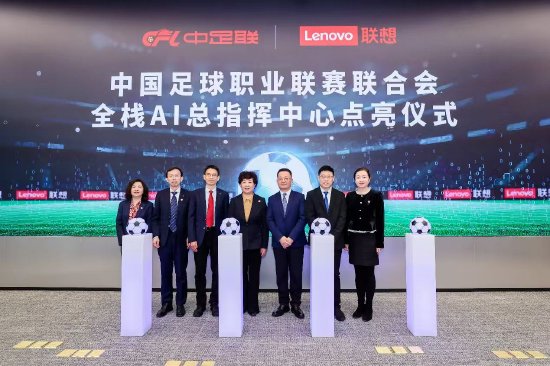
Core Insights - The launch of the full-stack AI Command Center marks a significant step in the integration of AI and sports within China's professional football industry [1] - This initiative is a collaboration between the Chinese Football Association and Lenovo, representing the first AI command center in the country [1] Group 1: AI Command Center Features - The full-stack AI Command Center includes a command supervision center and a data center, functioning as the "strongest brain" and "data heart" for coordinating the entire event organization process [1] - The initiative introduces a dedicated AI entity, "Zhi Zhi Duo Mo AI," aimed at enhancing event operations, competitive performance, and industry development through comprehensive AI capabilities [1] Group 2: Industry Impact - Lenovo's senior vice president emphasized the belief that the deep integration of AI and sports will significantly boost the intelligent, professional, and international development of Chinese football [1] - This project is seen as a new era for smart football in China, indicating a shift towards more advanced technological applications in sports management [1]

中足联携联想点亮国内首个全栈AI总指挥中心,助推足球赛事迈入AI新时代
Xin Lang Ke Ji· 2025-11-18 09:36
Core Insights - The launch of the full-stack AI Command Center marks a significant milestone in the integration of AI technology within China's professional football league, representing a new phase of "AI + Sports" collaboration [2][3] - The AI Command Center consists of a command and supervision center and a data center, functioning as the "strongest brain" and "data heart" of the league, facilitating comprehensive event organization [2] - The dedicated AI entity, "Smart AI," aims to enhance event operations, competitive performance, and industry development through advanced data analysis capabilities [2] Company Collaboration - The initiative is a result of the partnership between the Chinese Football Association and Lenovo, highlighting the importance of this collaboration in advancing the digital transformation of the league [2] - Future cooperation will focus on exploring the application boundaries and innovative transformations of AI technology across various league sectors, aiming to empower clubs and provide technological support for the league [2] Industry Impact - The integration of AI in sports is expected to drive the intelligent, professional, and international development of Chinese football, creating a new era of smart football [3]

恒生科技指数跌近2%
Mei Ri Jing Ji Xin Wen· 2025-11-18 08:23
每经AI快讯,11月18日,香港恒生指数收盘跌1.72%,恒生科技指数跌1.93%。联想集团跌超4%,蔚 来、快手跌超3%。 ...


存储涨价惩罚PC市场,为何唯独放过了苹果与联想?
Ge Long Hui· 2025-11-18 08:09
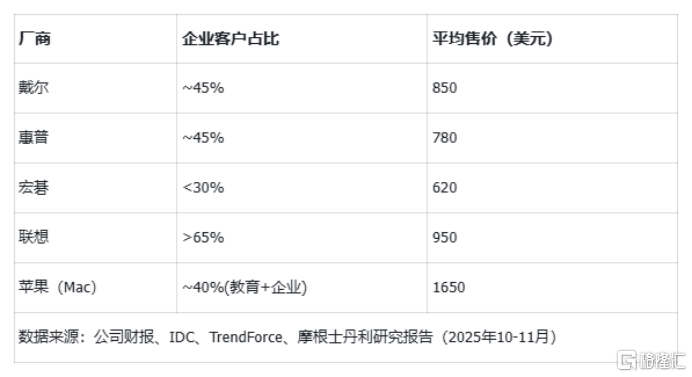
Core Viewpoint - The global storage chip contract prices have experienced a rare nonlinear surge since Q2 2025, driven by the high demand for high-bandwidth memory (HBM) from AI accelerators like NVIDIA's H100, leading to a tightening supply of traditional PC DRAM and NAND [1][3][15] Supply Chain Dynamics - The demand for high-performance SSDs and HBM has led manufacturers to prioritize production for high-margin products, resulting in a squeeze on mid-to-low-end DDR and client SSD supplies, which in turn drives up spot and contract prices [3][7] - By 2025, the global DRAM market revenue is expected to exceed $200 billion, with HBM contributing over half of the profit growth despite accounting for less than 30% of the market [3][15] - Major manufacturers like Samsung, SK Hynix, and Micron are shifting their production capacity towards HBM and enterprise SSDs, leading to a significant reduction in traditional PC DRAM supply [3][6] Impact on PC Manufacturers - Consumer-oriented manufacturers such as Dell, HP, and Acer are particularly vulnerable to rising storage costs due to their high reliance on the consumer market, where price sensitivity is extreme [4][6] - The average selling price of global consumer PCs is projected to be around $620 in 2025, making it difficult for these manufacturers to pass on increased costs without risking a decline in sales [4][6] - Morgan Stanley's report indicates that Dell and HP are the most sensitive to storage price increases, with expected declines in PC gross margins by 2-4 percentage points in FY 2026 [4][6] Resilience of Lenovo and Apple - Lenovo and Apple are viewed as exceptions that may benefit from the storage price surge due to their strong customer bases and supply chain management capabilities [1][6][15] - Lenovo's market share exceeds 25%, with over 65% of its revenue coming from enterprise and government clients, allowing it to better absorb cost increases [8][10] - Apple maintains a dominant position in the high-end market, enabling it to quickly pass on costs to consumers, supported by long-term contracts with suppliers that ensure priority access to components [13][15] Long-term Outlook - The current surge in storage prices is expected to continue, potentially leading to a reshaping of the PC industry, with Lenovo and Apple likely to maintain or even expand their market shares during this period [15]

存储涨价惩罚PC市场,为何唯独放过了苹果(AAPL.US)与联想?
Zhi Tong Cai Jing· 2025-11-18 08:01
Core Insights - The global storage chip contract prices have experienced a rare nonlinear surge since Q2 2025, driven by the high demand for high-bandwidth memory (HBM) from AI accelerators like NVIDIA's H100 [1] - Major storage manufacturers such as Samsung, SK Hynix, and Micron are shifting production capacity from traditional PC DRAM and NAND to more profitable HBM, tightening supply for traditional PC DRAM and NAND [1][2] - Companies like Lenovo and Apple are viewed as exceptions that may benefit from this storage price upcycle due to their strong customer bases and supply chain management capabilities [1][3] Supply Chain Dynamics - The demand for high-performance SSDs and HBM has surged due to AI data centers, leading manufacturers to prioritize higher-margin products, which in turn has squeezed the supply of mid-range DDR and client SSDs [2] - In 2025, the global DRAM market revenue is expected to exceed $200 billion, with HBM contributing over half of the profit growth despite accounting for less than 30% of the market [2] - The average bill of materials (BOM) for laptops shows that DRAM and NAND typically account for 10-20% of costs, meaning a 20% increase in storage costs could raise BOM by $30-50, significantly impacting profit margins if not passed on to consumers [2] Impact on PC Manufacturers - Consumer-oriented manufacturers like Dell, HP, and Acer are particularly vulnerable to rising storage costs, with their PC businesses heavily reliant on the consumer market [3] - The average selling price of consumer PCs is projected to be around $620 in 2025, making these companies sensitive to price increases, which could lead to a decline in sales or profit margins [3] - Morgan Stanley's report indicates that Dell and HP are the most sensitive to rising storage prices, predicting a 2-4 percentage point decline in their PC gross margins for FY 2026 [3] Resilience of Lenovo and Apple - Lenovo and Apple are better positioned to withstand the pressures of rising storage prices due to their strong supply chain control and customer structures [4][6] - Lenovo's market share exceeds 25%, with over 65% of its revenue coming from enterprise and government clients, allowing it to pass on costs more effectively [6][7] - Apple maintains absolute control over its supply chain, often securing long-term contracts that ensure priority access to components, allowing it to keep costs low and maintain high product prices [9][10] Long-term Outlook - Despite the pressure from rising storage prices, both Lenovo and Apple are expected to maintain or even expand their market shares during this "super cycle" of storage price increases [10] - The current situation is likely to accelerate industry differentiation and reshuffling, with Lenovo and Apple potentially gaining a competitive edge over other PC manufacturers [10]
存储涨价惩罚PC市场,为何唯独放过了苹果(AAPL.US)与联想(00992)?
智通财经网· 2025-11-18 07:57
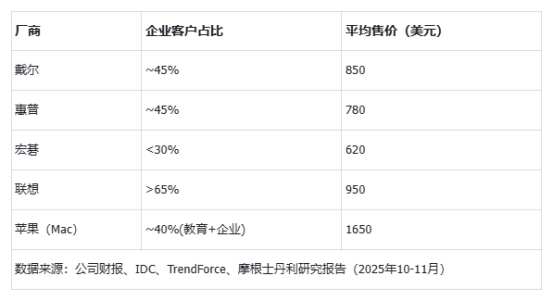
Core Insights - The global storage chip contract prices have experienced a rare nonlinear surge since Q2 2025, driven by the high demand for high-bandwidth memory (HBM) from AI accelerators like NVIDIA's H100 [1] - Major storage manufacturers such as Samsung, SK Hynix, and Micron are shifting production capacity from traditional PC DRAM and NAND to more profitable HBM, tightening supply for traditional PC DRAM and NAND [1][2] - Companies like Lenovo and Apple are viewed as exceptions that may benefit from this storage price uptrend due to their strong customer bases and supply chain management capabilities [1][3] Supply Chain Dynamics - The demand for high-performance SSDs and HBM has surged due to AI data centers, leading manufacturers to prioritize production for high-margin products, which has squeezed the supply of mid-range DDR and client SSDs [2] - In 2025, the global DRAM market revenue is expected to exceed $200 billion, with HBM contributing over half of the profit growth despite accounting for less than 30% of the market [2] - The average storage cost increase of 20% for an $800 laptop could raise the bill of materials (BOM) by $30-$50, potentially eroding 3-6 percentage points of gross margin if manufacturers cannot pass on costs [2] Impact on Consumer-Oriented Manufacturers - Dell, HP, and Acer, which heavily rely on the consumer market, face significant profit margin threats due to their sensitivity to storage price increases [3] - The average selling price of global consumer PCs is projected to be around $620 in 2025, making these companies vulnerable to price sensitivity in a highly competitive market [3] - Morgan Stanley's report indicates that Dell and HP are the most sensitive to rising storage prices, predicting a 2-4 percentage point decline in their PC gross margins for FY 2026 [3] Resilience of Lenovo and Apple - Lenovo and Apple are better positioned to withstand the pressures of rising storage prices due to their strong supply chain control and customer structure [4][10] - Lenovo's market share exceeds 25%, with over 65% of its revenue coming from enterprise and government clients, allowing it to pass on costs more effectively [6][7] - Apple maintains absolute control over its supply chain, benefiting from long-term contracts that ensure priority access to components, which helps it manage costs effectively [9] Competitive Advantages - Lenovo's procurement strategy, which includes multi-regional sourcing, enhances its bargaining power and allows it to secure better prices and delivery guarantees [8] - Apple's BOM structure has a lower storage cost percentage, allowing it to absorb price increases more easily, and its strong brand allows for higher pricing flexibility [9][10] - Both companies are expected to maintain or even expand their market share during this "super cycle" of storage price increases, leading to greater industry differentiation [10]
超大规模数据中心取胜 星展:上调联想目标价至20港元
Ge Long Hui· 2025-11-18 07:41
Group 1 - The core viewpoint is that Lenovo, as a leading global PC and server manufacturer, is expected to benefit significantly from the upcoming upgrade cycle in 2025, leading to an increased buy rating and a target price adjustment to HKD 20 from HKD 15 [1][2] - Lenovo is transitioning from a technology hardware giant to a service-oriented company, leveraging its 25% market share in active PC users and strong reputation in the PC and server sectors to drive growth in services and solutions [1] - The company is well-positioned in the AI wave, with its AI assistant "Xiao Tian" integrated with DeepSeek, enhancing capabilities such as summarization, translation, and transcription, which is expected to boost AI PC shipment volumes significantly [1] Group 2 - Lenovo's server business is poised to benefit from the super cycle of AI infrastructure in China, with the server market projected to exceed USD 140 billion by 2029, directly impacting Lenovo's order volume [2] - In the period from April to June 2025, Lenovo's AI server revenue saw a remarkable year-on-year growth of 155%, supported by strong partnerships and innovative cooling technologies that reduce data center power consumption [2] - Lenovo currently holds approximately 35% of the AI cloud server revenue in China, with expectations to exceed 20% market share by 2028 as large-scale deployments and water cooling technology become standard in new AI data centers [2]
受益PC换机周期 星展再度上调联想目标价至20港元
Zhi Tong Cai Jing· 2025-11-18 07:37
Core Viewpoint - DBS Bank maintains a "buy" rating for Lenovo (00992) and raises the target price to HKD 20 from HKD 15, citing benefits from the 2025 upgrade cycle [1] Group 1: Transition to Service-Oriented Company - Lenovo is transitioning from a technology hardware giant to a service-oriented company, leveraging its 25% market share in active PC users and strong reputation in PCs and servers to drive growth in services and solutions [2] - The company is well-positioned in the AI wave due to its extensive production expertise and product innovation [2] Group 2: 2025 Upgrade Cycle - The upgrade cycle in 2025 is expected to be driven by the migration to Windows 11 and a strong AI PC product line, with Lenovo's AI assistant "Xiao Tian" integrated with DeepSeek for enhanced functionalities [2] - AI PC shipments are projected to grow by 93% in FY3/26 and by 52% in FY3/27, increasing their share of total PC shipments to 37% and 57% respectively [2] Group 3: Server Business Growth - The Chinese server market is expected to exceed USD 140 billion by 2029, benefiting Lenovo's orders significantly [3] - Lenovo's AI server revenue grew by 155% year-on-year from April to June 2025, supported by strong IDM partnerships and the Neptune water-cooling system that reduces data center power consumption by approximately 40% [3] - Lenovo holds about 35% of the AI cloud server revenue in China as of early 2025, with expectations to exceed 20% market share by 2028 as large-scale deployments and water-cooling technology become standard [3] - The company updates its earnings forecasts for FY2027 and FY2028 by 10.1% and 17.1% respectively, reflecting higher AI server shipment assumptions [3]
受益PC换机周期 星展再度上调联想(00992)目标价至20港元
智通财经网· 2025-11-18 07:36
Core Viewpoint - DBS Bank maintains a "buy" rating for Lenovo (00992) and raises the target price to HKD 20 from HKD 15, citing benefits from the 2025 upgrade cycle [1] Group 1: Transition to Service-Oriented Company - Lenovo is transitioning from a technology hardware giant to a service-oriented company, leveraging its 25% market share in active PC users and strong reputation in PCs and servers to drive growth in services and solutions [2] - The company is well-positioned in the AI wave due to its extensive production expertise and product innovation [2] Group 2: 2025 Upgrade Cycle - The upgrade cycle in 2025 is expected to be driven by the migration to Windows 11 and a strong AI PC product line, with Lenovo's AI assistant "Xiao Tian" integrated with DeepSeek for enhanced functionalities [2] - AI PC shipments are projected to grow by 93% in FY3/26 and by 52% in FY3/27, increasing their share of total PC shipments to 37% and 57% respectively [2] Group 3: Server Business Growth - The Chinese server market is expected to exceed USD 140 billion by 2029, benefiting Lenovo's orders significantly [3] - Lenovo's AI server revenue grew by 155% year-on-year from April to June 2025, supported by strong IDM partnerships and the Neptune water cooling system that reduces data center power consumption by approximately 40% [3] - Lenovo holds about 35% of the AI cloud server revenue in China as of early 2025, with expectations to exceed 20% market share by 2028 as large-scale deployments and water cooling technology become standard [3] Group 4: Financial Projections - The valuation benchmark for Lenovo has been updated to the fiscal year 2027, with earnings forecasts for FY27 and FY28 raised by 10.1% and 17.1% respectively, reflecting higher assumptions for AI server shipments [3]
联想携手中足联点亮首个全栈AI总指挥中心
Zhong Guo Jing Ji Wang· 2025-11-18 07:15
Core Insights - Lenovo and the Chinese Football Association have launched the first AI Command Center for football events in China, marking a significant step towards the integration of AI in sports operations [1] - This initiative follows Lenovo's establishment of a smart sports business unit and represents its first foray into football [1] Group 1: AI Command Center Features - The AI Command Center employs a "large screen visualization + intelligent interaction" model, creating a smart service system with three core functions: event status, event supervision, and command dispatch [1] - The "Event Status" module displays real-time data for 16 Chinese Super League teams, including standings, schedules, and weather conditions [1] - The "Event Supervision" module allows for simultaneous monitoring of multiple matches, security surveillance, and live broadcast feeds [1] - The "Command Dispatch" module supports both daily coordination and emergency command capabilities, ensuring smooth event operations [1] Group 2: Impact on Chinese Football - The establishment of the AI Command Center is expected to inject strong development momentum into the intelligent, professional, and international aspects of Chinese football events [1] - This collaboration is part of Lenovo's broader strategy to implement its full-stack AI solutions across various industries, including manufacturing, education, and finance [1]