AGRICULTURAL BANK OF CHINA(01288)

Search documents
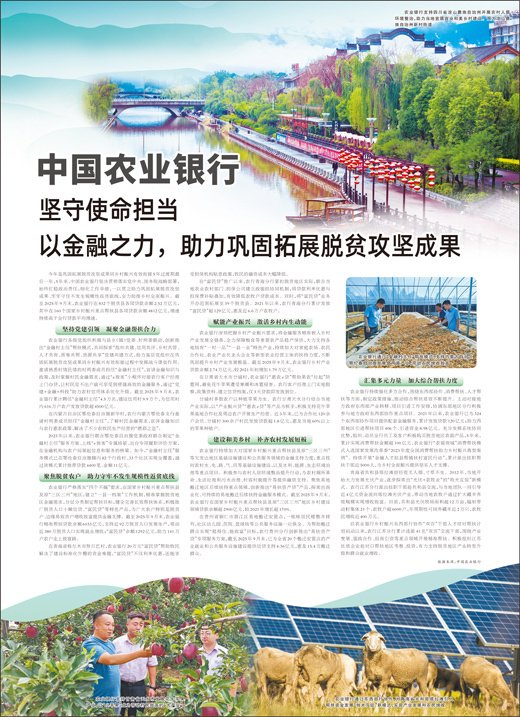
中国农业银行 坚守使命担当 以金融之力,助力巩固拓展脱贫攻坚成果
Ren Min Wang· 2025-12-01 01:16
Core Viewpoint - The Agricultural Bank of China is actively supporting the consolidation of poverty alleviation achievements and the effective connection with rural revitalization, with a focus on financial assistance and innovative service models to enhance rural development and prevent large-scale poverty recurrence [2][3][4]. Group 1: Financial Support and Loan Balances - As of September 2025, the Agricultural Bank has a loan balance of 2.52 trillion yuan in 832 poverty-stricken counties, with 481.2 billion yuan in 160 key rural revitalization counties, maintaining a growth rate higher than the bank's average loan growth [2]. - The bank has provided a cumulative loan balance of 6.033 trillion yuan for targeted poverty alleviation, supporting nearly 920,000 impoverished individuals in production development and creating job opportunities for about 3.8 million people [4]. Group 2: Innovative Service Models - The bank has implemented the "Financial Village Director" model, appointing 45,000 directors to connect with local communities, provide financial education, and facilitate loan access through the "e-push customer" app, benefiting 6.16 million rural households with over 450 billion yuan in loans [3][4]. - In Inner Mongolia, the "Financial Village Director" model has been adopted in 82 administrative villages and 33 communities, resulting in 4,400 loan recommendations totaling 1.1 billion yuan [4]. Group 3: Targeted Loan Products - The "Rich People Loan" product has been instrumental in providing financial support to farmers, with a balance of 129.2 billion yuan, helping 1.41 million households improve their livelihoods [4][5]. - Since the launch of the "Rich People Loan," the Qinghai branch has issued over 12.9 billion yuan in loans, benefiting approximately 66,000 farmers and herders [5]. Group 4: Infrastructure and Public Services - The bank has increased financial support for infrastructure projects in key rural revitalization counties, with a loan balance exceeding 290 billion yuan, representing a growth of over 170% since 2021 [7]. - In Guizhou, the bank has provided 436 million yuan in credit support for public service facilities in 20 resettlement sites, benefiting 154,000 relocated individuals [7]. Group 5: Comprehensive Assistance and Collaboration - The Agricultural Bank has engaged in multi-faceted cooperation to enhance comprehensive assistance, providing financial services for 324 East-West cooperation projects with a total loan issuance of 12 billion yuan since 2021 [9]. - The bank's "Agricultural Bank Mall" model has facilitated over 10 billion yuan in consumption assistance for poverty-stricken areas, recognized as a national model for rural revitalization [9].


11月红利主题基金月度成立规模新高|财富周历 动态前瞻
Sou Hu Cai Jing· 2025-12-01 00:45
A股 - Minmetals Capital's announcement of a related party transaction has drawn industry attention, with its subsidiary Minmetals Trust planning to jointly invest in a joint venture with Minmetals Real Estate, injecting 300 million yuan in cash and an asset package valued at 16.29 billion yuan [2] - The results of the subscription for Moer Thread, known as the "first domestic GPU stock," were announced, with public funds, social security funds, and pension funds acquiring approximately 38.59 million shares, accounting for 98.44% of the offline final issuance [2] - Yunnan Aluminum announced plans to acquire stakes in three aluminum companies from Yunnan Metallurgical Group, while AVIC Helicopter's subsidiary plans to merge with another wholly-owned subsidiary [2] 港股 - The Hong Kong IPO market is experiencing a surge, surpassing the NYSE and NASDAQ, aiming to become the top global fundraising market for new stocks by 2025, with 81 new listings raising a total of 215.98 billion HKD in the first ten months of the year [3] - More than half of the fundraising amount in Hong Kong has come from 14 A-share companies, with notable price discrepancies between A-shares and H-shares, exemplified by CATL's H-share price being over 14% higher than its A-share price [3] 理财 - In November, nine dividend-themed funds were established, raising a total of 6.615 billion yuan, marking a new monthly high for the year, with significant contributions from several funds launched on November 25 [4] - Major state-owned banks and some joint-stock banks have begun to withdraw 5-year large-denomination time deposits, focusing on shorter-term products, with a broad impact across various banks [4] - Sixteen technology-themed funds have been approved, including several ETFs focused on artificial intelligence and semiconductor sectors, with some products receiving approval on the same day they were submitted [4] 个人养老金 - As the year-end personal pension contribution window approaches, banks are intensifying promotional efforts, offering exclusive benefits to attract customers to open accounts and contribute funds, with potential subsidies of around 600 yuan for maximum contributions [5] 债务 - The issuance of new local special bonds in November is expected to reach 492.2 billion yuan, an increase of over 200 billion yuan from the previous month, alongside a significant rise in refinancing bonds [5] 其他 - From January to October, profits of large-scale industrial enterprises in China totaled 595.03 billion yuan, a year-on-year increase of 1.9%, with equipment manufacturing and high-tech manufacturing being the main profit growth drivers [6] - China remains the world's largest market for industrial robots, with significant improvements in performance and quality, and a projected increase in domestic multi-joint robot sales [6] - The National Development and Reform Commission announced a new credit repair management method, effective from April 1, 2026, allowing credit subjects to apply for credit repair under certain conditions [6] - China's foreign direct investment reached 1,033.23 billion yuan in the first ten months, a year-on-year increase of 7%, with investments made in 9553 overseas enterprises across 152 countries and regions [7] - The Chinese medical device market is expected to reach 1.22 trillion yuan by 2025, driven by innovation, with a record number of approved innovative medical devices [7]





银行5折卖房潮来袭!上万套房产大甩卖,普通人该不该接盘?
Sou Hu Cai Jing· 2025-11-30 18:06
Core Viewpoint - Banks are aggressively selling properties at significant discounts, with prices as low as 50-70% of market value, in response to the declining real estate market and increasing non-performing loans [1][3]. Group 1: Market Dynamics - The real estate market has undergone drastic changes, leading to a rise in loan defaults as borrowers choose to stop payments, forcing banks to reclaim properties [3]. - Banks are facing a saturation in the foreclosure market, with many properties being returned after failing to sell at auction, necessitating urgent liquidation efforts [3][5]. - Major banks, including Agricultural Bank and Postal Savings Bank, are participating in this property sell-off, with significant numbers of properties listed for sale [1][3]. Group 2: Pricing Examples - In Beijing, a bank-listed property is priced at 51,000 yuan per square meter, compared to a market price of 70,000 yuan, representing a 27% discount [5]. - In Lanzhou, a property is listed at only 2,000 yuan per square meter, while the market price is 5,000 yuan, indicating a 60% reduction [5]. Group 3: Buyer Considerations - Buyers must be prepared to pay in full, as banks are not offering financing options for these discounted properties, which may pose a financial burden [8]. - There are potential risks associated with existing rental agreements that may complicate ownership transfer, as well as issues related to unpaid utility fees and household registration [8][10]. - Due diligence is essential, as highlighted by individual experiences of buyers facing unexpected costs and complications after purchase [10]. Group 4: Market Impact - The large-scale sale of discounted properties by banks is accelerating the decline in real estate prices, further straining developers and real estate agents [10]. - Banks are likely to adopt more stringent lending practices in the future, tightening the availability of credit in the real estate market [10][15]. Group 5: Future Outlook - The ongoing trend of banks selling properties reflects a significant transformation in the Chinese real estate market, shifting from a speculative mindset to a more cautious approach among buyers [15]. - As banks continue to clear their inventory, more discounted properties may become available, presenting both opportunities and risks for potential buyers [15].




2025年全球系统重要性银行名单出炉
Zheng Quan Ri Bao Zhi Sheng· 2025-11-30 16:06
Core Insights - The Financial Stability Board (FSB) has released the 2025 list of Global Systemically Important Banks (G-SIBs), maintaining the number of banks at 29, with five Chinese state-owned banks included [1][2] - The grouping of banks has changed, reflecting shifts in their core business activities, with the Industrial and Commercial Bank of China (ICBC) moving from the second to the third group, marking it as the first Chinese bank in that category [1][2] Group Changes - The highest group (fifth group) remains vacant, while the fourth group includes only JPMorgan Chase [1] - The Agricultural Bank of China, Bank of China, and China Construction Bank remain in the second group, while the Bank of Communications is in the first group [1] Score Changes - The scores of Chinese G-SIBs have changed significantly, with ICBC and Bank of China increasing by 33 and 32 points respectively, driven by multiple factors rather than just size [2] - Currency effects have also positively influenced the scores of Chinese G-SIBs [2] Capital Requirements - Following the group adjustment, ICBC's additional capital requirement will increase from 1.5% to 2.0%, necessitating compliance with Total Loss-Absorbing Capacity (TLAC) requirements within a specified timeframe [2] Importance in Global Financial System - The adjustment confirms ICBC's significant position in the global financial system, raising expectations for its compliance and risk management [2] - The five Chinese banks are encouraged to enhance their ESG management and global strategy, leveraging financial technology for new service models [3] Recommendations for Future Strategy - The banks should improve their compliance and risk management systems by learning from global experiences and actively participating in discussions on international financial management standards [3] - They are advised to innovate in business practices to enhance their narrative in the global financial system and increase their influence [3]


6400亿元!绿色金融债发行翻倍,中小银行加速入场
券商中国· 2025-11-30 07:29
Core Viewpoint - The issuance of green financial bonds in China has significantly increased in 2023, driven by supportive policies and a diverse range of issuing institutions, including small and medium-sized banks, which have become new growth points in the market [2][3][9]. Group 1: Green Bond Issuance - On November 27, the National Development Bank successfully issued 9 billion yuan of 3-year green financial bonds with an interest rate of 1.52%, achieving a subscription multiple of 2.46 times [1]. - Since the implementation of the "Green Bond Support Project Directory (2025 Edition)" in October, financial institutions have entered a "fast track" for green bond issuance, with 14 bank green bonds issued in November alone, marking the highest issuance density of the year [2]. - In November, various banks issued a total of 110.7 billion yuan in green financial bonds, setting a new monthly record for 2023 [3]. Group 2: Diverse Issuers - The issuance of green bonds has expanded beyond state-owned banks to include small and medium-sized banks and non-bank financial institutions, indicating a diversification of issuers [4][9]. - In November, several small banks issued green bonds ranging from 700 million yuan to 3.5 billion yuan, with specific examples including Tangshan Bank and Chongqing Three Gorges Bank [5][6][7]. Group 3: Policy Support and Market Growth - The explosive growth in green bond issuance is attributed to continuous policy support, particularly following the launch of the new project directory, which has unified various green financial products and reduced identification costs for financial institutions [9]. - As of November 28, over 240 green bonds have been issued by financial institutions, with a total issuance scale exceeding 640 billion yuan, doubling the issuance scale from 2024 [9]. Group 4: Cost Optimization and Innovation - The average issuance cost of bank green bonds has improved, decreasing from 1.94% in 2024 to 1.74% in 2023, enhancing the financing cost-effectiveness [3]. - There has been a notable increase in product innovation within the green bond market, with various financial institutions exploring new mechanisms, including floating rate bonds and thematic bonds focused on specific sectors like green manufacturing [11][13].



农业银行梅州分行 金融活水赋能“百千万工程”提速增效
Zheng Quan Ri Bao Zhi Sheng· 2025-11-30 07:06
Core Insights - The "Hundred Million Project" is being effectively implemented in Meizhou, Guangdong, with Agricultural Bank of Meizhou Branch focusing on serving this initiative to promote local economic development through financial empowerment [1][2]. Group 1: Financial Support for Local Industries - Agricultural Bank of Meizhou Branch is targeting financial needs of local industries, particularly in advanced manufacturing sectors such as copper foil and automotive parts, to strengthen the county's economic foundation [2][3]. - The bank successfully provided a 10 million yuan "credit + guarantee" working capital loan to Meizhou Jinyou Kang Health Industry Technology Co., addressing their financing challenges due to lack of collateral [2]. Group 2: Support for Agricultural Development - The bank has established a comprehensive financial service system covering the entire agricultural value chain, including planting, processing, storage, marketing, and cold chain logistics, to enhance local specialty products [3]. - A case study of a local grapefruit farmer illustrates the bank's commitment to rural revitalization, as they provided a 200,000 yuan unsecured loan to support agricultural upgrades, significantly boosting the farmer's income prospects [4][5]. Group 3: Innovative Financial Services - Agricultural Bank of Meizhou Branch is innovating its services to meet diverse financial needs, establishing a "green channel" for credit approval to enhance efficiency for key projects and clients [7]. - The bank is also expanding its outreach through mobile banking and a rural financial service team, allowing farmers to access various banking services conveniently [7]. Group 4: Future Plans - The bank plans to continue increasing credit investments and optimizing financial service quality to further integrate into the "Hundred Million Project" [8].
逾3.7亿港元!近50家金融机构捐款捐物驰援香港大埔火灾
Guo Ji Jin Rong Bao· 2025-11-29 10:06
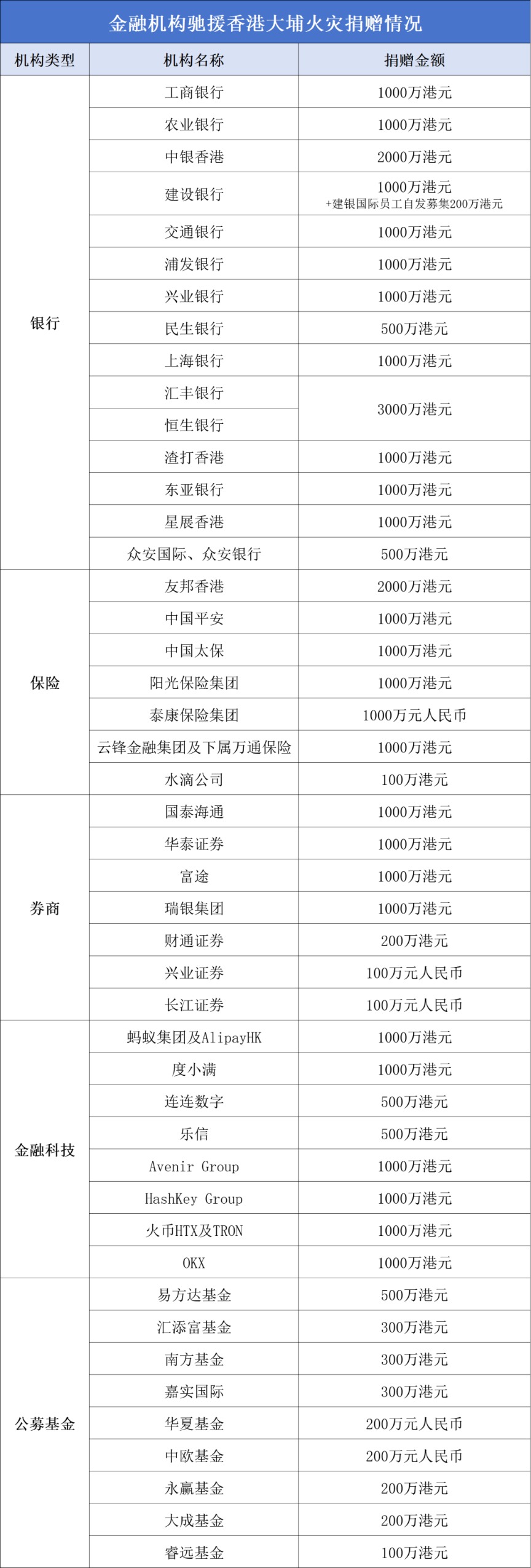
Core Viewpoint - The fire at Hong Kong's Tai Po Wang Fuk Court resulted in significant casualties, with 128 confirmed dead and around 200 individuals unaccounted for, prompting a swift response from the financial sector to support relief efforts [1][2]. Financial Institutions' Donations - Nearly 50 financial institutions have contributed over 370 million HKD to aid in disaster relief, including major banks, insurance companies, and fintech firms [1][2]. - Notable contributions include: - Bank of China Hong Kong: 20 million HKD - HSBC: 30 million HKD - Agricultural Bank of China: 10 million HKD [2][3][6]. Emergency Support Measures - The Hong Kong Monetary Authority and the Hong Kong Association of Banks urged banks to provide flexible support to affected individuals, including expedited cash withdrawals and waiving fees [6][7]. - Major state-owned banks, including ICBC and Agricultural Bank of China, quickly mobilized to assist in relief and reconstruction efforts [6][7]. Insurance Companies' Response - Insurance firms activated emergency plans, offering streamlined claims processes and immediate financial support to affected clients [9][10]. - AIA Hong Kong pledged 20 million HKD for community support and initiated contact with potentially affected clients [9][10]. Securities Firms' Contributions - Several securities firms, including Guotai Junan and Huatai Securities, donated funds to support emergency relief and reconstruction efforts [12][13]. - UBS announced a donation of 10 million HKD through its charitable foundation for community support [13][14]. Fintech Sector Involvement - Fintech companies, such as Ant Group and Du Xiaoman, contributed 10 million HKD each to assist with emergency relief and recovery efforts [17][18]. - Various digital asset platforms also pledged significant donations to support affected communities [19]. Public Fund Contributions - Public fund companies collectively donated over 20 million HKD to support disaster relief and recovery initiatives [20][21]. - Notable contributions include: - E Fund: 5 million HKD - Huatai Fund: 3 million HKD [21][22][23]. Overall Impact - The financial sector's rapid response and substantial contributions highlight its role as a stabilizing force in times of crisis, providing essential support to affected communities [27][28].


固收点评20251129:二级资本债周度数据跟踪-20251129
Soochow Securities· 2025-11-29 08:46
1. Report Industry Investment Rating No information provided in the report. 2. Core View of the Report The report provides a weekly data tracking of secondary capital bonds from November 24 to November 28, 2025, covering primary market issuance, secondary market trading, and valuation deviation of individual bonds [1]. 3. Summary by Relevant Catalogs 3.1 Primary Market Issuance - Three new secondary capital bonds were issued in the inter - bank and exchange markets this week, with a total issuance scale of 68.9 billion yuan. The issuance term is 10 years, the issuers include local state - owned enterprises and central financial enterprises, with subject ratings of AA+ and AAA, and the issuer regions are Zhejiang, Hunan, and Beijing [1]. 3.2 Secondary Market Trading - **Trading Volume**: The total weekly trading volume of secondary capital bonds was approximately 178.5 billion yuan, an increase of 13.2 billion yuan from last week. The top three bonds in terms of trading volume were 25 Bank of China Secondary Capital Bond 02BC (10.146 billion yuan), 25 Agricultural Bank of China Secondary Capital Bond 04A(BC) (9.421 billion yuan), and 25 Bank of China Secondary Capital Bond 01BC (6.028 billion yuan). By issuer region, the top three in trading volume were Beijing (141.6 billion yuan), Shanghai (12.6 billion yuan), and Fujian (4.7 billion yuan) [2]. - **Yield to Maturity**: As of November 28, for 5Y secondary capital bonds, the yield - to - maturity changes of AAA-, AA+, and AA - rated bonds compared to last week were 5.46BP, 7.44BP, and 8.44BP respectively; for 7Y bonds, the changes were 9.05BP, 10.90BP, and 10.90BP respectively; for 10Y bonds, the changes were 10.13BP, 9.50BP, and 9.50BP respectively [2]. 3.3 Valuation Deviation of Top 30 Individual Bonds - The overall valuation deviation of the weekly trading average price of secondary capital bonds was not significant this week. The proportion and amplitude of discount transactions were smaller than those of premium transactions. - **Discount Bonds**: The top three discount - rate bonds were 21 Jiutai Rural Commercial Secondary (-48.4374%), 21 Guiyang Rural Commercial Secondary (-1.0131%), and 23 China CITIC Bank Secondary Capital Bond 01B (-0.3428%). The remaining discount rates were within - 0.31%. The ChinaBond implicit ratings were mainly AAA-, AA+, and AA - rated, and the regional distribution was mainly in Beijing, Zhejiang, and Shanghai [3]. - **Premium Bonds**: The top three premium - rate bonds were 25 Shanghai Pufa Bank Secondary Capital Bond 01B (1.5031%), 25 Qujiang Rural Commercial Bank Secondary Capital Bond 01 (1.3216%), and 25 Agricultural Bank of China Secondary Capital Bond 04B(BC) (0.8022%). The remaining premium rates were within 0.78%. The ChinaBond implicit ratings were mainly AAA-, AA+, and AA - rated, and the regional distribution was mainly in Beijing, Shanghai, and Tianjin [3].
超百家企业捐赠总额超12亿港元,企业驰援香港大埔火灾救援


第一财经· 2025-11-29 07:06
Core Points - A significant fire occurred in Hong Kong's Tai Po district, resulting in major casualties and prompting over 100 companies and foundations to donate for emergency relief and community recovery efforts, with total donations exceeding HKD 1.2 billion [2][4]. Donation Summary - Major companies such as Yuexiu Group donated HKD 10 million, while China Overseas and China State Construction contributed HKD 20 million [3]. - Tencent donated HKD 30 million, and Alibaba made an initial donation of HKD 20 million [3]. - Other notable contributions include HKD 30 million from the Li Ka Shing Foundation and HKD 12 million from the Chaozhou Association [4]. - The total amount of donations has surpassed HKD 1.2 billion as of the latest reports [4].

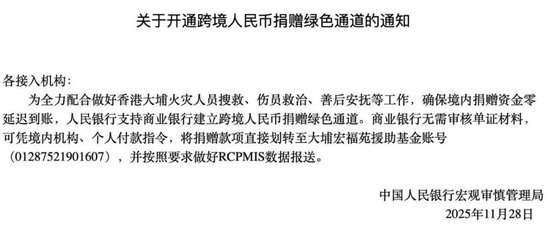
央行、工行、农行、中行、建行、交行等集体出手,全力支持救灾及灾后重建工作
2 1 Shi Ji Jing Ji Bao Dao· 2025-11-29 07:04
Core Viewpoint - Several major banks in China, including Industrial and Commercial Bank of China (ICBC), Agricultural Bank of China (ABC), Bank of China (BOC), China Construction Bank (CCB), and others, have collectively mobilized to provide financial support and aid for disaster relief following a significant fire incident in Hong Kong's Tai Po district, demonstrating a strong commitment to corporate social responsibility and community support [1][3][6][9][12][14][17][18]. Group 1: Donations and Financial Support - ICBC announced a donation of HKD 10 million to support disaster relief and reconstruction efforts, coordinating with its Hong Kong branches to provide emergency financial services and support for affected customers [3][12]. - ABC pledged HKD 10 million for fire rescue and post-disaster recovery, organizing volunteer teams and financial support for affected families [6][12]. - BOC committed HKD 20 million, establishing a dedicated donation account for public contributions and offering expedited banking services for affected clients [9][12]. - CCB also donated HKD 10 million, facilitating cross-border donations and providing emergency services for affected residents [12][14]. - Bank of Communications announced a donation of HKD 10 million, setting up emergency service stations and providing immediate cash support for affected customers [14][18]. Group 2: Collective Efforts from Other Banks - Other banks, including Shanghai Bank, Spdb Bank, and Minsheng Bank, collectively donated nearly HKD 100 million, with Spdb Bank and Minsheng Bank each contributing HKD 10 million and HKD 5 million respectively for emergency aid [17][18]. - Foreign banks such as HSBC and Hang Seng Bank jointly donated HKD 30 million, while Standard Chartered and DBS Bank each contributed HKD 10 million to support the affected residents [18].