
AGRICULTURAL BANK OF CHINA(01288)

Search documents
侃股:农行市值突破3万亿元,银行股迎黄金时代
Bei Jing Shang Bao· 2025-11-12 10:56
Core Viewpoint - Agricultural Bank's stock price has reached a new high, with its market value surpassing 3 trillion yuan, indicating a growing recognition of the valuation of quality bank stocks [1][2] Group 1: Market Performance - The banking sector is experiencing a revaluation, particularly quality bank stocks, which are attracting more investors due to stable dividends and performance [1] - The overall banking sector is entering a golden era, with strong dividend stability and improved valuation recognition across both large and small banks [2] - Agricultural Bank's market value crossing 3 trillion yuan serves as a significant signal for the revaluation of bank stocks [2] Group 2: Investment Trends - With the decline in risk-free interest rates, bank stocks offer more attractive high dividends compared to fixed-income assets, leading to increased investment from long-term funds [1] - Institutional investors, such as insurance funds and public funds, are increasing their investments in bank stocks based on asset allocation needs [1] - Small and medium-sized bank stocks may appeal more to retail investors due to their operational flexibility and potential for higher price increases in a bullish market [2]

行业点评报告:抵债房产加速处置下,银行涉房风险再观察
KAIYUAN SECURITIES· 2025-11-12 10:13
Investment Rating - The industry investment rating is "Positive" (maintained) [1] Core Insights - Banks are accelerating the disposal of debt properties due to multiple considerations including capital, profitability, and market risks. This includes selling properties obtained from non-performing loans on platforms like JD and Alibaba, which helps avoid legal disputes [3][4] - The current economic environment pressures banks to dispose of these assets quickly to reduce capital consumption, supplement profits, and mitigate risks associated with fluctuating real estate prices [3][4] - The scale and impairment provisions of debt assets among listed banks show significant differentiation, with some banks having higher levels of non-performing assets and varying impairment ratios [4][5] Summary by Sections Section on Debt Property Disposal - Banks are expediting the sale of debt properties to alleviate capital pressure, as regulations require disposal within two years to avoid punitive risk weights [3] - The new capital management guidelines propose extending the disposal period to five years and reducing risk weights for non-self-use properties beyond the disposal period [3][8] Section on Asset Characteristics - The characteristics of debt assets among listed banks vary significantly, with some banks like ICBC and Minsheng Bank having higher levels of debt assets and differing asset structures [4][9] - The impairment provision ratios for debt assets also differ, with some banks fully provisioning while others have lower ratios, indicating potential under-provisioning issues [4][5] Section on Risk Parameters - The risk exposure and default parameters for housing collateral loans indicate that the majority of banks have low default probabilities, particularly in first and second-tier cities [5][15] - The analysis shows that higher collateral values correlate with lower default probabilities, suggesting that banks with significant exposure in major cities may face manageable risks [5][15]


尾盘,直线涨停!A股,发生了啥?
券商中国· 2025-11-12 09:02
Core Viewpoint - The article highlights significant movements in the satellite navigation and banking sectors, driven by recent developments and market dynamics, indicating potential investment opportunities in these areas [1][2][4][6][10]. Satellite Navigation Sector - On November 12, satellite navigation stocks surged, with Shanghai HuGong and Shanghai Gangwan hitting the daily limit, and Aerospace Zhizhuang rising over 16% [2]. - Apple is reportedly advancing new satellite connectivity features for iPhones and Apple Watches, which could enhance offline capabilities and expand usage scenarios [4]. - The low Earth orbit (LEO) communication satellites are seen as a future trend in satellite internet, with potential applications for millions of smartphones as communication satellite terminals [4][5]. - High Throughput Satellites (HTS) significantly increase capacity and reduce bandwidth costs, making them a crucial development direction for communication satellites [5]. - The satellite internet industry is poised for growth due to strong policy support, marking the beginning of a new era in commercial space [6]. Banking Sector - Agricultural Bank of China and Industrial and Commercial Bank of China reached historical highs, with Agricultural Bank's stock price peaking at 8.56 CNY, a rise of over 4% [7]. - Insurance capital is increasingly investing in the banking sector, driven by factors such as new premium inflows and enhanced equity investment ratios [7][9]. - The third quarter saw insurance capital actively positioning in banks, with a focus on stable dividends and low valuations, particularly favoring high ROE small and medium banks [7][9]. - The upcoming mid-term dividend distribution from banks is expected to attract more financial investments from insurance funds, further boosting the sector's valuation [8][10]. - The insurance sector also experienced a significant rise, with major companies reporting substantial profit growth, indicating a favorable investment environment [10][11].


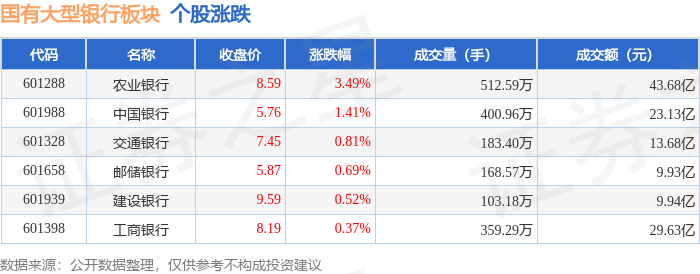
国有大型银行板块11月12日涨1.82%,农业银行领涨,主力资金净流入11.17亿元
Zheng Xing Xing Ye Ri Bao· 2025-11-12 08:44
Core Insights - The state-owned large bank sector experienced a rise of 1.82% on November 12, with Agricultural Bank leading the gains [1] - The Shanghai Composite Index closed at 4000.14, down 0.07%, while the Shenzhen Component Index closed at 13240.62, down 0.36% [1] Bank Performance - Agricultural Bank (601288) closed at 8.59, up 3.49% with a trading volume of 5.1259 million shares [1] - Bank of China (601988) closed at 5.76, up 1.41% with a trading volume of 4.0096 million shares [1] - Bank of Communications (601328) closed at 7.45, up 0.81% with a trading volume of 1.8340 million shares [1] - Postal Savings Bank (601658) closed at 5.87, up 0.69% with a trading volume of 1.6857 million shares [1] - China Construction Bank (666109) closed at 9.59, up 0.52% with a trading volume of 1.0318 million shares [1] - Industrial and Commercial Bank (601398) closed at 8.19, up 0.37% with a trading volume of 3.5929 million shares [1] Capital Flow - The state-owned large bank sector saw a net inflow of 1.117 billion yuan from institutional investors, while retail investors experienced a net outflow of 769 million yuan [1] - Agricultural Bank had a net inflow of 506 million yuan from institutional investors, while retail investors had a net outflow of 303 million yuan [2] - Industrial and Commercial Bank had a net inflow of 214 million yuan from institutional investors, with retail investors experiencing a net outflow of 177 million yuan [2] - Bank of China had a net inflow of 203 million yuan from institutional investors, with retail investors seeing a net outflow of 113 million yuan [2] - Bank of Communications had a net inflow of 166 million yuan from institutional investors, while retail investors had a net outflow of 917.7 million yuan [2] - China Construction Bank experienced a net outflow of 22.94 million yuan from institutional investors, but had a net inflow of 606.79 million yuan from speculative funds [2]


中信金属:为全资子公司中信金属宁波能源有限公司提供8.00亿元担保
2 1 Shi Ji Jing Ji Bao Dao· 2025-11-12 08:39
Core Viewpoint - The company has signed a maximum guarantee contract with Agricultural Bank of China to provide a guarantee of up to 800 million yuan for its wholly-owned subsidiary's operational needs [1] Group 1: Guarantee Details - The guarantee covers the principal, interest, penalty interest, compound interest, liquidated damages, compensation for damages, and costs related to the realization of creditor's rights [1] - The guarantee is not backed by any counter-guarantee and falls within the approved external guarantee plan for 2025, thus no additional review procedures are required [1] Group 2: Financial Position - As of the announcement date, the total external guarantees provided by the company and its controlling subsidiaries amount to approximately 4.00 billion yuan, which represents 182.29% of the company's most recent audited net assets [1] - There are no overdue guarantees reported by the company [1]


收评:沪指窄幅震荡微跌0.07%,农业银行总市值突破3万亿元再创新高
Xin Lang Cai Jing· 2025-11-12 07:03
Market Overview - The three major A-share indices collectively declined, with the Shanghai Composite Index down 0.07%, the Shenzhen Component down 0.36%, and the ChiNext Index down 0.39% [1] - The total trading volume in the Shanghai and Shenzhen markets was 19,648 billion yuan, a decrease of 491 billion yuan compared to the previous day [1] - Over 3,500 stocks in the market experienced declines [1] Sector Performance - The insurance, pharmaceuticals, oil and gas extraction and services, gas, brain-computer interface, and aluminum metal sectors saw the largest gains [1] - Conversely, the cultivated diamond, photovoltaic, film and television, energy metals, and humanoid robot sectors faced the most significant declines [1] Notable Stocks - The pharmaceutical and pharmacy sectors collectively rose, with stocks such as Yiyigou, Kaineng Health, and Zhongyuan Hehe reaching their daily limit [1] - Oil and gas stocks were active, with PetroChina and Zhun Oil both hitting their daily limit [1] - The banking sector saw a brief surge, with Agricultural Bank's total market value surpassing 3 trillion yuan, setting a new historical high [1] Declines in Specific Stocks - The photovoltaic sector experienced adjustments, with stocks like Canadian Solar and Airo Energy dropping over 10%, while Hongyuan Green Energy, Longi Green Energy, and Tongwei Co. also faced significant declines [1] - The cultivated diamond sector also retreated, with stocks such as World Diamond falling over 10%, and Huifeng Diamond, Power Diamond, and Sifangda also experiencing declines [1]
A500ETF基金(512050)获得资金密集加仓,农业银行总市值一度突破3万亿元
Mei Ri Jing Ji Xin Wen· 2025-11-12 06:12
Group 1 - The A-share market experienced fluctuations, with the A500 ETF fund seeing a net subscription of 1.377 billion yuan in the last 10 days and 2.398 billion yuan in the last 20 days, indicating strong capital inflow [1] - Key sectors such as banking, pharmaceuticals, and consumer goods showed resilience, with Agricultural Bank's market value reaching a new high of over 3 trillion yuan [1] - The Shanghai Stock Exchange's International Investor Conference emphasized the importance of guiding capital towards advanced technologies and industries, enhancing corporate governance, and promoting long-term investment strategies [1] Group 2 - CITIC Securities maintains a positive outlook on A-shares and Hong Kong stocks, identifying four driving forces: capital inflow, technological innovation, institutional reform, and consumption upgrade [2] - The market is expected to focus on themes such as technological self-reliance, industrial upgrades, and resource security, with opportunities identified in AI, semiconductors, and high-end manufacturing [2]
农业银行股价创新高,总市值一度突破三万亿元
Huan Qiu Lao Hu Cai Jing· 2025-11-12 06:06
Core Viewpoint - Agricultural Bank of China has shown strong performance in the stock market, reaching a historical high with a market capitalization exceeding 3 trillion yuan, driven by solid fundamentals and favorable market conditions [1][2] Group 1: Stock Performance - On November 12, the banking sector rose against the trend, with Agricultural Bank's stock price increasing approximately 3.13% to 8.56 yuan [1] - The bank's stock has seen a cumulative increase of over 60% year-to-date, outperforming the Shanghai Composite Index [1] - Agricultural Bank has maintained its position as the top A-share market value leader since early August [1] Group 2: Financial Performance - For the first three quarters of 2025, Agricultural Bank reported operating income of 550.88 billion yuan, a year-on-year increase of 1.97%, and a net profit attributable to shareholders of 220.86 billion yuan, up 3.03% [1][2] - As of September 30, 2025, the bank's total assets reached 48 trillion yuan, reflecting an 11.33% growth compared to the end of the previous year [1] Group 3: County Financial Potential - The bank's strong performance is attributed to the release of potential in county-level finance, with county loans amounting to 10.90 trillion yuan, a 10.57% increase year-on-year [2] - The proportion of county loans in domestic loans stands at 40.98%, indicating a strategic focus on this segment [2] Group 4: Asset Quality and Valuation - As of September 30, the non-performing loan ratio was 1.27%, a decrease from the beginning of the year, with a provision coverage ratio of 295.08% and a capital adequacy ratio of 17.78% [2] - Agricultural Bank's A-share price-to-earnings ratio is 10.17, with a dividend yield of 2.86%, making it the only major bank with a price-to-book ratio exceeding 1 [2] Group 5: Dividend Distribution - The bank has completed two cash dividend distributions for the 2024 fiscal year, totaling 84.66 billion yuan, and plans to distribute an additional 41.82 billion yuan, representing 30% of its semi-annual net profit [3]
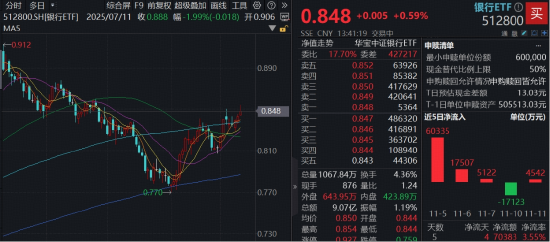
重要信号,农业银行、工商银行齐创历史新高!双百亿银行ETF(512800)稳步三连阳,近5日超7亿资金抢跑
Xin Lang Ji Jin· 2025-11-12 06:02
Core Viewpoint - The banking sector continues to show strong performance, with Agricultural Bank and Industrial and Commercial Bank reaching historical highs, indicating robust market interest in bank ETFs [1][3]. Group 1: Market Performance - Agricultural Bank's stock rose over 3%, while Industrial and Commercial Bank's stock increased nearly 2%, both hitting record highs [1]. - The bank ETF (512800) saw a price increase of over 1% at one point, currently up 0.59%, marking three consecutive days of gains [1]. - The bank ETF has accumulated a net inflow of over 700 million yuan in the past five days, reflecting increased investor interest [3]. Group 2: Investment Appeal - The banking sector is expected to attract more market attention due to its stable and high dividend characteristics, supported by long-term capital from insurance funds, state-owned enterprises, and public funds [3]. - The bank ETF (512800) tracks the CSI Bank Index, which has a price-to-book ratio (PB) of only 0.72, placing it in the lower range of the past decade [3]. - The dividend yield of the index stands at 4.02%, exceeding the 10-year government bond yield by 2.22 percentage points, highlighting its "quasi-fixed income" appeal [3]. Group 3: Fund Characteristics - The bank ETF (512800) has a scale exceeding 20.6 billion yuan and an average daily trading volume of over 800 million yuan, making it the largest and most liquid bank ETF in A-shares [4]. - The ETF passively tracks the CSI Bank Index, which includes 42 listed banks in A-shares, serving as an efficient investment tool for the banking sector [4].
“18罗汉”突然异动!农业银行总市值盘中突破3万亿,背后有何逻辑?
Zheng Quan Shi Bao Wang· 2025-11-12 05:20
Core Viewpoint - The A-share market experienced a significant shift with large-cap stocks showing strong performance, particularly the top 18 stocks, which collectively exceeded a market capitalization of 20 trillion yuan, indicating a potential change in market dynamics and investor sentiment [1][2]. Group 1: Market Performance - On November 12, the A-share market saw a collective rise in the top 18 stocks, with Agricultural Bank reaching a new historical high, while the overall market showed mixed results with over 3,800 stocks declining [1]. - The major indices initially faced declines, with the Shenzhen Component and ChiNext Index dropping over 1%, but later rebounded due to the strong performance of large-cap stocks [1]. Group 2: Fund Flows - Southbound capital saw a significant net inflow of 12.748 billion yuan during the week of November 3 to November 7, with the banking, non-banking financial, and oil and petrochemical sectors being the primary beneficiaries [2]. - The net inflow amounts for these sectors were 8.27 billion yuan for banking, 5.35 billion yuan for non-banking financials, and 4.81 billion yuan for oil and petrochemicals, totaling approximately 18.4 billion yuan [2]. Group 3: Market Logic - Analysts suggest that the shift towards large-cap stocks may be driven by changes in market risk appetite, with current macro leverage at approximately 12.46 times and high valuations in the technology sector [3]. - The market is experiencing increased valuation and sentiment risks, with a decrease in liquidity for sell orders, indicating heightened selling pressure [3]. - Recommendations for asset allocation include increasing exposure to domestic stocks and commodities, with a focus on large-cap stocks and balanced growth-value strategies, particularly in sectors like coal, photovoltaics, telecommunications, and agriculture [3].
