NCI(01336)

Search documents
狂赚4260亿元! A股五大险企前三季度业绩出炉
Mei Ri Jing Ji Xin Wen· 2025-11-03 12:55
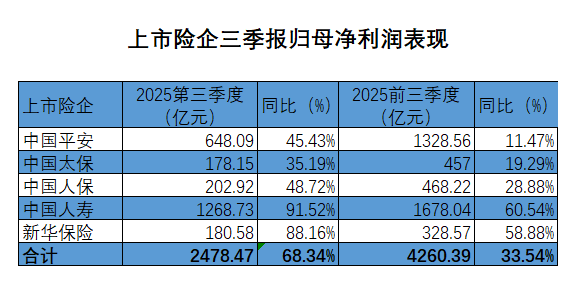
Core Insights - The five major A-share insurance companies reported a total net profit of 426.04 billion yuan for the first three quarters, a year-on-year increase of 33.5% [1] - In the third quarter alone, the net profit reached 247.85 billion yuan, reflecting a significant year-on-year growth of 68.3% [1] Investment Income Growth - The net profits for the first three quarters of 2025 for the major insurance companies were as follows: China Life (167.80 billion yuan, +60.5%), New China Life (32.86 billion yuan, +58.9%), PICC (46.82 billion yuan, +28.9%), China Pacific (45.70 billion yuan, +19.3%), and Ping An (132.86 billion yuan, +11.5%) [2] - In the third quarter, the net profits were: China Life (126.87 billion yuan, +91.5%), New China Life (18.06 billion yuan, +88.2%), Ping An (64.81 billion yuan, +45.4%), PICC (20.29 billion yuan, +48.7%), and China Pacific (17.82 billion yuan, +35.2%) [2] - The increase in profits is attributed to growth in investment income, with companies actively increasing equity investments and optimizing asset allocation [2][4] Total Investment Returns - China Life achieved total investment income of 368.55 billion yuan, a year-on-year increase of 41.0%, with a total investment return rate of 6.42% [3] - Ping An's investment portfolio yielded a non-annualized comprehensive return of 5.4%, with total assets exceeding 6.41 trillion yuan, up 11.9% from the beginning of the year [3] - PICC reported total investment income of 86.25 billion yuan, a 35.3% increase, with total investment assets at 1.83 trillion yuan, up 11.2% [3] New Business Value Growth - China Life's total premium income reached 669.65 billion yuan, a 10.1% increase, with all premium categories showing double-digit growth [5] - Ping An's new business value in life and health insurance was 35.72 billion yuan, up 46.2%, with a new business value rate increasing by 9.0 percentage points [5] - China Pacific achieved a premium income of 263.86 billion yuan, a 14.2% increase, and a new business value of 15.35 billion yuan, up 7.7% [6] Channel Development and Product Structure - The individual insurance channel has seen significant transformation, with New China Life adding over 30,000 new agents, resulting in a 50% increase in per capita productivity [6] - The bancassurance channel also experienced rapid growth, with New China Life's premium income from this channel increasing by 66.7% [7] - Companies are focusing on enhancing their dividend insurance products to meet diverse customer needs, with a notable shift towards long-term premium-paying insurance products [8]



保险行业点评:预定利率切换后寿险阶段性放缓,非车险企稳回升
Minsheng Securities· 2025-11-03 10:40
Investment Rating - The report maintains a "Recommended" rating for the insurance industry, indicating a positive outlook for the sector's performance in the coming months [6]. Core Insights - The insurance industry experienced a premium income of CNY 521.46 billion from January to September 2025, reflecting a year-on-year increase of 8.8%. However, the premium income in September alone was CNY 41.48 billion, showing a slight decline of 0.3% year-on-year [2]. - Life insurance premiums reached CNY 317.08 billion from January to September 2025, up 12.7% year-on-year, while September's premium income was CNY 19.62 billion, down 4.6% year-on-year. The decline in September was anticipated due to the scheduled switch in the predetermined interest rate [3]. - Health insurance premiums showed a modest increase of 0.2% year-on-year, totaling CNY 64.22 billion from January to September 2025. The September premium income was CNY 6.38 billion, down 2.1% year-on-year, attributed to fluctuations in high-cost medical treatments and policy adjustments [4]. - The auto insurance sector demonstrated steady growth, with premiums reaching CNY 683.6 billion, a 4.4% increase year-on-year, while non-auto insurance premiums were CNY 687.6 billion, up 5.4% year-on-year. The growth in auto insurance is supported by rising vehicle sales, particularly in the passenger and new energy vehicle segments [5]. Summary by Sections Life Insurance - The life insurance sector is expected to focus on dividend insurance, which remains attractive compared to traditional savings products. The long-term growth logic for dividend insurance is still intact despite recent fluctuations [7]. - The report highlights a recovery in new contributions to policyholder investment funds, with a significant year-on-year increase of 29.1% in September 2025, indicating a renewed interest from policyholders [4][7]. Health Insurance - The health insurance segment is undergoing a transformation, with traditional medical insurance facing adjustments while high-end medical insurance is still in the cultivation phase. Long-term factors such as aging population and health consumption upgrades are expected to support growth in this sector [4][7]. Property Insurance - The property insurance sector is anticipated to maintain stable growth, with leading companies focusing on refined pricing and claims management to enhance profitability. The overall premium income for property insurance is expected to grow steadily [7].

A股五大险企前三季度狂揽4260亿,日均赚15.6亿,投资收益成最大推手
Xin Lang Cai Jing· 2025-11-03 09:30
Core Insights - The five major listed insurance companies in A-shares reported impressive performance for the first three quarters of 2025, with a total net profit of 426.04 billion yuan, a significant increase of 33.5% year-on-year, averaging about 1.56 billion yuan per day [1][2] Financial Performance - China Life led with a net profit of 167.80 billion yuan, a year-on-year increase of 60.5%, followed by New China Life, China Pacific Insurance, China Ping An, and China Property & Casualty, all achieving double-digit growth [2][3] - In Q3 2025, the net profits of these five companies surged, with year-on-year growth rates of 91.5% for China Life, 88.2% for New China Life, 48.7% for China Property & Casualty, 35.2% for China Pacific Insurance, and 45.4% for China Ping An [2] Investment Performance - The substantial increase in investment income was attributed to the recovery of the stock market, with companies actively increasing equity investments [1][3] - For the first three quarters, China Life reported total investment income of 368.55 billion yuan, a 41.0% increase year-on-year, with an investment return rate of 6.42%, up 104 basis points [3][4] New Business Value - All five listed insurance companies reported new business value growth exceeding 30% in the first three quarters [5] - China Property & Casualty achieved the highest growth rate in new business value at 76.6%, while China Life and New China Life reported increases of 41.8% and 50.8%, respectively [5][6] - The focus on dividend insurance is driving the transformation of the business structure towards "floating income" products, with China Life significantly increasing the proportion of floating income business in its first-year premium income [5][6]
买买买!险资,持续加仓股市!
证券时报· 2025-11-03 09:00
Core Viewpoint - Insurance capital has entered a "buying" mode in equity investments, significantly increasing their holdings in A-shares as evidenced by the third-quarter reports of listed companies [1][3]. Group 1: Insurance Capital Investment Trends - As of the end of the third quarter, the number of A-shares held by insurance institutions increased by 19% compared to the end of the previous year, with the market value of these holdings rising by 18% [1][3]. - In the third quarter alone, the number of A-shares held by insurance capital grew by 14% compared to the previous quarter, with a total market value exceeding 650 billion yuan [3][6]. - Financial stocks remain a cornerstone of insurance capital investments, with their market value exceeding 300 billion yuan, accounting for nearly 50% of total holdings [3][4]. Group 2: New Investments and Sector Focus - Over 300 new stocks were added to the insurance capital's heavy holdings in the third quarter, with a total market value of over 100 billion yuan [5][6]. - The manufacturing sector accounted for the highest proportion of new investments, with over 200 new stocks and a market value exceeding 45 billion yuan [6]. - Significant new investments were also made in strategic emerging industries and high-tech manufacturing, including sectors like semiconductors and medical devices [6]. Group 3: Performance and Returns - The increase in equity investments has led to substantial returns, contributing to record-high profits for several insurance companies in the third quarter [7][8]. - For instance, China Life reported a net profit of 167.8 billion yuan for the first three quarters, a year-on-year increase of 60.5%, driven by a total investment income of 368.6 billion yuan [8]. - New China Life also saw a net profit increase of 58.9%, with a total investment income reflecting a significant growth trend in the capital market [8].


新华保险(601336) - 新华保险H股公告
2025-11-03 09:00
FF301 股份發行人及根據《上市規則》第十九B章上市的香港預託證券發行人的證券變動月報表 截至月份: 2025年10月31日 狀態: 新提交 致:香港交易及結算所有限公司 FF301 公司名稱: 新華人壽保險股份有限公司 呈交日期: 2025年11月3日 I. 法定/註冊股本變動 | 1. 股份分類 | 普通股 | 股份類別 | H | | | 於香港聯交所上市 (註1) | | 是 | | | --- | --- | --- | --- | --- | --- | --- | --- | --- | --- | | 證券代號 (如上市) | 01336 | 說明 | | | | | | | | | | | 法定/註冊股份數目 | | | 面值 | | | 法定/註冊股本 | | | 上月底結存 | | | 1,034,107,260 | RMB | | 1 | RMB | | 1,034,107,260 | | 增加 / 減少 (-) | | | | | | | RMB | | | | 本月底結存 | | | 1,034,107,260 | RMB | | 1 | RMB | | 1,034,107,26 ...
新华保险(01336) - 截至2025年10月31日止之股份发行人的证券变动月报表
2025-11-03 08:24
FF301 股份發行人及根據《上市規則》第十九B章上市的香港預託證券發行人的證券變動月報表 截至月份: 2025年10月31日 狀態: 新提交 致:香港交易及結算所有限公司 公司名稱: 新華人壽保險股份有限公司 呈交日期: 2025年11月3日 I. 法定/註冊股本變動 | 1. 股份分類 | 普通股 | 股份類別 | H | | | 於香港聯交所上市 (註1) | | 是 | | | --- | --- | --- | --- | --- | --- | --- | --- | --- | --- | | 證券代號 (如上市) | 01336 | 說明 | | | | | | | | | | | 法定/註冊股份數目 | | | 面值 | | | 法定/註冊股本 | | | 上月底結存 | | | 1,034,107,260 | RMB | | 1 | RMB | | 1,034,107,260 | | 增加 / 減少 (-) | | | | | | | RMB | | | | 本月底結存 | | | 1,034,107,260 | RMB | | 1 | RMB | | 1,034,107,260 | | ...
【Fintech 周报】世界黄金协会:市场尚未饱和;保险业前三季罚金超3亿禁业86人
Sou Hu Cai Jing· 2025-11-03 08:15
Regulatory Dynamics - Five banks were fined a total of over 200 million yuan for various violations, with China Bank fined 97.9 million yuan for issues in governance and loan management [1] - The Central Bank's Zhejiang branch imposed fines exceeding 16 million yuan on six banks, affecting 25 responsible individuals, with penalties ranging from 7,500 to 100,000 yuan [1] Insurance Industry - The total fines in the insurance industry exceeded 300 million yuan in the first three quarters of 2025, marking a year-on-year increase of 9.64%, with 86 individuals banned from the industry [2] - In Q3 2025, the insurance sector saw 632 penalties totaling 134 million yuan, with a significant rise in the number of penalties and institutions involved compared to the previous year [2] Industry Dynamics - The six major state-owned banks reported their Q3 results, with Industrial and Commercial Bank of China achieving a revenue of 610.97 billion yuan, a year-on-year increase of 1.98% [2] - Agricultural Bank of China reported a revenue of 550.77 billion yuan, up 1.87%, while Bank of China and China Construction Bank also showed modest growth in revenue and net profit [2] Corporate Developments - China Pacific Insurance reported a net profit of 45.7 billion yuan in the first three quarters of 2025, reflecting a year-on-year growth of 19.3% [9] - The appointment of Zhao Guid as vice president of Industrial and Commercial Bank of China was announced, highlighting his extensive experience in digital transformation and financial technology [6] - Yibin Bank announced a change in leadership, appointing Guo Hua as the new president after the resignation of Jiang Lin [7] - China Life and New China Life reported significant net profit growth rates of 91.5% and 88.2% respectively in Q3 2025, driven by substantial investment income [5]





保险行业2026年度投资策略:资负两端全面开花,估值低位攻守兼备
Soochow Securities· 2025-11-03 07:05
Group 1 - The insurance industry has shown strong growth in both the liability and asset sides, with a notable increase in net profit and net asset value for listed insurance companies in 2025 [3][13][15] - The net profit of listed insurance companies for the first three quarters of 2025 reached CNY 426 billion, a year-on-year increase of 33.5%, with Q3 alone showing a remarkable growth of 68.3% [13][14] - The new business value (NBV) for listed insurance companies grew over 30% year-on-year, driven by a significant increase in new policy premiums, particularly from the bancassurance channel [3][29] Group 2 - The insurance industry is undergoing a transformation with a shift towards floating income products and channel reforms, enhancing growth prospects [3][5] - The bancassurance channel has experienced explosive growth, contributing significantly to new business and NBV, with major companies like Xinhua and China Life seeing substantial increases in new premiums [48][49] - The historical performance of insurance stocks has been influenced by factors such as stock market trends, interest rates, and new policy premium growth, with stock market performance being a key short-term catalyst [3][5] Group 3 - The investment strategy for the insurance sector indicates continued improvement in both liability and asset sides, with significant upside potential in valuations [3][5] - The current market conditions, including high savings demand and declining bank deposit rates, favor insurance product sales, while the stock market's upward trend benefits listed insurance companies' equity investments [3][5] - As of October 31, 2025, the valuation of the insurance sector is at historical lows, with expected price-to-earnings ratios ranging from 0.56 to 0.92 times [3][5]
炒股赚翻!上市险企前三季度净利4260亿元,已超去年全年
第一财经· 2025-11-02 14:04
Core Viewpoint - The listed insurance companies in A-shares have achieved a record high in net profit attributable to shareholders for the third quarter, driven primarily by significant investment income growth and strong performance in new business value [3][5][14]. Group 1: Financial Performance - The total net profit attributable to shareholders of the five major listed insurance companies reached 426.04 billion yuan in the first three quarters, representing a year-on-year increase of over 30% compared to the previous year's high growth of 80% [5][6]. - The third quarter alone contributed nearly 60% of the total net profit for the first three quarters, with a year-on-year increase of 68.34% [7][8]. - China Life and New China Life reported the highest year-on-year growth rates in net profit for the first three quarters, both around 60% [6][7]. Group 2: Investment Income - The average investment income of listed insurance companies grew by over 35% in the first three quarters, with the third quarter seeing a nearly 67% increase [3][9]. - The total investment income for the first three quarters amounted to 887.5 billion yuan, with the third quarter contributing 542.4 billion yuan [9][10]. - The rise in investment income has led to an increase in investment yield, with New China Life reporting an annualized total investment yield of 8.6%, up by 1.8 percentage points year-on-year [10][12]. Group 3: New Business Value - The new business value for listed insurance companies continued to show strong growth, with increases ranging from over 30% to more than 70% year-on-year [13]. - The growth in new business value is primarily driven by the increase in new single premium insurance policies and improvements in new business value rates [13][14]. - The bancassurance channel has been a significant contributor to the growth of new single premium insurance policies, with notable increases reported by several companies [13].

炒股赚翻!上市险企前三季度净利4260亿元,已超去年全年
Di Yi Cai Jing· 2025-11-02 12:35
Core Insights - The listed insurance companies in A-shares achieved a record net profit attributable to shareholders of 426.04 billion yuan in the first three quarters, marking a year-on-year increase of over 30% compared to the previous year's high growth of 80% [2][3] - The significant increase in net profit is primarily driven by a surge in investment income, with an average growth of over 35% in total investment income for the first three quarters [2][7] - The new business value also saw a year-on-year increase of over 30%, with the bancassurance channel continuing to be a major contributor to new premium growth [2][11] Investment Performance - The total investment income for the listed insurance companies reached 887.5 billion yuan in the first three quarters, reflecting a year-on-year growth of 35.64%, with the third quarter alone contributing 542.4 billion yuan, a 66.64% increase [7][8] - The annualized total investment return for companies like New China Life reached 8.6%, up 1.8 percentage points year-on-year, while other companies also reported returns exceeding 5% [8] Accounting Strategies - Different accounting classification strategies among insurance companies have led to varying sensitivities of net profit to fluctuations in equity asset prices, with companies like China Life and New China Life having higher proportions of FVTPL (Fair Value Through Profit or Loss) assets [10] - The higher the FVTPL proportion, the greater the potential for net profit increases during market upswings, but also greater volatility during downturns [10] New Business Value - The new business value for the listed insurance companies continued to show widespread growth, with increases ranging from 30% to over 70% year-on-year [11] - The growth in new business value is primarily driven by the increase in new premium sales, with significant contributions from the bancassurance channel [11][12]