
XIAOMI(01810)

Search documents
小米开源首代机器人VLA大模型
Xin Lang Cai Jing· 2026-02-12 03:36
Group 1 - The core announcement is that Xiaomi has open-sourced the Xiaomi-Robotics-0 model, which features 4.7 billion parameters and combines visual language understanding with high-performance real-time execution capabilities [1]


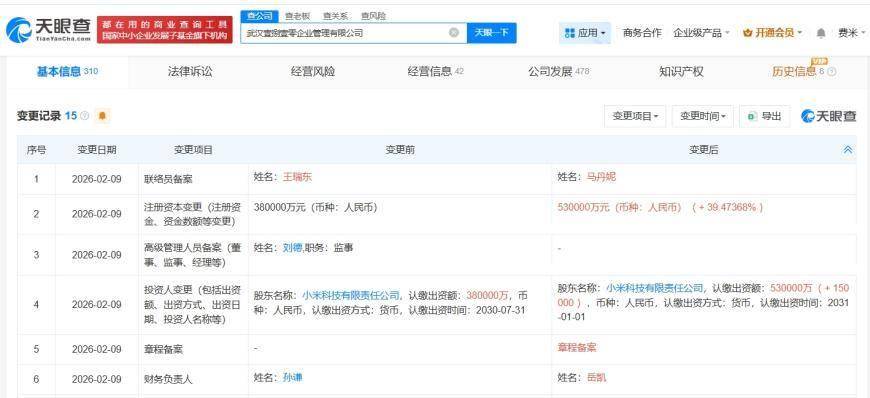
小米旗下武汉企业管理公司增资至53亿 增幅约39%
Sou Hu Cai Jing· 2026-02-12 03:28
天眼查显示,近日,武汉壹捌壹零企业管理有限公司发生工商变更,注册资本由38亿人民币增至53亿人民币,增幅约39%。 | | | | 四公司 白字图 直关系:直风险 | | | | | | | --- | --- | --- | --- | --- | --- | --- | --- | --- | | | | 图在用的频业更向工具 MALINERS MANAGER | 三次都是在第十六年度有限公司 | 8 天殿一下 | 十 应用 · | | 商务合作 企业级产品。 必开通会员。 | ● 费米· | | 基本信息 310 | | 法律诉讼 | 经营风险 | 经营信息 42 | 公司发展 478 | 知识产权 | 用中信息 8 G | | | 变更记录 15 @ | | | | | | 变更项目· | 变更时间。 ■ 含品 | ●大眼圈 | | 序号 | 委員日期 | 受用则目 | | 变更前 | | | 变更后 | A | | 1 | 2026-02-09 | 联络员备案 | 姓名:王瑞乐 | | 姓名:马丹妮 | | | | | 2 | 2026-02-09 | 注册资本变更(注册资 金、节量的额等变更) | ...

出行观丨初代小米SU7谢幕:销量与争议并行下的产品迭代选择
Guan Cha Zhe Wang· 2026-02-12 02:55
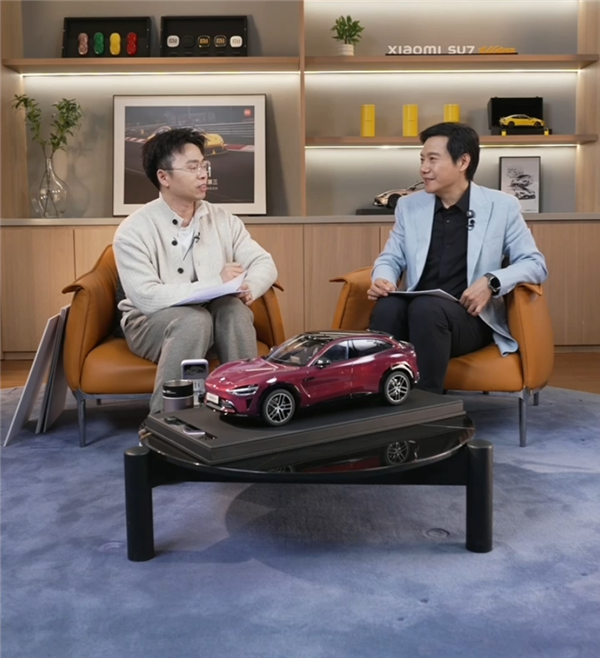
(文/观察者网 张家栋 编辑/高莘) 2月10日,当雷军在直播间平静地说出"第一代SU7量产已经结束。"标志着小米汽车这款充满着传奇色彩且带有争议的首发车型,正式完成其历史使命。 小米汽车直播间 作为小米跨界造车的真正起点,SU7自2024年春季上市以来就带着强烈破圈属性进入市场。不同于传统车企循序渐进推新,小米用互联网品牌的传播方式和 爆款逻辑切入整车赛道,长周期预热、参数密集披露、创始人深度参与讲解与背书,整体呈现方式更接近科技旗舰产品发布会。 这种传播方式也令小米迅速在社交平台获得巨量关注并转化为订单。公开数据显示,SU7开启预订后24小时内订单超过8.8万辆;在随后不到两年的产品周 期内,全生命周期累计交付接近37万辆,成为同价位新能源轿车中鲜有媲美特斯拉的单一车型。 但高热度也同步放大了风险暴露面,去年来SU7多起事故暴露的安全问题,以及营销层面的争议事件,使小米一度陷入舆论漩涡,甚至冲击到其既有的用户 基本盘。 更重要的是,伴随相关事件持续发酵,外界讨论已不只停留在单一产品本身,而是延伸到车辆安全冗余设计、智能化能力边界界定、用户引导方式等更底层 问题,并引发行业与监管层面对相关定义和规范进行反复 ...
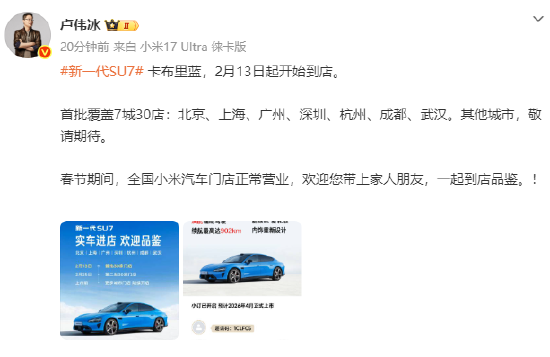
卢伟冰:新一代SU7卡布里蓝明日起到店,首批覆盖7城30店
Xin Lang Cai Jing· 2026-02-12 02:43
Group 1 - The president of Xiaomi Group, Lu Weibing, announced the launch of the new generation SU7 in Capri Blue, starting from February 13 [1][2] - The initial rollout will cover 30 stores across 7 cities: Beijing, Shanghai, Guangzhou, Shenzhen, Hangzhou, Chengdu, and Wuhan [1][2] - Other cities will be announced later, indicating a phased expansion strategy [1][2]
12家火车票第三方购票平台被约谈
新华网财经· 2026-02-12 02:28
Group 1 - The core viewpoint of the article highlights the regulatory actions taken by Beijing's market supervision authority against major online platforms involved in train ticket sales due to consumer complaints about issues like false ticket grabbing and price fraud [1][3]. Group 2 - The Beijing market supervision authority will intensify regulatory enforcement to combat illegal activities such as false ticket grabbing and misleading transactions [3]. - A comprehensive review and rectification of platform pages will be conducted, including the removal of misleading promotional products and adjustments to promotional content to prevent consumer confusion regarding partnerships with 12306 [4]. - Platforms are required to ensure clear pricing, prominently display the content and prices of value-added services, and rectify issues where displayed ticket prices do not match actual payment amounts, thereby safeguarding consumer rights [4].





Omdia:2025年Q4全球智能手机市场同比增长4% 苹果以25%市场份额领跑
智通财经网· 2026-02-12 01:33
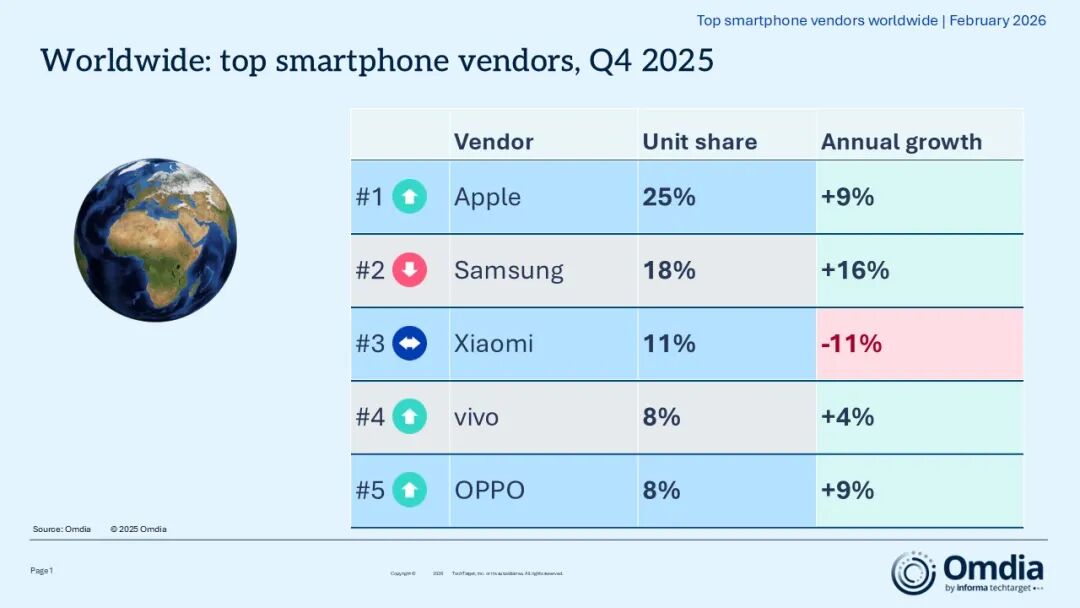
Core Insights - The global smartphone market is expected to grow by 4% year-on-year in Q4 2025, driven by seasonal demand recovery and improved inventory management, despite some manufacturers facing rising component costs [1] - Apple leads the market with a 25% share, benefiting from strong demand for the iPhone 17 series, achieving record quarterly shipments and maintaining its position as the largest smartphone manufacturer for three consecutive years, slightly ahead of Samsung [1] - Samsung holds the second position with an 18% market share, primarily driven by strong sales of models priced below $300, particularly the Galaxy A17 4G and 5G series [1] Global Market Rankings - In Q4 2025, the top smartphone vendors by unit share are: - Apple: 25% (+9% growth) - Samsung: 18% (+16% growth) - Xiaomi: 11% (-11% growth) - Vivo: 8% (+4% growth) - OPPO: 8% (+9% growth) [2] Regional Performance - In the APAC region (excluding Greater China), the top vendors are: - Samsung: 19% (+18% growth) - Apple: 18% (+4% growth) - Vivo: 15% (+11% growth) - OPPO: 11% (+6% growth) - Xiaomi: 10% (-23% growth) [4] - In Latin America, the rankings are: - Samsung: 33% (+21% growth) - Lenovo: 16% (+14% growth) - Xiaomi: 15% (+6% growth) - HONOR: 9% (+64% growth) - Apple: 7% (-8% growth) [4] - In India, the top vendors are: - Vivo: 25% (+16% growth) - OPPO: 16% (+4% growth) - Samsung: 14% (-11% growth) - Xiaomi: 12% (-26% growth) - Apple: 11% (-1% growth) [6] - In the United States, the rankings are: - Apple: 69% (+8% growth) - Samsung: 14% (-3% growth) - Lenovo: 9% (+13% growth) - Google: 3% (-15% growth) - TCL: 2% (-7% growth) [6] - In Brazil, the top vendors are: - Samsung: 39% (-1% growth) - Lenovo: 23% (+12% growth) - Xiaomi: 15% (+12% growth) - Apple: 11% (+10% growth) - realme: 5% (-7% growth) [7]

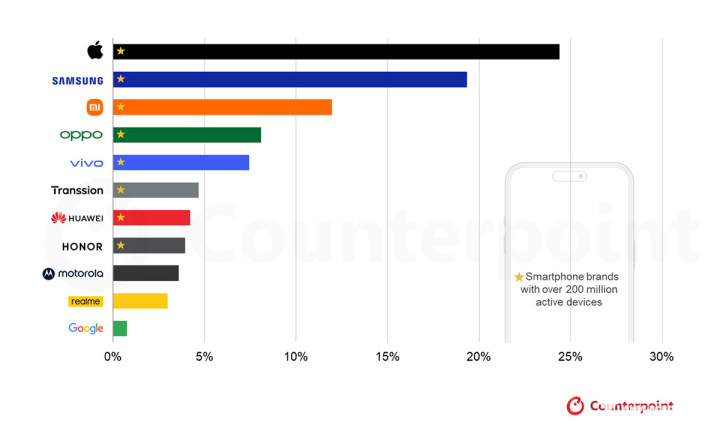
2025手机活跃存量增2% 苹果三星小米位列前三
Xin Lang Cai Jing· 2026-02-12 01:30
Core Insights - The report by Counterpoint Research indicates that eight smartphone manufacturers have surpassed 200 million active devices globally, collectively accounting for over 80% of the active device market share [1][6][8] - By 2025, the global active smartphone device stock is expected to grow by 2% year-on-year, with the average replacement cycle extending to nearly four years, marking a new phase of competition focused on existing users [1][5] Market Share Distribution - Apple and Samsung demonstrate a significant lead, being the only two brands with active devices exceeding 1 billion, together holding 44% of the global market share, with Apple at approximately 25% and Samsung at around 20% [5][8] - Xiaomi is the only other brand in the "200 million club" with a market share exceeding 10%, holding about 12%, while OPPO and vivo form the second tier [5][8] - The remaining brands, including Transsion, Huawei, and Honor, have closely matched market shares, with Honor making its debut in this club, while Motorola and realme are approaching the 200 million mark, indicating potential growth [5][8] Industry Challenges - The report highlights that due to soaring memory prices and extended replacement cycles, simple hardware upgrades are no longer sufficient to drive frequent device replacements among users [5][8] - The core challenge for smartphone brands moving forward will be to extract value from existing users and expand revenue through software and services [5][8]
Omdia数据快闪:2025年第四季度,全球智能手机重点市场厂商排名
Canalys· 2026-02-12 01:03
Core Insights - The global smartphone market experienced a year-on-year growth of 4% in Q4 2025, driven by seasonal demand recovery and improved inventory management, despite some manufacturers facing rising component costs [2] - Apple led the global smartphone market with a 25% market share, attributed to strong demand for the iPhone 17 series, achieving record quarterly shipments and maintaining its position as the largest smartphone manufacturer for three consecutive years, slightly ahead of Samsung [2] - Samsung ranked second with an 18% market share, boosted by strong sales of models priced below $300, particularly the Galaxy A17 4G and 5G series [2] - Xiaomi maintained its position as the third-largest manufacturer, although its market share declined to 11% due to shipment challenges in key markets [2] - Vivo achieved an 8% market share, benefiting from its leading position in the Indian market, while OPPO returned to growth, re-entering the global top five [2] Regional Summaries Global Key Regions - In Q4 2025, Apple held a 25% market share globally with a 9% annual growth, while Samsung had an 18% share with a 16% growth. Xiaomi's share fell to 11% with an 11% decline, Vivo and OPPO both held 8% shares with growth rates of 4% and 9% respectively [2] Europe - In Europe, Apple captured a 30% market share with a 6% growth, while Samsung followed closely with 28% and a 10% growth. Xiaomi's share was 17%, down by 3%, and Lenovo achieved a 6% share with a 13% growth [3] APAC (Excluding Greater China) - In the APAC region, Samsung led with a 19% market share and an 18% growth, followed by Apple at 18% with a 4% growth. Vivo and OPPO held 15% and 11% shares with growth rates of 11% and 6% respectively, while Xiaomi's share dropped to 10% with a 23% decline [3] Mainland China - In Mainland China, Apple ranked first with a 22% market share and a significant 26% growth. Vivo and OPPO followed with 16% and 15% shares, experiencing declines of 8% and growth of 9% respectively [7] India - In India, Vivo led with a 25% market share and a 16% growth, followed by OPPO at 16% with a 4% growth. Samsung's share was 14%, down by 11%, while Xiaomi's share fell to 12% with a 26% decline [7] United States - In the United States, Apple dominated with a 69% market share and an 8% growth, while Samsung held 14% with a 3% decline. Lenovo captured 9% with a 13% growth [9] Brazil - In Brazil, Samsung led with a 39% market share, experiencing a slight decline of 1%. Lenovo and Xiaomi both held 23% and 15% shares with 12% growth, while Apple had an 11% share with a 10% growth [10]

新一代SU7卡布里蓝将于2月13日起到店
Jin Rong Jie· 2026-02-12 00:51
小米汽车今日发文称,新一代SU7卡布里蓝将于2月13日起开始到店。首批覆盖7城30店:北京、上海、 广州、深圳、杭州、成都、武汉。春节期间,全国小米汽车门店正常营业。 ...
胖东来创始人于东来年后退休;雷军:初代SU7正式停产;拓竹科技年终奖总额增超50%,最高奖金超200万;xAI两位联合创始人离职 丨邦早报
Sou Hu Cai Jing· 2026-02-12 00:41
Group 1 - Founder of Pang Donglai, Yu Donglai, announced retirement after the New Year, transitioning to an advisory role, with decision-making now led by the Pang Donglai decision committee [1] - xAI co-founders Jimmy Ba and Wu Yuhua have both announced their departures from the company, marking significant talent loss as 6 out of 12 co-founders have left [3] - Tuo Zhu Technology's year-end bonus for 2025 is reported to exceed a 50% increase compared to 2024, with the highest bonus surpassing 2 million yuan [3] Group 2 - Boston Dynamics CEO Robert Playter has announced his resignation, with CFO Amanda McMaster taking over temporarily while a successor is sought [6] - Xiaomi's CEO Lei Jun announced the discontinuation of the first-generation SU7, with the new generation expected to launch in April [6] - Estée Lauder has filed a lawsuit against Walmart for selling counterfeit products, seeking an injunction and monetary damages [7] Group 3 - Meta plans to build a new data center in Lebanon, Indiana, with an investment exceeding $10 billion, creating approximately 4,000 construction jobs and over 300 operational jobs [7] - Yonghui Supermarket's CEO Wang Shoucheng reflected on the company's past focus on scale, announcing plans to close nearly 400 low-quality stores and distribute nearly 50 million yuan in profit sharing to employees in 2025 [7] - ByteDance is reportedly developing AI chips and negotiating with Samsung for manufacturing [7] Group 4 - Heineken announced plans to cut 5,000 to 6,000 jobs and lowered its 2026 operating profit growth forecast to 2% to 6% [8] - UCloud announced a price increase for its products and services starting March 1, 2026, due to rising costs in the global supply chain [8] - Zhi Ran Medical completed a 300 million yuan A+ round financing to advance clinical trials and product iterations [8] Group 5 - Eutelsat secured approximately 1 billion euros in export credit financing for its OneWeb satellite procurement project [9] - iFLYTEK launched the Xinghuo X2 model, which boasts enhanced capabilities in various areas, including mathematics and language understanding [9] - The global logistics robot company, Geekplus, introduced the world's first general-purpose humanoid robot designed for warehouse operations [11]
