PING AN OF CHINA(02318)

Search documents
人保国寿大动作!新设健康管理公司,究竟在下一盘什么样的大棋
Sou Hu Cai Jing· 2026-01-22 16:24
Core Insights - The establishment of health management companies by major insurers like PICC and China Life highlights a strategic shift towards integrating health services with insurance offerings [1][2] - The trend is driven by declining interest rates and the need for insurers to enhance their market competitiveness by offering health and wellness services alongside traditional insurance products [3] Group 1: Company Developments - PICC Health Management Co., established with a capital of 200 million yuan, is the first non-financial subsidiary approved by the National Financial Regulatory Administration [1] - China Life's health management company, with a registered capital of 323 million yuan, focuses on various elder care and health services, expanding its previous health management initiatives [1][2] - PICC Health Management aims to provide a stable health service module for the group's diverse insurance sectors, emphasizing the integration of AI and digital technology in health management [2] Group 2: Industry Trends - Insurers are increasingly investing in health management to address the changing consumer demand for health security rather than just financial compensation [3][9] - The competitive landscape is shifting from merely having health services to the quality and efficiency of those services, prompting insurers to optimize their resource allocation [3][10] - Different insurers are adopting varied strategies in health management, with some focusing on building comprehensive ecosystems while others leverage external partnerships and technology [4][7] Group 3: Strategic Models - The "closed-loop" model, utilized by leading insurers like Taikang and China Life, integrates various health services into a cohesive ecosystem, positioning insurers as both service providers and asset owners [4][5] - The "integrative" model, adopted by companies like PICC and Fosun, emphasizes flexibility and resource connectivity, allowing for a broader range of health management services [7][8] - Taikang's recent shift towards a mixed asset approach in its health services indicates a trend towards more adaptable business models in the industry [5][6]


见证历史!第一重仓股变了 中际旭创登顶偏股型基金第一大重仓股
Zhong Guo Ji Jin Bao· 2026-01-22 14:17
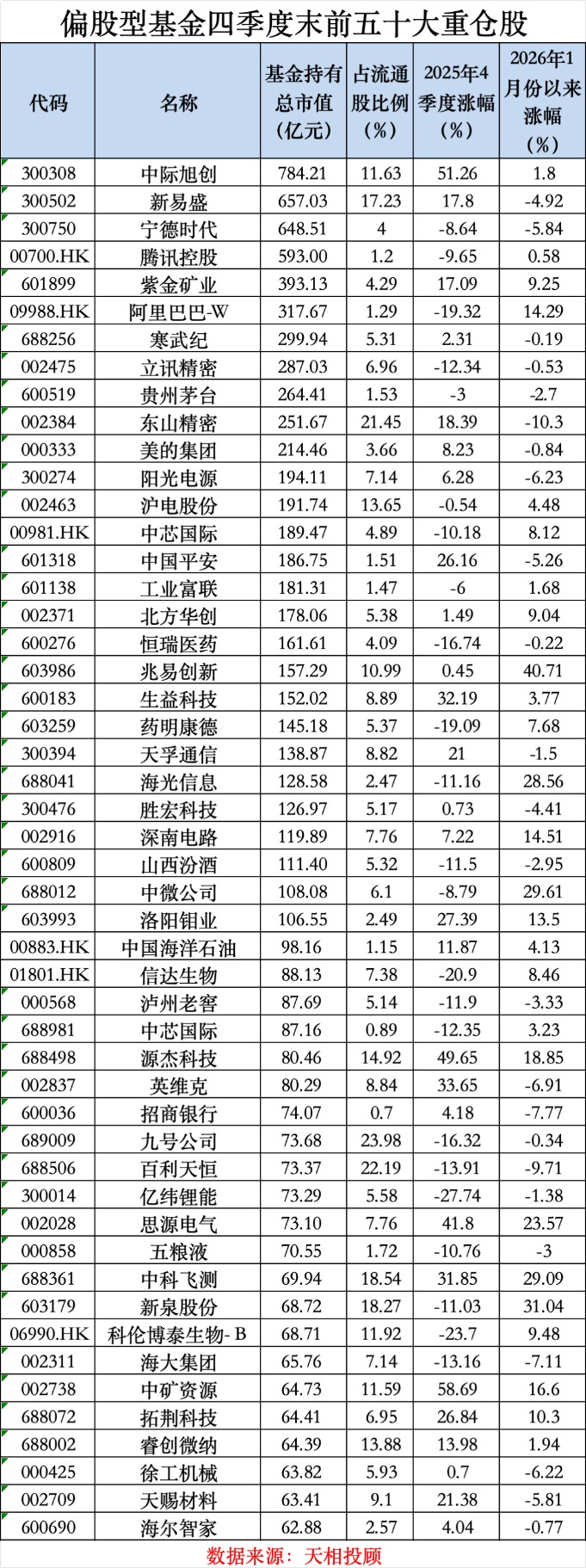
Group 1 - The core focus of the news is the shift in the top holdings of public funds, with Zhongji Xuchuang and Xinyi Sheng replacing CATL and Tencent as the top two holdings [1][5] - In the fourth quarter of last year, the information technology sector saw significant increases in fund holdings, with four out of the top five increased stocks belonging to this sector [1][6] - Zhongji Xuchuang's market value held by public funds increased from 55.81 billion to 78.42 billion, despite a reduction in shares held [5][9] Group 2 - The top ten holdings of public funds at the end of the fourth quarter included Zhongji Xuchuang, Xinyi Sheng, CATL, Tencent, Zijin Mining, Alibaba-W, Cambricon, Luxshare Precision, Kweichow Moutai, and Dongshan Precision [2] - The increase in holdings for Zhongji Xuchuang was the highest at 22.6 billion, followed by China Ping An and Dongshan Precision, both exceeding 10 billion [9] - Several stocks that saw significant price increases in the fourth quarter, such as Tianhua New Energy and Maiwei Co., also experienced substantial increases in fund holdings [9] Group 3 - The fourth quarter saw a reduction in holdings for major tech stocks, including Alibaba-W, Tencent, and SMIC, indicating a trend of public funds reducing exposure to these stocks [10][11] - The top ten stocks with reduced holdings included Alibaba-W, Industrial Fulian, CATL, and Tencent, with significant decreases in their market values held by funds [11] - The overall trend indicates a shift in investment focus towards sectors like information technology, non-ferrous metals, and chemicals, reflecting fund managers' latest strategies [6][9]






见证历史!第一重仓股,变了
Zhong Guo Ji Jin Bao· 2026-01-22 14:16
Core Viewpoint - The report highlights the significant changes in the top holdings of equity funds at the end of the fourth quarter, with Zhongji Xuchuang and Xinyi Sheng replacing CATL and Tencent as the top two holdings, reflecting a shift in investment focus towards technology stocks [1][7]. Group 1: Top Holdings - Zhongji Xuchuang emerged as the largest holding for equity funds, with a total market value of 78.42 billion yuan, despite a reduction in shares held by 970,140 shares, a decrease of 7.02% from the previous quarter [4][7]. - Xinyi Sheng ranked second with a market value of 65.70 billion yuan, also experiencing a slight reduction in holdings but benefiting from a stock price increase of 17.8% [4][7]. - CATL and Tencent fell to third and fourth positions, with market values of 64.85 billion yuan and 59.30 billion yuan, respectively, both experiencing declines in share prices [4][7]. Group 2: Sector Performance - The information technology sector saw significant increases in fund holdings, with four out of the top five increased holdings belonging to this sector [1][9]. - China Ping An was the only new entrant in the top twenty holdings, moving up from 41st to 15th place, indicating a growing interest in the insurance sector [7][12]. Group 3: Fund Activity - Equity funds increased their holdings in several sectors, particularly in information technology, non-ferrous metals, and chemicals, reflecting a strategic shift in investment focus [8][9]. - The top five stocks with the largest increases in holdings included Zhongji Xuchuang, China Ping An, and Dongshan Precision, with increases in market value exceeding 100 billion yuan for several stocks [10][12]. Group 4: Reduction in Holdings - Many leading stocks in the Hang Seng Technology Index, such as Alibaba, Tencent, and SMIC, faced reductions in holdings by equity funds, indicating a cautious approach towards these stocks amid a weak performance of the index [13][14]. - The top ten stocks with the largest reductions included Alibaba, Tencent, and CATL, with significant declines in their market values [15][16].
见证历史!第一重仓股,变了
中国基金报· 2026-01-22 14:11
Core Viewpoint - The article highlights the significant changes in the top holdings of equity funds at the end of the fourth quarter, with Zhongji Xuchuang and Xinyi Sheng replacing CATL and Tencent as the top two holdings, reflecting a shift towards technology stocks driven by a prolonged bull market in the sector [2][3][8]. Group 1: Top Holdings - As of the end of the fourth quarter, the top ten holdings of 5,458 actively managed equity funds included Zhongji Xuchuang, Xinyi Sheng, CATL, Tencent, Zijin Mining, Alibaba-W, Cambricon, Luxshare Precision, Kweichow Moutai, and Dongshan Precision [4][8]. - Zhongji Xuchuang emerged as the largest holding with a market value of 78.42 billion yuan, despite a reduction in shares held by 970,140 shares, a decrease of 7.02% from the previous quarter [5][8]. - Xinyi Sheng also saw a similar trend, with a slight reduction in holdings but a significant increase in market value due to stock price appreciation [8]. Group 2: Sector Trends - The information technology sector received substantial increases in fund allocations, with four out of the top five increased holdings belonging to this sector, alongside significant investments in the insurance sector, particularly in China Ping An [2][10]. - The article notes that the top five increased holdings in equity funds were Zhongji Xuchuang, China Ping An, Dongshan Precision, Xinyi Sheng, and others, indicating a strong preference for technology and financial sectors [11][12]. Group 3: Fund Activity - The article reports that the fourth quarter saw a general trend of reduced holdings in major tech stocks, with Alibaba-W, Tencent, and others being among the most significantly reduced [16][18]. - The reduction in holdings for these stocks was attributed to their poor performance in the Hang Seng Tech Index, with Alibaba-W and Tencent seeing reductions of 183.46 million yuan and 106.18 million yuan, respectively [17][18]. - Conversely, several stocks that doubled in price during the fourth quarter, such as Tianhua New Energy and Maiwei, experienced significant increases in fund holdings, reflecting a shift in investment strategy towards high-growth potential stocks [14].

西部利得港股通新机遇混合A:2025年第四季度利润76.21万元 净值增长率4.58%
Sou Hu Cai Jing· 2026-01-22 12:21
Core Insights - The AI Fund West China Gain Hong Kong Stock Connect New Opportunities Mixed A (008861) reported a profit of 762,100 yuan for Q4 2025, with a weighted average profit per fund share of 0.0342 yuan [3] - The fund's net asset value growth rate for the reporting period was 4.58%, and the fund size reached 15.5946 million yuan by the end of Q4 [3] - The fund manager highlighted that the Hong Kong stock market experienced adjustments in Q4 due to fluctuating expectations of interest rate cuts and tariffs, with notable performance in the Hang Seng materials, finance, and energy sectors [3] Fund Performance - As of January 21, the fund's three-month cumulative net asset value growth rate was 9.77%, ranking 542 out of 1,286 comparable funds [4] - The fund's six-month cumulative net asset value growth rate was 22.31%, ranking 624 out of 1,286 comparable funds [4] - The fund's one-year cumulative net asset value growth rate was 58.35%, ranking 213 out of 1,286 comparable funds [4] - The fund's three-year cumulative net asset value growth rate was -5.88%, ranking 1,088 out of 1,286 comparable funds [4] Risk Metrics - The fund's three-year Sharpe ratio was 0.2164, ranking 1,022 out of 1,275 comparable funds [9] - The maximum drawdown over the past three years was 50.65%, ranking 1,201 out of 1,264 comparable funds [12] - The largest single-quarter drawdown occurred in Q1 2022, at 28.84% [12] Investment Strategy - The fund maintained an average stock position of 81.95% over the past three years, compared to a peer average of 72.57% [15] - The fund reached its highest stock position of 90.04% by the end of Q3 2025, with a lowest position of 72.27% in the first half of 2023 [15] - The fund's top ten holdings include major companies such as Ping An Insurance, China Life, Alibaba, and Tencent [19]


今日财经要闻TOP10|2026年1月22日
Xin Lang Cai Jing· 2026-01-22 12:03
Group 1 - The framework agreement regarding Greenland and the Arctic region is expected to be beneficial for the U.S. and NATO member countries [1] - The U.S. will not implement the previously planned tariffs set to take effect on February 1, based on the agreement reached [1] - Discussions are ongoing regarding Greenland and the "Golden Dome" project, with key officials responsible for negotiations [1] Group 2 - President Trump predicts a 5.4% economic growth rate for the U.S. in the fourth quarter and believes the stock market will double in the future [2] - The U.S. is actively developing nuclear energy and has approved multiple nuclear reactor projects [2] - Trump emphasizes the importance of strong allies in Europe and criticizes the current state of NATO relations [2][3] Group 3 - Russia's President Putin confirms a meeting with U.S. presidential envoy regarding Greenland, stating that the U.S. and Denmark will reach an agreement [3] - The U.S. is involved in discussions about mineral rights in Greenland as part of the framework agreement with NATO [5][14] Group 4 - Alibaba's chip company, Tianshu, is reportedly planning to go public, marking a significant move in the semiconductor industry [4] - Morgan Stanley has doubled its sales forecast for humanoid robots in China for 2026, now predicting 28,000 units [15]



港交所消息:纽约梅隆银行公司持有的中国平安保险(集团)股份有限公司H股多头仓位于1月20日从5.75%降至4.27%
Xin Lang Cai Jing· 2026-01-22 12:02
Group 1 - The core point of the article indicates that Bank of New York Mellon Corp has reduced its long position in the H-shares of China Ping An Insurance (Group) Company Limited from 5.75% to 4.27% as of January 20 [1]

兴业证券基金四季报拆解:加仓有色与金融 减持电子与医药
Zhi Tong Cai Jing· 2026-01-22 11:57
Core Viewpoint - As of January 22, 2026, the disclosure rate of active equity funds' quarterly reports reached 100%, with a slight decrease in overall positions but remaining at historically high levels [2][3] Fund Positioning - Active equity funds' positions decreased by 0.83 percentage points to 86.6%, still the second highest level after Q3 2025, with ordinary stock, mixed equity, and flexible allocation funds decreasing by 0.5, 0.8, and 0.9 percentage points respectively [3] - The ChiNext board saw an increase in positions by 1.2 percentage points to 25.0%, while the Sci-Tech Innovation board decreased by 0.9 percentage points to 16.6%, and the main board decreased by 0.3 percentage points to 58.2% [3] Sector Allocation - The sectors with the highest increases in positions were non-ferrous metals (+2.3 percentage points), communication (+1.9 percentage points), and non-bank financials (+0.9 percentage points), with non-ferrous metals increasing for four consecutive quarters and communication for three [3] - The sectors with the largest decreases were electronics (-1.7 percentage points), pharmaceuticals and biology (-1.5 percentage points), and media (-1.2 percentage points) [3] Sub-sector Insights - In the secondary industry, the sectors with the highest increases were communication equipment (+1.9 percentage points), industrial metals (+1.2 percentage points), and insurance (+0.9 percentage points), while the largest decreases were in consumer electronics (-1.9 percentage points), batteries (-1.3 percentage points), and chemical pharmaceuticals (-1.0 percentage points) [3] Stock Performance - The stocks with the highest increases in positions included Zhongji Xuchuang, Xinyi Technology, Dongshan Precision, China Ping An, and Zijin Mining, while the stocks with the largest decreases included Industrial Fulian, Yiwei Lithium Energy, CATL, Luxshare Precision, and Focus Media [3] Hong Kong Market Overview - In the Hong Kong market, the active equity positions decreased by 3.1 percentage points to 16.0%, with increases in financials, materials, and energy sectors, while decreases were seen in non-essential consumer, information technology, and healthcare sectors [3] - The most increased stocks were China Ping An H, CNOOC H, and China Life H, while the most decreased stocks were Alibaba, Tencent Holdings, and SMIC [3]

2026年1月托管月报:保险抢配、资管户配债力量偏弱-20260122
Ping An Securities· 2026-01-22 09:28
Group 1: Report's Industry Investment Rating - There is no information provided about the industry investment rating in the report. Group 2: Report's Core View - In December 2025, the bond supply scale was at a relatively low level, with the bond custody balance's year - on - year growth rate dropping by 1.8 percentage points compared to November, and the monthly new custody scale being 819.2 billion yuan, a low level in 2025. The supply of credit bonds increased while that of inter - bank certificates of deposit decreased. In terms of institutions, asset management accounts had insufficient bond - allocation power, while insurance institutions increased their holdings. Looking ahead, the government bond issuance in Q1 may be fast, and banks are expected to be the main force in absorbing government bond supply. Insurance institutions' bond - allocation scale may be supported by high yields and supply, while the non - bank bond - allocation power of asset management accounts may be weak [3]. Group 3: Summary by Relevant Catalogs 1. Bond Supply in December 2025 - The bond custody balance's year - on - year growth rate in December 2025 was 11.6%, 1.8 percentage points lower than in November. The new custody scale was 819.2 billion yuan, a low level in 2025 [3][4]. 2. Bond Supply by Type - Treasury bonds, local government bonds, and inter - bank certificates of deposit had less - than - seasonal increases of 42.4 billion yuan, 175.9 billion yuan, and 1.3 trillion yuan respectively. Credit bonds and ABS had more - than - seasonal increases of 596.8 billion yuan and 165.5 billion yuan respectively. In December 2025, the new supply of treasury bonds was 358.2 billion yuan, and that of local bonds was 431 billion yuan, both at relatively low levels. The net supply of inter - bank certificates of deposit was - 622.4 billion yuan, at a low level in 2025, while the net supply of corporate credit bonds was 377.1 billion yuan, rising against the season [3][8][11]. 3. Bond - Allocation by Institutions in December 2025 - **Banks**: After adjustment for repurchase, the actual bond - buying scale was 385.6 billion yuan, in line with the season. They mainly increased their holdings of policy - financial bonds and treasury bonds. The adjusted government - bond - buying scale was 432.5 billion yuan, accounting for 55% of the new government - bond custody scale, indicating a seasonal weakening of bond - allocation power [23]. - **Insurance institutions**: They increased their holdings by 304.7 billion yuan, 204.6 billion yuan more than the season, mainly increasing their holdings of credit bonds and local government bonds, possibly due to low bond - allocation in November and year - end bond - grabbing [26]. - **Asset management accounts**: They increased their holdings by 221.3 billion yuan, 358.5 billion yuan less than the season, mainly reducing their holdings of inter - bank certificates of deposit and increasing their holdings of credit bonds, possibly due to the stock - bond seesaw effect and low issuance of debt - biased funds [29]. - **Foreign investors**: They reduced their holdings by 115.5 billion yuan, 147.3 billion yuan less than the season, mainly reducing their holdings of inter - bank certificates of deposit, possibly due to the unsustainability of risk - free carry - trade and insufficient new supply of inter - bank certificates of deposit [35]. - **Securities firms**: They reduced their holdings by 504 million yuan, 178.5 billion yuan less than the season, mainly reducing their holdings of credit bonds, possibly for year - end profit - taking [35]. 4. Outlook - **Bond supply**: With the front - loaded fiscal policy, the government bond issuance in Q1 may be fast, and the supply of local government bonds is expected to be higher than last year [38]. - **Banks**: They are expected to be the main force in absorbing government bond supply. With stable deposit growth and slowing loan growth, banks still have large bond - allocation space, but attention should be paid to the structural restrictions on bond - allocation caused by deposit transfer and activation [41]. - **Insurance institutions**: High yields and supply may support their bond - allocation scale. In January, they continued to have strong bond - allocation power, possibly affected by the premium "good start" effect. The wide spread between ultra - long - term local government bonds and insurance's predetermined interest rate is still attractive [44]. - **Asset management accounts**: Under the pressure of stock - market diversion, the non - bank bond - allocation power is expected to be weak. The bond - allocation power of wealth management products and debt funds has not increased significantly, possibly due to funds flowing into bank deposits, the equity market, and insufficient issuance of inter - bank certificates of deposit [46].
港股保险股持续走低,新华保险跌4.3%
Mei Ri Jing Ji Xin Wen· 2026-01-22 07:26
每经AI快讯,1月22日,港股保险股持续走低,新华保险(01336.HK)跌4.3%,中国太平(00966.HK)、中 国人寿(02628.HK)跌超3%,中国平安(02318.HK)、中国太保(02601.HK)跌2.6%。 ...